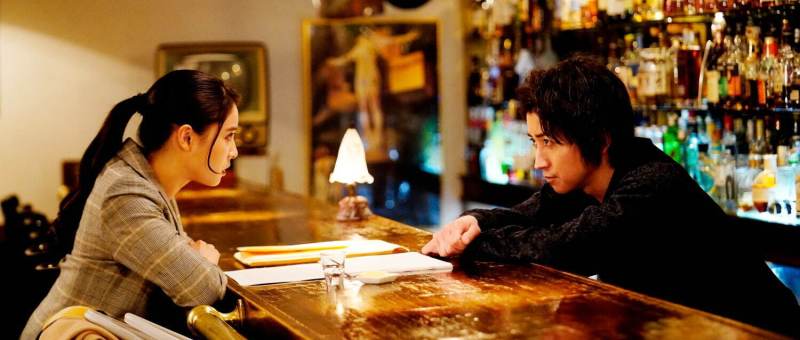
Every Trick In The Book (鳩の撃退法, Hideta Takahata, 2021)

A down on his luck writer finds himself at the centre of a mystery only how much is truth and how much “fiction”? Based on the novel by Shogo Sato, Hideta Takahata’s Every Trick in the Book (鳩の撃退法, Hato no gekitai-ho) ponders the possibilities of literature as the hero seems to create a fictional world around him in which it is largely unclear whether he is solving a real world mystery or simply imagining one based on his impressions of the strange characters he encounters through the course of his everyday life.

That everyday life is however eventful just in itself. Tsuda (Tatsuya Fujiwara) once won a prestigious literary prize and was destined to become a popular author but hasn’t written anything of note for some time and in fact now largely works as a driver ferrying sex workers around on behalf of his shady boss. The mystery begins when he approaches a man, a rare solo reader in an overnight cafe, and promises to lend him a copy of Peter and Wendy by JM Barrie only to later discover that the man went missing along with his wife and the daughter he had explained was fathered by another man. 

Like many of his subsequent encounters it isn’t entirely clear if this meeting really took place or at least as Tsuda said it did or is only part of the novel he is beginning to write. The man, Hideyoshi (Shunsuke Kazama), asks him if it’s a novelist’s habit to begin imagining backstories for everyone he sets eyes on and there may well be some of that even as Tsuda is fond of claiming that amazing things happen around us every day to which we are mostly oblivious. Still, Tsuda probably didn’t expect to be pulled into the orbit of local gangster Kurata (Etsushi Toyokawa) after accidentally passing on counterfeit currency he found by chance. It’s true that most of what’s happening to him is the result of a series of bizarre coincidences or cosmic confluence which has accidentally united this collection of people in an unintended mystery which Tsuda intends to solve in either literal or literary terms. 

“It’s all a novelist can do” he later claims in trying to write a better ending for “characters” he has come to like than the one he assumes they “actually” met. But then his editor Nahomi (Tao Tsuchiya) chief worry is that, like his previous novel, Tsuda’s story will contain too much of the “literal” truth which could cause his publishers some legal problems. Part of the reason Tsuda left the industry is apparently because his last book was inspired by a real life affair which was then considered somewhat hurtful and defamatory. For that reason it comes as quite a blow to Nahomi as she begins to investigate and discovers that much of Tsuda’s story lines up with “real” places and events, but then again as he says if you can draw connections between known facts then you begin to see a “hidden” truth which may in its own way be merely his invention. 

The film’s Japanese title translates more literally as something like “how to fend off a dove” which does indeed have its share of irony especially considering the meaning the dove symbolism turns out to have in the film but perhaps also hints at the essential absurdity of trying to fight back against something that is otherwise harmless and in fact represents peace. Tsuda may be onto something and nothing, embracing the bizarre serendipity of a writer’s life while trying to recover his creative mojo but embellishing it with more danger and strangeness than it actually has to offer. Then again as his editor discovers, there really is an incinerator it seems anyone can just walk up and use to burn whatever they want including dead bodies, while people in general are full of duplicities all of which keeps the “fake” money circulating as people use it to try to buy things that can’t really be bought. Hideyoshi calls them “miracles”, embracing the strange serendipity of his life as an orphan longing for a family to call his own and unexpectedly finding one which is “real” in someways and “fiction” and in others. Then again, if you believe in something does it really matter if it’s “real” or not? Hideyoshi and Tsuda might say it doesn’t, the publishing company’s lawyers might feel differently, but it seems there really are amazing things going on around us every day if only you stop to look. 


Original trailer (English subtitles)

Love, Life and Goldfish (すくってごらん, Yukinori Makabe, 2021)

An emotionally repressed salaryman discovers that it really is all about connection in Yukinori Makabe’s absurdist musical, Love, Life, and Goldfish (すくってごらん, Sukutte Goran). Adapted from the manga by Noriko Otani, the Japanese title is itself a minor pun in that it could be translated either as “please try to save me”, or “please have a go at scooping” as in goldfish which is a popular activity at Japanese summer festivals. A fish out of water, former top banker Makoto (Matsuya Onoe) is in a sense saving himself, biding his time until he’s scooped back up again, but discovers his true purpose may be to save someone else in this strange, goldfish-obsessed tranquil country town. 

Defiantly aloof, Makoto arrives a wounded man resentful that one mistake could have derailed his career to the extent that he’s gone from a cushy job in the Tokyo head office to a regular clerk in a rural branch of a nationwide bank. Viewing himself as an elite, infinitely better than all these country bumpkins with their weird goldfish obsession, Makoto is scrupulously polite but abruptly deflects the attempts of his new colleagues to make him feel welcome. He does however, develop a fascination for a melancholy young woman dressed in kimono, Yoshino (Kanako Momota), whom he firstly mistakes for a geisha running a house of ill-repute only to realise that her establishment caters to a different clientele in that she runs a goldfish scooping emporium. Meanwhile, he also becomes an object of fascination for Asuka (Nicole Ishida), a young woman running a bar with her brother. 

Makoto is fond of saying that “numbers don’t lie”, devoting himself entirely to work and insisting that he has no need of things like love or friendship but is in fact deeply lonely and trying to fill the void with industry. Though we never see much of his previous life, it’s easy to assume that he has at some point been deeply hurt and has affected this impervious persona as a means of self defence. Nevertheless, bottling up his emotions is apparently what caused his career to implode leading him to break with salaryman protocol and tell his boss what he actually thought in a less than polite manner. In a repeated motif, Makoto is no longer sure if and when his interior monologue has become exterior with the unwanted consequence that some of his less than charitable thoughts and inner insecurities accidentally leak into the outside world. 

More self aware than he seems, Makoto is moved to tears on hearing a heartfelt song from Asuka who, like him, is a Tokyo “reject” having come back after failing to achieve her dreams of becoming an actress. Overwhelmed by the sight of someone expressing their emotions without embarrassment he can’t help crying but continues to struggle with his feelings for Yoshino who is herself perhaps also feeling something similar. Once a promising pianist, she now only plays alone too afraid of judgement or rejection to risk playing for others. 

Tellingly Makoto’s Tokyo outburst had been over a business plan for an AI robot massage parlour which his boss dismissed on the grounds that it’s human warmth and kindness which are essential for healing. Of course Makoto didn’t want to hear that because he wants to live in a cold world of order ruled by the unassailable logic of numbers, but through gradually bonding with the townspeople comes to accept that it’s human connection that’s most important after all. “Sometimes you have to face reality even if it’s painful”, he remarks eventually realising that “you can’t save anyone if you obsess over numbers” after failing to scoop an arbitrary number of goldfish with a broken paddle. 

Realising life’s not a numbers game gives Makoto the courage to sing with his heart no longer quite so repressed as he prepares to escape this strange holding tank for the oceans of the metropolis. An old-fashioned integrated musical, the whimsical score skips through several genres from j-pop to rap though it’s true enough that some of the melodies stray uncomfortably close to popular hits from recent musical theatre and family animation. Nevertheless, the quirky production design and absurdist direction make Love, Life, and Goldfish difficult to resist as the repressed salaryman its centre learns to open his heart while swimming in a different river to realise that it really is all about feeling after all. 


Love, Life and Goldfish screened as part of this year’s Glasgow Film Festival.

Original trailer (no subtitles)