Popran (ポプラン, Shinichiro Ueda, 2022)

“Wieners are stuck to the body, they can’t go flying!” a confused father attempts to convince his toddler son, but as the young boy had said that isn’t quite the case. The hero of Shinichiro Ueda’s Popran (ポプラン) has been, well, to put it bluntly, a bit of a dick to just about everyone in his life but when even his bits seem to have become tired of his schtick it can’t help but provide something of a wakeup call. More surrealist morality drama than scatological comedy, Popran’s heart at least is in the right place as its hero attempts to, literally, piece himself back together to repair his fractured integrity. 

As we first meet 30-ish entrepreneur Tagami (Yoji Minagawa ), he’s being interviewed for a documentary that wants to explore the real lives of well-known people. As might be expected, the opening questions are fawning, pointing out his vast success at such a young age as the developer of app and manga publishing platform but the atmosphere soon changes when they stray into less positive territory. It seems Tagami’s success might have come as a result of betraying his old friend and business partner, while he also abandoned his wife and child to chase success in Tokyo and apparently has become estranged from his parents. His well-meaning PR shuts down the interviewer’s attempts to ask anything remotely challenging, yet it’s obvious that something inside Tagami is dying even as he reads out a cheesy speech he’d written about the importance of following the compass of your heart from a cue card held up by his assistant. 

We can see what kind of man he is or has been when an excited employee approaches him in the corridor about an exciting project but, feigning politeness, he has to ask his assistant who the guy was once he’s gone. At a birthday party for one of their writers, he leers over a woman sitting behind him and offers to introduce her to their editing department when she tells him she’s interested in writing something herself despite his clearly stated policy of not running original material only buying rights to distribute perennially popular series. It’s after taking her to bed with false promises that he discovers his penis is missing. 

More than a symbol of his masculinity, the errant penis is an indictor of his misplaced desires and lack of both moral fibre and impulse control. To achieve success he’s screwed over countless people besides the young woman who seems to have been the last straw for his literally alienated genitalia leaving a trail emotional chaos in his wake. After discovering that he is not the only one to fall victim to the “Popran” phenomenon he is forced to face himself, his moral cowardice, anxieties, and fears, and reckon with his sense of inadequacy and disappointment. Just as in the message he’d delivered to the youngsters watching the documentary, he too needs to take a look at the compass of his heart and realise he’s been reading it wrong chasing down his penis with a butterfly net before realising he knew where it was all along he just needed to go back to where it all started and remember who he really is. 

Then again, there is perhaps something of frustrated masculinity in Tagami’s quest. As his friend point out, he makes all his money exploiting other people’s labour while offering nothing new of his own. In the interview, he’d said he wanted to be a mangaka but felt he wasn’t good enough so decided to become a distributor instead setting up the company with a colleague from the manga cafe where he was working. But they parted ways because his friend wanted to publish original material and with his eye on the bottom line Tagami forced him out. Where his friend is now running a small studio from his apartment and even while not wealthy creatively fulfilled, Tagami has become rich but empty. Obviously that’s not to say there’s no value in the kind of work he does, but he’s begun to appropriate others’ success as his own with no real thought for their well-being. Chasing his dick around is also in its way a desire to regain his creative mojo as symbolised in his re-energised commitment to publishing original material rather than simply raking in royalties from safe and stable classics.  

As is often pointed out to him, his fantastical tale sounds like something out of a manga though Popran is certainly less reflexive than Ueda’s previous efforts telling a story which is much smaller in scale though also in its way heartwarming as the hero is pulled around by the penises of past and present if not future before reaching a moment of emotional maturity that allows him to exercise a more healthy control over his desires knocking his dickish behaviour on the head to wise up and realise being a man’s about treating others with respect and dignity. Some things you can’t just stick back on if they fall off, but you can at least acknowledge that you should have treated them better and resolve to be happy that they have at least found better futures as you might yourself if only you can figure out which compass to follow. 


Popran streams in Germany until 6th June as part of this year’s Nippon Connection.

Original trailer (English subtitles)

Images: Ⓒ ”Popran” Film Partners
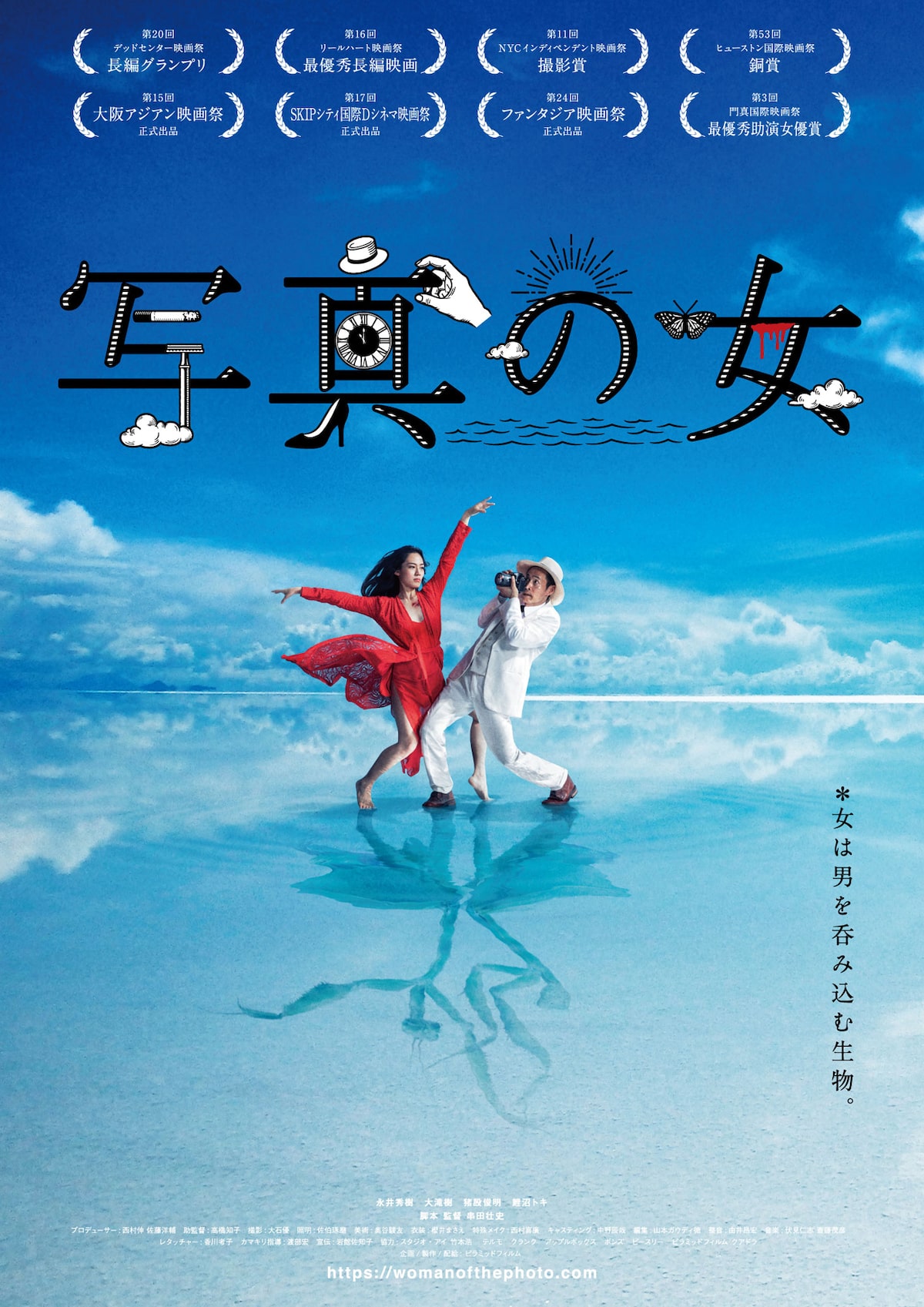
Woman of the Photographs (写真の女, Takeshi Kushida, 2020)

(C)PYRAMID FILM

“We can only love ourselves through others’ eyes” according to an increasingly obsessed young woman desperately trying to “fix” her image of herself through retouching her photo. An inverted take on Woman of the Dunes, Woman of the Photographs (写真の女, Shashin no Onna) sees the world of a bug-obsessed photographer with a talent for “improving” on reality disturbed by the arrival of a mysterious dancer who falls from a tree in the forest into his previously ordered existence.  

Kai (Hideki Nagai), a middle-aged man dressed in an old fashioned white suit, operates a small photo studio taking official photos for things like funerals and omiai arranged marriages. As we later find out from his only regular human contact, the funeral director from across the road (Toshiaki Inomata), Kai’s mother died in childbirth and his father opened this shop to support his son. Kai has taken over but has an intense fear of women and lives alone save for his pet praying mantis with whom he regularly eats his preferred dinner of microwave pizza. 

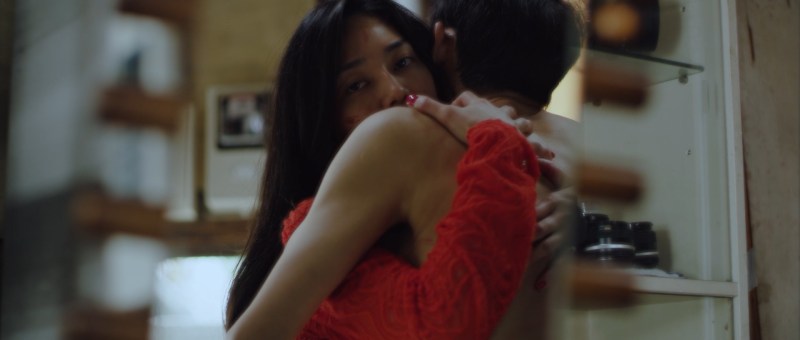
It’s on a regular bug hunting trip that Kai is struck by the beautiful figure of Kyoko (Itsuki Otaki) tumbling out of a nearby tree and causing herself manageable if painful injuries including a nasty gash along her collarbone. Not wanting to go to a hospital, Kyoko gets Kai to take her to a pharmacy and patches herself up, later accompanying him home where he takes some photos of her to post on her Instagram, retouching them to get rid of the traces of wounds. Despite Kai’s silence, she manages to convince him to have dinner with her in a nearby restaurant and later to allow her to stay the night, after which she becomes a more permanent fixture in his life. 

A former dancer now Instagram star, Kyoko originally thinks nothing of getting Kai to clean up her photos to rid them of unsightliness, but is mildly disturbed to watch him do it. In a reverse Dorian Gray effect, Kai must scar the image to repair it, scrubbing away traces of unwanted “reality” in an act which seems to contradict the true nature of photography. “A good lie can make people happy” according to the funeral director who regularly uses Kai’s services to create suitably solemn photos of the suddenly deceased, but Kyoko isn’t so sure. Ever since she asked Kai to soften her reality, her followers have begun to desert her and she’s losing her lucrative sponsorship deals. The apologetic lady from the agency points out that she’s diverging from the “image” her fans expect from her and if she wants to keep them she’ll have to be the Kyoko they want her to be. 

Kyoko doesn’t quite like that, she’d like to be more authentic. Hisako (Toki Koinuma), meanwhile, an unexpected regular to the studio, is of the opposite opinion. In her view, retouching the photo allows her to be more herself, reflect her true essence through manipulating her image. Asking if she hasn’t got things the wrong way round, Kyoko wonders if the men she’s sending them to will be confused or disappointed that the photo and the reality don’t match but Hisako counters her that a man falling in love with her idealised self would only bring her closer to it. The self reflected in the eyes of others is the true self and only through others’ eyes can you find self love, according to Hisakao. Ironically, Kyoko has been looking for something similar through her Instagram success, but begins to resent the extent to which it is changing her, encouraging her to hide the parts of herself others might find ugly in order to gain acceptance. 

Deciding not to retouch the photos, however, has the opposite effect. Her fans love her again, bowled over by her authenticity, but at the same time perhaps she’s engaging in a strange kind of self-exploitation. Her wounds will, after all heal. Could she be tempted into a life of continued self-harm just for likes? Kyoko begins to lose her sense of self, as if she doesn’t quite exist online or off, caught between the “real” and the “ideal”.

Kai, meanwhile, remains silent but also captivated by the conflicted Kyoko. His life has been one of isolation, afraid of female touch and contented only among his insects. Yet like Kyoko he’s learning that scars can be beautiful because wounds are a sign of life. Waking up to connection and desire, he learns a different lesson from the lifecycle of the praying mantis realising that the male’s greatest pleasure lies in surrendering its body so the female can continue in life and creation. He no longer fears being devoured, but honours the true connection of mutual exchange. Inverting the conclusions of Woman of the Dunes, Kai finds himself liberated not by a sense of simplicity in life but by its complication, accepting all the richness it has to offer in joy and pain, engaging in his own strange mating dance as a man with a camera capturing his subject in all of her essential beauty. 


Woman of the Photographs was screened as part of this year’s Osaka Asian Film Festival.

Original trailer (English subtitles)

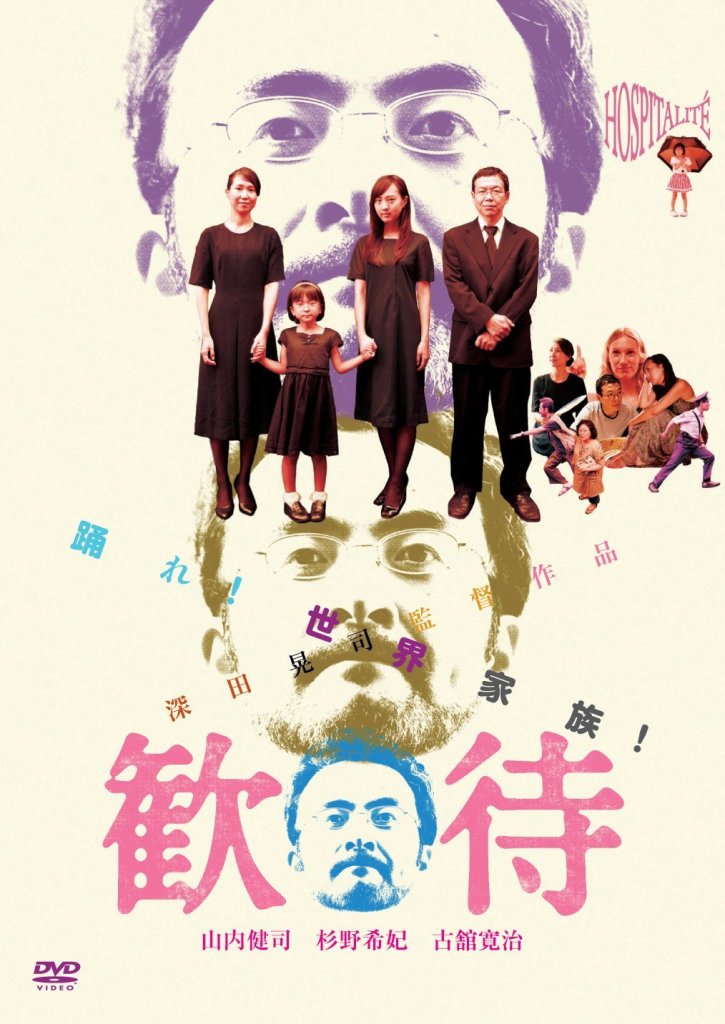
Hospitalité (歓待, Koji Fukada, 2010)

hospitaliteFrom the Ozu-esque, classic calligraphy of its elegant title sequence, you might expecting a rather different kind of family drama than the one you find in Koji Fukada’s Hospitalité (歓待, Kantai). Though his compositions lean more towards the conventional, Fukada aims somewhere between a more restrained The Family Game and a much less explosive Theorem as he uses the family as a microcosmic analogy for his country’s attitudes towards “outside intrusion”. An absurdist tale of dysfunctional families and hypocritical social standards, Hospitalité takes a long hard look at whom exactly you regard as “guest” and how much you’re really prepared to take care of them.

The Kobayashis run a small printers shop in a rundown suburban backwater. Son Mikio has inherited the business and lives above it with his second wife, Natsuki, and his daughter from a previous marriage, Eriko. Older sister Seiko has recently moved back in following a divorce though she also has a vague idea of wanting to study abroad. Things start to go haywire when little Eriko’s pet parakeet absconds from the family home. Heartbroken, she designs a special flyer to try and find it which brings them to the attention of “old friend” Kagawa who claims to have seen the bird somewhere near the station.

Kagawa hangs round a little longer than necessary chatting to the couple when their assistant suddenly keels over. This allows a convenient opening for Kagawa to volunteer his services at the print shop – luckily he knows how to handle the machines. He quickly moves into their spare upstairs room before also moving in his “foreign wife”, Annabelle, and a bunch of other non-Japanese people by which time he’s well and truly wrested control of the mini printshop empire away from the mild mannered Mikio and caused a degree of local panic in the process.

The Kobayashis are “hospitable” people. To begin with they don’t mind having this “old friend” hanging around and helping him out by letting him stay and work in the shop. When he suddenly introduces his wife without warning they may feel he’s taking advantage but anyway they go along with it. Annabelle, from “Brazil”, or was it “Bosnia”, gives the impression of someone who is always pretending their language skills aren’t as good as they really are so people let their guard down around her. She teaches “salsa”, apparently, and starts to get on Natsuki’s nerves by usurping her position as resident English speaker.

The town itself is not quite as charitable as the Kobayashis as evidenced by the older lady who keeps dropping by with petitions for the neighbourhood watch to which she’d also like to recruit the ladies of the house. She’s worried about the increasing number of “foreigners” in the area which she now feels is becoming “dangerous” as a consequence. That’s not to mention the proposed “beautification” plan for the park (which really means getting rid of all those people who sleep there in cardboard boxes). That said, though neither of the women is particularly interested in joining the neighbourhood watch or against the idea of non-Japanese people coming to live in their town, they go along with the woman and her plans not to rock the boat. They run a business here after all so they have an interest in keeping the town stable and in maintaining good social relations with their neighbours, so it makes sense to just put up with whatever bigoted nonsense they’re spouting, right?

For all their “lascivious dancing”, topless sunbathing, and “promiscuous immorality”…the foreigners are quite clearly not as much of a problem as the underlying hypocrisy which runs through the Kobayashis’ world. When Kagawa asks about Mikio’s previous wife, he says “she got sick” leading him to think Mikio is a widower which isn’t quite true but is a less embarrassing for explanation for Mikio to offer than what really happened. There’s an obvious tension between Mikio and Natsuki as well as with the recently returned older sister. As soon as Kagawa begins to work his magic, driving a pneumatic drill right into all of those tiny cracks and fractures which exist between a husband and a wife, everything begins to fall apart though in an equally quiet and subtle fashion. However, people have need of their fantasies and even after Kagawa has exposed the holes in their marriage, Mikio and Natsuki seem content to simply paper over their differences and go back to pretending everything’s fine just like before.

A surrealist’s meditation on xenophobia, social mores, and what happens when a caged bird decides to be free, Hospitalité is a suitably nuanced, not to mention frequently amusing, look at contemporary small town mentality. Everyone is so invested in maintaining a particular quality of personal truth, be it in a hospitable place which thinks the answer to people cluttering up the park with their cardboard boxes is to “beautify” the area by throwing them out, or a neighbourhood watch group that’s all egos with a local place for local people mentality, that maintaining the lies is much more important than solving the underlying problem. Koji Fukada’s farcical approach to the absurdity of everyday life is a good natured and humorous one, but the problems at its core are all too real.


Hospitalité was released on DVD in the US by Filmmovement and still appears to be in print though the distributor’s website is constant 403.

English subtitled trailer: