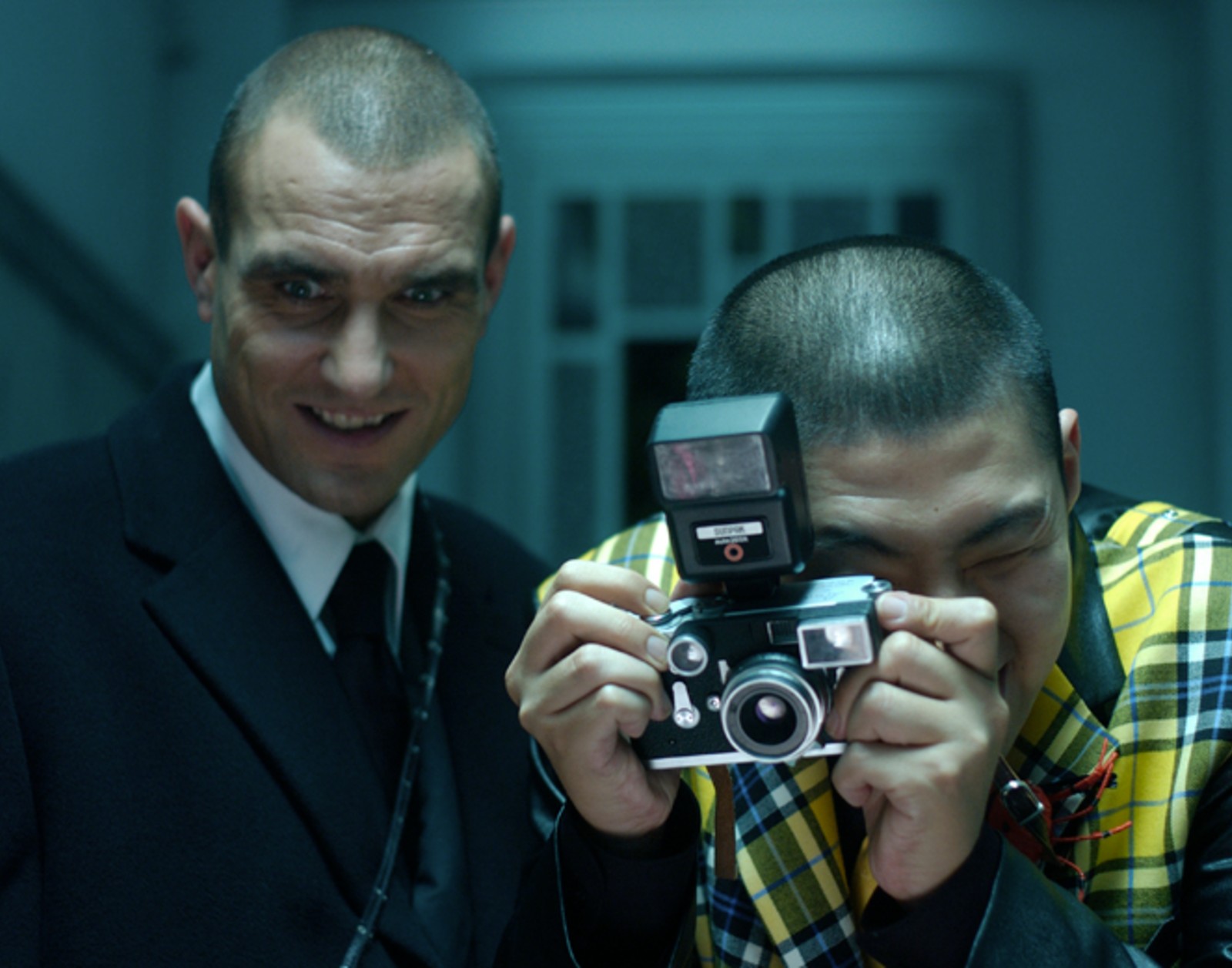
Survive Style 5+ (Gen Sekiguchi, 2004)

“What is your function in life?” It is, after all, quite a difficult question as an air stewardess (Tae Kimura) points out when interrogated by an irate British hitman (Vinnie Jones), and perhaps one that most people never really think about. Indeed, many of those questioned struggle with the meaning of “function”, replying with the most obvious answer of their occupation or job title without really considering any deeper implications or whether their existence is really meaningful. The hitman seems to have a secondary mission of eliminating those whom he deems “unnecessary”, while simultaneously giving his only sign of approval to a man who straightforwardly tells him that he doesn’t have one.

Gen Sekiguchi’s Survive Style 5+ is full of this kind of questioning but ultimately a tale of how one learns to survive in an often absurd world. Like many films from the mid-2000s, it cuts between several interwoven plot threads that at first seem nonsensical but finally coalesce into a complete whole. An artist (Tadanobu Asano) repeatedly kills his wife (Reika Hashimoto) who is forever trying to kill him in bizarre ways only for her to respawn back at their very weird Western-style country lodge in the woods. An ad executive (Kyoko Koizumi) becomes fed up with her vain hypnotist boyfriend (Hiroshi Abe) who mocks her career. A salaryman (Ittoku Kishibe) is hypnotised to think that he’s a chicken, and a trio of burglars (Kanji Tsuda, Yoshiyuki Morishita, Jai West) deal with repressed emotion and romantic longing. 

They are all to some extent trying to find some way to survive along with a sense of purpose in their lives. Ad executive Yoko is forever coming up with zany ideas for TV adverts that she records on her dictaphone, sniggering to herself at their surreal humour though she is the only one who finds them funny and her work is often dismissed by her corporate clients who complain that her ads don’t do anything to inform the prospective customer about the nature of the product. Sekiguchi was himself also a director of TV adverts which informs the film’s short and snappy style, and Yoko’s artistic frustrations perhaps echo his own as she tries to fulfil herself creatively while meeting the client’s demands. 

The CEO of the pharmaceuticals company she’s working with (Shinichi Chiba) is forever taking “emergency” calls from his wife about such important issues as the bulb having gone in the bathroom which he treats with the upmost seriousness while admitting that he really doesn’t know how to address any of these domestic issues. Similarly, the salaryman is prevented from living a full family life because of the demands of his job, but becomes a temporary hero after getting tickets to see the sold-out hypnotist. In someways, he might even be happier as a bird which after all offers more “freedom” if only he could learn to fly. While his wife and daughter are most interested in curing him so that he can become a stereotypical salaryman again and fulfil the roles of father and husband by providing for the family, only his son determines to accept his father’s new reality and love him for who he is now. 

The family’s home is designed with an artificial quality giving it the appearance of the set for a TV sitcom, bearing out the ersatz nature of conventional family life in which everyone is forced to bear out their particular “function” without imbuing it with much meaning. When the burglars break in, they too inhabit this space as if they were children who’ve come over to play by sitting down and playing cards rather than looting the place, though it turns out the family don’t actually have very much worth stealing. While Tsuda is forever taking calls from a girlfriend, Morishita and J exchange a series of longing looks but are otherwise unable to express their feelings for each other due to lingering societal homophobia and emotional vulnerability. Only when challenged by the hitman are they able to express their feelings after questioning their own “function in life”.

Jones was clearly hired for his hardman image which he’d successfully brought off the football pitch and into a series of gangster movies in the late 90s, imbuing each of his lines with an absurd intensity which is equally matched by Yoshiyoshi Arawakawa’s comical attempts to echo his intimidating speech patterns as his interpreter though without the physical presence to pull it off. The hitman is quite clearly a harbinger of death, but at the same time it’s his existential probing that points the way towards survival as his various targets are forced to consider what their “function in life” really is and if they’re living in ways that are meaningful and fulfilling. The film’s anarchic production design and deadpan humour add to the sense of surreality as Sekiguchi gleefully ricochets between one storyline and another looking for new modes of survival in an increasingly absurd world.


Survive Style 5+ is currently screening in select UK cinemas and released on UHD/Bluray on 19th October courtesy of Third Window Films.

Trailer (dialogue free)
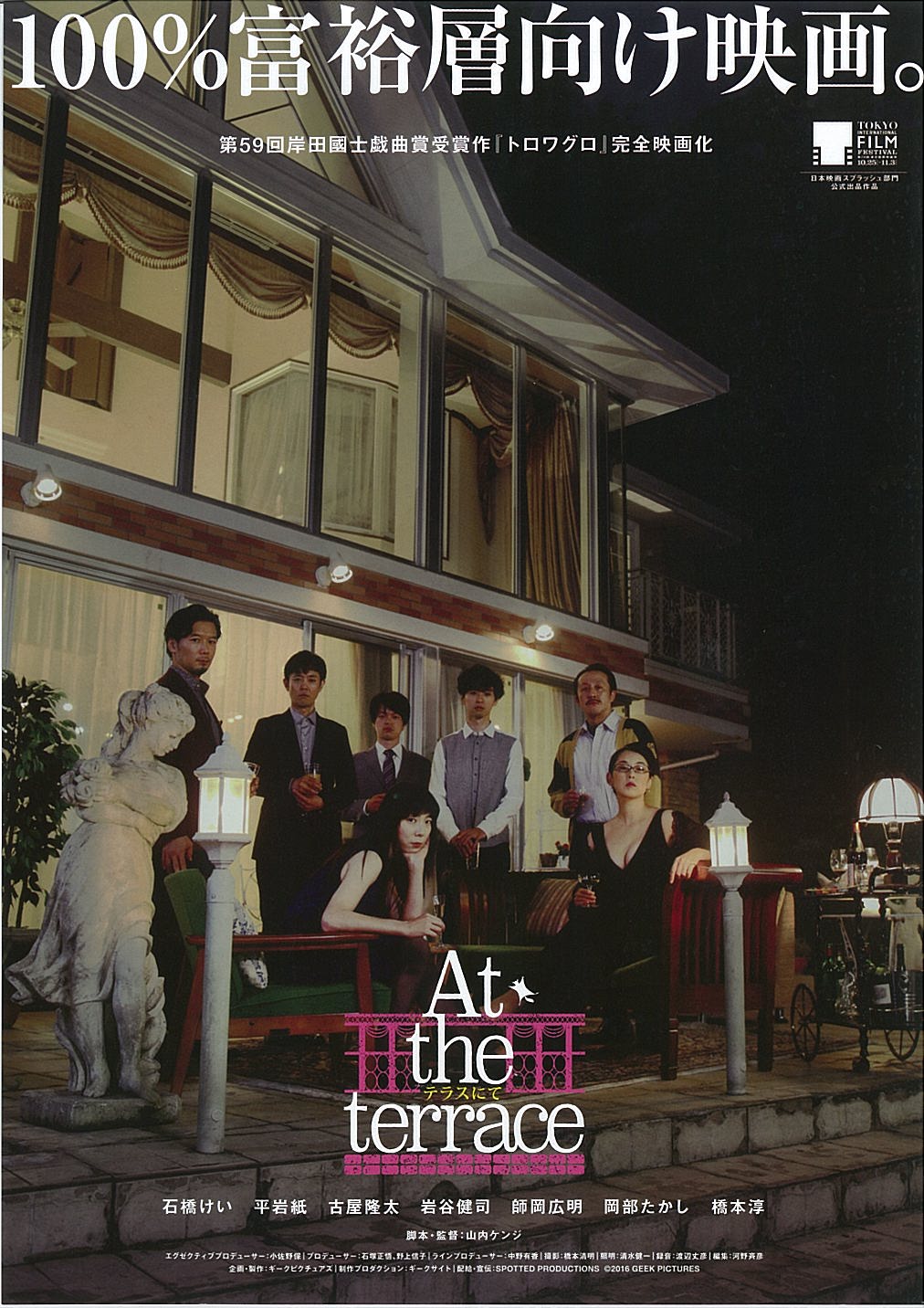
At the Terrace (テラスにて, Kenji Yamauchi, 2016)

At the TerraceEvery keen dramatist knows the most exciting things which happen at a party are always those which occur away from the main action. Lonely cigarette breaks and kitchen conversations give rise to the most unexpected of events as those desperately trying to escape the party atmosphere accidentally let their guard down in their sudden relief. Adapting his own stage play titled Trois Grotesque, Kenji Yamauchi takes this idea to its natural conclusion in At the Terrace (テラスにて, Terrace Nite) setting the entirety of the action on the rear terraced area of an elegant European-style villa shortly after the majority of guests have departed following a business themed dinner party. This farcical comedy of manners neatly sends up the various layers of propriety and the difficulty of maintaining strict social codes amongst a group of intimate strangers, lending a Japanese twist to a well honed European tradition.
Haruko (Kami Hiraiwa), a youngish middle-aged woman has stepped out onto the terrace to check her phone with a degree of privacy but she is shortly joined by a late arrival to the party, Tanoura (Hiroaki Morooka), who lets out a long sad sigh right alongside her. The party’s hostess, Kazumi (Kei Ishibashi), hears his small howl of exasperation and decides to make something of it. Embarking on a strange line of questioning, she gets Tanoura to admit not only to a fondness for the woman who was just on the terrace, but particularly for her shapely white arms. Tanoura fusses and backpedals but is pushed into a corner of defeat with relative ease by his more experienced host. Unfortunately he did not know that Haruko is the wife of a fellow guest – in fact, the guest of honour who has just delivered a speech at the dinner party (which he missed because he was late). Kicking off a late night challenge, Kazumi’s brazen questioning and subsequent decision to announce the results to the group at large proves the catalyst for visible crumbling of the bourgeoisie which is about to take place.

Even though everybody ought to be getting home, the guests linger and the atmosphere becomes increasingly tense and awkward. Insecure hostess Kazumi quickly begins a war with her attractive rival, Haruko, using the bizarre obsession everyone seems to have with her arms as the first round of fire. Haruko counters that she disagrees and thinks Kazumi is the more attractive because of her low cut dress designed to show off her ample bosom. This line of conversation makes the men feel very awkward, especially when asked for their opinion but someone then attempts to move to a higher level by discussing similar themes in the works of Kawabata and Tanizaki, though this flies over the heads of some of the guests prompting a return to the slightly unpleasant atmosphere of the earlier part of the evening.

If Kazumi is attempting to remain the dominant female at her own party, the men have various other concerns mostly bound up with their working relationships. Business and pleasure rarely mix, at least not at parties, and so there’s an immense amount of politeness and de-escalation involved in the way in which they talk to each other. Mr. Soejima (Kenji Iwaya) – Kazumi’s husband, the host, and the owner of this fine villa has organised the party as a networking event at which Haruko’s husband, Taro (Ryuta Furuta), delivered the keynote speech. Another company guest, Masato (Takashi Okabe), is known and not known as he’s recently lost an awful lot of weight thanks to gastric surgery which means no one quite recognises him and despite having been quite a drinker in the past he is now supposed to be avoiding alcohol altogether. While Masato spends most of the evening sitting quietly to the side, Tanoura seems to get dragged into arguments despite his attempts to remain neutral and polite, eventually bursting into tears as he thinks about the horrors of Syria – not a side of him this hard-nosed, business focused gathering is likely to find endearing.

Alcohol flows, secrets are revealed and flirting is embarked upon as pretty much everyone is after Haruko who is dismayed to find her husband either hardly notices or is actively allowing other men to flirt with her to increase his networking potential. The arrival of the Soejima’s son, Teruo, throws another kind of energy into the room as he reveals juicy details about his parents’ marriage and becomes the subject of a few barbed comments from his father. Teruo is young and handsome, becoming something of a mirror for the ways that Haruko has dominated the conversation despite his mother’s best efforts to remain in charge, even matching her in the beauty of his arms. As the evening finally draws to a close sex and death mingle across the crowded terrace filled with onlookers not sure in which direction to cast their gaze.

Yamauchi sticks to his one set conceit but shoots it from various angles to best capture the drama erupting amongst this group of not quite friends. The two women face off against each other while their husbands do the same only with tales of their masculine exploits. No one quite knows how to behave now that they’ve moved away from the business table, who they’re supposed to be and what their proper place is, leading to a dangerous destabilising of the established social order. Haruko, at least, is striking out to prove she’s more than her husband’s wife even if she was made to come to this party against her will and has wanted to go home for ages.

Opting for an appropriately surreal, retro edge, Yamauchi closes with a series of “you have been watching” portraits and the sight of an adorable small furry squirrel captured in the garden to remind you that not everything here is ugly and attempting to misrepresent itself to get the best out of a difficult social situation. Hilarious, if excruciating, At the Terrace neatly sends up the hypocrisy of the bourgeoisie as they lie, deflect, and sometimes spar in order to conform to their expected social roles only to inadvertently destroy them through improper application.


At the Terrace was screened at the Udine Far East Film Festival 2017.

Original trailer (no subtitles)

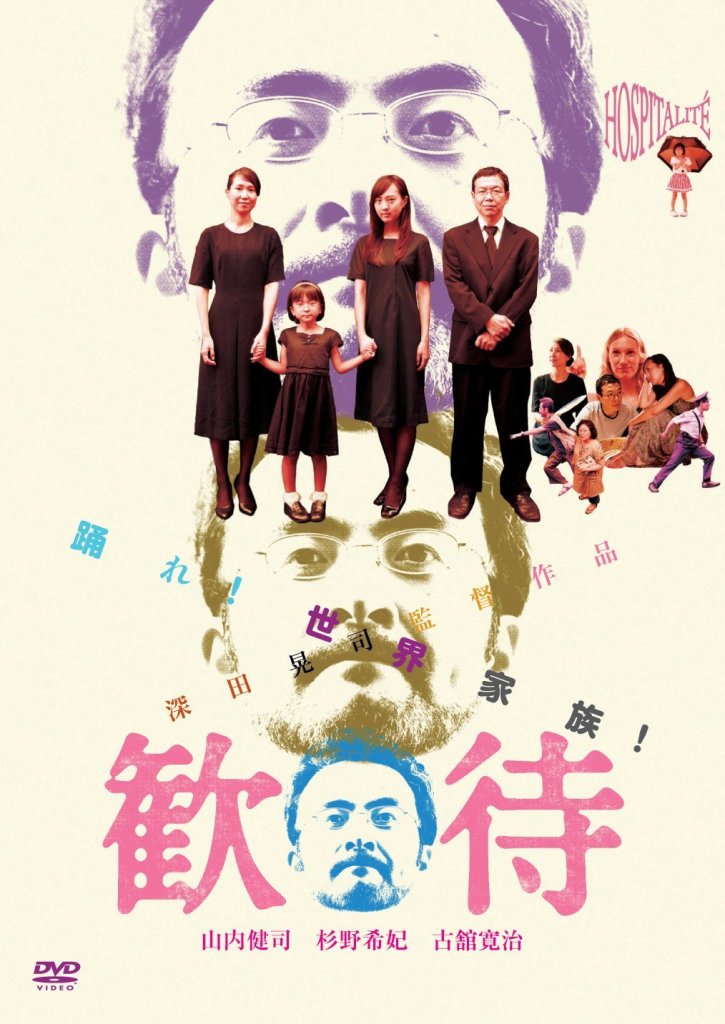
Hospitalité (歓待, Koji Fukada, 2010)

hospitaliteFrom the Ozu-esque, classic calligraphy of its elegant title sequence, you might expecting a rather different kind of family drama than the one you find in Koji Fukada’s Hospitalité (歓待, Kantai). Though his compositions lean more towards the conventional, Fukada aims somewhere between a more restrained The Family Game and a much less explosive Theorem as he uses the family as a microcosmic analogy for his country’s attitudes towards “outside intrusion”. An absurdist tale of dysfunctional families and hypocritical social standards, Hospitalité takes a long hard look at whom exactly you regard as “guest” and how much you’re really prepared to take care of them.

The Kobayashis run a small printers shop in a rundown suburban backwater. Son Mikio has inherited the business and lives above it with his second wife, Natsuki, and his daughter from a previous marriage, Eriko. Older sister Seiko has recently moved back in following a divorce though she also has a vague idea of wanting to study abroad. Things start to go haywire when little Eriko’s pet parakeet absconds from the family home. Heartbroken, she designs a special flyer to try and find it which brings them to the attention of “old friend” Kagawa who claims to have seen the bird somewhere near the station.

Kagawa hangs round a little longer than necessary chatting to the couple when their assistant suddenly keels over. This allows a convenient opening for Kagawa to volunteer his services at the print shop – luckily he knows how to handle the machines. He quickly moves into their spare upstairs room before also moving in his “foreign wife”, Annabelle, and a bunch of other non-Japanese people by which time he’s well and truly wrested control of the mini printshop empire away from the mild mannered Mikio and caused a degree of local panic in the process.

The Kobayashis are “hospitable” people. To begin with they don’t mind having this “old friend” hanging around and helping him out by letting him stay and work in the shop. When he suddenly introduces his wife without warning they may feel he’s taking advantage but anyway they go along with it. Annabelle, from “Brazil”, or was it “Bosnia”, gives the impression of someone who is always pretending their language skills aren’t as good as they really are so people let their guard down around her. She teaches “salsa”, apparently, and starts to get on Natsuki’s nerves by usurping her position as resident English speaker.

The town itself is not quite as charitable as the Kobayashis as evidenced by the older lady who keeps dropping by with petitions for the neighbourhood watch to which she’d also like to recruit the ladies of the house. She’s worried about the increasing number of “foreigners” in the area which she now feels is becoming “dangerous” as a consequence. That’s not to mention the proposed “beautification” plan for the park (which really means getting rid of all those people who sleep there in cardboard boxes). That said, though neither of the women is particularly interested in joining the neighbourhood watch or against the idea of non-Japanese people coming to live in their town, they go along with the woman and her plans not to rock the boat. They run a business here after all so they have an interest in keeping the town stable and in maintaining good social relations with their neighbours, so it makes sense to just put up with whatever bigoted nonsense they’re spouting, right?

For all their “lascivious dancing”, topless sunbathing, and “promiscuous immorality”…the foreigners are quite clearly not as much of a problem as the underlying hypocrisy which runs through the Kobayashis’ world. When Kagawa asks about Mikio’s previous wife, he says “she got sick” leading him to think Mikio is a widower which isn’t quite true but is a less embarrassing for explanation for Mikio to offer than what really happened. There’s an obvious tension between Mikio and Natsuki as well as with the recently returned older sister. As soon as Kagawa begins to work his magic, driving a pneumatic drill right into all of those tiny cracks and fractures which exist between a husband and a wife, everything begins to fall apart though in an equally quiet and subtle fashion. However, people have need of their fantasies and even after Kagawa has exposed the holes in their marriage, Mikio and Natsuki seem content to simply paper over their differences and go back to pretending everything’s fine just like before.

A surrealist’s meditation on xenophobia, social mores, and what happens when a caged bird decides to be free, Hospitalité is a suitably nuanced, not to mention frequently amusing, look at contemporary small town mentality. Everyone is so invested in maintaining a particular quality of personal truth, be it in a hospitable place which thinks the answer to people cluttering up the park with their cardboard boxes is to “beautify” the area by throwing them out, or a neighbourhood watch group that’s all egos with a local place for local people mentality, that maintaining the lies is much more important than solving the underlying problem. Koji Fukada’s farcical approach to the absurdity of everyday life is a good natured and humorous one, but the problems at its core are all too real.


Hospitalité was released on DVD in the US by Filmmovement and still appears to be in print though the distributor’s website is constant 403.

English subtitled trailer: