A Muse Never Drowns (ミューズは溺れない, Nozomi Asao, 2022)

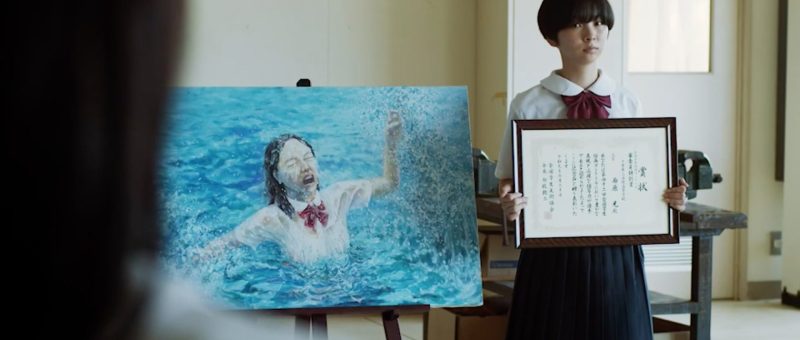
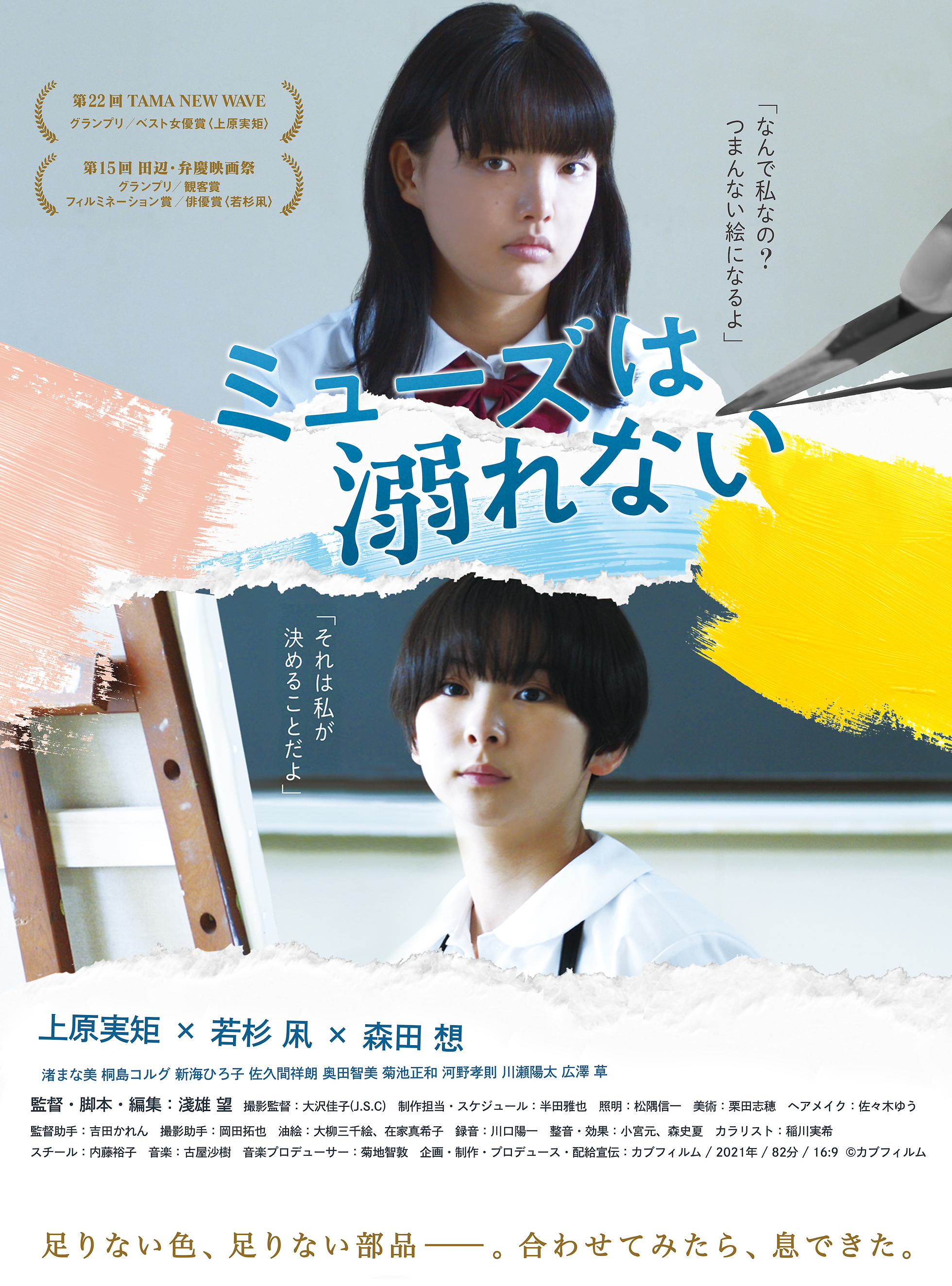
A teenage girl flounders amid a series of changes in her life while questioning her future and identity in Nozomi Asao’s empathetic coming-of-age film, A Muse Never Drowns (ミューズは溺れない, Muse wa Oborenai). Saku (Miku Uehara) is however drowning, a fact brought home to her by the relentlessly aloof Saibara (Mimori Wakasugi) who captures a sense of her panic and despair in a painting of her falling into the local harbour. Yet through their rather tumultuous friendship the pair eventually discover that they aren’t so different after all.

Saibara’s perfectly executed painting destabilises Saku on more than only level, firstly in her discomfort in having been seen and secondly in the insecurity it causes her in her own talent as an artist. Saku had wanted to go to art college, but a teacher harshly corrects her drawing style as if trying to push her towards a more authentic form of expression that’s less worried about getting it right than capturing a sense of what she sees and feels. Lacking confidence that she’ll get in, Saku is thinking about quitting the club in embarrassment but is persuaded to try making something else for the cultural festival while simultaneously receiving an unexpected entreaty from Saibara who wants her to pose for her next painting.

Most of the other students seem to resent Saibara for what they see as her superiority complex, believing she is aloof because she thinks she’s better than them. Because of her blunt manner, Saku too had thought her to be ultra confident and is surprised to realise that Saibara too is filled with doubts and anxieties even if she makes a point of pushing through them. Echoing her teacher’s words, Saibara admits that the lines don’t always come out the way she wants them either but all she can do is try to connect the dots. The reason for her aloofness is a vicious circle of deep-seated loneliness that convinces her she will ultimately be rejected, mirroring Saku’s conviction that she is a “boring” person, and therefore it is easier to remain alone from the start. 

Part of Saibara’s self-rejection is borne of internalised homophobia uncertain if others will accept her sexuality while harbouring a crush on Saku she doesn’t know how to articulate other than through her art while Saku too struggles with her feelings and is confused by the attention she receives from Saibara. Saku’s feelings of insecurity are informed by a sense of embarrassment that she has never experienced a romantic crush like her friend Emi (Kokoro Morita) who likes baseball player Endo despite knowing that likes he Saku, though Emi has also picked up on the way she looks at Saibara and is drawing conclusions about her lack interest in boys. Emi tells her that she accepts her whatever her sexuality is, but is hurt and confused when Saku remains silent and declines the opportunity to open up to her though perhaps partly because she does not really know the answer herself. 

Other than Saibara, Saku is the only one who hasn’t yet returned her careers survey still uncertain of the future direction of her life. Her father has recently remarried and he and her step mother Satomi (So Hirosawa) are expecting a baby all of which has Saku feeling somewhat adrift, displaced within her family and soon to lose her home which has been bought out for a new development project meaning they’ll soon be moving to a new house shorn of the memories of her birth mother and primed for her father’s new start. 

Yet through all her experiences, slowly bonding with Saibara and repairing her friendship with Emi, Saku begins to discover a path towards a more authentic art born of the desire to take things apart and put them back together again while quite literally feeling her way forward with her hands. Coming to terms with her new family circumstances, she builds herself a boat and is no longer drowning but drawing strength from her new found friendships with a renowned sense of possibility for the future while her friends do much the same in the knowledge that they are all scared and uncertain but doing their best to join the dots towards a happier future. 


Trailer (English subtitles)

Melancholic (メランコリック, Seiji Tanaka, 2018)

Melancholic posterJust because you’re smart and graduated from a top university, does that necessarily mean you have to put on the salaryman straitjacket in order to become “a success”? The dejected hero of Seiji Tanaka’s Melancholic (メランコリック) isn’t quite so sure, but then he’s always been the type to amble through life going wherever the wind blows him. The time is about to come, however, when decisions must be made and priorities decided lest someone else decide them for you.

Kazuhiko (Yoji Minagawa) graduated from Tokyo University but he’s never been in full time employment and has no definite career plans. Still living at home with his parents, he floats between part-time jobs with little sense of forward motion while his mum and dad are content to let him find his way, if a little exasperated. On a rare visit to a public bathhouse he ends up running into an old high school classmate, Yuri (Mebuki Yoshida), who half-jokingly advises he apply for the open job at the baths seeing as it’s bound to be less stressful than your average salaryman gig. Smitten but too awkward to do much about it, Kazuhiko applies for the job and consents to go to a school reunion as a means of seeing Yuri again. Much to his surprise, however, the bathhouse has a second life as a yakuza kill room with on site body disposal facilities.

Asking questions about what goes on at the bathhouse after dark, Kazuhiko’s boss Azuma (Makoto Hada) tells him that it’s dangerous to know things you aren’t supposed to know, but Kazuhiko is not good with hints and his natural curiosity won’t it let it rest. After he finds out about the secret yakuza backroom deal, Kazuhiko has a “difficult” choice to make – elect to help out with the “night shift”, or die. Kazuhiko chooses to help out (he likes being helpful) and discovers that he actually doesn’t mind it all that much, especially considering the “bonus” package Azuma gave him for being a good boy.

The extra money made Kazuhiko feel as if he could grasp that swanky salaryman life without having to submit himself to the rat race. He uses the money to take Yuri to a fancy French restaurant where he’s flummoxed by the wine list and she’s uncomfortable, but still it goes well even if they both resolve to go somewhere more casual next time. Kazuhiko’s inferiority complex is only enflamed by the lingering presence of Tamura (Yuta Okubo), another old classmate made good, who is also interested in Yuri and is everything Kazuhiko feels himself not to be – handsome, successful, filthy rich, cultured, and confident.

Being allowed in on the after hours business made Kazuhiko feel as if he’d been promoted, that Azuma obviously trusted him and that there might be more overtime coming if he played his cards right. His confidence receives a further knock, however, when he realises that a punkish colleague who joined at the same time as him, Matsumoto (Yoshitomo Isozaki), is technically in a more senior position despite being a barely literate drop out with bleach blond hair. In way over his head, Kazuhiko still desperately wants to regain some of that status and approval he felt was his when the cleanup business was their little secret.

An awkward, naive, but sincere man, Kazuhiko marvels on realising how many yakuza seem to be “around” before Azuma and Matsumoto remind him that not everyone involved with crime is a bona fide yakuza. The bathhouse outfit is, more or less, run by freelancers but still at the mercy of mob boss Tanaka (Masanobu Yada) who has an iron hold over Azuma because of outstanding debts. Azuma would like to put a stop to the night shift, but can’t – or so he claims. As is later pointed out, for those getting on in years an unsatisfying status quo is often preferable to a turbulent new. Though Kazuhiko has no real objection to working the night shift as far as the clean up goes, he is not completely comfortable with its wider implications, often asking why it was someone had to die only for Matsumoto and Azuma to shrug and say it doesn’t matter. They had orders and carried them out, anything else is an irrelevance they don’t need to worry about.

Kazuhiko, however, does worry if in a fairly minor way until his gradual descent into the world of crime drags him into a vicious quagmire in which he must accept the seriousness of his situation along with its potential costs. Despite the original animosity and natural sense of distrust, what wins out is a sense of fellow feeling between unlikely allies Matsumoto and Kazuhiko who begin to see a way out of their mutual malaise through seizing their own futures and daring to pin their hopes on things they assumed unattainable, like love and friendship. Rather than chasing the salaryman dream, or climbing to the top of the yakuza tree, they pick an ordinary kind of “good enough” success in which moments of warmth and togetherness become the only things which give life meaning. A surreal ode to just muddling through and learning to be happy in the moment, Melancholic more than lives up to its name but despite all the darkness eventually finds real joy in the easy pleasures of mediocrity and mutual acceptance.


Melancholic was screened as part of the 2019 Udine Far East Film Festival. It will also be screened at the 2019 Nippon Connection Film Festival where director Seiji Tanaka and actor Yoshitomo Isozaki will be present for a Q&A.

Original trailer (English subtitles)