
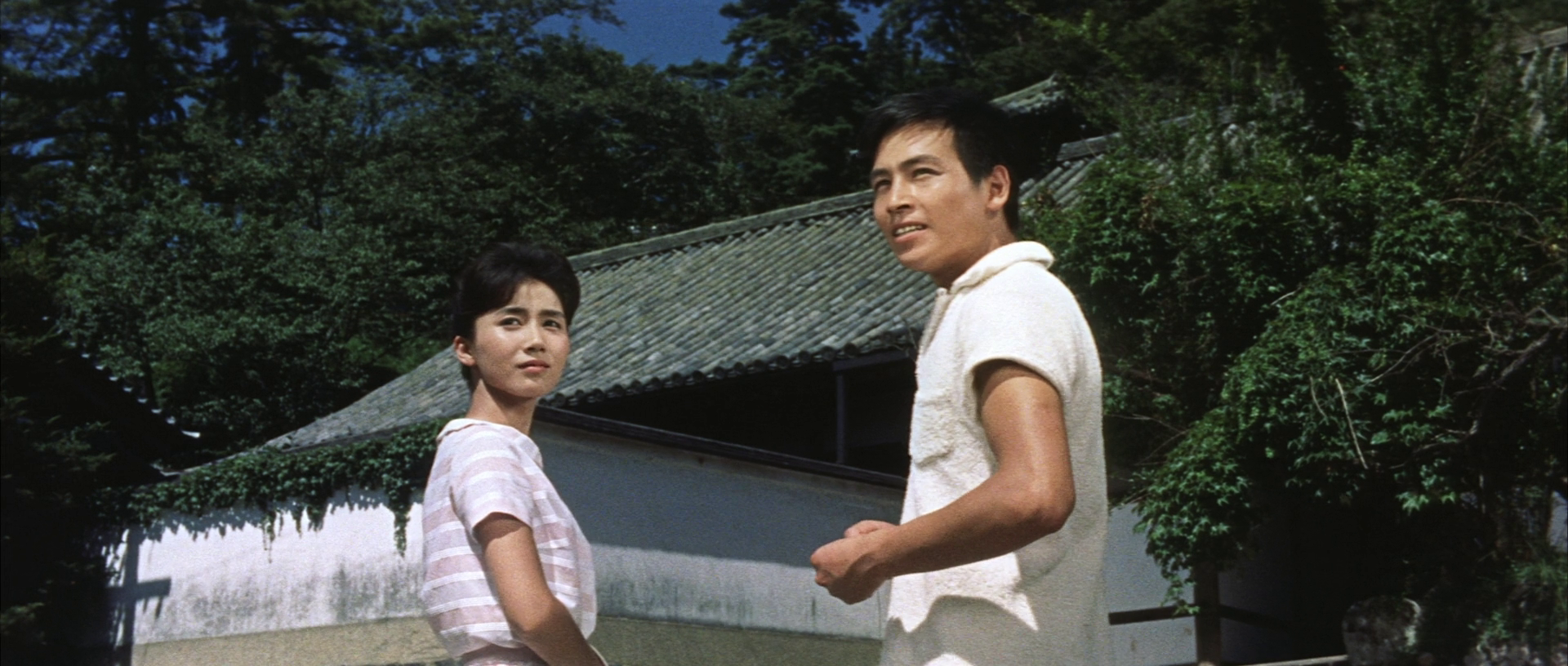
It’s funny, in a way, that life can hold so much goodness in it even with an underlying, barely visible melancholy. Goodness does indeed breed goodness for the sometimes misunderstood heroes of A Good Man, a Good Day (好人好日, Kojin Kojitsu) who struggle to adjust themselves to changing times but at the end of the day just want each other to be happy and for life to be blissfully dull and free of complication.
The obvious point of friction is that 20-something daughter Tokiko (Shima Iwashita) has had a proposal. She behaves as if it’s an arranged marriage, but in reality Ryuji (Yusuke Kawazu) is actually her boyfriend and the two of them have mutually decided to formalise their union but are doing things the “proper” way perhaps in part because Ryuji’s family run a 200-year-old ink shop and are intensely conservative. Though it’s Tokiko’s fuddy-duddy professor father Hitoshi (Chishu Ryu) who is often regarded as the sticking point, it’s equally Ryuji’s family and particularly his traditionalist grandmother (Tanie Kitabayashi) who isn’t sure that Tokiko is really good enough. She is however the only member of the family who thinks it’s not a big deal after discovering that Tokiko is adopted while others regard her with an increased suspicion and the prejudice often held towards orphans that they don’t want to let someone into their family whose familial lineage they don’t know.
It’s most likely for their benefit that Tokiko and Ryuji are intent on compromising by doing everything the “proper” way rather than as her mother Setsuko (Chikage Awashima) tells her just get married on their own without worrying about what anyone thinks. But in this awkward mix of tradition and modernity we can see that times have changed and Ryuji and Tokiko have decided their future for themselves. They firmly believe it will work out so they’re remaining patient, but should that patience run out they will decide to prioritise their own happiness.
For his part, Hitoshi later says that he never actually objected to the marriage but just hates the idea of big weddings which he regards, not without reason, as stupid and pointless. In any case he warms to Ryuji when he loses his temper and calls him an “old fart,” realising that he’s a young man with a backbone and possibly worthy of Tokiko. A professor of mathematics, Hitoshi is an awkward man who doesn’t quite fit into polite society but has a good heart even if he has a funny way of showing it. When he wins an important medal from the government for his contribution to scholarship and it gets stolen, he won’t let the hotel owner report it because of his embarrassment but when the chastened thief brings it back he sends Tokiko after him with money for his train fare and a little more as a thank you.
Still, he was probably not an easy man to live with and Setsuko’s not so secret sake habit is likely a result of the strain of dealing with him and his constant faux pas in the boredom of a rural life in which she says all she does is make pickles. But despite that, she still tells Tokiko that marriage is essential to a woman’s happiness if also encouraging her to fight for what she really wants. Tokiko is already doing just that, but has lingering doubts over her parentage and wants to know who her birth parents may have been partly out of curiosity but also a mild fear of the implications it may have. But what Hitoshi eventually tells her is that she is a war orphan which makes her a kind of everywoman and a symbol of the young, post-war generation which is making a break with the past.
The film in fact includes a small satirical, anti-war sequence in which Hitoshi is accosted by a snooty nationalist who shouts out that he lacks “patriotism” for allowing the medal the emperor so generously gave him to be stolen. The man tells him he should face the direction of the Imperial Palace and apologise all which makes him look quite mad and paints Hitoshi as the figure of exasperated sanity. He also rejects contemporary consumerist culture in continuing to live like a student counting every last yen and rejecting the TV set Ryuji buys him because it would deprive him of going to the coffee shop to watch baseball games instead (though he does regret it later). In any case, Hitoshi’s guileless goodness does seem to ameliorate the world around him in making others, like the thief, want to live up to it as he, like Tokiko, defiantly does what he wants and though at times perhaps insensitive generally has his heart in the right place.
 Windows on Worlds