Abang Adik (富都青年, Jin Ong, 2023)

Displaced brothers find themselves trapped on the margins of a prosperous city in Jin Ong’s gritty drama, Abang Adik (富都青年). Essentially a story of brotherhood, Ong explores the fates of those largely cast out from mainstream society who must as one character later says be forever watchful, keeping a place to hide and to which escape while denied the most ordinary of things such as home and family for no reasons other than bureaucracy and prejudice. 

Both Abang (Chris Wu Kang-ren) and Adi (Jack Tan) were born in Malaysia but are technically undocumented and finding it difficult to replace their identification without things like birth certificates or access to other family members to help replace them. While Abang, who is deaf, is earnest and determined to do everything properly, Adi is sick of waiting for things to work out in his favour and has begun working as a middleman for traffickers to earn enough money to pay for a fake ID while supplementing his income with sex work. The pair are aided by social worker who tries to do her best to help get their documentation in order but finds herself with an uphill battle against implacable bureaucracy and governmental indifference. 

Ong spends most time with the brothers but makes clear the oppressive quality of the world inhabited by those trapped on the margins such as the undocumented migrants who become victims of a police raid following a tip from a broker taking kickbacks. As Adi later remarks they ask for workers to come and then they want them to go, irritated to see a policeman carrying a watch he appears to have just accepted as a bribe. With no other family members around them, the brothers have been cared for by a neighbour, transgender sex worker Money, who is like them locked out of mainstream society just for being who she is while Abang finds himself further disadvantaged by his disability and the difficulties involved in finding employment. 

Abang falls in love with a refugee from Myanmar but her family will soon be moved on to another country, while Ali develops feelings for one of his clients though she soon tells him she’s planning to move to another area to get married and enjoy a more stable if perhaps less financially comfortable life outside of the city. He offers to marry her instead, but really has nothing to give her other than his body. When a tragic accident sends the brothers on the run, they realise they have no one to rely on but each other and no real place to go. In a poignant monologue in the film’s closing scenes, Abang complains to a well-meaning monk that he is incapable of understanding his life or how difficult it has been for him to simply go on existing. He wishes that he could speak, that he had a family, that he had a safe space to call home and was not forever looking over his shoulder in case he had to leave in a hurry but instead all he gets is cosmic irony sacrificing himself to save Adi in the belief that he still has a chance at a better life if only he can swallow his pride, meet his father, and get an ID card. 

In the end they are both displaced, forcibly separated and pushed in opposing directions. Abang revisits their childhood, making paper aeroplanes as he once had with Adi and saying a final farewell with their ritualistic practice of cracking hardboiled heads on each other’s heads finding for a moment an identity as brothers reflected in each other. Ong shoots their marginalised existence in vibrant colour but also captures a sense of the city as oppressive and unwelcoming, as if it were actively ejecting them with its ubiquitous police patrols and constant danger while authority figures are largely corrupt and uncaring save the earnest social worker who ironically pays a heavy price just for wanting to help those who need it most. Melancholy if not exactly bleak, the film positions the brotherhood between the two men as a course of salvation allowing them to overcome a sense of despair in a society that seems all but closed to them.


Abang Adik screened as part of this year’s New York Asian Film Festival

Original trailer (Traditional Chinese / English subtitles)
Miss Andy (迷失安狄, Teddy Chin, 2020)

“The things we like we’re still going to lose” according to a drunken young man lamenting youthful impossibility in Teddy Chin’s melancholy tale of marginalisation and frustrated hope, Miss Andy (迷失安狄). A Malaysian-Taiwanese co-production, Chin’s sensitive drama allows its disparate protagonists to find a sense of security in the solidarity of an accidental family, but all too quickly reminds us that despair is the enemy of love and that a lack of faith in human connection can undermine even the most genuine of bonds in those who can no longer believe in future happiness. 

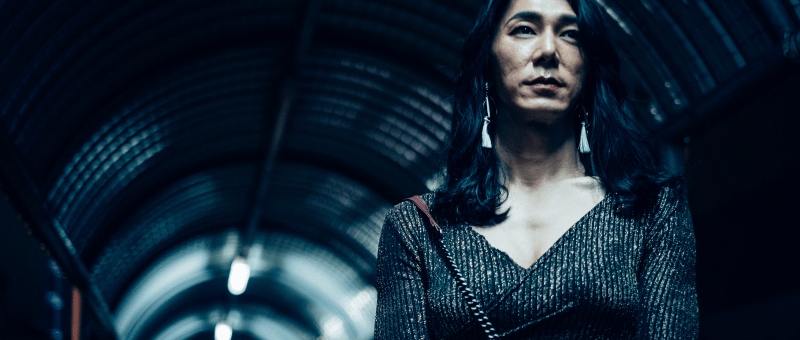
The titular “Miss Andy”, Evon (Lee Lee-zen), has certainly had her share of disappointment. Now 55, she transitioned five years previously following the death of her wife but both of her grown-up children have since disowned her. Having lost her livelihood, she’s had no choice other than to resort to sex work in order to make ends meet, finding herself on the receiving end of male violence from her clients only then to be arrested with the man insisting that he was only defending himself against her advances and attempt to rob him while the unsympathetic police officer dead names and berates her with homophobic slurs. She is eventually forced to strip and expose her genitals while half the station gawp and take photos. Evon decides to give up on sex work and advises her friend Lucy to do the same, but she refuses to see the danger and is later murdered by a man who solicited her for sex. 

Feeling totally alone, Evon tries to claim her position in society, insisting on receiving her pay from her previous employer who tries to short-change her justifying herself with more transphobic slurs. Evon has only one other friend, Teck (Jack Tan), a young man with a hearing impairment who offers her additional work as a delivery driver during which she encounters a little boy looking longingly at some pastries in a small store by a petrol station. She decides to buy one for him, but the boy has gone when she returns. Later that night, however, she gets a surprise discovering the boy and his mother having snuck into her apartment after stowing away on the truck. Hearing that they’ve escaped an abusive relationship and have nowhere else to go she invites them to stay.

Sophia (Ruby Lin), the boy’s mother, is an undocumented migrant from Vietnam. She’s struck by the unlikely miracle of Evon because her name sounds a little like the Vietnamese for hope, something on which she was beginning to give up. We see her telephone her family, but her father only angrily demands more money, eventually passing the phone over to her sister who unsentimentally tells her that her mother has died. All the rest of the family were with her, only Sophia was absent. Feeling just as alone as Evon she is grateful for her kindness, swearing to find a job to repay it while cooking and cleaning as a means of saying thank you. 

Later joined by Teck and anchored by Sophia’s young son Kang who is the same age as the granddaughter Evon is rarely allowed to see, they begin to become a family, united in their sense of marginalisation each in some way rejected by mainstream society. Evon religiously buys lottery tickets using the birthdays of her wife and children as numbers in the hope they’ll eventually come up and she’ll somehow win her family back. Even Sophia who had perhaps not dared to dream of a brighter future eventually joins in as they idly fantasise about the kind of home they’d build if they actually won while sitting in an upscale furniture store before the server at a festive restaurant offers to take a picture of their “family”, but when that sense of possibility finally presents itself the illusion is shattered. Desperation undermines their fragile bond, pushes them towards doubt and betrayal, no longer able to believe in the viability of simple human goodness or mutual support as mechanisms for living but suddenly selfish and self-destructive destroying everything they’d built in mistakenly staking all on the vague possibility of material comfort.

Asked about her dreams, Evon had only stated that she wanted a safe and stable life but what she craved was the sense of togetherness and acceptance she felt with Sophia and Kang while her children continue to reject her and she finds herself marginalised by a conservative society that refuses to affirm her existence as a transgender woman. Bathed alternately in the melancholy neon of the outside world and the golden warmth of Evon’s apartment, Miss Andy leaves its marginalised protagonists wounded, pushed into acts of self harm having lost all faith in the veracity of simple human connection corrupted by the fear and despair of an unforgiving society ruled by inequality and prejudice. 


Miss Andy streamed as part of this year’s New York Asian Film Festival.

Original trailer (English subtitles)

A Land Imagined (幻土, Yeo Siew Hua, 2018)

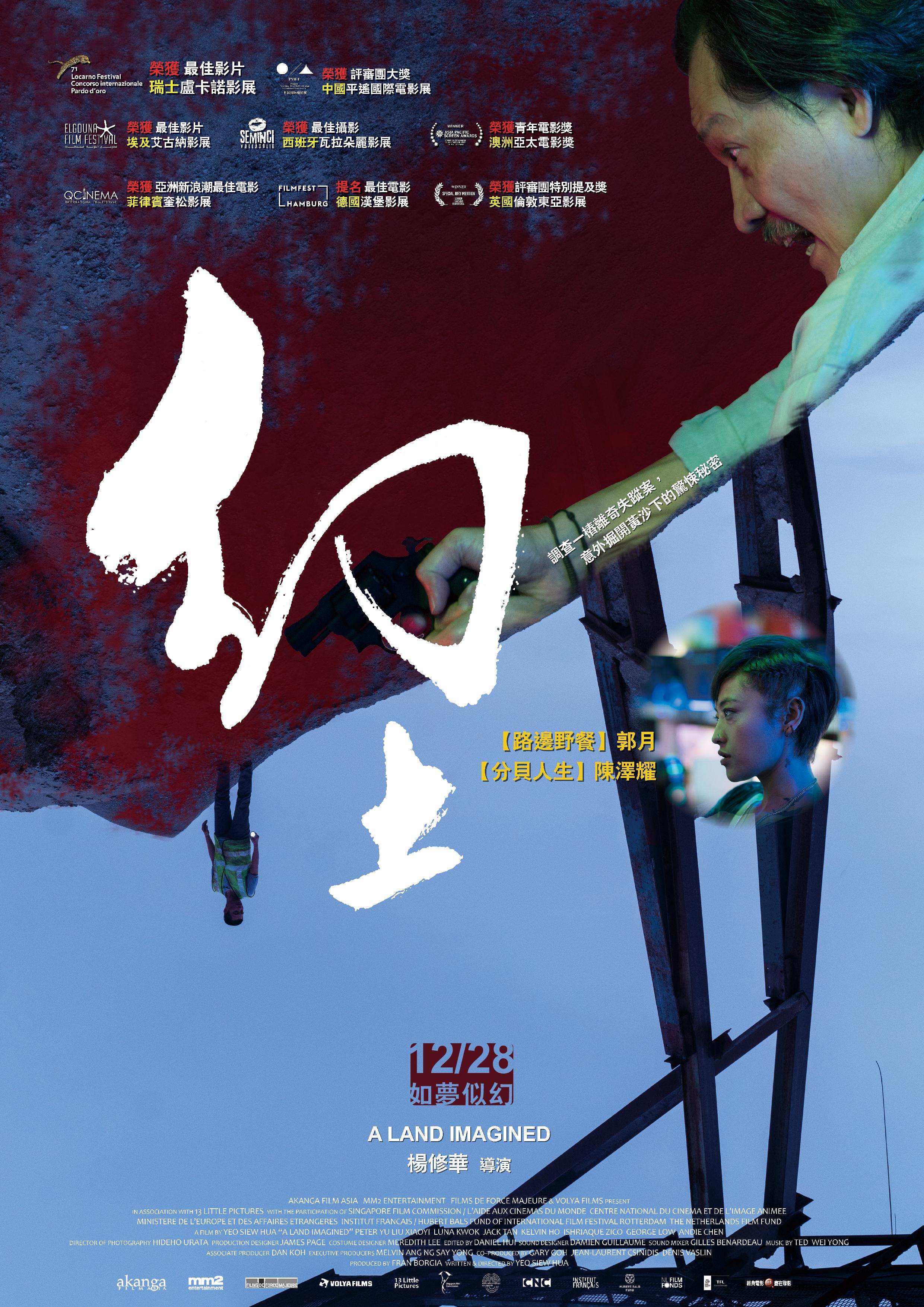
A Land Imagined posterAs the world gets bigger and smaller at the same time, it’s as well to be asking on whose labour these new lands are being forged. Yeo Siew Hua’s Locarno Golden Leopard winner A Land Imagined (幻土, Huàn Tǔ) attempts to do just that in digging deep into the reclaimed land that has made the island of Singapore, an economic powerhouse with a poor record in human rights, 22% bigger than it was in 1965. A migrant worker goes missing and no one really cares except for an insomniac policeman who dreams himself into a kind of alternate reality which is both existential nightmare and melancholy meditation on the rampant amorality of modern day capitalism.

Lok (Peter Yu), a hangdog middle-aged detective, is charged with looking for Wang Bi Cheng (Liu Xiaoyi), a missing migrant worker from China. Just who it was that noticed Wang’s absence is only latterly explained and in suitably ambiguous fashion, but the fact remains that there is an empty space where a man named Wang used to be and Lok is the man charged with resolving that space no matter who might or might not be interested. We discover that Wang was injured on the job, almost sacked and then reprieved to drive the workers’ bus where he befriended a worker from Bangladesh, Ajit (Ishtiaque Zico), who later disappeared sending Wang on his own mirrored missing persons case in which he begins to suspect something very bad may have happened to his friend.

Despite his presumably long years on the force and world weary bearing, Lok is refreshingly uncynical for a police detective but apparently extremely naive about the city in which he lives. Stepping into the world of Wang Bi Cheng, he is shocked to discover that people live “like this” – several men crammed into in tiny bed bug infested rooms so brightly lit from outside that it’s difficult to believe that anyone gets any sleep at all. Wang, in any case, like Lok did not sleep and gradually migrated over to the 24hr internet cafe across the way where he developed a fondness for the spiky proprietress, Mindy (Luna Kwok), while repeatedly dying in videogames and being trolled by a mysterious messenger who may or may not have information about his missing friend.

Like Lok, Wang Bi Cheng cannot sleep but lives in a waking dream – one in which he envisages his own absence and the two police detectives who will search for him, not because they care but because it’s their job and they’re good at it. Men like Wang are the invisible, ghostly presence that makes this kind of relentless progress possible yet they are also disposable, fodder for an unscrupulous and uncaring machine. Asked if it’s possible that Wang and his friend Ajit simply left, the foreman’s son Jason (Jack Tan ) answers that it’s not because the company keeps the men’s passports, adding a sheepish “for their own protection, in case they lose them” on realising the various ways he has just incriminated himself.

Yeo opens with a brief and largely unrelated sequence of a young Chinese migrant worker climbing a tower in his bright orange overalls. Later Lok reads a newspaper report about this same man who tried to launch a protest in having been denied his pay and forced to endure dangerous and unethical working conditions. Meanwhile, Mindy the internet cafe girl, is forced to resort to taking money for sex acts in order to make ends meet. Like Wang, she dreams of escape, of the right to simply go somewhere else without the hassle of visas and passports. Wang jokes that the sand that built the reclaimed beach they are sitting on came from Malaysia, and that in a sense they have already crossed borders, offering to take Mindy away from all this (for a moment at least) in his (borrowed) truck but knowing that their escape is only a mental exercise in transcending the futility of their precarious existences.

Indeed, Yeo seems to be saying that Singapore itself is a “land imagined” – constantly creating and recreating itself with repeated images of modernity. One could even read its artificial territorial expansion as reshaping of its mental landscape while all this progress is dependent on the exploitation of wayfarers like Wang and Ajit wooed by the promises of wages higher than in their home countries but left with little protection and entirely at the mercy of their unscrupulous employers. Yet a strange kind of affinity arises between the lost souls of Lok and Wang, united in a common dreamscape born of sleeplessness and lit by the anxious neon of rain-drenched noir as they pursue their parallel quests, looking for each other and themselves but finding only elusive shadows of half-remembered men dreaming themselves out of existential misery.


A Land Imagined screens as part of the eighth season of Chicago’s Asian Pop-Up Cinema on March 20, 7pm at AMC River East 21 where director Yeo Siew Hua will be present for an introduction and Q&A.

Original trailer (English subtitles)