
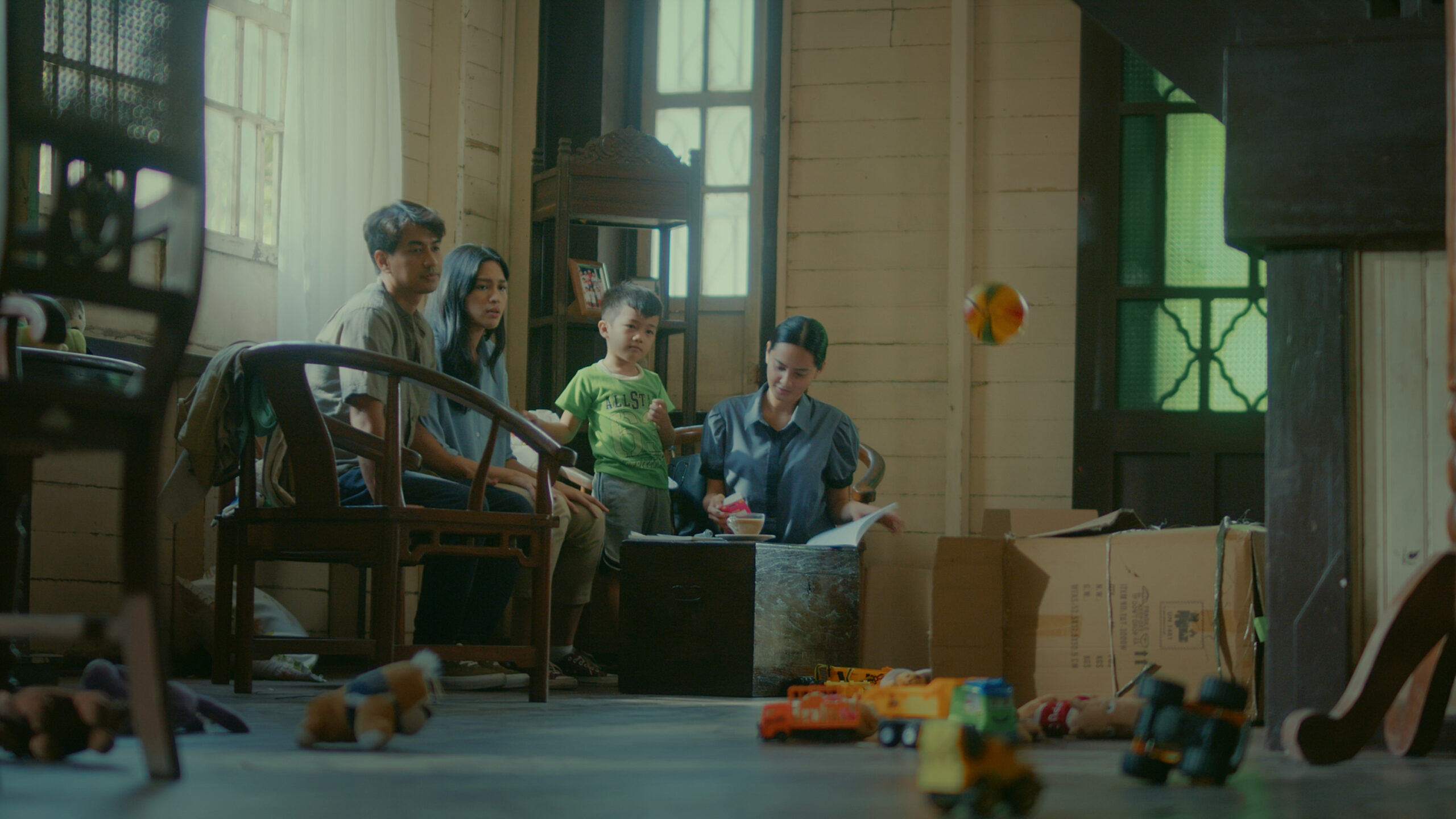
A young couple find themselves struggling in an uncompromising society while trying to raise their young autistic son who has complex needs in Jonathan Jurilla’s semi-autobiographical drama, Love Child. Inspired by the director’s own experiences of raising an autistic son, the film never shies away from the inherent difficulties involved but is as interested in the wider social context that makes life particularly hard for parents Ayla (Jane Oineza) and Pao (RK Bagatsing).
The first issue they face is their youth which though termed a “superpower” by a well-meaning older woman makes it difficult for them to raise a child without having had time to generate a financial buffer. Meanwhile, they also face a mild degree of prejudice because they are not actually married nor do they have a religion in a fiercely Catholic culture. The pair were still in university when Kali (John Tyrron Ramos) was conceived and subsequently had to break off their studies meaning not only that they’ve had to change course in life but that they’re locked out of the better paying jobs their degrees would have led to. Ayla was studying to become a lawyer but now has a part-time remote office job that is increasingly incompatible with raising Kali. Her unsympathetic boss complains about the noise and later lays into her about her priorities, claiming that she’s a mother too and she manages so Ayla’s on notice for the next time she infringes on workplace mores.
Though Kali is now old enough to be enrolled in school, they struggle to find a place for him and are at a loss when he suffers bullying from one of the neighbourhood children after they send him to a government-run special school. It seems their only option is an expensive private institution, but it’s obviously a struggle for them on their already compromised incomes. Meanwhile, they’re constantly recommended other treatments and services that might help Kali’s development and made to feel like bad parents for not being able to afford them. Neither of them can rely on family support as Ayla’s mother disapproved of them having Kali in the first place and is hostile towards him because of his disability while Pao carries a degree of resentment towards his estranged father who abandoned the family and now lives in Australia.
Pao’s relationship with his father informs the kind of father he’d like to be in his desire to protect his family, but the solutions that present themselves are those familiar to other struggling youngsters and would result in splitting the family up with one or both parents living abroad to earn higher salaries so they can afford the best education and treatment for Kali. Meanwhile, Ayla looks around her former friendship groups and realises that most people her age have either rejected or postponed the idea of starting a family and are instead spending their money on things like travel and entertainment or patiently saving to achieve financial stability. She wonders if they did the right thing or were naive to believe in love and that everything would somehow work out because they were a family.
Though raising a child is hard enough on its own, the additional financial strain placed on them along with the impossibility of both looking after Kali and trying to earn a living is something exacerbated by the lack of provision for families like theirs especially those without the support of friends or relatives. Sacrificing their dreams to look after their son, the couple do everything they can to ensure he has the best future possible but are often frustrated by those around them who maybe prejudiced or lack understanding of kids of like Kali and the additional care he sometimes needs especially as his developmental process is obviously slower than average and he may never achieve independence. Though some of the meta commentary and references to tropes of a stereotypical Philippine rom-coms are a little on the nose, Jurilla focuses on the love the parents have for their child and their earnest attempts to do the best for him even at the cost of their own health and wellbeing while also hinting at the unfairness of the society around them in which there is little help available to those who do not have the resources to pay for that which should be provided for all.
Love Child screens Nov. 8/9 as part of this year’s San Diego Asian Film Festival.
Original trailer (English subtitles)
 Windows on Worlds