

In a moment of calm in Chang Er’s Hidden Blade (无名, Wúmíng), a man is served drunken shrimp and watches the poor creatures flail as they’re cooked alive in a bloody soup before placing them in his mouth still kicking, the red liquid dripping from his lips. The heroes are to some extent much the same, plunged into the dangerous waters of the Sino-Japanese war and drowning among its myriad confusions no longer even certain of their own identity let alone that of others.
It’s at this that the Chinese title, Anonymous, hints for in this world of constant duplicity names are rarely exchanged or on occasion given only posthumously. That is aside from Mr. He (Tony Leung Chiu-wai) who introduces himself promptly after giving a secret knock to enter a hotel room marked with a Japanese character to meet a Mr. Liang who, it seems, intends to betray the Communist cause and instead serve the Wang Jingwei Regime which has sided with Japan in the puppet state of Manchuria, though we can in no way be sure if either of these men are telling the full truth or are who they claim to be.
Chang replays this scene later with additional content as he will with several scenes throughout the film adding new context as he goes. Like Lou Ye’s Purple Buttlerfly, the fractured narrative hints at the chaos of an age in which nothing is quite as it seems and the truth is always obscured if at times irrelevant. Spanning the second Sino-Japanese war and its immediate aftermath, the film suggests that the motivations underpinning Japanese imperialism are anti-Communist and that Manchuria is a key asset for them as a bulwark against Soviet incursion. Collaborating with the Japanese, the Wang Jingwei Regime is the third point in a triangle lodged between Chiang Kai-shek’s Nationalists and the Communist Party with the implication that it essentially needs to drop out lowering the barriers for a confrontation between the two and the eventual victory of the Communists which occurs three years after the end of the film in 1949.
Technically the third part in the “China Victory Trilogy” which was conceived as “a gift to the Communist Party for its centenary” the film may make some bold claims as to the role of Communist spies in the 1930s but nevertheless neatly aligns the covert resistance movement with the Party’s eventual triumph if subversively ending on a note of loss and melancholy which leaves the survivors in lonely exile, ideologically victorious but emotionally ruined. Both Liang and the ambivalent Japanese soldier Watanabe (Hiroyuki Mori) talk of wanting a quiet life retiring to ancestral land as ordinary farmers freed from the murky world of politics but are each frustrated while He and Watanabe’s young goon Ye (Wang Yibo) wrestle with the romantic costs of their political choices. Yet the most dignified performance is reserved for an impossibly beautiful KMT assassin caught before she was able to take out a government minister while posing as his mistress “He used to write poems, now he writes execution orders,” Watanabe laments of the Minister (Da Peng) who later it seems pays a heavy price for his ruthless opportunism. At least his would-be-assassin remained true to her ideals and accepted her fate with dignity. Indeed, she may be the only one who is certain of herself and her identity even in her impeccable elegance which is a something of a mixed message given her political affiliation.
In the end, it may be the self-denial that slowly erodes their souls while forced to conceal their true intentions even to those close to them. Then again, it’s impossible to know what’s for real and what’s for show. An intensely emotional exchange could in fact be intended for someone else’s ears or merely a cruel tragedy of misrepresentation. The real hidden blade is the self-repression living in an atmosphere of oppressive suspicion requires rather than the communist sleeper agents who in this version of the tale beat the Japanese into retreat. Featuring top notch production design and costuming, Chang’s oscillating venture through an abyss of cruelty and betrayal finds its heroes victorious but no so much anonymous as robbed of both name and country, lonely exiles of a war not quite won.
Hidden Blade is available digitally in the US courtesy of Well Go USA.
US trailer (dialogue free)
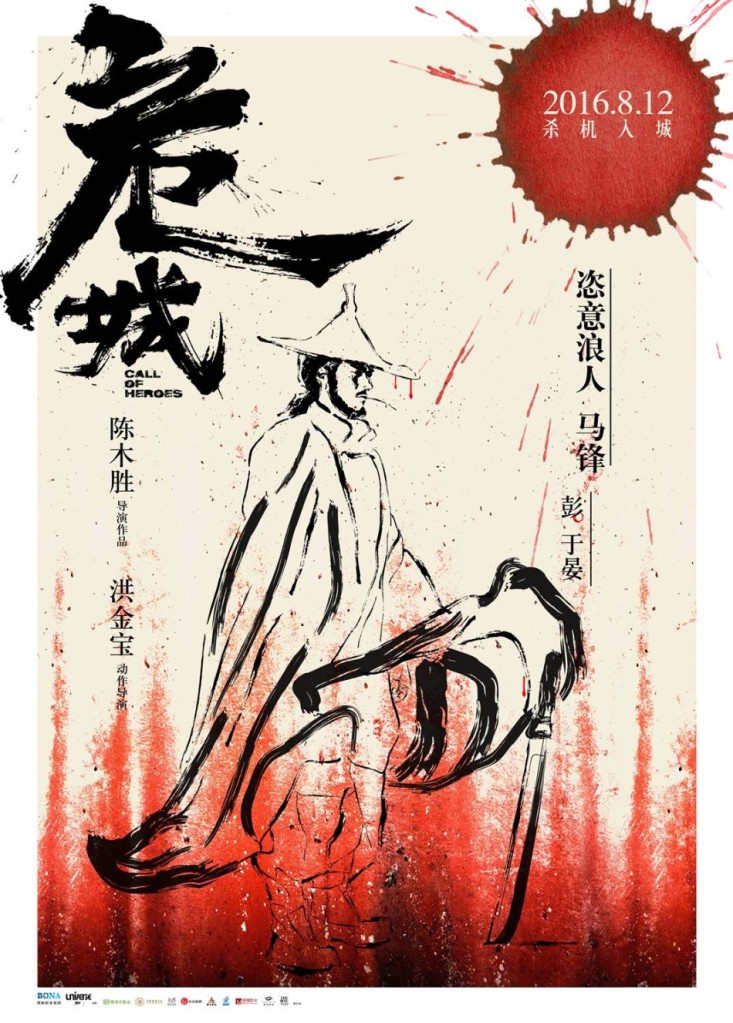 A blast from the past in more ways than one, Benny Chan’s Call of Heroes (危城, Wēi Chéng) is a western in disguise though one filtered through Akira Kurosawa and Sergio Leone more than John Ford. Filled with Morricone-esque musical riffs and poncho wearing reluctant heroes, Chan’s bounce back to the post-revolutionary warlord era is one pregnant with contemporary echoes yet totally unafraid to add a touch of uncinematic darkness to its wisecracking world.
 Windows on Worlds