The Looming Storm (暴雪将至, Dong Yue, 2017)

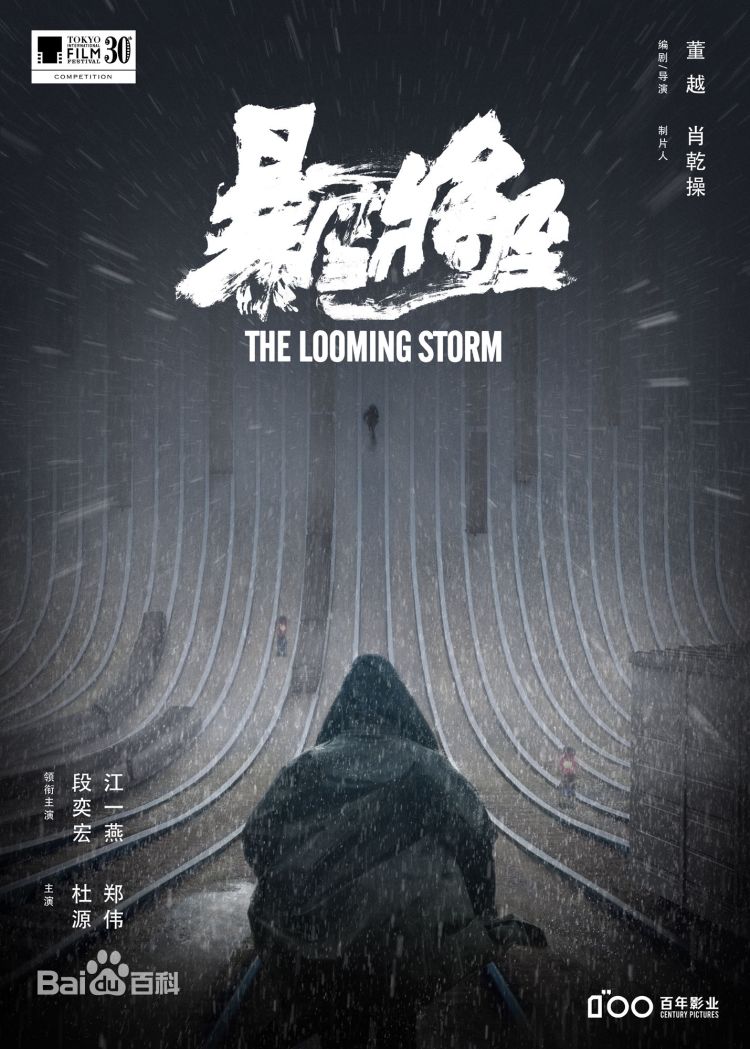
The Looming Storm posterGreat changes were afoot in China in 1997. While the rest of the continent contended with the Asian Financial Crisis, China saw the death of reformer Deng Xiaoping who had begun the business of putting the nation’s economy on a modern footing – something which was still very much in progress under the then premier, Jiang Zemin. The old unprofitable factory cities and the work unit system were on their way out, but with little in the way to replace them save the hope for a new and glorious future. The hero of Dong Yue’s debut, The Looming Storm (暴雪将至, Bào Xuě Jiāngzhì) has an unhappy destiny in that his name uses characters which could be translated as “unnecessary remnant of a glorious nation”. He, like many of his generation, is one caught out by his country’s sudden shifts and finds himself living out a fantasy, chasing at shadows and eventually destroying himself in a misdirected attempt to attack a society which has all but forgotten him.

We begin at the end – in 2008, Yu Guowei (Duan Yihong) is released from prison as a parolee, awaiting the return of his ID card and along with it his official existence as a member of society. Flashing back to 1997, Guowei is the security officer at the local factory. Having proved himself efficient in catching petty criminals thieving from the communal resources, Guowei gets himself a “model worker” commendation and the nickname “Detective Yu”. Fancying himself as a top investigator and there being very little to do in this no horse town, Guowei is, in a sense, excited when another body of a young woman turns up near the factory closely matching the pattern of other recent murders and hinting at a serial killer. Seeing as the police are short staffed in any case, the local sheriff decides to humour Guowei by allowing him to go on trying to solve the case on his own.

Guowei investigates the crime with methods he’s learned from hardboiled movies – staking out the crime scene and asking awkward questions in an illicit local disco where, it is suggested, some of the victims may have been earning money through casual sex work. He becomes obsessed with shadowy figures, faces hidden by raincoats, who lurk on the periphery anonymous and almost unseen but yet unsettling. Guowei finds and chases his quarry, only to abandon a friend in need while the suspect gets away leaving Guowei with only his shoe as a possible clue.

During his model worker speech, Guowei somewhat milks the occasion but proudly states that he intends to live a “meaningful live”. Given the depressing drudgery of his existence it’s unclear how he intends to do that, but then his “investigation” becomes his great and glorious destiny – something which will bring both meaning and acclaim to his otherwise meaningless existence. Like many of his age, Guowei has learned to be proud of his contributions to society through his work but remains unaware that the security bureau is not well respected. Everyone knows Guowei is a pure hearted sort who cannot be corrupted and pretends to respect him for it, but in reality they find him priggish and ridiculous. Unbeknownst to him to there have been many more mysterious thefts he’s never discovered because the entire factory and even his own assistant are engaged in a complex system of bribery to cover them all up.

When the factory is unceremoniously shut down, all Guowei is left with is his need to find the killer. Striking up a relationship with a pretty sex worker, Yanzi (Jiang Yiyan), who dreams of opening her own hair salon in Hong Kong – another new horizon in 1997 though one she fears she may never see, Guowei perhaps has another shot at building a “meaningful life” but rejects it, suppressing his natural desires for his obsessive pursuit in deciding to use his new muse as bait. Time and again, Guowei backs away from the reality, unwittingly sacrifices friends and lovers in service to his self created narrative in which he is a hero seeking justice whose victory is all but assured. Having discovered the truth, Yanzi’s eyes are opened – she has woken up from the beautiful dream of a possible future while Guowei is still boyishly dreaming of becoming a hero in an unheroic world.

Dong paints the industrial factory town in tones of washed out browns and greys as the rain falls without end, muddying the streets and thickening the air. Having made a life changing transgression, Guowei is asked what the point in any of this really was and seemingly has no answer, his fantasy perhaps shattered by his single act of horrifying violence intended for the world in which he lived which had already robbed him of so much, but vented on a possibly innocent party all because of a personal conviction more akin to prejudice. A victim of changing times denied his future, the “meaningful life” that would allow him to greet the new century with head held high, Guowei creates a new narrative for himself in which he can be the hero but there is a storm always looming and Guowei has been swiping at ghosts flickering on the peripheries of his fracturing mind. Eventually Guowei too decides it’s time to leave this place only to find no way out from the blizzard conditions which continue frustrate the path towards his future.


The Looming Storm screens at New York Asian Film Festival 2018 plus Q&A with director Dong Yue on 9th July at 9.30pm.

Original trailer (English subtitles)

The Vanished Murderer (消失的凶手, Law Chi-leung, 2015)

vanished-murderWhen The Bullet Vanishes was first released back in 2012, the film received unfair criticism in some quarters due to its enormous debt to Guy Richie’s then popular Sherlock Holmes. Derivative or not, The Bullet Vanishes remains an innovative and intricately plotted cerebral thriller, primed to launch the return of its central detective, former prison warden, Inspector Song (Sean Lau). Only slightly late, Song is finally back to address another series of baffling deaths and conspiracies in 1930s China only this time he’s landed in a pulpy LA noir rather than the cowboy-tinged action of the previous film.

The Murderer Vanishes (消失的凶手, Xiāoshī de Xiōngshōu) revolves around Song’s Irene Adler figure, Fu Yuan (Jiang Yiyan), whom we saw Song making frequent prison visits to in The Bullet Vanishes. Song is called to the prison because Fu Yuan has mysteriously disappeared from her cell leaving only a Shawshank Redemption inspired red herring behind her. The strange bond between Song and Fu Yuan in which they chastely dance around each other in the ultimate long distance romance, dictates that Fu Yuan send him a letter to tell him exactly where she is so he can come and arrest her all over again.

After a hot date at the cemetery, Fu Yuan takes Song to a philosophy lecture in which the speaker, Professor Hua (Gordon Lam), muses on a thought experiment in which he discusses the ethical problem of making an active choice to sacrifice one life in order to save multiple lives and whether making such a choice is any different from committing a murder – i.e. pushing another person in front of a moving train to stop it hitting a crowd further up the track. The experiment is eerily echoed when a body falls out of the sky just as Song is about to re-arrest Fu Yuan, allowing her to once again slip away.

Song investigates and is arrested only to be recruited to solve the mystery of why so many of the workers at evil corporate boss Gao Minxiong’s (Guo Xiaodong) string of factories are suddenly leaping to their deaths whilst wearing shirts bearing slogans which decry him as a slave driver.  Song is assisted by the girl he jilted at the alter eight years ago with whom he was improbably reunited on the train, Chang Sheng (Li Xiaolu), and a local policeman, Mao Jin (Rhydian Vaughan), as well as the philosophy professor but somehow this must all be linked to Fu Yuan’s mysteriously timed prison escape.

The biggest departure The Vanished Murderer has to deal with is the absence of co-star Nicholas Tse. Rather than give Song a new partner or attempt to ditch the buddy format altogether, Tse’s role has been awkwardly split into four with Song surrounded by his cohorts of varying stripes but never achieving the same kind of bond that made The Bullet Vanishes so satisfying. Many of the first film’s plot elements are also ported over wholesale, rehashing the same political subplots and betrayals but without the subtlety.

One again we have an exploited work force of factory workers suffering at the hands of a heartless capitalistic sociopath. Gao Minxiong is seen early on collaborating with a British businessman who warns him about the effects of the depression only for Gao to explain the “measures” he’s taken which include burning harvests to increase demand and therefore drive prices up, as well as closing factories to increase competition for jobs and therefore drive wages down. Gao also has a private militia he uses for strike breaking and indiscriminate massacre. The people suffer while the elites prosper, it’s an old story.

The Bullet Vanishes may have had one foot in the Old West, but The Vanished Murderer has stayed in the same geographical area whilst jumping fifty years into the future in terms of tone. Gone are the lawless, dingy back alleys and saloons – The Murderer Vanishes takes place under bright sunlight, in an airy city surrounded by green country estates. Song has even switched up his zany bowler hat from the first film for a wide brimmed fedora and the musical score also pulls in some Spanish guitar to ram home that West coast style. This is a land of flappers and jazz babies, filled with art deco elegance and international flair.

For all that it’s a pulp world too and as such exempts itself from the need to make any kind of real sense. The central mystery is nowhere near as compelling as that of The Bullet Vanishes and resolves in a less than satisfactory manner. In the great pulp tradition action set pieces become increasingly ridiculous until the point Song and Fu Yuan attempt to escape by riding a horse through a building. The film’s finale takes place entirely on a train and does at least make good use of its CGI budget even if it’s a disappointingly simple way to conclude.

A slight misstep after the well plotted charm of The Bullet Vanishes, The Vanished Murderer can’t live up to the promise of the first film. The relationship between Song and Fu Yuan ought to take centre stage but the pair spend too much time apart to make it work and the film kills off a promising ongoing plot strand for the sake of cheap melodrama in the closing moments. Still, The Vanished Murderer provides enough thrills of its own even if lighter in tone and with a weaker central mystery to make the continuing adventures of Inspector Song worth investigating.


Original trailer (Mandarin with English subtitles)

The Bullet Vanishes (消失的子弹, Law Chi-leung, 2012)

20128291720405212Review of Law Chi-leung’s The Bullet Vanishes (消失的子弹, Xiāo Shī Dè Zǐ Dàn) – first published on UK Anime Network in June 2013.


In 1930’s Shanghai there’s a bullet factory where a young girl has been accused of pilfering. The punishment, it seems, is a cruel and very public trial by Russian roulette where fate, the gods or whoever will judge her innocent or guilty with a simple click or a loud bang. Crying out her innocence to the end, the girl pulls the trigger and presumably never actually hears the outcome as her co-workers look on in horror – she must have been guilty though, right? Or she would have been spared by the immortal powers at be.

Following this horrific incident, other deaths start to occur in the factory – the strange thing is, on examining the bodies, no trace of a bullet can be found (nor any casings at the scene). Some of the munitions workers start to believe the ghost of the poor girl who died must have returned to take revenge – perhaps she was innocent after all. To solve this intriguing mystery, the police turn to two unorthodox detectives – recently transferred former prison warden Song (Lau Ching-Wan) and maverick cop “fastest gun in town” Guo (Nicholas Tse). Neither of these two are buying the “supernatural” explanation and both are determined to get to the truth even if they work in very different ways. The solution is going to be a lot more complicated than anyone could have thought, and will, ultimately, be painful to hear.

Let’s get this out of this way first – yes, the film owes a significant debt to the recent “westernisation”, if you want to put it that way, of Ritchie’s Sherlock Holmes and other Victorian set crime dramas (e.g. Ripper Street) which seek to present themselves as taking place in a totally lawless world denizened by a criminal population that is somehow both repellent and glamourous. Although The Bullet Vanishes is set in 1930s, it still has a noticeably “Victorian” sensibility presenting a world in which rapid industrialisation has brought about mass corruption and a decline in morality. Once again, setting a film in China’s past proves to be a surefire way of getting subtextual criticisms of modern China past the country’s strict censorship regulations.

The murder mystery itself is certainly very intriguing with a series of unpredictable twists and turns. The idea of disappearing bullets might not be a new one, but The Bullet Vanishes manages to find an original solution that is perfectly plausible within its own time setting. Also, the “supernatural” element exists only as an idea and is never seriously entertained as an explanation by any of the investigators – something of a break from the genre norm.

The two detectives seem much more like rivals than partners for much of the film though an awkward sort of camaraderie does eventually grow up between them. Lau and Tse both give excellent performances but Tse in particular who’s often criticised for being a pretty boy trading on family connections, really proves himself with his surprisingly complex Guo. There is, however, the familiar criticism that the female characters are severely underdeveloped and seem almost like a rushed afterthought. Yang Mi gives a lot to the barely two dimensional Little Lark but can’t disguise the fact that the character only exists as a love interest for Guo and that in turn a love interest for Guo only exists so that we can have the “obligatory” love scene. That wouldn’t be so much of a problem if the love scene itself didn’t feel quite so “obligatory” – it could easily have been excised and the film would have remained pretty much unchanged as the scene feels as if it exists purely to satisfy a perceived audience need for romance.

There really isn’t much to fault with The Bullet Vanishes. As a slightly cerebral mainstream period thriller it’s certainly very successful. It has an engaging mystery element, strong characters played excellently by the cast and extremely slick, modern direction. In Song they’ve created a very interesting character who’d be very welcome in a sequel or two. His relationship with female prison inmate, a sort of Irene Adler figure to Song’s cerebral detective, who he’d previously investigated before being transferred was quite an usual idea that would really benefit from further exploration. All in all The Bullet Vanishes is a very impressive and enjoyable period procedural that is truly a cut above its genre origins.


http://www.youtube.com/watch?v=8oZOMNeJjzQ