Snow Leopard (གསའ།, Pema Tseden, 2023)

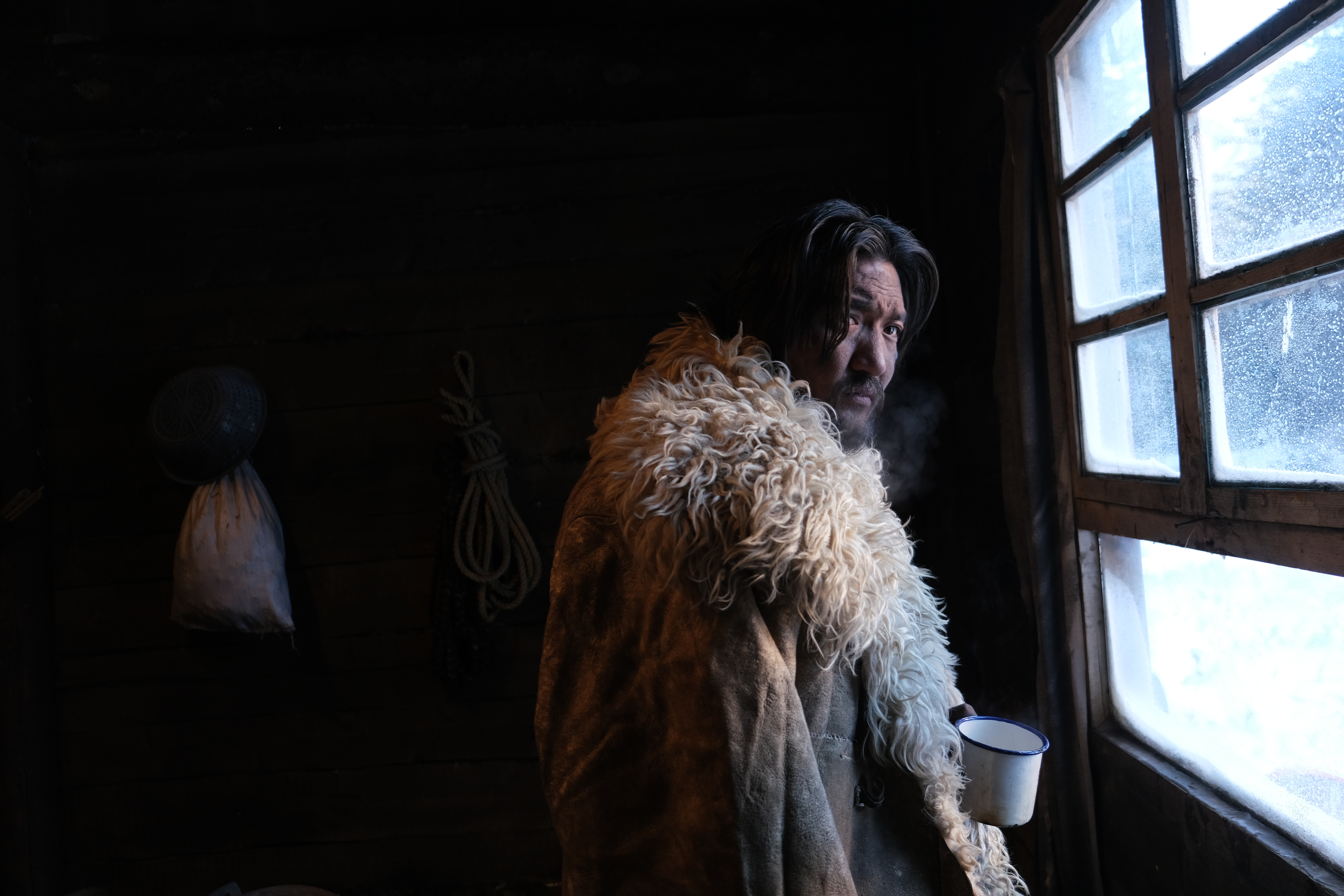
When a snow leopard breaks into a herder’s pen and kills nine of his castrated rams, the herder traps it and effectively holds the animal hostage in the hope of gaining compensation in Pema Tseden’s mystical drama Snow Leopard (གསའ།). He is reminded that the snow leopard is a “first class protected animal” but understandably asks who’s going to protect him, why is the snow leopard’s life so much more important than his own?

Prone to angry rants, Jinpa (Jinpa) is more often than not portrayed as a snow leopard himself grunting and struggling to get free when the forestry police attempt to restrain him. He says that the herders and local wildlife used to live in harmony. If a snow leopard eats one or two sheep, then they just accept it but as climate change and other environmental forces have pushed them further down the mountain Jinpa feels the snow leopards in particular have become greedy and must be stopped. He wants to kill the snow leopard in revenge and refuses to let it go until the government agrees to compensate him for his financial loss. His rage is such that it’s economically irresponsible, calling in a local man with a digger to rescue the remaining sheep and telling him that it’s fine if one or two die while agreeing to pay the same price as the sheep is worth to have him try to rescue them. 

Jinpa’s brother, a monk obsessed with photographing snow leopards, and father are each of the opinion that it’s spiritually irresponsible to keep the snow leopard bound up as it is the embodiment of the spirit of the mountains. It’s possible to read Jinpa’s animosity towards it as rage against the natural world and his fierce, almost mad diatribes against it as a kind of irrational hatred. Yet like him the snow leopard contains dualities. The one in the pen has a cub on the mountainside and seems to be capable of true tenderness though also violent carnality in its attack on the sheep. Jinpa more than anyone seems to be aware that the snow leopard is simply being what it is, but cannot forgive it for this very personal act of betrayal. 

The monk, meanwhile, has a unique relationship with the captive snow leopard segueing into a surreal black and white sequence in which he eventually sets it free and is rewarded for his act of kindness. This seems to hint at the ways in which human life and animal could coexist but also at the essential spiritual quality of the snow leopard as a symbol of something elemental along with the roots of traditional Tibetan culture which are now on the brink of eclipse. A TV news crew tipped off by the monk with whom the reporter went to school turn up to capture these bizarre events but appear uncertain as to what they’re actually filming. The cameraman is frequently so awestruck that he forgets to film anything while the reporter is constantly fending off calls from his girlfriend.

A farcical stand off occurs when representatives from the government turn up, seemingly looking down on Jinpa and irritated by his demands for compensation while insisting that the snow leopard must be released. He refuses to give in even as they remind him that if anything happens to it, it’s him that will be held legally responsible. The forces of authority are also intruders, making an incursion from the world of modernity much as the snow leopard descends from the mountain and the ancient past. Men like Jinpa occupy a liminal space, caught between the old and the new while their way of life is increasingly threatened by the forces of modernity. 

In a way, perhaps you could say the monk is trying to capture the snow leopard too even as he shares a special affiliation with it that connects him to the land and his culture along with something deeper and older that the modern world may lack. Yet what they need to do is set it free and restore an order that’s natural rather than manmade. Director Pema Tseden sadly passed away at the young age of 55 shortly after completing the film but offers a sense of the eternal in the snow-covered expanses of mountains and the cruel tenderness of those who live there.


Snow Leopard screened as part of this year’s London East Asia Film Festival.

International trailer (English subtitles)
One and Four (一个和四个, Jigme Trinley, 2021)

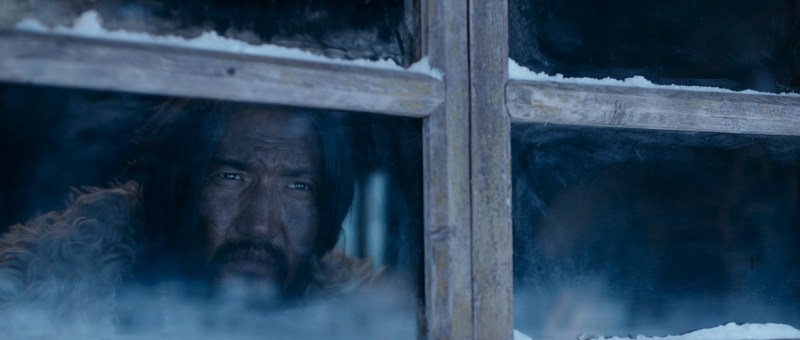
A lonely forest ranger nursing a broken heart and an incredible hangover finds himself the accidental arbiter of truth in Jigme Trinley’s frosty psychological drama, One and Four (一个和四个, yī gè hé sì gè). One and four is what each of these men are, individuals pitted one against the other. The atmosphere is one of danger and mistrust coupled with almost supernatural dread in the constant warning of an approaching blizzard with a ruthless maniac on the loose while it’s true enough that the only neutral party may have been quietly going stir crazy for quite some time aside from his recent troubles. 

Troubles do indeed descend on Sanggye in threes with each of his various visitors only complicating an already dangerous situation. As the film opens he’s clearly hungover, grumpy, and tense, going about his quotidian tasks and chopping wood while apparently out of food resorting to sucking old bread and bones. He writes in his diary that he wishes the events of the previous night had been a dream and introduces a note of mistrust regarding village man Kunbo who visited him Sanggye had assumed to borrow money but may have had a different purpose in mind. He’s later startled by another knock at the door from a wounded man carrying a rifle who claims to be a policeman chasing a dangerous poacher but looks to Sanggye like he could well be the poacher himself. 

Then again, Sanggye isn’t entirely honest with him either telling the man that he has no alcohol because forest rangers aren’t supposed to drink yet we’ve already seen bottles littering the cabin and it seems clear he woke with a hangover. “I didn’t know you why should I tell you the truth” he later tells his guest not unreasonably having concealed Kunbo’s visit the night before but now finding himself dragged into a wider drama involving a high speed crash which seems to have caused the death of at least one policeman with the poacher supposedly on the run. Sanggye looks for clues most particularly in the policeman’s badge number though we might wonder if it’s reasonable to assume someone driving a police car or wearing a jacket with a number on it is necessarily a policeman, or if on the other hand someone carrying a hunter’s rifle in the manner of a poacher must be a poacher. He looks for objective facts occasionally asking for verifiable detail such as the name of the man who runs the forest commission and his place of birth but once both Kunbo and another man also claiming to be a policeman turns up the situation only becomes more confusing.

Did Kunbo set him up, drop by deliberately to upset him so he’d be less likely to catch him committing crimes or is he simply in the middle of a bad situation? Are both these men policemen or neither, could they both be poachers after the same kill with Kunbo caught in the middle or is the whole thing some kind of bizarre cosmic coincidence ironically occurring on the “day for heroes to gather” as it says today to be on Sanggye’s wall calendar. As Sanggye points out, if one of these men is a poacher most likely he’d be dead by now but then maybe he’s only waiting to retrieve his missing hoard of antlers cut from a bemused deer left bleeding in the snow. 

“Preventing forest fires is everyone’s responsibility” according to Sanggye’s mug, though it seems unlikely anyone’s going to be able to stamp out this conflagration very speedily. Aligned with nature, Sanggye first refuses to accept a gun perhaps because he does not trust the man who gives it to him fearing that he intends to lull him into a false sense of security but is eventually forced to wield one in a four-way stand off uncertain who to believe in this increasingly complicated piece of game theory thought experiment. Sanggye probably wishes this had all been a dream too though one supposes he’s reason to believe the bad news he received the previous evening may not be true. In any case another cosmic coincidence eventually makes his decision for him as the clock rounds out the day. Tense, frosty, and full of questioning angles, Jigme Trinley’s well designed forest fable suggests the most dangerous beast in the forest is your fellow man though a deer may repay a kindness if you’re mindful enough to show them one. 


One and Four screened as part of this year’s New York Asian Film Festival.

Original trailer (English subtitles)

Images: © Mani Stone Pictures/Tsemdo

Balloon (气球 / དབུགས་ལྒང་, Pema Tseden, 2019)

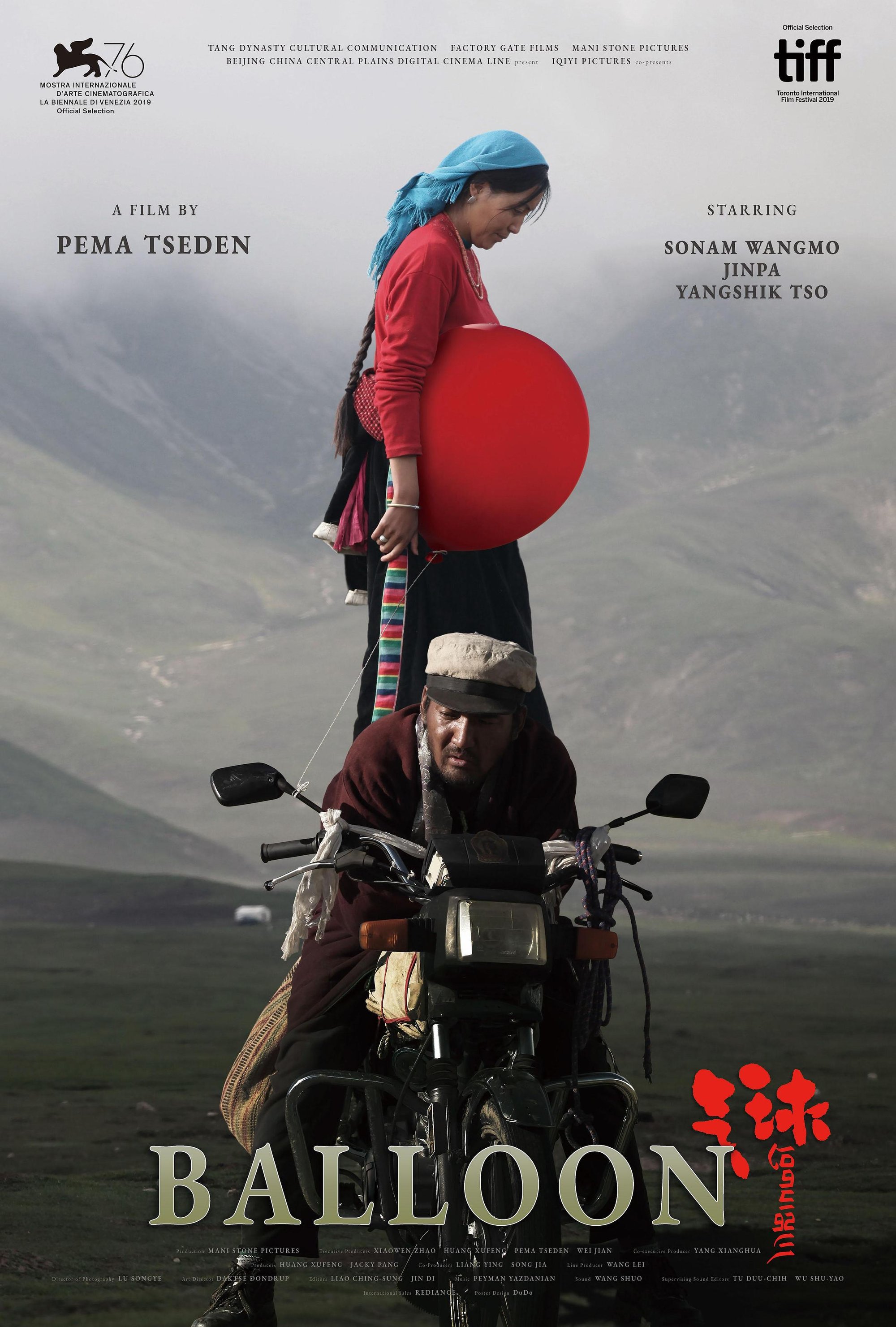
Balloon poster“The world has changed but you’re still so conservative”, a bemused doctor exclaims on learning that a female patient would rather wait around for a woman doctor than disclose a “woman’s problem” to a man. Set in ’80s Tibet, Pema Tseden’s seventh feature, Balloon (气球, Qìqiú / དབུགས་ལྒང་), finds itself at the intersection of multiple worlds and changing times as a small family is quietly torn apart by societal forces beyond its control.

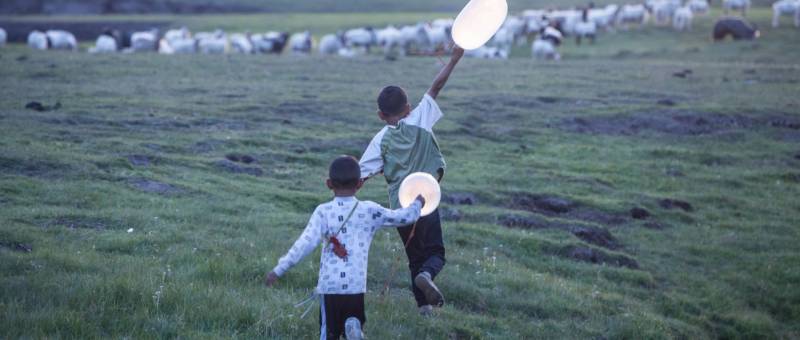
As the film opens, the family’s two youngest sons are busy spying on dad and grandad through the fuzziness of an overinflated balloon. Only, unbeknownst to them, it isn’t a balloon at all but a condom, a slightly embarrassing harbinger of modernity now necessitated by the recently instituted One Child Policy. With the oldest boy away at high school, Dargye (Jinpa) and his wife Drolkar (Sonam Wangmo) have three kids already and paying the fine on a fourth would more or less mean financial ruin. Thankfully, the condoms are free – the only problem being that Drolkar has to go to the clinic in town to ask for them which she finds extremely embarrassing, so much so that she can’t even bear to say the word, almost winking as she whispers “the free things” before quickly stuffing them in her pocket. 

What Drolkar wanted to ask the doctor about, however, was the possibility of sterilisation. With the kids constantly nicking the condoms along with the chance that they aren’t 100% reliable, she is in constant worry of what it might mean for the family if she becomes pregnant with a fourth child, especially, she tells the doctor, because Dargye seems to be in a particularly amorous mood at the moment which increases the chances of something going “wrong”. The female doctor can’t quite understand Drolkar’s prudery, or her slightly “old-fashioned” way of thinking. The doctor, obviously, enjoyed a university education. She has a career of her own and a clearly defined individual life as something other than a wife and mother. She wonders why anyone would want to have so many children in this day and age. Having only one means she can devote all of her resources in one direction, ensuring her child can have a good education and the best start in life, whereas Dargye has just had to sell a cow to pay for his eldest’s school fees while the second two stay home.

For Drolkar, who was perfectly happy with the way things were, the world is still an intensely patriarchal place and even if she wanted to (which she doesn’t, really), it’s probably too late to become anything other than a wife to her husband and mother to her sons. This her sister Ani (Yangshik Tso) learned to her cost. Venturing pick up her nephew Jamyang from school she ends up running into an old flame who apparently ruined her life though some kind of “misunderstanding” which led to her leaving home to become a nun. Now a divorced teacher and apparently rising literary star, he hands her a book inspired by their love affair which he hopes might help to explain whatever it was that happened between them, but Drolkar, still outraged on her sister’s behalf, prevents her from reading it – firstly by throwing it on the fire causing Ani to get her fingers burned (again, but literally) pulling it out, and then by telling Ani’s ex to take the book back and refrain from causing any more trouble dragging up the past.

Yet as much as she’s Dargye’s wife Drolkar tries to assert her authority in other ways aside from taking control of her sister’s romantic future. More practical than her husband, it’s she who is in charge of the condoms, and she who worries about the potential effects of a problematic pregnancy on their family. In a society as patriarchal as this, some might say that such things are in any case a woman’s responsibility, but Drolkar’s belief that bearing a child or not is her own decision eventually places her at odds with her husband who becomes temporarily violent when faced with his impotence, powerless to prevent his wife aborting their baby if that’s what she decides, but also at the mercy of the Chinese state who have arbitrarily decided that something as natural as conceiving a child is now a crime.

For Dargye and his family who live traditional lives far from the urban centres of the modern state, it isn’t only the pain and sadness of being forced to abort their child against their will which burdens them but a spiritual taboo in knowing that the child whose birth they’d be denying may be the reincarnated soul of a much loved relative. Drolkar is forced to choose between her Buddhist beliefs and the demands of Chinese communism, her husband’s wishes and those of the state acting as father. Of course she tries to choose her family, but whichever decision she makes may destroy it either through her husband’s resentment or the costs involved with trying to defy the political reality.

Grandad laments that everyone rides motorbikes these days, you never see horses anymore. Times have indeed changed, but in some ways more than others. While Dargye seems to draw vicarious power from the randy ram he’s borrowed from his friend to stud his sheep, a figure of robust and virile masculinity, he’s effectively neutered by the society in which he lives. Conversely, Drolkar, according to the doctor at least, ought to feel herself liberated but is left with no real choice at all. Only the kids, cheerfully playing with the instruments of their parents’ oppression, have learned to find innocent joy in the midst of such uncertainty while the modern world creeps in all around them.


Balloon was screened as part of the 2019 Five Flavours Film Festival.

Original trailer (English subtitles)

Jinpa (撞死了一只羊, Pema Tseden, 2018)

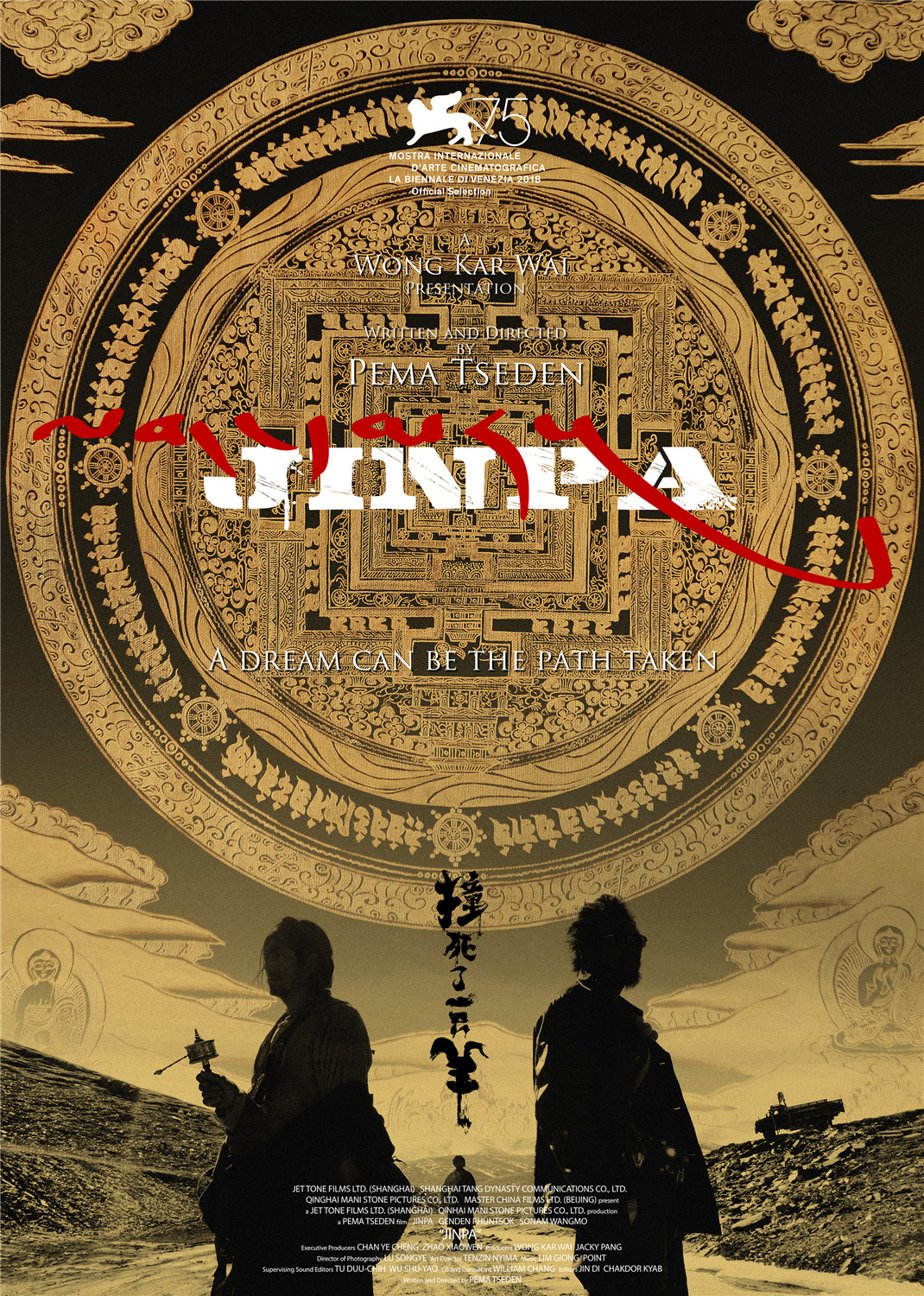
Jinpa poster 1Dreams, reality, and memory intertwine in Pema Tseden’s surrealist Tibetan western Jinpa (撞死了一只羊, Zhuàng le Yī ZYáng). Cycles of revenge and regret, killings accidental and deliberate, lost love, and inescapable karma bind two men or two parts of one whole as two travellers meet each other on the road, part, and then are perhaps reunited if in a more spiritual sense than literal. Moving away from the realism of Tharlo into mystical abstraction, Pema Tseden’s sixth feature is as obtuse as it is beguiling.

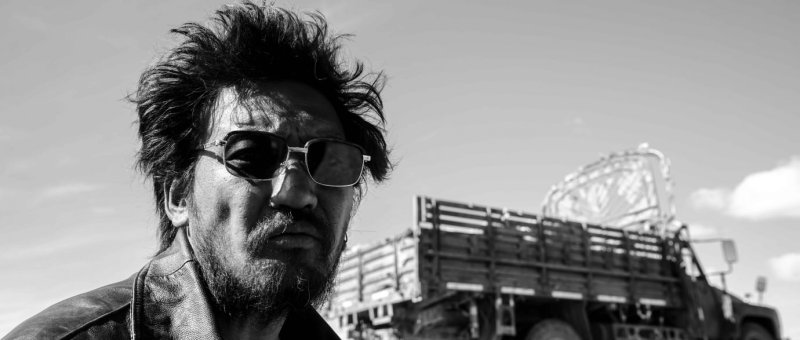
The titular Jinpa is an ultra cool truck driver in black leather and sunshades whose main jam is, incongruously enough, a Tibetan cover of O Sole Mio. Out on the road one day and distracted by the swooping flight a nearby bird, he accidentally hits and kills a sheep. Remorseful, Jinpa bundles the poor creature’s body into his cab, only to have to shift it into the back when he gets another passenger – a young wanderer (Genden Phuntsok) who later abandons his silence to explain that his name is also “Jinpa” and he’s on a quest for revenge against the man who killed his father 20 years ago. A decade long search has led him to Sanak where he hopes to find the man he’s looking for.

The men part company at the next turning, but the older Jinpa can’t seem to forget about his strange encounter. He takes the sheep for a proper funeral (before stocking up on lamb from a street stall), and pays a visit to lover where he unable to perform to anyone’s satisfaction. Jinpa hits the road again to look for his hitcher, either eager to prevent a crime which may add to his own karma, or simply to discover the end to the mystery.

Jinpa’s accidental slaughter of a sheep and the younger man’s quite deliberate quest for blood become somehow linked. Tracking the other Jinpa he finds himself at a tavern with a flirtatious barmaid (Sonam Wangmo) who gives him a few more clues, most particularly a possible identification of the man the other Jinpa might have been looking for but her tale is a strange one. The tavern goers’ background conversation is identical to the present moment, implying this is either one very boring spotlight hogger or that events are somehow occupying the same temporal space.

Shifting into hazy black and white for his flashbacks, Pema Tseden hints at the malleability of memory – as if one figure could easy be swapped out for another, past and present uncomfortably overlapping with memory as the unstable glue at their centre. The younger Jinpa’s prospective target, we discover, also has a son. Would he grow up to seek revenge against the man who killed his father? One circle closes, but another envelopes it just as quickly. A man kills a sheep, by accident, but perhaps there’s more that he’s atoning for than simply inattentive driving.

“If I involve you, it becomes your dream too” the opening text tells us citing a Tibetan proverb. Could the older Jinpa simply be dreaming a version of himself, or are the two men somehow inhabiting the same dreamscape? Events repeat, the two men walk the same path at different times, diverging and reuniting as they make their way towards whichever realisation is lying in wait for them.

Played by real life poet and actor himself called “Jinpa”, the eponymous hero oozes cool in his edgy rockstar getup and ever present sunshades, embodying the stranger in town a little too consciously as he wanders in search of his younger self. Produced by Wong Kar-wai and adapting Tsering Norbu’s novel The Slayer, as well as the director’s I Ran Over a Sheep, Jinpa is an unabashed exercise in style and mood, swapping the washed out iciness of the road for the colourful warmth of taverns, stores, and temples while memory remains a blur of radiating black and white frustratingly difficult to see in its entirety. Jinpa’s circular travels mimic his life, caught between cycles of violence and regret but hoping for forgiveness and eventual release. Abstract and inscrutable, Jinpa’s mythic fable nevertheless retains its strange power as its hero(es) attempt to free themselves from an inescapable spiral of existential despair.


Jinpa screens as part of the 2019 New York Asian Film Festival on June 29.

Original trailer (no subtitles)

https://www.youtube.com/watch?v=vB4DjlyQPZ8