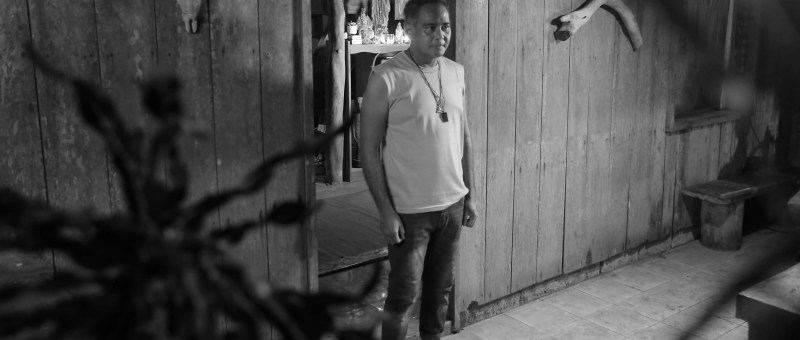
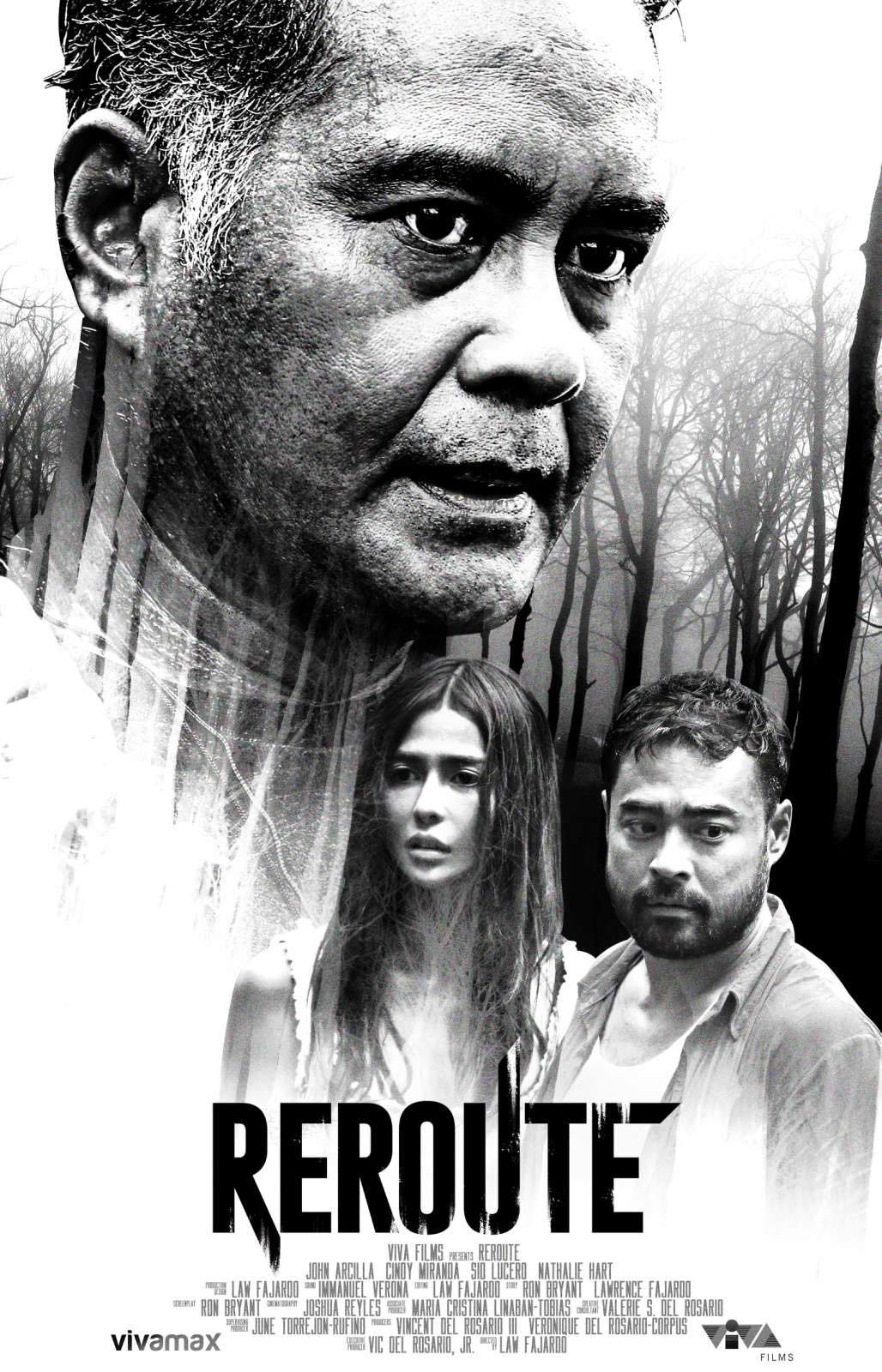
Reroute (Lawrence Fajardo, 2022)

A young couple find themselves straying into a strange and purgatorial landscape after taking an ill-advised shortcut in Lawrence Fajardo’s eerie gothic horror, Reroute. Shot in a crisp black and white, Fajardo’s journey into darkness is one of intensely toxic masculinity born of a macho culture which manifests itself most clearly in the military and authoritarianism while the “private property” onto which the couple stray appears to be a liminal space inhabited by those who cannot live in the modern society. 

As for the couple, when we first meet them they are in the middle of a blazing row on a long distance drive mostly caused by the man, Dan’s (Sid Lucero), jealously and resentment towards the woman, Trina (Cindy Miranda), who supports them both with her down to earth job as a bank manager while he is in a band but technically unemployed. Dan’s volatility is palpable, quickly getting into a physical altercation with a local man at a rest stop much to Trina’s dismay but uncomfortably enough the fight seems to clear the air between them. Cooling off at the beach, they become warm and gentle with each other making love at the shore, but tensions rise once again when they approach their destination and discover that the road is closed because of a military exercise. The soldier on the checkpoint tells them to follow the diversion which involves going round in a huge circle adding hours onto their journey, but Dan doesn’t listen and decides, as he grew up in the area, to take a “shortcut” using the old road. To placate Trina he agrees to check directions with a local man whose house they’re passing but he tells them they’re on private property and should turn back. 

Again, Dan ignores him and the car breaks down stranding them in the middle of nowhere with no phone signal, Trina further blaming Dan for not having checked all of this out beforehand or made sure the car was in good condition. The following morning a man approaches and offers to help, but there’s no kindness in his eyes and something unsettling about the way he keeps staring at Trina. Gemo (John Arcilla) takes them back to his house and offers to radio a mechanic but otherwise spends his time responding to cryptic messages about some kind of military operation. “If I were you I’d leave now” Gemo’s wife, presumably, Lala (Nathalie Hart) advises Trina but it’s already too late. They’re miles from anywhere and this weird village seems to be completely cut off from the outside world.  

One level, the contrast between Gemo and Dan is stark. A former military man Gemo’s old-fashioned masculinity is rigid and austere while Dan is an underachieving slacker with an inferiority complex prone to fits of rage. In an ironic way, they could be father and son yet they fight over a girl, not Trina but the absent daughter of Gemo, Ariana, who passed away after getting an abortion at 16 when the boyfriend who got her pregnant abandoned her. Half-crazed, Gemo is convinced Dan is the man guy ruined his life and takes an extremely ironic form of revenge in proving his masculine dominance over the younger man while forcing Trina into the role of his 16-year-old daughter. 

Then again from what we later see perhaps Gemo is responsible for ruining his own life and those of the people around him as product of the society in which he lived, spouting religious aphorisms and talking of his military past suppressing protests by the Muslim community on Mindanao. This weird village where all the villagers seem to be on Gemo’s side and also involved in some kind of covert operation appears to be a kind of purgatorial space inhabited only by former soldiers who can not move on from the authoritarian past, yet Gemo is haunted by a different kind of ghost and commits a different kind of crime in trying to quell it. Trina is dragged into this bizarre series of events because of Dan’s wounded male pride, insisting he knew a shortcut and ignoring all the warnings, but in the end is the only one capable of ending the curse in forcing Gemo to accept the reality of his daughter’s death “so we can all be free”. Filled with an intense sense of dread and malevolence, Fajardo’s eerie drama ends in the mist-drenched forests of the remote countryside but perhaps suggests that escape is only possible through fully exorcising the past. 


Reroute screened as part of this year’s Udine Far East Film Festival.

Original trailer (English subtitles)
Big Night! (Jun Robles Lana, 2021)

In the opening scenes of Jun Robles Lana’s darkly comic farce Big Night! a young man is shot in the head by another young man, this one wearing a motorcycle helmet with its visor down, who calmly walks away and gets back on the back of the bike he arrived on his friend then driving them both away. Of course people are shocked but then again not all that much, they barely pause despite the fact that his man, Ronron, was well known to them and no one really thought he had much to do with drugs. Beautician Dharna (Christian Bables) gossips about the killing with his friend Biba but gives it little thought before returning to his day, so normalised has death on the streets become in Duterte’s Philippines. 

Dharna may not have given much thought to extrajudicial killings, but then it’s different when it’s you who might be next in the firing line as he discovers when Biba gets an advance view of the following day’s “Watch List” from her law enforcement boyfriend. What ensues is a kafkaesque quest to clear his name though there’s no real “official” path towards getting off a watch list when you’re on one. His boyfriend Zeus who is due to perform in a “Big Night” pageant at a local gay bar that very night suggests simply fleeing to another district, but flight implies guilt and as Dharna points out he’ll lose all his customers if he has to move to another area and neither of them have the money to start all over again somewhere new. Like many of Dharna’s friends and acquaintances Zeus doesn’t seem to share his concern. “The police won’t bother you if you’re not doing anything illegal” he naively advises, sure it’s all just a random mistake that soon will blow over but otherwise so numbed to the idea of extrajudicial killing that he doesn’t really think too much of it and is mainly annoyed that Dharna has lost interest in helping finish his costume for the big show. 

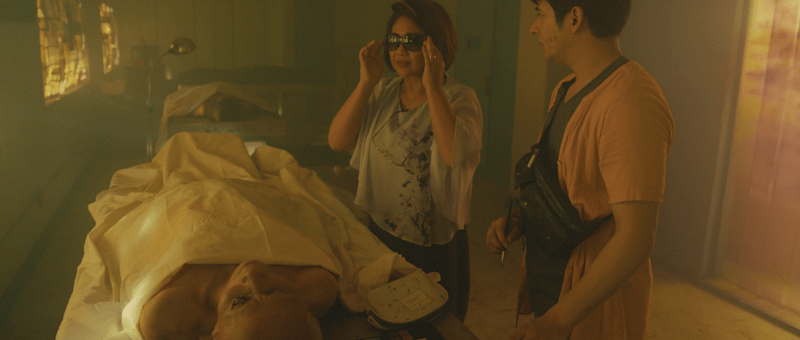
Neither of them can think of a reason why Dharna, under his full legal name, would have been placed on a list as he’s not a drug user and doesn’t know anyone who is. He does, however, have some useful connections including local law enforcement official Cynthia who isn’t terribly interested or helpful but manipulates his anxiety to force him to help her out by filling in for her regular mortician, Connie, who has mysteriously not shown up for work. The morgue is currently overflowing, Cynthia making a dark joke that undertaking is a growth industry while revealing that there are so many bodies in part because families have to pay a fee to get them back and most of those involved in extrajudicial killings are from the slums so they can’t afford it. Even so, she explains to Dharna that they get more donations when families can see the body which is why he’s supposed to make them up to look as good as they can despite many of them having sustained gunshot wounds to the head or face. 

Cynthia sends him on to local community leader Roja warning him that he’s “allergic to gays” while he too makes Dharna do his bidding pointlessly walking laps around a fountain in some sort of macho display of endurance while insisting that he’s so anti-drug that even if he gets a stomach upset he just powers through it with raw masculine energy. He too is a self-interested hypocrite spouting religious nonsense while hanging out in “massage parlours”, dangling the idea of salvation but unprepared to grant it. Dharna wonders if it might have been someone from the area where he grew up who reported him but discovers that unlicensed midwife Melba (Janice De Belen) makes a point of not putting any names forward at all and is herself willing to risk breaking the law to help women in need who are denied medical treatment because of their poverty.

It’s impossible to avoid the implication that this is happening to Dharna in part because he’s poor and powerless in an authoritarian and hierarchal society but he’s eventually forced to consider that someone may have put his name in a drop box anonymously, that perhaps they gave a random name when someone asked for one to save their own, because they had something against him, or sought to profit in some way from his absence. Like the witch trials of old, the war against drugs is another tool that can be manipulated for personal gain and so inured to violence has the society become that many are prepared to use it. Dharna finds himself at the centre of a random conspiracy in which he has no other option than to accept his complicity or die, discovering that as the radio report that opened the film had suggested the same officials in charge of prosecuting the war on drugs are in fact secretly using it to secure their stranglehold over the local drugs trade. 

Dharna finds himself compromised at every turn, beginning by offering free haircuts to help his case to progressing to covering up state crime, literally, by repairing the faces of the dead and graduating to faking a seizure in an ambulance to bypass a checkpoint. At the hospital he is confronted by the face of an old lady filled with despair one hand holding that of a little girl and the other a pair of bloody sandals before she simply collapses. Dharna tries to wash the sandals clean but there’s only so much you can do when the stain runs so deep. The irony of his big night taking place on All Souls Day is not lost though there’s precious little time for honouring the dead when your survival can no longer be assured. 


Big Night screens at UltraStar Cinemas Mission Valley, San Diego April 23/27 as part of this year’s SDAFF Spring Showcase.

Original trailer (English subtitles)