About Us But Not About Us (Jun Robles Lana, 2022)

A lunchtime conversation between two men provokes a series of confrontations in Jun Robles Lana’s pressing psychological drama About Us But Not About Us. There is indeed more going on than it seems, prompting a number of questions about who it is that’s really in control along with the subjective quality of memory and personal myth making. After all as the younger of the men later says, nothing compares to our fictional counterparts both those we create for ourselves and those born of the projections of of others. 

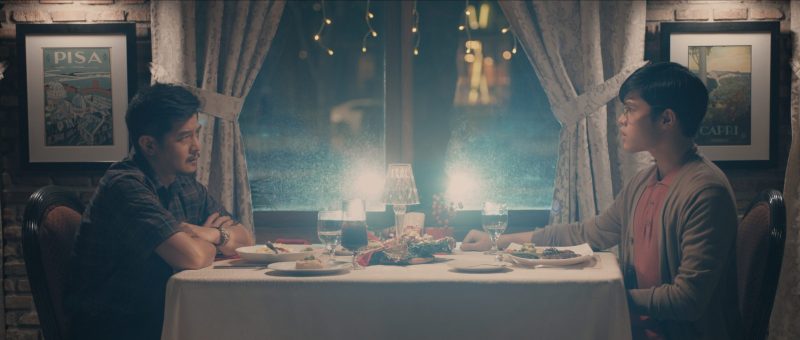
40-year-old professor Eric (Romnick Sarmenta) takes a look at the bags under his eyes in the mirror of his classic Beetle as he arrives at a restaurant for a lunch meeting with a student and gently applies moisturiser to his eyes before heading inside. It’s a small moment that hints at his insecurity about his age and also that he may have more interest in the student, Lance (Elijah Canlas), than he later claims. Lance is already waiting, perky and preppy in his neutral beige outfit and non-threatening haircut. The purpose of the meeting seems to be so that Lance can return the keys to Eric’s spare flat where he had being staying to escape an abusive stepfather. Lance no longer feels comfortable being there, in part because he’s afraid false rumours that there may be something inappropriate going on between them could cause problems for them both at the university, but also because he worries that his presence may have contributed to the suicide of Eric’s late partner Marcus, a leading light of English-language literature in the Philippines. 

Marcus had known about Eric’s interest in Lance but warned him about becoming too involved seeing as he is a teacher and Lance his student not to mention that he is also 20 years older and even if he’s done nothing wrong others may read his well-meaning attempts to help as “inappropriate”. But then we start to wonder, is Lance really as helpless as he claims to be? It seems strange that a 22-year-old man would need this kind of rescuing, perhaps as some have suggested he’s constructed an image of himself as vulnerable so that Eric will feel compelled to help him. Despite his seeming meekness, Lance does appear to be ambitious yet insecure smarting from an offhand comment of Marcus’ that he may in the end lack the necessary talent to be accounted a writer. 

In a theatrical conceit, Lana realises the projected images each has of the other to segue into recreations of previous meetings in which either Eric or Lance plays the role of the absent Marcus whose views are recounted only in the book he had written shortly before he died, his first in Filipino, or filtered through the memories and intentions of the other two men who of course may not be entirely honest in their recollections. Eric insists the problems that may or may not have existed between himself and Marcus were not not really “about” Lance. He claims to have been unhappy and emotionally neglected for years if also still in love, while later conceding that the book is both about and not about them in its retelling of a “trashy” love triangle as an intensely literary potboiler. 

That the book is in Filipino rather than English may hint at a further desire for “authenticity”, as may Lance’s desire to transfer from the English department to that in his native language. Yet neither man is really being “authentic”, not entirely able to reclaim themselves from the image projected onto them by others. The battle for control shifts uneasily between them, Eric assuming he has the upper hand by virtue of his age and position all while Lance may be cynically manipulating him, playing on his latent desire while fluffing his ego in appearing as a lost young man in need of help and guidance. Even so, a possibly imagined conversation with Marcus later suggests that Eric enjoys the subversion and is at heart a masochist who actively seeks to be controlled, perhaps he knows what the game is after all. Lana ends on a note of ambiguity in which it seems there is a choice to be made between sustaining a fiction and rejecting it but then again “sometimes feelings are more important than the truth.”


About Us But Not About Us screened as part of this year’s Queer East .

Original trailer (English subtitles)

Ode to Nothing (Oda Sa Wala, Dwein Ruedas Baltazar, 2018) [Fantasia 2019]

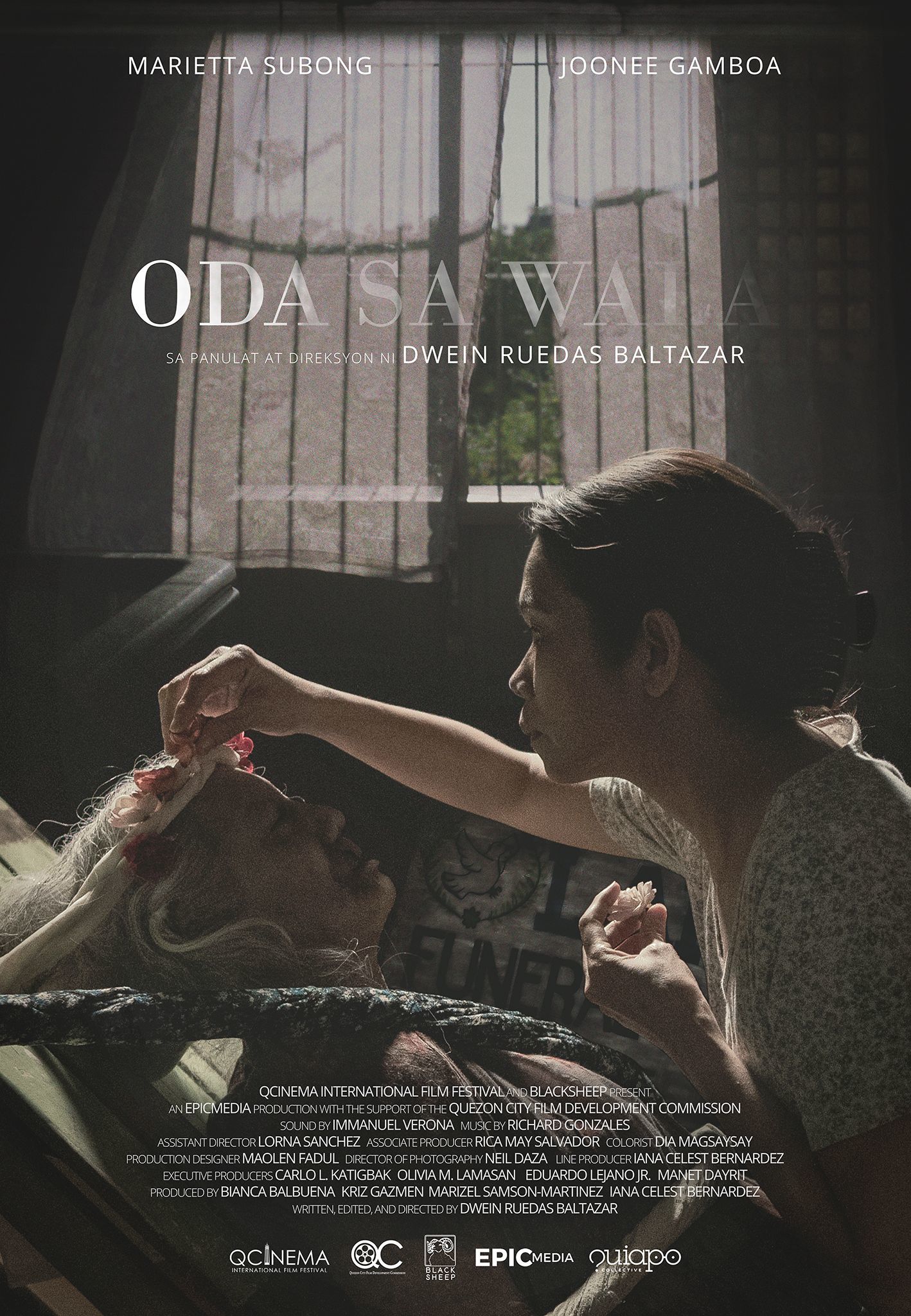
Ode to Nothing poster 3“Maybe it would be better if I just disappeared rather than physically be here but feel invisible all the time” the lonely heroine of Dwein Ruedas Baltazar’s Ode to Nothing (Oda sa wala) sadly laments to her only source of comfort, a semi-embalmed corpse. A melancholy meditation on the living death that is existential loneliness, Ode to Nothing takes its alienated heroine on a journey of hope and disappointment as she rediscovers a sense of joy in living only through befriending death. 

43-year-old Sonya (Marietta Subong, AKA Pokwang) lives alone with her elderly father (Joonee Gamboa) to whom she barely speaks in a large Spanish-style house which doubles as a moribund funeral home. Short on custom, Sonya’s only frequent visitor is sinister loanshark Theodore (Dido de la Paz) who currently holds the deeds to the house while she struggles to make the interest payments. Meanwhile, she spends her days gazing out of open windows, waiting for the handsome young taho seller to arrive, and listening to an ancient cassette tape of Chinese folksong Mo Li Hua.

The stillness of her life is ruptured late one night when a couple of men arrive with the fresh corpse of an old woman, seemingly having run her over and not wanting the bother of taking her to a hospital seeing as she is already dead. Sonya is dubious. She doesn’t want any trouble either, but needs the money and the custom and so she agrees to take the woman in and see if anyone claims her. No one does, and soon enough the corpse has become a new presence in Sonya’s life and home. She begins to confide in it, dresses it in her mother’s old clothes, and sits it at the dinner table where her father too indulges the illusion, finally talking to her once again as if the family had really been restored.

In an odd way, the corpse guides Sonya back to life. No longer so sullen, her funeral parlour finally attracts some customers while she begins to dress more cheerfully, even dancing and skipping along to Mo Li Hua with girlish enthusiasm. “As you get older, you have more reason to do the things you were too afraid to do when you were younger” she explains to the corpse, outlining a brief overture she just made to Elmer (Anthony Falcon), the taho vendor, whose grandfather she also saw off around three years ago after which Elmer took over the taho vending business.

Taho is perhaps the perfect encapsulation of Sonya’s newfound hopes, wholesome sweetness and easy comfort. The blandness of off-white silken tofu mixed with the gentle colouring of the amibal syrup and sago pearls, like the Jasmine flower of the folksong, seem to symbolise the brief moments of possible happiness in an otherwise dull existence but even within her increasing sense of positivity she perhaps knows her rekindled desire for Elmer and for life is likely go answered. In any case, she falls into the corpse’s lap as if it really were her mother, attributing to it a supernatural power that keeps the corpses flowing and beckons both life and death to her lonely home.

As in any good fairy tale, however, you have to be careful what you wish for. Sonya gets what she wanted, but not at all in the way she wanted it. The corpse betrays her, leaving her bereft once again and entombed inside her own funeral home with the feeling that there is only one way out. Baltazar shoots in 4:3 with the rounded corners of nostalgic 16mm, but the frame cannot help but recall the small window on the surface of a coffin, as if we were peeking in on her still life from some other plane. Sonya is, in many ways, already dead, trapped in a moribund and hopeless world where even the fragmentary past is being slowly taken away from her – the broken cassette tape, the rapidly depleting furniture, Elmer’s crushing absence. She confesses that she’s afraid of the dark and of being alone, tired enough of her resignation to abandonment to embrace a corpse which can, of course, never leave you. It can, however, disappoint as all false idols will. A melancholy exploration of loneliness, defeat, and despair, Baltazar’s whimsical drama is a haunting ode to emptiness but one that clings sadly to life and hope even as the night draws in.


Ode to Nothing was screened as part of the 2019 Fantasia International Film Festival.

Original trailer (English subtitles)
Mo Li Hua

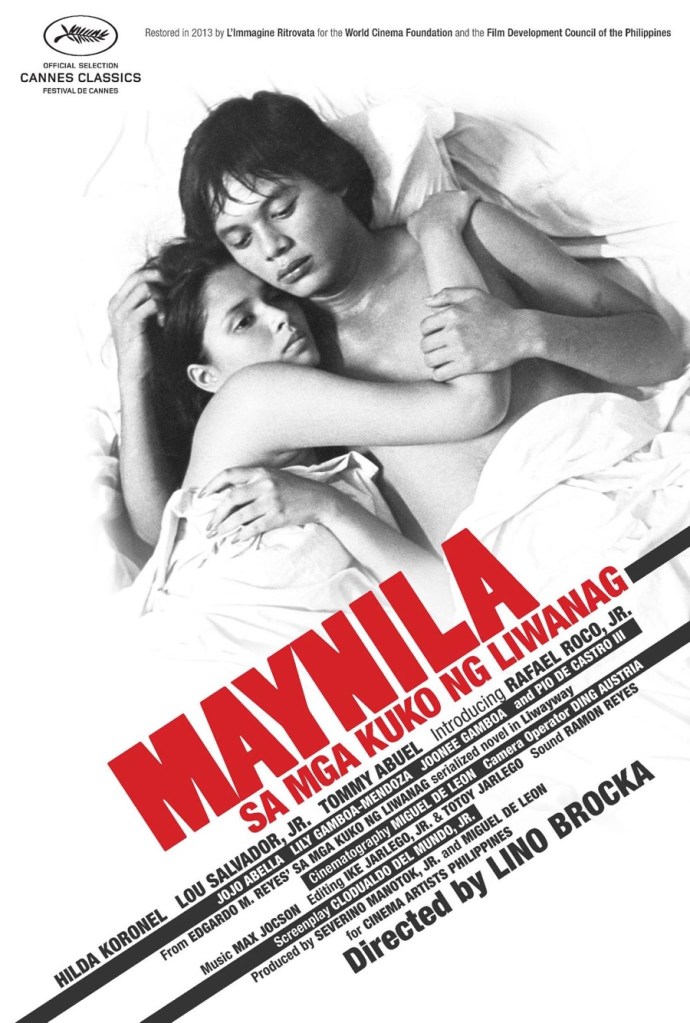
Manila in the Claws of Light (Maynila, sa mga Kuko ng Liwanag, Lino Brocka, 1975)

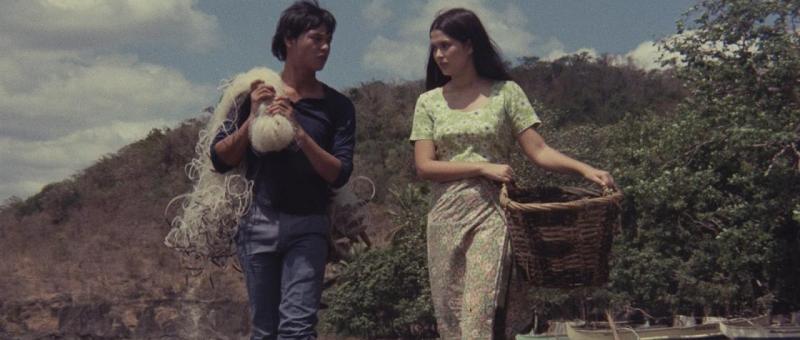
manila-large-900About half way through Lino Brocka’s masterpiece of Philippine cinema Manila in the Claws of Light (Maynila, sa mga Kuko ng Liwanag), the hero, Julio (Bembol Roco), sits watching the window where he thinks the woman he loves may be being held prisoner as a trio of guitar players strums out The Impossible Dream, unwittingly narrating his entire story. Julio is no Don Quixote but he has his own Dulcinea and, as the song says, without question or pause he is ready to march into hell for the heavenly cause of rescuing her from clutches of this cruel city. Not quite content to love pure and chaste from afar, Julio plays Orpheus descending into the underworld, plunged into a strange odyssey through a harsh and indifferent world driven by mutual exploitation and the expectation of violence.

Orphaned fisherman Julio has been in Manila for some months in search of his girlfriend, Ligaya (Hilda Koronel), lured away from her hometown by the false promises of the elegant Mrs. Cruz (Juling Bagabaldo) who claimed there were good factory jobs waiting for pretty girls in the city which also provide the opportunity to study. After she abruptly stopped writing home, Julio left to find her but months of searching have left him with few leads other than tracking Mrs. Cruz to a Chinese grocers where he sometimes thinks he sees a familiar silhouette in an upper window.

The first of Julio’s falls brings him into the world of the casual day labourer, reliant on the transience of ongoing construction and at the mercy of corrupt foremen. Having been mugged and deprived of all of his savings, Julio is completely broke and lucky to have found this job for which he will be paid 2.50 pesos per day, which is 0.5 pesos less than the wage he was getting on his last job. Later he finds out that his payslip says 4 pesos, but whether that extra 1.50 is imaginary or finding its way into the pockets of the foreman is anyone’s guess. In any case, the money is rarely paid in full but offered under the system of “taiwan” in which the company effectively refuses to pay the current wages but offers an advance on future ones for a small fee. Should an employee complain, he will simply be fired. Conditions are poor with no safety provisions and fatal accidents are not uncommon. When the project nears completion, workers will be unceremoniously laid off with no warning or additional pay, overtime is available but is paid at the basic rate.

Julio is a single man and is only ever thinking of his quest and so he is prepared to suffer. The labourers he meets are all good men and friendly, quick to help him find his feet in this often harsh terrain. Sleeping in the communal dorm, Julio makes friends with some of the other workers who each have their own dreams from studying at night school for a corporate job to becoming a famous singer but his closest ally becomes a kind man trying to support his paralysed father – shot in the back by police after refusing to leave the family’s ancestral farm illegally grabbed by a Spanish millionaire, and his younger sister all now living in a fetid slum.

Julio’s second fall occurs after he loses his job at the construction site and finds himself roaming around the city, ending up in a dodgy part of town apparently very popular for cruising. Picked up by a friendly local, Julio gets himself another place to stay but soon finds out the main idea is to recruit him as a rent boy for an exclusive gay club. Talked into it and persuaded by the possibility of earning ten times what he’d get in construction, Julio tries prostitution on for size but is not interested in sex with other men and finds it impossible to adapt to the kind of showmanship the role requires. His experiences do, at least, provide a kind of mirror for what he fears has befallen his lady love though the gay club is a much more open environment in which the staff is free to leave at any time, turn clients down, and generally take in the atmosphere whilst waiting around.

The city is a willing collaborator in Julio’s fate. Naivety has no place here where the only route out of oppression is to become an oppressor. Early on Julio mentions going to the police to get help for Ligaya but is cautioned against it. Impotent and hopeless, Julio’s rage only grows as he watches friends die in cruel, ridiculous and unnecessary ways to the point at which he almost kills a purse snatcher in a kind of vengeance against an unkind society. Brocka breaks the contemporary action with frequent flashbacks as Julio remembers happier times with Ligaya some lasting mere seconds and others minutes reflecting Julio’s growing madness and unresolved rage. To try to live here is to dream the impossible dream, but for Julio there can only be one way out and it lies in violence, loss and defeat. Laying bare the futility of life under a dictatorial regime with all of its fear and emptiness, Manila in The Claws of Light is quietly angry, filled with a young man’s fire as he finds the world denied him, his dreams impossible, and his hope already in ashes.


Restoration trailer (no subtitles)