
Gwang-sik (Seo Young-chun, a popular comedian nicknamed “Salsal”) is the very definition of someone who’s seen too many movies. The film opens with him playing a joke on his boss by messing around with a chocolate gun and stabbing a mannequin after becoming obsessed with the world of James Bond. Gwang-sik’s fixation echoes the kind of Bond-mania that was sweeping the globe, but has an additional flavour in the Korea of the 1960s that was ever watchful for North Korean communist spies. The title cards preceding the film even include a number to contact if you catch one or want to turn yourself in.
Nevertheless, Gwang-sik’s interest in 007 has a pulpier quality in which he sees himself as a kind of justice-minded vigilante and indulges in various gimmicks such as attaching knives to the bottom of his boots. The knife boots, however, turn out to be fairly impractical, getting stuck in a wall and making him a sitting duck for his enemies. Though they might fall for his chocolate gun, it doesn’t take them long to figure out that Gwang-sik is a complete idiot bumbling his way through life. He does, however, seem to have luck on his side. After going on the run with no money and promising to help a young lady who was robbed but also needs to get to Busan, Gwang-sik enters an amateur boxing competition despite weighing almost nothing and somehow ends up winning just on a fluke.
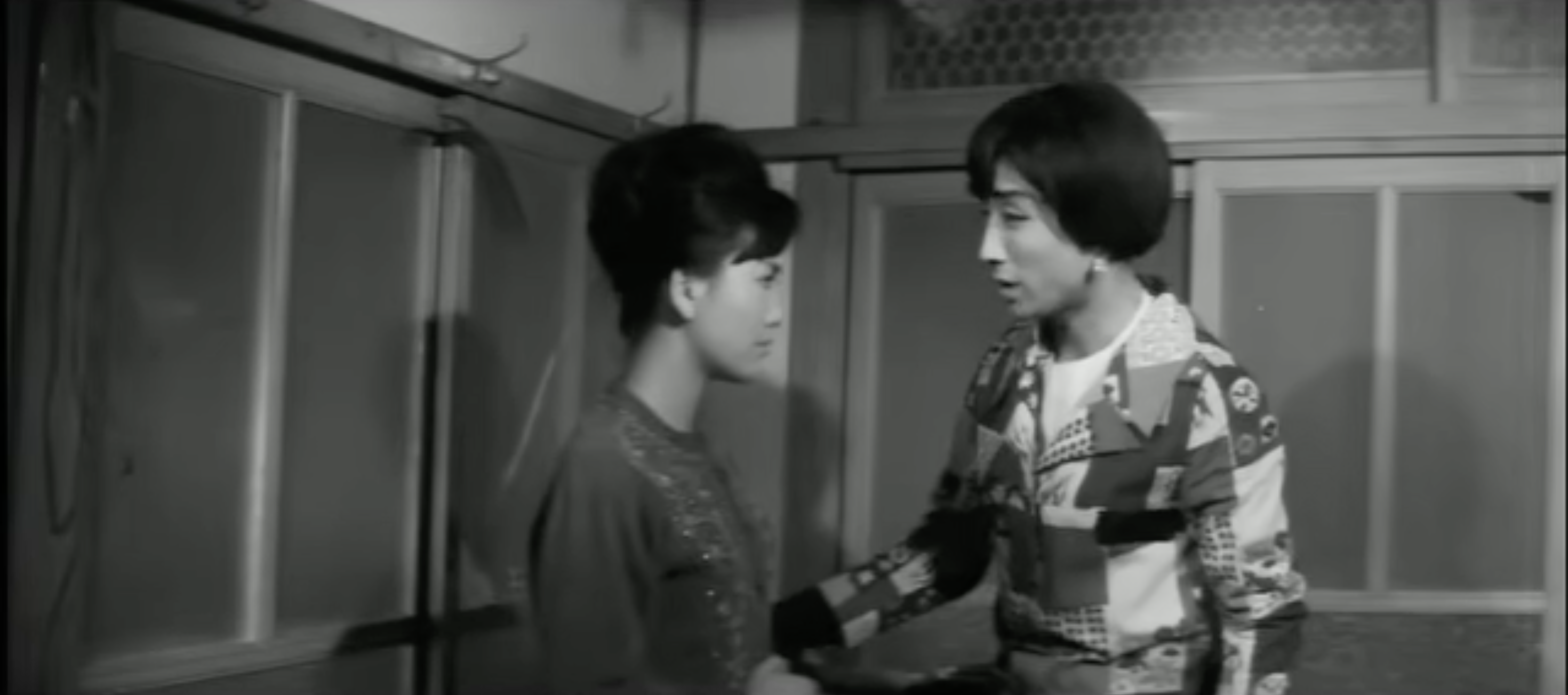
He has a rather camp, effeminate quality that is finally fulfilled when he cross-dresses to go undercover as a dancer at a cabaret bar in order to unmask the criminals who robbed the jewellery store where he works. While he continues to read Casino Royale and idolise the hyper-masculinity of James Bond, the scenes at the cabaret bar seem inspired more Some Like it Hot as Gwang-sik unwittingly breaks hearts all over Busan and gets to do some very nifty dancing. For the avoidance of doubt, his relationship with Myeong-ja, the woman he met in Daegu, originally remains chaste, but she takes a liking to him for exactly that reason and, despite her appearing to be into the cross-dressing, they eventually become a heteronormative couple after Gwang-sik has solved the mystery and reclaimed his masculinity by putting on a stylish leather jacket.
Though he makes constant references to the Korean War which mark him out as being from a slightly older generation than Myeong-ja, Gwang-sik seems caught between old and new Koreas by virtue of his job at the jewellery shop. Seong-ja, the unwilling scammer and Myeong-ja’s sister, carries out a complicated heist by trying to buy 950,000 won’s worth of jewellery suggesting that the economic situation has developed to the extent that it’s produced a new class of super rich people willing to spend this kind of money, which as someone later says is enough to buy a house in a nice part of town, on something inessential purely as a status symbol. She claims that she’s been robbed, as Myeong-ja is actually later hinting the growing wealth disparity and that there are still those trapped and desperate at the end of the economic ladder. Seong-ja herself is only doing all of this because she wanted to get enough money to send her sister to university, but has since fallen into crime and immorality and is now afraid to face her, leaving the two sisters on either side of a dividing line.
Meanwhile, she makes an unwitting co-conspirator of an acupuncturist who says he treats mental illness by telling him that Gwang-sik is her brother-in-law who literally lost his mind when she inherited her late husband’s estate instead of him. Now, she says, he just goes around asking everyone he meets for money and rants about cheques and promissory notes. Swayed by her 10,000 won certified cheque deposit, the acupuncturist seems to take all of this at face value and even describes the brother-in-law’s condition as a modern malady that causes people to become obsessed with money and consumerism. Ironically enough, Gwang-sik ends up “arresting” two men for counterfeiting currency they intended to circulate in the city as if symbolising the essential meaninglessness of money as a concept, though it’s all anyone’s after.
Seon-ja turns out to be working for a kingpin (Heo Jang-gang) who runs a swanky nightclub whom she appears to despise. No matter how much she regrets her choices, she is already too corrupted and cannot be allowed to join the new society like her sister Myeong-ja. Most of the film is taken up with silliness and Gwang-sik’s anarchic spy craft in which he has the ability to turn any situation to his advantage, uttering his iconic catchphrase, “Surprise! Salsali.” and behaving more like a hero from a classic serial rather than international spy James Bond, who didn’t really do a lot of crime prevention or protecting civilians in the course of his work. Nevertheless, the film ends on a note of reconciliation as Gwang-sik’s boss patches things up with the acupuncturist. Both men look on from a paternal position, supportive, if a little embarrassed by Gwang-sik’s intention to marry and wishing the new couple well for their future having fully transitioned into the contemporary society.
 Windows on Worlds