
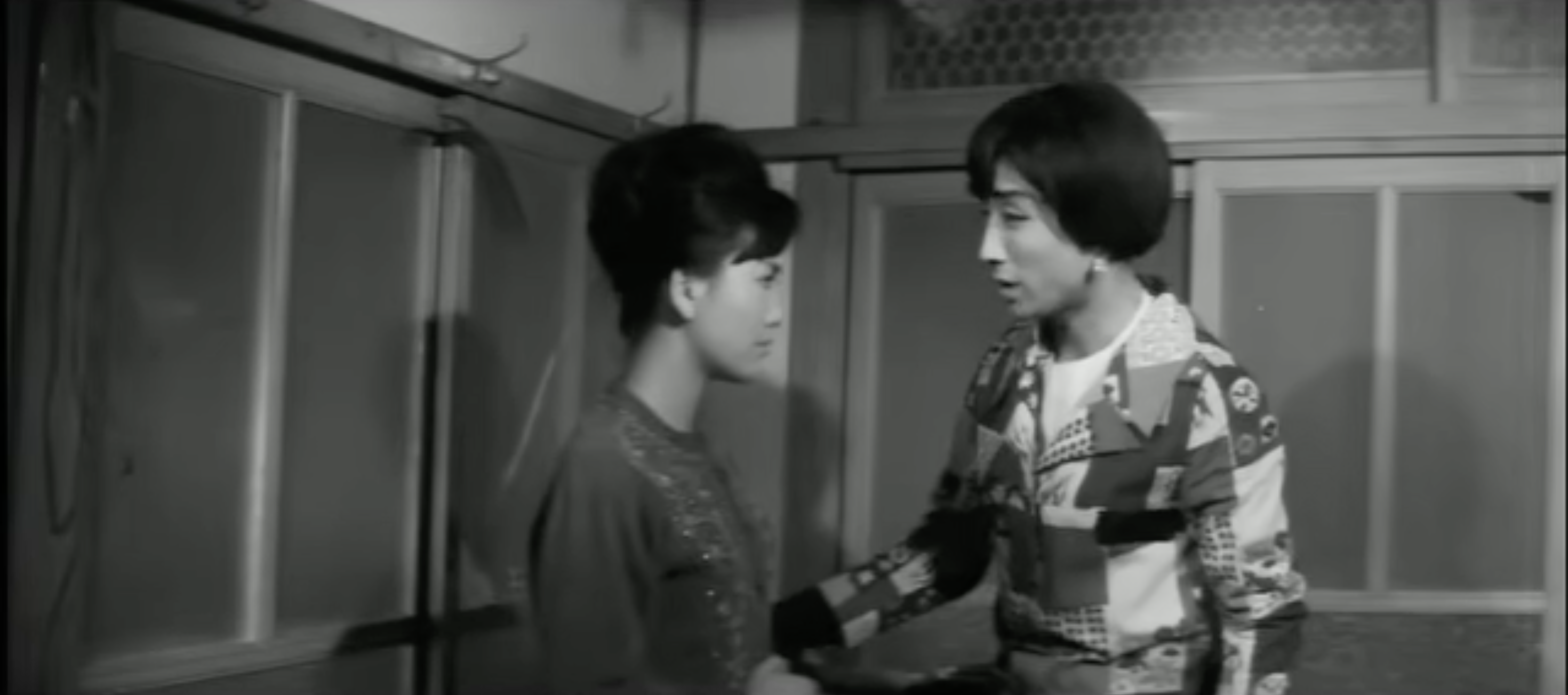
Salsali, You Didn’t Know (007 폭소판 살사리 몰랐지?, Kim Hwa-rang, 1966)

Gwang-sik (Seo Young-chun, a popular comedian nicknamed “Salsal”) is the very definition of someone who’s seen too many movies. The film opens with him playing a joke on his boss by messing around with a chocolate gun and stabbing a mannequin after becoming obsessed with the world of James Bond. Gwang-sik’s fixation echoes the kind of Bond-mania that was sweeping the globe, but has an additional flavour in the Korea of the 1960s that was ever watchful for North Korean communist spies. The title cards preceding the film even include a number to contact if you catch one or want to turn yourself in.

Nevertheless, Gwang-sik’s interest in 007 has a pulpier quality in which he sees himself as a kind of justice-minded vigilante and indulges in various gimmicks such as attaching knives to the bottom of his boots. The knife boots, however, turn out to be fairly impractical, getting stuck in a wall and making him a sitting duck for his enemies. Though they might fall for his chocolate gun, it doesn’t take them long to figure out that Gwang-sik is a complete idiot bumbling his way through life. He does, however, seem to have luck on his side. After going on the run with no money and promising to help a young lady who was robbed but also needs to get to Busan, Gwang-sik enters an amateur boxing competition despite weighing almost nothing and somehow ends up winning just on a fluke. 

He has a rather camp, effeminate quality that is finally fulfilled when he cross-dresses to go undercover as a dancer at a cabaret bar in order to unmask the criminals who robbed the jewellery store where he works. While he continues to read Casino Royale and idolise the hyper-masculinity of James Bond, the scenes at the cabaret bar seem inspired more Some Like it Hot as Gwang-sik unwittingly breaks hearts all over Busan and gets to do some very nifty dancing. For the avoidance of doubt, his relationship with Myeong-ja, the woman he met in Daegu, originally remains chaste, but she takes a liking to him for exactly that reason and, despite her appearing to be into the cross-dressing, they eventually become a heteronormative couple after Gwang-sik has solved the mystery and reclaimed his masculinity by putting on a stylish leather jacket.

Though he makes constant references to the Korean War which mark him out as being from a slightly older generation than Myeong-ja, Gwang-sik seems caught between old and new Koreas by virtue of his job at the jewellery shop. Seong-ja, the unwilling scammer and Myeong-ja’s sister, carries out a complicated heist by trying to buy 950,000 won’s worth of jewellery suggesting that the economic situation has developed to the extent that it’s produced a new class of super rich people willing to spend this kind of money, which as someone later says is enough to buy a house in a nice part of town, on something inessential purely as a status symbol. She claims that she’s been robbed, as Myeong-ja is actually later hinting the growing wealth disparity and that there are still those trapped and desperate at the end of the economic ladder. Seong-ja herself is only doing all of this because she wanted to get enough money to send her sister to university, but has since fallen into crime and immorality and is now afraid to face her, leaving the two sisters on either side of a dividing line.

Meanwhile, she makes an unwitting co-conspirator of an acupuncturist who says he treats mental illness by telling him that Gwang-sik is her brother-in-law who literally lost his mind when she inherited her late husband’s estate instead of him. Now, she says, he just goes around asking everyone he meets for money and rants about cheques and promissory notes. Swayed by her 10,000 won certified cheque deposit, the acupuncturist seems to take all of this at face value and even describes the brother-in-law’s condition as a modern malady that causes people to become obsessed with money and consumerism. Ironically enough, Gwang-sik ends up “arresting” two men for counterfeiting currency they intended to circulate in the city as if symbolising the essential meaninglessness of money as a concept, though it’s all anyone’s after.

Seon-ja turns out to be working for a kingpin (Heo Jang-gang) who runs a swanky nightclub whom she appears to despise. No matter how much she regrets her choices, she is already too corrupted and cannot be allowed to join the new society like her sister Myeong-ja. Most of the film is taken up with silliness and Gwang-sik’s anarchic spy craft in which he has the ability to turn any situation to his advantage, uttering his iconic catchphrase, “Surprise! Salsali.” and behaving more like a hero from a classic serial rather than international spy James Bond, who didn’t really do a lot of crime prevention or protecting civilians in the course of his work. Nevertheless, the film ends on a note of reconciliation as Gwang-sik’s boss patches things up with the acupuncturist. Both men look on from a paternal position, supportive, if a little embarrassed by Gwang-sik’s intention to marry and wishing the new couple well for their future having fully transitioned into the contemporary society.


Piagol (피아골, Lee Kang-cheon, 1955)

piagol poster 1Under the oppressive regime of Park Chung-hee, “anti-communism” became a national policy and all films, at least implicitly, had to display anti-communist sentiment. In the 1950s, however, despite the immediacy of the war’s end, there might have been more room for nuance. Then again, perhaps not. Lee Kang-cheon’s Piagol (피아골), released just two years after the events it depicts, was among the first to concern itself with the North Korean partisans and was subsequently banned for its supposedly sympathetic depiction of communist guerrilla fighters, finally released only with the addition of the South Korean flag superimposed over the closing scene in order to suggest that the sole surviving partisan had decided to walk towards freedom.

Led by hardline Captain Agari (Lee Ye-chun), the partisans are in a sorry state. The truce has been signed and the war is “over” (or, at any rate, as “over” as it is now). They know no further reinforcements from China or the Soviet Union will be forthcoming, but have decided to continue fighting anyway. Holed up on Mount Jiri, the partisans are involved in an internecine guerrilla conflict with the encroaching South Korean and American forces, but are determined to root out “reactionary” elements and have been taking brutal revenge on local villages they believe to have “betrayed” them to the authorities.

Unlike the later anti-communist films, Lee’s partisans are not rabidly evil or gleefully sadistic but they are casually cruel and wilfully heartless. After the escape sequence which opens the film, a roll is called recording a casualty and a lost rifle. Captain Agari is much more worried about the gun than the man, eventually executing the soldier who dropped it after being shot in the arm for dereliction of duty. Agari’s actions are even harder to defend given that he knows there will be no further reinforcements and he’s down to a handful of men already, but neatly exemplify his lack of human feeling and intense need to enforce both dominance and ideological purity.

Convinced that someone in a nearby village is acting as an informant for the South, Captain Agari decides to carry out a raid to rid it of “reactionary” elements, which is a thinly veiled excuse to sack it. Not all of the partisans are entirely on board, especially as some of them hail from this village originally and have family members still living there. During the raid, Lee focuses on cowardly Captain Agari hiding in a nearby temple while Buddhist statues seem to be giving him the hard stare, before shifting to the same temple now in flames. A baby cries and crawls over the half naked body of its mother, raped and left for dead. Meanwhile, teenage recruit Il-dong (Cho Nam-suk) searches for his mum only to find her dying of a bullet wound in the street. Half delirious she asks him why he shot his own mother while all he can do is cradle her as she dies. Cold as ice partisan Ae-ran (Roh Kyung-hee) blows her whistle to tell him to get moving and brushes off the disapproval of sensitive intellectual Chul-soo (Kim Jin-kyu) with an affirmation that all actions to eradicate reactionaries should be praised.

Ae-ran is one of only two female partisans and seems to have something of a vendetta against the other, Soju (Kim Young-hee), who is berated by Captain Agari for being weak and womanly, “too wimpy for the communist party”. Breaking down in tears, Soju is raped by Agari who, a few moments later, is handed a commendation for heroism from the guerrilla commander and has her transferred to HQ out of the way. Unlike Soju, Ae-ran is presented as overly masculine, tough and unforgiving but, crucially, able to defend herself against Agari and successfully resist his advances. She is, however, softened by the quiet expression of desire for sensitive romantic Chul-soo whom she describes as “like a poet in fairyland”, and is unique among the partisans for her eventual acceptance of defeat as she urges to Chul-soo to go down the mountain and surrender to take advantage of the amnesty proposed by Southern forces, remaining reluctant to go herself in believing there is no way back for her after all she has done in the mountains.

Ae-ran has indeed done quite a lot in the mountains and none of it good. Chul-soo may lament that he has already lost his humanity despite being the only partisan to regularly voice dissent, but Ae-ran does not appear to have had very much of it in the first place. Still, she is “a survivor”. Given that we’ve seen them repeatedly commit atrocities and eventually destroy each other out a series of petty resentments, attempts to cover up crimes, and revenge born of sexual jealousy, you could hardly say that the communists have been shown in a very positive light, but audiences at the time failed to identify the film as sufficiently “anti-communist” because they couldn’t be sure that Ae-ran’s ideological disillusionment had led her to choose freedom in the South, rather than it simply being a case of physical desperation. Unlike the anti-communist films of the ‘60s, Lee refuses to demonise the partisans, depicting them as ideologically committed, cruel, and heartless, but also flawed and human as they succumb to despair on realising they have been abandoned by their nation, marooned in the South somewhere between death and freedom. In this at least, they are victims of their ideology, ruined by emotional austerity and betraying their own revolution even as they attempt to enact it.


Piagol was screened as part of the 2019 London Korean Film Festival.