Murderer Report (살인자 리포트, Cho Young-jun, 2025)

“Call it a psychodrama,” the psychiatrist/serial killer at the centre of Cho Young-jun’s psychological thriller Murderer Report (살인자 리포트, Salinja Report) suggests in a meta moment, and the film is, in some ways, a battle of wits between down on her luck journalist Sun-ju (Cho Yeo-Jeong) and a man who claims to have killed 11 people. There is, of course, more going on than it first seems, but also a push and pull between interviewer and interviewee in which the tables are always turning.

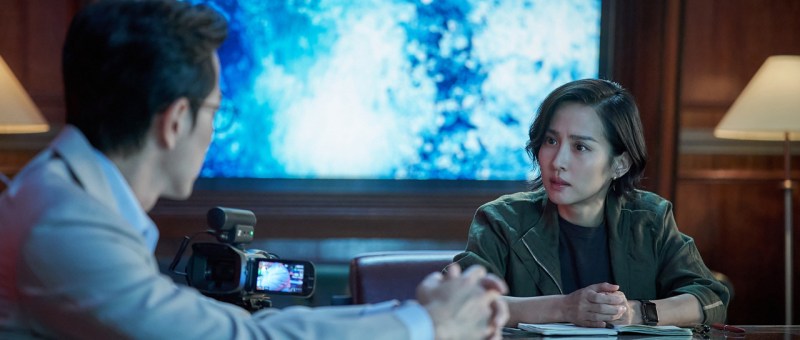
One might debate the wisdom of entering a hotel room with a man who says he’s a serial killer (Jung Sung-Il), but Sun-ju insists she’s agreeing to meet him not because she could really use an exclusive, but because he told her she could save his next victim by agreeing to interview him properly. She has no way of knowing whether he’s telling the truth, but leans towards assuming he’s a crank seeing as the victims he named didn’t have any obvious connections and were all killed in different ways, but still it’s a risky business. Despite assuring him that she hadn’t told anyone about their meeting, Sun-ju is being watched over by her policeman boyfriend Sang-woo (Kim Tae-Han) who is in the room below waiting to strike.

As for why the psychiatrist might want to be interviewed, he describes it as if it’s a kind of therapy session in which he can interrogate himself to ensure his practice is still justified. He believes it is because he only kills bad people that have harmed his patients and sees it as just another part of his treatment plan in alleviating his patients’ suffering as if he were excising a painful tumour from their lives. To that extent, it’s as if he’s providing extrajudicial justice in the face of a justice system in which he believes many have lost faith when criminals get off with light sentences while victims and their families will suffer forever. According to the psychiatrist, revenge is the best way to alleviate their pain. 

Or perhaps, as Sun-ju says, he just likes killing people and is trying to rationalise his actions. After all, even if he doesn’t, the patients probably feel guilty, though the psychiatrist claims to treat that too as part of his holistic service. Little by little he chips away at Sun-ju’s civility, pushing her towards an admission of her hypocrisy that if it were her in this situation and someone caused harm to her child, then she’d probably want them dead too. The psychiatrist obviously knows more about her than she does about him, including her career setbacks and difficult relationship with her teenage daughter whom she fears might rather live with her father instead.

That Sun-ju’s workplace troubles are concerned with a failed attempt to expose the wrongdoings of a major corporation who leaked toxic substances into the water supply leading to an increase in childhood cancers, further deepens the sense of rottenness in contemporary society. The corporation managed to cover it up by bribing prosecutors and politicians, implying that only a man like the psychiatrist is capable of providing true justice despite his claims that he isn’t trying to cure the slickness in his society only alleviate the pain of his patients. The doctor challenges Sun-ju’s ethics too, insisting that she as a duty to social justice and the safety of citizens, so rather than being here interviewing him she should have alerted law enforcement. Of course, Sun-ju has actually done that in having Sung-woo watch her, breaking her promise to keep it confidential, but perhaps trying to have her cake and eat it too. 

Still, the jury’s out on who is really interviewing who as the doctor and Sun-ju each attempt to dominate the narrative. This is indeed a psychodrama, or an extreme form of therapy in which the doctor is trying to force Sun-ju into a self-examination in order to alert her to things going on in her life that she is ironically unaware of. She, meanwhile, begins to get under his skin to the extent that he is mildly shaken from his mission, until hearing that there is another patient waiting to see him so his services may once again be needed. Tense, if eventually outlandish, the film reaches a rather troubling conclusion but is truly at its best in the verbal sparring between the doctor and Sun-ju each of whom has hidden agendas and a singular goal in mind.


Trailer (English subtitles)
Omniscient Reader: The Prophecy (전지적 독자 시점, Kim Byung-woo, 2025)

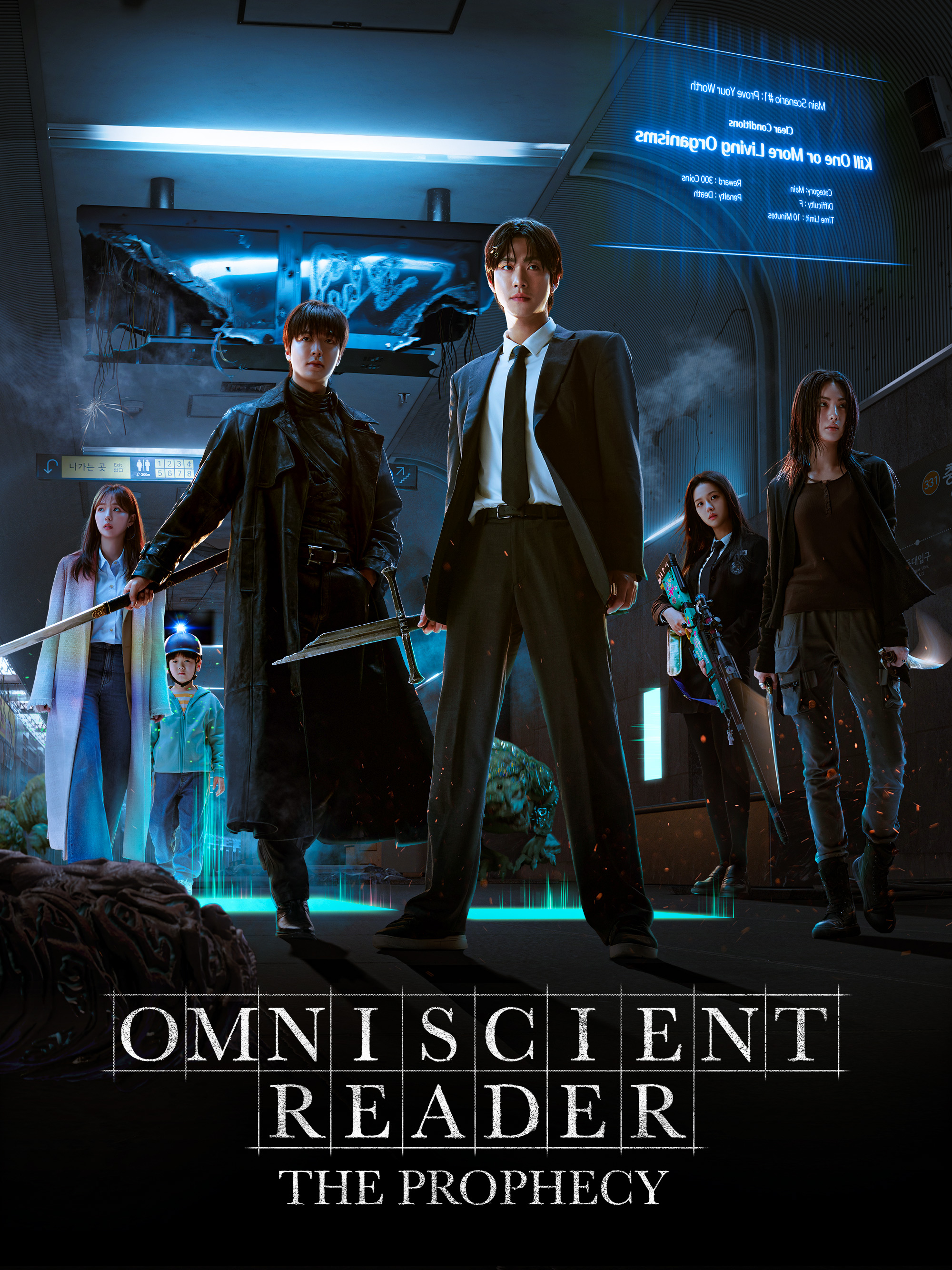
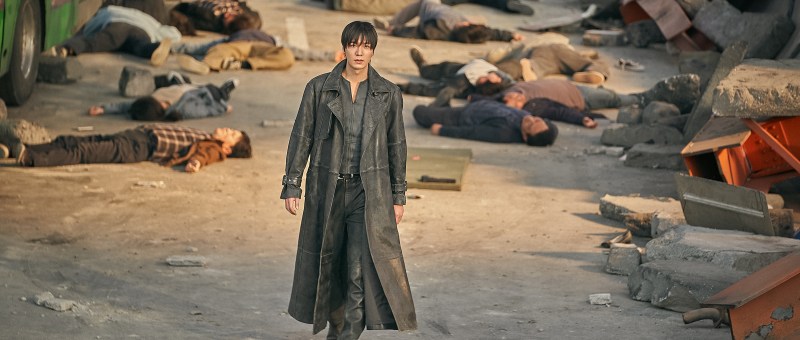
Fed up with the ending of a web novel he’s been reading since his teens, Dokja (Ahn Hyo-seop) sends the author a message. By this stage, he’s the only reader left, a kind of “lone survivor”, if you will. But he tells the author that the ending has disappointed him and that he can’t accept that the main theme was that it’s alright to sacrifice the lives of others so that you alone can live. Adapted from the popular webtoon, Kim Byung-woo’s Omniscient Reader: The Prophecy (전지적 독자 시점, Jeonjijeok Dokja Sijeom) is in part about the conflict between nihilistic pragmatism and selfishness, and a pure-hearted altruism that insists it’s possible for us all to survive and that surviving alone would be pointless anyway.

It only obliquely, however, touches on these themes in how they relate to the contemporary society in hinting at the destructive effects of capitalism. Dokja is the hero of this story, but he’s also a face in the crowd as a member of a constant stream of office workers on their way to work, not really so different from little ants squeezed between the fingers of powerful elites. Dokja at least feels himself to have lost out in this lottery, a contract worker let go by a conglomerate, while his sleazy boss Mr Han (Choi Young-joon) slobbers all over his female colleague, Sangha (Chae Soo-bin), who unlike him is no longer wedded to the corporate philosophy and is considering striking out on her own to do something that interests her personally. Perhaps the novel ending on the same day as his contract felt a little bit to much like the end of a world, which is what pushed him to write a message that in other ways seems uncharacteristically mean. 

But then the author tells him that if he doesn’t like this ending he can write his own, perhaps obliquely reminding him that he is free to change his future if he wants. Nevertheless, Dokja is soon thrown into the world of the novel where he is faced with a series of scenarios where he must choose whether to sacrifice the lives of others in order to save his own for the entertainment of celestial beings who watch the whole thing via live streams and occasionally sponsor interesting players. Dokja has an advantage in that he already knows what’s going to happen, but is also aware that things don’t always go the way they should and his own actions change the course of the narrative. He’s convinced that he has to save the “hero”, Jung-hyeok (Lee Min-ho), or the fantasy world will end, killing everyone inside it, but never really considers that he too can be the protagonist of his own story. 

He remains committed, however, that the only way to survive is through mutual solidarity even if he scoffs at the quasi-communist mentality at the Geumho subway station correctly guessing that it’s all a scam being run by a corrupt politician which muddies the water somewhat when it comes to the film’s politics. In any case, Dokja seems to believe that he must save Jung-hyeok not just physically but spiritually in proving to him that his nihilistic viewpoint is mistaken and the only way for them to survive is to support each other by pooling their skills and resources. In dealing with his own trauma and guilt over having once sacrificed someone else to ensure his own survival, Dokja is able to write a new ending for himself surrounded by his companions rather than as a lone survivor roaming a ruined land with nothing to look forward to except death.

On the other hand, perhaps it’s true that he thinks he needs a hero to save him rather than realising that he is also the hero of this story, while the fantasy world too is driven by capitalistic mentality in which Dokja must amass coins to be able to level up or literally buy his survival. Occasionally he wavers, wondering if the others have a point when they tell him he’s being foolish and should learn to just save himself no matter what happens to anyone else, but otherwise remains committed to rejecting the premise of the original novel’s nihilistic ending in insisting that there’s a way for us all to survive if only we can learn to be less selfish, trust each other, and work for the good of all.


Omniscient Reader: The Prophecy is available in the UK on digital download from 15th December.

UK Trailer (English subtitles)

Project Wolf Hunting (늑대사냥, Kim Hong-sun, 2022)

“Remember, there’s nowhere to run” an arrogant police officer explains to collection of rapists and murderers locked aboard a cargo ship ready to be delivered to “justice” in Korea having attempted to flee to the Philippines. It is in someways ironic that these men and women, depraved as many of them may be, have been loaded onto a commercial vessel to be shipped home less like cattle than faceless and inanimate objects. Kim Hong-sun’s eerie gore fest Project Wolf Hunting (늑대사냥, Neukdaesanyang) is in many ways about the horrors of the past but also suggests that the present is little better in a world in which there is little difference between cop and thug and we are all at the mercy of looming violence. 

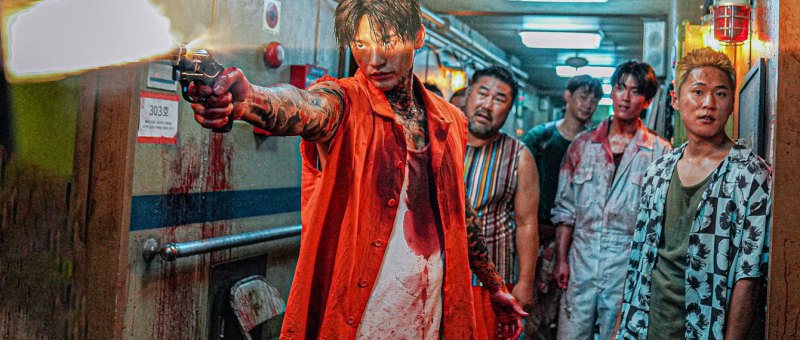
As one older prisoner puts it, “if this isn’t hell, I don’t know what is”. Thanks to an international extradition arrangement some of the worst Korean criminals are about to be repatriated from the Philippines only the historic event is disrupted by a suicide bombing carried out by a disgruntled victim whose smashed glasses and severed limbs are an eerie harbinger of what’s to come. After a rethink, the government decides to hire a cargo boat instead so the public won’t have access to the criminals, which is somewhat ironic, while accompanied by a crack team of veteran cops each with over 10 years of experience on the force. Already it isn’t seeming like a very well thought through plan, but as Captain Lee (Park Ho-San), who openly beats a prisoner with whom he has prior history on the dock, points out, there aren’t any cameras so he has full authority to enforce the law with no concern for the rights of inmates nor basic human morality. To cut it short, he’s little different than they are even if he isn’t, as far as we know, a multiple murderer or rapist. 

In any case, keeping a bunch of violent criminals handcuffed with only one bathroom break a day and no stimulation seems like a recipe for disaster even if it weren’t just plain inhumane. But inevitably the operation is compromised by an attempt to spring a gang boss which lets the criminals take control of the ship albeit temporarily seeing as there’s something else lurking in the bowels of this floating hellscape that is pure nightmare fuel and a not quite living embodiment of man’s inhumanity to man. Predictably, this all stems back to the abuses of the colonial era and the machinations of the equivalent of Unit 731 operating in the Philippines but has since seemingly been co-opted by a shady Korean organisation apparently also attracted to the research’s capitalistic potential in the booming anti-ageing market hoping to usher in the next stage of human evolution. 

What ensues is a parade of senseless violence in which cop and killer alike are stalked by a mysterious “monster” with wolf-like senses and preternatural strength, and that’s on top of the bloody destruction wrought by the vengeful criminals in their unsuccessful attempt to escape. As Lee had said, there really is nowhere to run though as it turns out that cuts both ways. The gang boss proves unexpectedly heroic, genuinely trying to save the moll who’d been arrested alongside him, while law enforcement reveals itself hopelessly out of depth even as Lee and his female subordinate Da-yeon (Jung So-min) pivot towards protecting the prisoners they were previously intent on oppressing as they form a temporary alliance to defend themselves against the mysterious threat, ironically a product of the “kemono” (beast) project and a reminder of what happens when you decide that some people aren’t really “human” after all. 

Even so, the rampage is indiscriminate. The “monster” doesn’t care if you’re a cop or a killer, all it knows is violence smashing in the heads of the toughest gangsters and ripping hearts out of well-built bodies without a second thought. It’s got no eyes but knows how to use a gun and it still might not be the scariest thing on the boat, at least not in the end as we wonder what exactly all this is for and what might be meant by the next evolution of our species. This is indeed hell and there’s no where to run either from the unresolved past or the malignant future. 


Project Wolf Hunting is released in the US on Digital, Blu-ray, and DVD on Feb. 14 courtesy of Well Go USA.

International trailer (English subtitles)