Ice Cream Fever (アイスクリームフィーバー, Tetsuya Chihara, 2023)

“Cold and sweet” is the way a customer to Million Ice Cream describes their produce, but it might also be an odd way to describe its comforts echoing the melancholy of the series of women who pass through its doors in Tetsuya Chihara’s adaptation of a short story by Mieko Kawakami, Ice Cream Fever (アイスクリームフィーバー). For each of the heroines it represents a kind of purgatorial space as they find themselves torn between past and future while seeking new directions.

For Natsumi (Riho Yoshioka), who took the job working part-time at the ice cream shop after experiencing burn out in her career as a designer, that new direction appears in the form of Saho (Serena Motola), an alluring yet sullen woman dressed all in black who turns out to be a formerly successful novelist plagued by writer’s block. A series of flirtatious encounters seem to rejuvenate the creative impulses of both women with Natsumi returning to doodling new signs for the shop and Saho beginning to write again, though there remains something distant and elusive between them. Saho later describes herself as like a summer storm destined to pass by in an instant and soon forgotten though in an ironic way her aloofness and enduring mystery may in fact be a way to ensure she is not forgotten while she at least seems unable to embrace her romantic desires instead sublimating them into her literature.

This inability to forget has also marred the life of Yu (Marika Matsumoto), a similarly lost woman approaching middle age who is suddenly approached by a niece she’s never met because she cut ties with her sister after she stole her boyfriend. Her mother having now passed away, Miwa (Kotona Minami) has come to Tokyo in search of her father and though seemingly aware of the circumstances of her familial estrangement enlists her aunt to help find him thereby forcing Yu to confront the past and reassess her life. Like Natsumi she is also becoming disillusioned with contemporary working culture and contemplating making a change. While she is a devotee of ice cream, it’s the local bathhouse, “an oasis for working women” as she describes it, that her been her refuge. When it suddenly closes due to the elderly owner’s (Hairi Katagiri) own decision to pursue a different kind of life, Yu wonders if she might be happier giving up her high powered corporate job to take it over. 

The dilemma both women face is reflective of a generational shift away from a desire for conventional success achieved by hitting each of life’s landmark events to that for immediate individual happiness derived from small comforts such as an ice cream cone or a soak in a large bath. The irony is that Miwa comes to Tokyo in search of an absent father and finds her aunt, while Yu is able to make peace with her past and accept the new gift life has given her in accepting a maternal role in her niece’s life. What both women choose are pleasant lives rooted in community and giving pleasure to others rather ones of consumerist desire or external validation.

Still, that doesn’t necessarily mean romantic resolution. While one woman’s decision may reflect a desire to move on, the other’s may not but rather an intention to wait if also to do so in a happier and more fulfilling environment that unlike the Mexican salamanders in Saho’s tank she has chosen for herself. Gradually we come to understand these events are unfolding at differing time intervals though weaving through around each other, pursuing a logic of memory rather a more literal reality while driven by the natural rhythms of a life which continues onward around them in continual oscillation. Gradually spinning outward it ropes in the unfulfilled romantic desires of Natsumi’s punkish co-worker choosing to move on in the realisation that her feelings have not been acknowledged and are unlikely to be returned, along with the cruel irony of the happy life seemingly being lived by Miwa’s long absent father. With its gentle framing and pastel colours, the film has an atmosphere of calm and serenity that belies its underlying melancholy in the frosty sweetness of a dormant love kept in the deep chill waiting for summer’s return.


Ice Cream Fever screens in New York July 20 as part of this year’s JAPAN CUTS.

Original trailer (English subtitles)

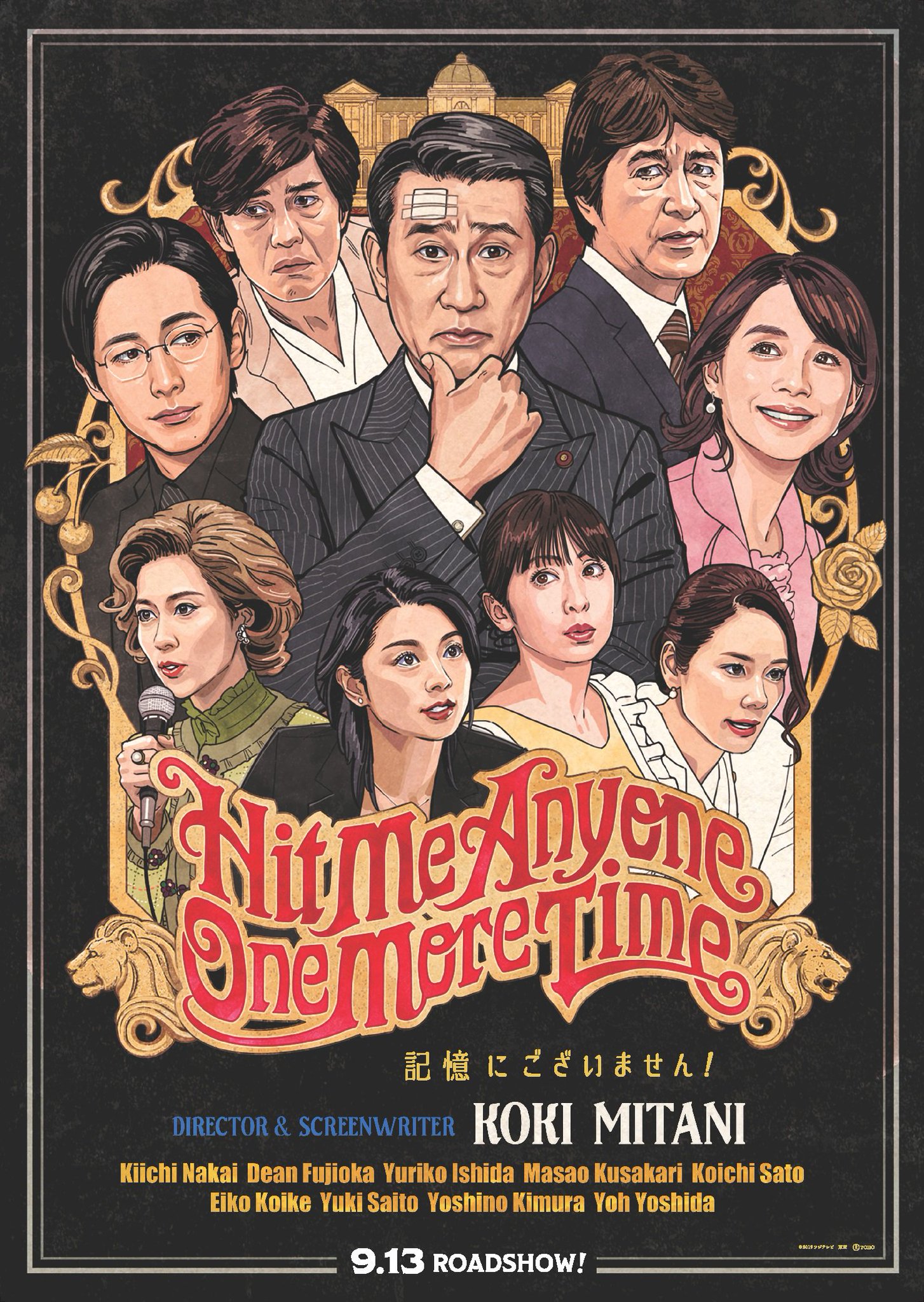
Hit Me Anyone One More Time (記憶にございません!, Koki Mitani, 2019)

Imagine if you woke up one day and found out you’re actually the national leader of your country and not only that absolutely everyone, including your wife and son, hates you with furious intensity. The hapless protagonist of Koki Mitani’s lowkey political satire Hit Me Anyone One More Time (記憶にございません!, Kioku ni Gozaimasen!) finds himself in just this stressful situation having lost all of his memories since he made the fateful decision to enter politics, rendered infinitely naive as he tries to keep up appearances while internally conflicted by the direction both his life and his country under his stewardship seem to have taken. 

Regarded as the “all-time worst prime minister” in Japanese history, Keisuke Kuroda (Kiichi Nakai) is known as a venal bore, a ghastly misogynist and all-round arsehole. To put it bluntly the very fact that a man like Kuroda could ever have become prime minster in the first place hints at a deep-seated rot in the political order. Aside from his gaffe-prone personality, the chief complaints against his administration are a sales tax hike and welfare cuts both of which target those with the least means, not that Kuroda cares very much about them. His big legacy idea is to build a second Diet building right next to the first Diet building only with spa facilities, illicitly teaming up with a childhood friend turned construction magnate who has been supplying him with hefty “donations”. 

After insulting the electorate during an outdoor balcony speech, Kuroda is hit on the head by a rock thrown by a disgruntled voter. Having lost his memory he regresses to a state of innocence from before he was corrupted by the cutthroat world of Japanese politics, now a nice, polite, slightly mild-mannered man who stuns his staff with his newfound consideration for others including a widely televised moment in which he stops to help up a female reporter who trips while chasing him in the lobby. Few believe he’s really changed, assuming this is some sort of bit intended to help rehabilitate his reputation. His new attitude, however, eventually fosters a new sense of hope for political change among his previously jaded, cynical staff who had long since given up hope of building a better Japan. 

Unsurprisingly, Mitani mostly avoids direct allusions to real world politics but adopts a mildly progressive stance as he sends a virtual innocent into the lion’s den of contemporary politics. It’s not long before Kuroda’s asking sensible questions about policy that wouldn’t go down so well with his (presumably) centre-right party including lowering the sales tax and raising the corporate, taking the time to greet constituents including a contingent of cherry farmers which contributes to his later decision to turn down a tariff-free trade deal for American cherries endangering diplomatic relations with the Japanese-American US President. No longer a ruthless political animal but a rueful middle-aged man who actually cares about ordinary people, Kuroda attempts to change the course Japanese politics largely by taking on the king maker, Tsurumaru (Masao Kusakari), his Chief Cabinet Secretary and the true holder of power in this infinitely corrupt political system. 

All sorts of sordid politics is on display from Kuroda’s womanising and a potential blackmail plot involving his wife’s affair to Tsurumaru’s yakuza ties and an even worse secret he would find personally ruinous should it get out. The ironic Japanese title of the film takes its name from that most universal of political get out of jail free cards, “I do not recall”, Kuroda’s standard response when questioned in the Diet about any of his extremely dodgy dealings. Instructing Kuroda that he should drop this “shallow humanism”, Tsurumaru can offer only the motivation that he wants to “remain in politics for as long as possible” while discovering that his old-school methods of political manipulation may no longer work when those around him find the courage to shed their cynicism and embrace a cleaner, kinder politics. 

Throwing in random gags such as a foreign minister who can’t speak English and has large ears with a pot belly that give him the appearance of Buddha while taking minor potshots as the usually toothless TV media through his series of acerbic anchors only too keen to criticise the PM live on air, Mitani’s comedy is characteristically inoffensive with its mix of slapstick and goodnatured farce but nevertheless makes a subtle plea for decent, compassionate politics which puts the interests of the people first rather than those of the governing elite. 


Hit Me Anyone One More Time streamed as part of this year’s Nippon Connection.

Original trailer (English subtitles)
The Gun (銃, Masaharu Take, 2018)

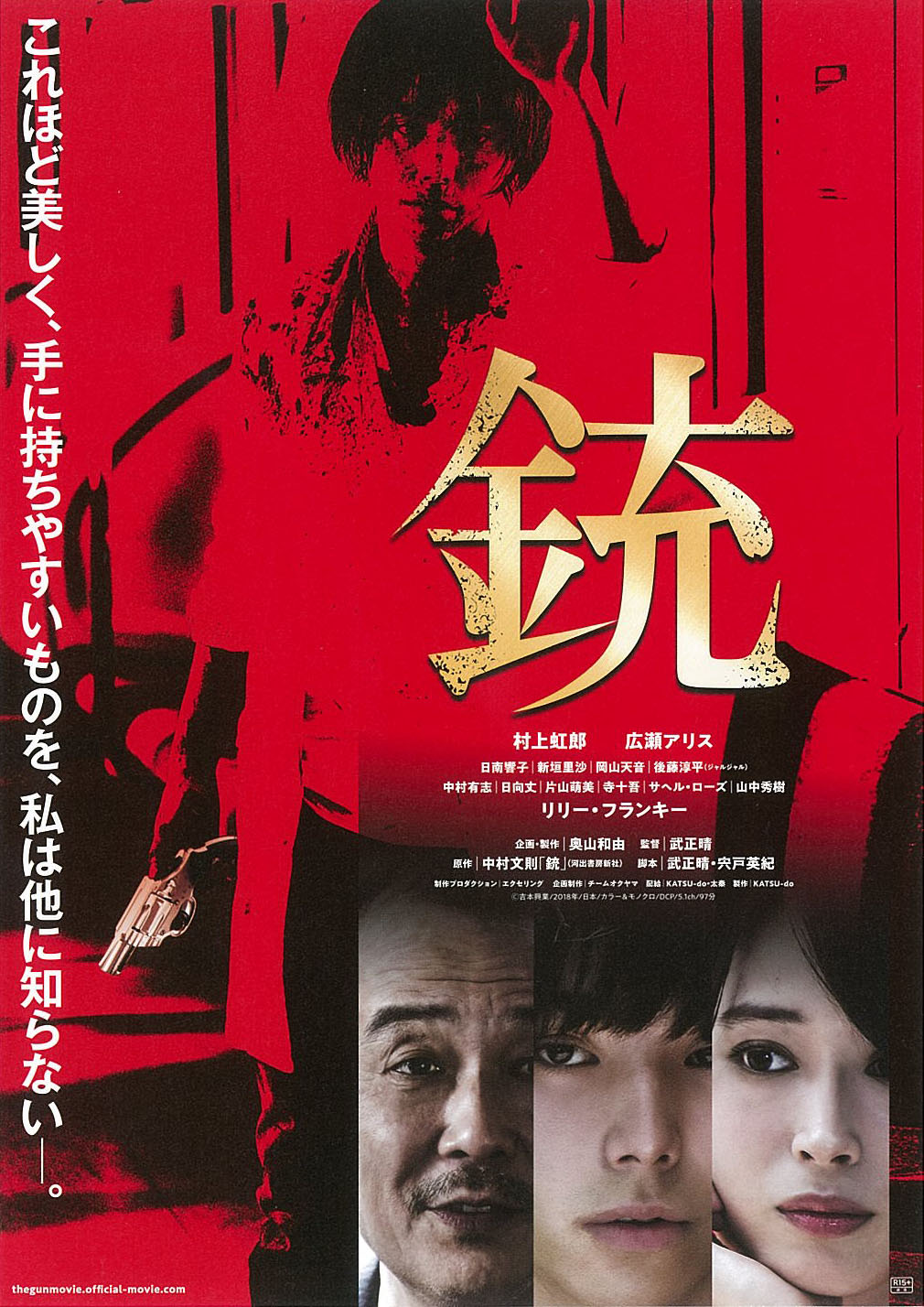
The Gun poster 1Much as Haruhiko Oyabu had in the post-war era, Fuminori Nakamura is fast becoming the go to voice for nihilistic noir in Japanese cinema. Several of his famously dark novels have already been adapted for the screen, most recently the grisly mystery Last Winter We Parted, but it’s only now that his lowkey debut The Gun (銃, Ju) is getting a suitably detached adaptation from 100 Yen Love’s Masaharu Take.

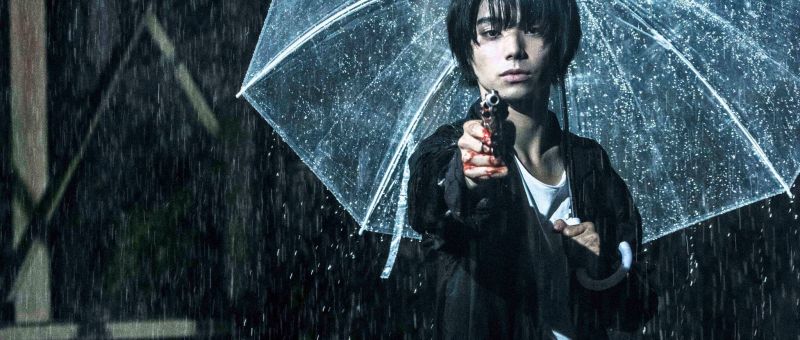
Like many of Nakamura’s “heroes”, Toru Nishikawa (Nijiro Murakami) is a disaffected youngster who thinks “it’s completely worthless to live”. His life changes one day when he comes across the body of a middle-aged man with a pistol lying next to it. For reasons he doesn’t quite understand, Toru picks the gun up and takes it home with him. Gradually its presence begins to obsess him as if he were literally being seduced by it. Believing he can communicate with the gun through touch, he lovingly caresses it, buys it trinkets, and lingers over thoughts of all they could do together.

Even when he takes a casual hookup (Kyoko Hinami) to bed, all Toru can think about is the gun. In the morning he tries to make her hate him by coming on strong, but it backfires because it appears to be what she likes, at least she suggests they hook up again, possibly on a regular but casual basis because she already has a boyfriend. Meanwhile, another prospect walks onto the scene – Yuko (Alice Hirose), a young woman Toru may or may not have forgotten meeting in the past. With Yuko Toru decides to do everything “properly” in a quest to win her heart rather than just her bodily submission.

Detached and very possibly a sociopath, Toru does indeed begin to show something of a more sensitive side in dealing with the similarly depressed Yuko. His gentlemanly act may be just that (and as one might expect, it largely works) but does at least display an acute emotional intelligence even if it’s being wilfully misused. Similarly, his first reaction to hearing alarming sounds suggesting the woman next door is mistreating her child is to turn his stereo up and ignore them, but he later finds himself trying to talk to the little boy in the street and eventually even calling the police only to have his mistrust of authority confirmed when they admit they’re aware of the situation and will send someone but probably not until the next day.

The woman next door, a bar hostess who rolls in late and kicks her kid out of bed to sleep on the porch so she can entertain her gentlemen callers, drags up unwelcome memories of the woman who abandoned him to an orphanage. To be fair, Toru does not seem any more misogynistic than his sleazy friends but has a fairly utilitarian idea of “romance”, viewing it as a game of conquest either fast and loose like with the casual hookup or slow and deep as in his careful pursuit of Yuko. Gradually his separate pursuits of the two women become confused, leading Yuko to confront him over whatever it is that’s so obviously “wrong” with him. Upset as she is, Yuko sees the darkness in Toru but must also see the light, affirming that she has her darkness too but is willing to help him with his if only he gives her a little time and waits for her forgiveness.

Toru, meanwhile, is still fixated on his beloved gun which he has begun to carry about with him in a little bag for added frisson. Living largely without feeling, the thrill of carrying such an illicit object becomes a peculiar kind of drug, as does the intoxicating thought of the act of actually firing it and finally of taking a life. A wily police detective (Lily Franky) cuts straight through Toru’s smug facade to the gaping void beneath, trying to prevent him from jumping straight into the abyss but confident he will fail. As the detective predicted, Toru’s sense of reason continues to fragment leaving him unsure of what is real and what isn’t while he obsesses over the gun and what he might do with it but in a purely intellectual sense without considering the real world consequences of his actions. An exercise in style, The Gun is a noirish tale of existential ennui and dark obsession filled with nihilistic dread as its soulless hero commits to living his “worthless” life only to wilfully rob himself of the possibility of salvation.


The Gun screens as part of the 2019 New York Asian Film Festival on June 30.

Original trailer (no subtitles)