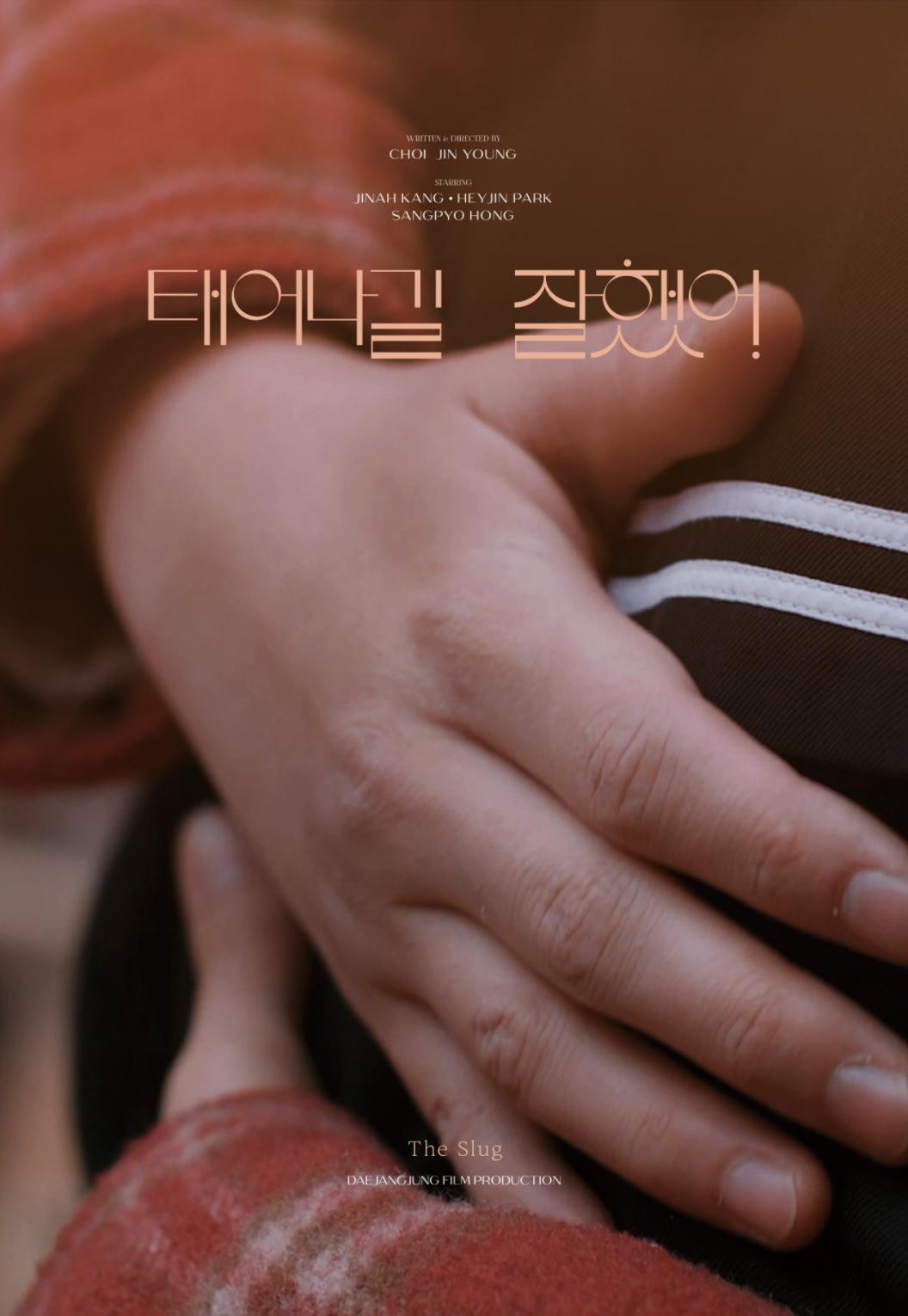
The Slug (태어나길 잘했어, Choi Jin-young, 2020)

“My name is Park Chunhee. I’m a little…drenched.” “From the weight of life?” asks a fellow sufferer a little too excitedly. “In sweat” she flatly replies, though in her case less from existential anxiety than a persistent medical condition she finds so embarrassing it prevents her leading a fulfilling life. Although, it seems, that’s not the only reason that Park Chunhee has found herself arrested since the age of 15. A whimsical tale of growing self-acceptance, Choi Jin-young’s The Slug (태어나길 잘했어, Taeeonagil Jalhaesseo) reconnects its lonely, defeated soon-to-be middle aged heroine with her teenage counterpart to make both sense of and peace with the past in order to “find purpose and meaning somewhere in this world”.

We first meet Chunhee (Kang Jin-a / Park Hye-jin) in 1998, shortly after the Asian Financial Crisis, entering the home of her uncle (Ko Jo-yeong) and aunt (Kim Geum-sun) following the funeral of her parents. It seems although the family has agreed to take her in, little thought has been given to her place within the household. Her cousin Yura (Kim Yeon-woo) flat out refuses to share her room while her aunt is reluctant to allow her to use the room of her son Wonseok (Lim Ho-jun / Yoo Gyeong-san) who is away at university in case he should come back. Slightly exasperated, grandma (Byeon Joong-hee) agrees she can come in with her, but her uncle has another idea – the attic crawlspace, according her aunt freezing and rat infested and though he offers to fix it up it’s clear he won’t be doing it himself and doesn’t want to pay. Nevertheless, it’s where she ends up staying, hidden away and treated quite literally as a poor relation with no one but grandma showing her the slightest bit of affection. 

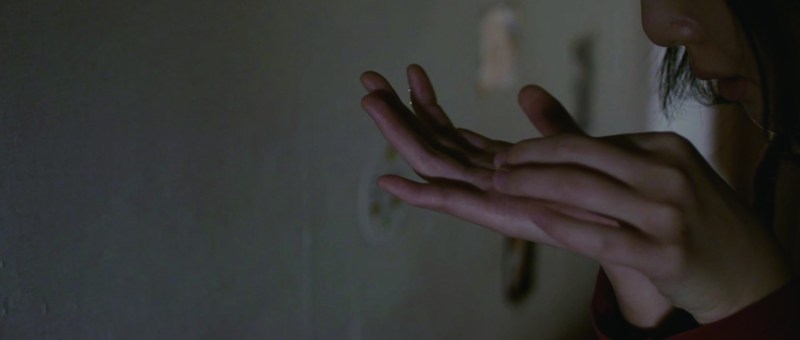
20 years later, Chunhee is still living in the house though apparently alone. Her attic room is more or less unchanged, pinups of a teenage Prince William still affixed to her windowsill along with a family photo. She finds strange companionship in an errant slug crawling on the wall, partly in the trail she leaves after herself because of her excessive sweating that caused her aunt to be forever berating her to mop the floor after she passed through in socks. These days she makes ends meet by pealing copious amounts of garlic for a local restaurant while saving up for an operation to cure her sweating. After being mysteriously struck by lightning, however, her life becomes even stranger as she’s haunted by the younger version of herself and plagued with flashbacks to her teenage trauma.

Besides the sweating, Chunhee’s problem seems to lie in the conviction that her life is worthless and it would have been better if she had died along with her parents but best if she were never born at all. After accidentally wandering into a weird support group under the name of “Time to Face Myself” she ends up bonding with a similarly dejected man who has developed a stammer after being beaten by his father and regrets that his life has been a series of missed opportunities as a consequence. Yet she still doubts that she has a right to love or happiness, convinced that people don’t like her and that she is a toxic person destined to make others unhappy. Only by reconnecting with the younger Chunhee and bonding with the kind yet awkward Juhwang (Hong Sang-pyo) does she begin to see that it was never her fault, she was not in the wrong, and has as much right to life as anyone else.

Originally changing the locks because it’s her house and she doesn’t want anyone else inside, Chunhee finally manages to escape her strange limbo land even as her feckless family members flounder, Wonseok apparently ruined by his failed revolution while her uncle died a failed poet and Yura apparently became an unsuccessful film director. “Life is cold” Chunhee is reminded by a new friend engineered by her innate kindness, realising that though she feared being alone alone is all she’s ever been. Nevertheless, her new connections have perhaps in a sense liberated her, given her courage to face herself and rediscover a sense of self worth that gives her the confidence to venture out into the world in search of answers walking towards a large heart comprised of several smaller ones as she embarks on an existential quest for meaning open to whatever it is that awaits her.


The Slug screened as part of the 2021 Osaka Asian Film Festival

Original trailer (no subtitles)

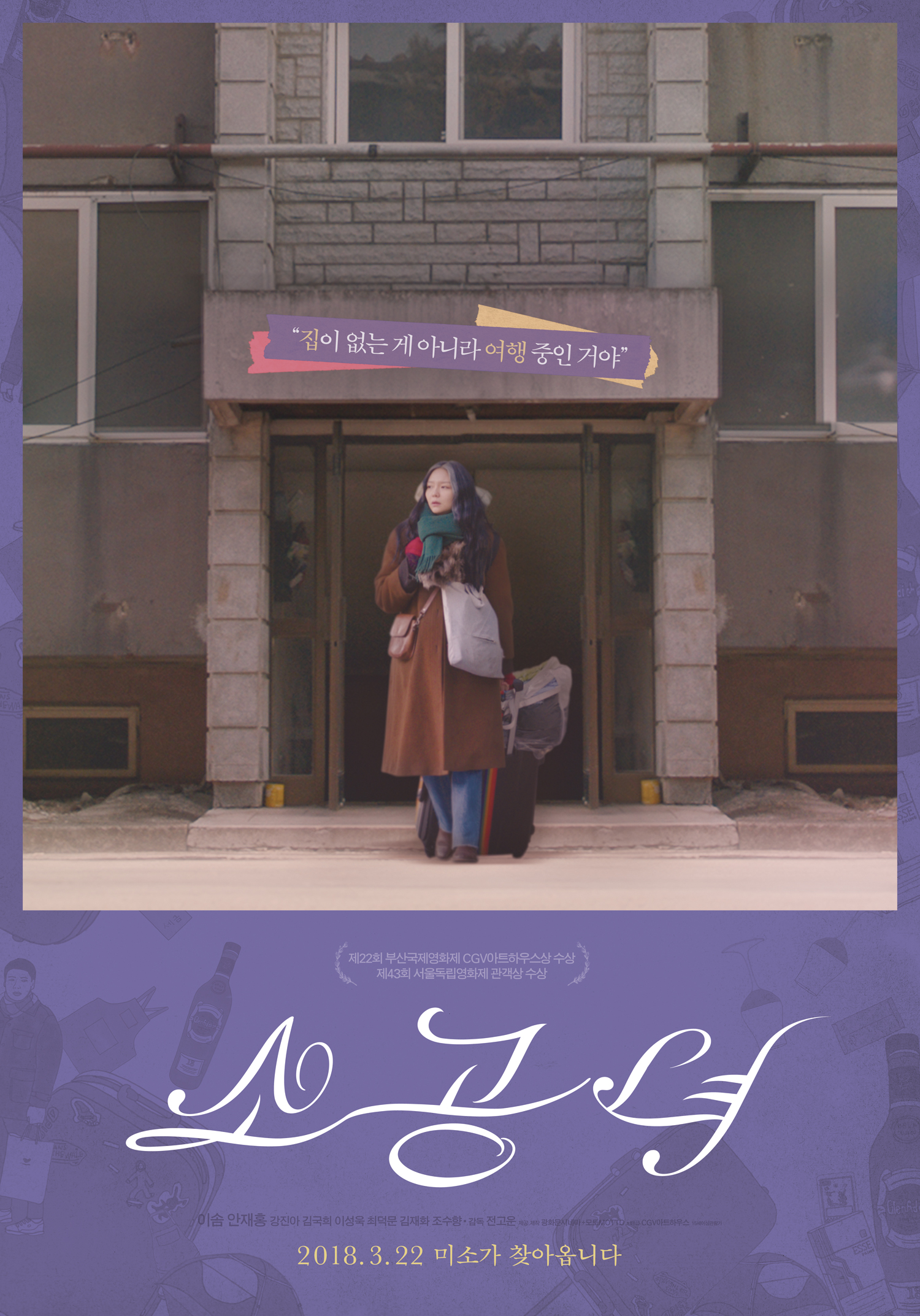
Microhabitat (소공녀, Jeon Go-woon, 2017)

Microhabitat posterIs there a “right” or, by implication, “wrong” way to live your life? The heroine of Jeon Go-woon’s debut feature Microhabitat (소공녀, Sogongnyeo) is determined to live by her own rules, but her unconventional approach to life in competitive Korean society is not treated with the same kind of universal acceptance with which she treats each and every person she meets on her meandering path towards fulfilment. Life is conspiring to take away even the smallest pleasures which make existence bearable, but small pleasures are sometimes all life is about and perhaps the only thing really worth fighting for.

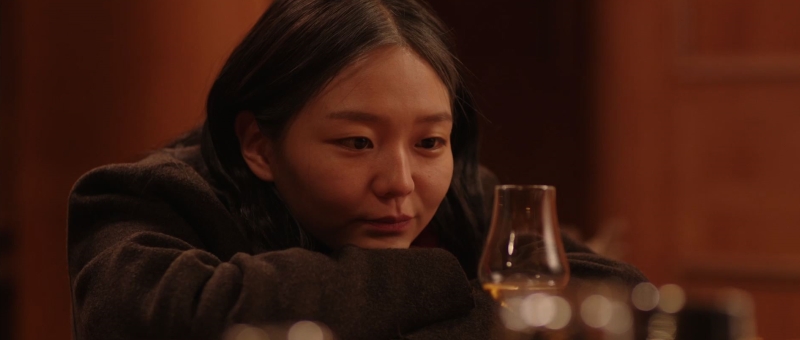
At 31 years old, Miso (Esom) lives what might outwardly be thought of as a miserable existence. Working as a cleaner she exists hand to mouth and is able to afford only a tiny, unheated, one room apartment in a run down part of the city. Her life is tightly budgeted and whatever else anyone might say about the way she lives, Miso is not irresponsible and refuses to get into debt. It is therefore a huge problem when a New Year price hike threatens to push her beloved cigarettes out of her reach. If that weren’t worrying enough, her landlord is also jacking up the rent. Staring intently at her accounts book, Miso contemplates a life without cigarettes and whiskey and then takes a look around her before deciding to strike through the line marked “rent”. Packing her most essential belongings into a couple of suitcases, she decides to make herself temporarily homeless and reliant on the kindness of former friends now virtual strangers whom she hopes will be minded to repay past kindnesses by putting her up for a while.

Miso’s plight is symptomatic of many in her generation who feel they’ve lost out in Korea’s relentlessly competitive, conformist, and conservative society, but her fate also bears out something of a persistent social stigma directed at those without means or family. Unlike the friends she decides to track down, Miso never graduated university – she lost her parents young and then ran out of money, but then she isn’t particularly bitter about something she was powerless to control. Miso’s small pleasures are also ones generally marked off limits to “nice” young women who generally do not smoke or drink and the old fashioned austerity mentality sees nothing good in a “self indulgent” need to enjoy life by “wasting” money on “frivolous” things if you claim not to be able to find the money to pay your rent. Some would say Miso has her priorities all wrong and has messed up her life by getting trapped in the world of casual labour and still being single at such an advanced age, conveniently ignoring the fact that much of the social order functions solely to keep women like her in their place so the higher ups can prosper.

Miso, however, would probably listen patiently to their concerns before calmly brushing them off. She is happy – to an extent, at least, with her minimalist life. She doesn’t need a fancy apartment or a swanky car, she only wants her cigarettes, her whisky, and her boyfriend Hansol (Ahn Jae-Hong) – an aspiring manhwa artist who feels broadly the same but is starting to get frustrated with his own precarious economic circumstances and present inability to offer the degree of economic support which would mean the pair could move in together. The first friend she tracks down, Mun-young (Kang Jin-a), has become a workaholic salary woman who self administers saline drips at work to increase her productivity and declines to put Miso up on the grounds having someone around when she’s not there makes her uncomfortable. Each of her old bandmates has opted for the conventional life but it has not served them well – keyboardist Hyun-jung (Kim Gook-hee) is unhappily married and trapped in a home of oppressive silence, Dae-yong (Lee Sung-wook) is a brokenhearted wreck whose wife has left him after less than eight months of marriage, vocalist Roki (Choi Deok-moon) has a strange relationship with his parents, and former guitarist Jung-mi (Kim Jae-hwa) has thrown herself headlong into stepford wife territory going quietly mad through boredom and insecurity in the palatial apartment that belongs to her husband’s family.

For various reasons, Miso understands that she can’t stay with her friends very long though she tries to help each of them as best she can while she’s around. She cleans their apartments, cooks them nutritious meals, keeps them company and listens to their problems though few of them take the trouble to really ask her why it is she is in the position she is in or how they might be able to help beyond providing temporary shelter. Surprised by one of her wealthy clients who is unexpectedly at home during cleaning time and seems to be distressed, Miso does her best to comfort her, making it clear that she does not disapprove of her client’s lifestyle and thinks she has nothing in particular to be ashamed of. The client, vowing to leave her present occupation behind, feels quietly terrible that her decision inevitably means Miso will lose her job but Miso genuinely means it when she says she’s happy for her client and hopes she will be able to attain her dreams.

Forced to leave the memory of each of her friends behind, Miso’s world seems to shrink until even her beloved whisky now seems like it will be out of her reach. Jeon Go-woon is unafraid to lay bare Miso’s bleak prospects, though she depicts them in an often humorous light as Miso goes apartment hunting in the darkest and dingiest part of Seoul, striding up endless flights of stairs to rooms with increasingly tiny windows before landing at the only realistic possibility in a filthy attic space with no electricity. Still, Miso remains undaunted. She is free, beholden to no one, and retains her kind heart even as she becomes a cypher to us, lost under the grey skies of an indifferent city until she alone becomes the tiny light on its ever expanding horizons.


Microhabitat screens as part of New York Asian Film Festival 2018 on 10th July, 6.30pm.

Original trailer (no subtitles)