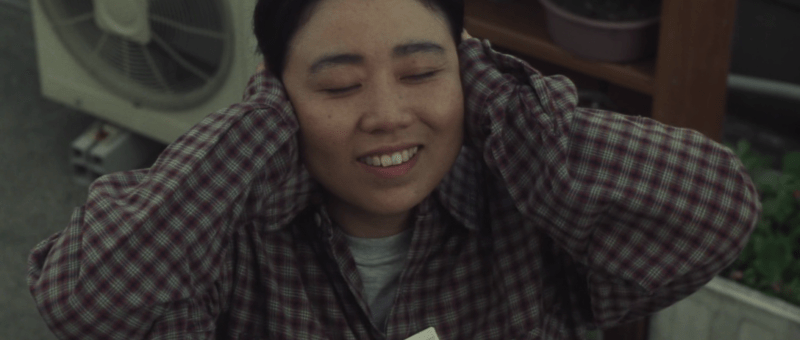
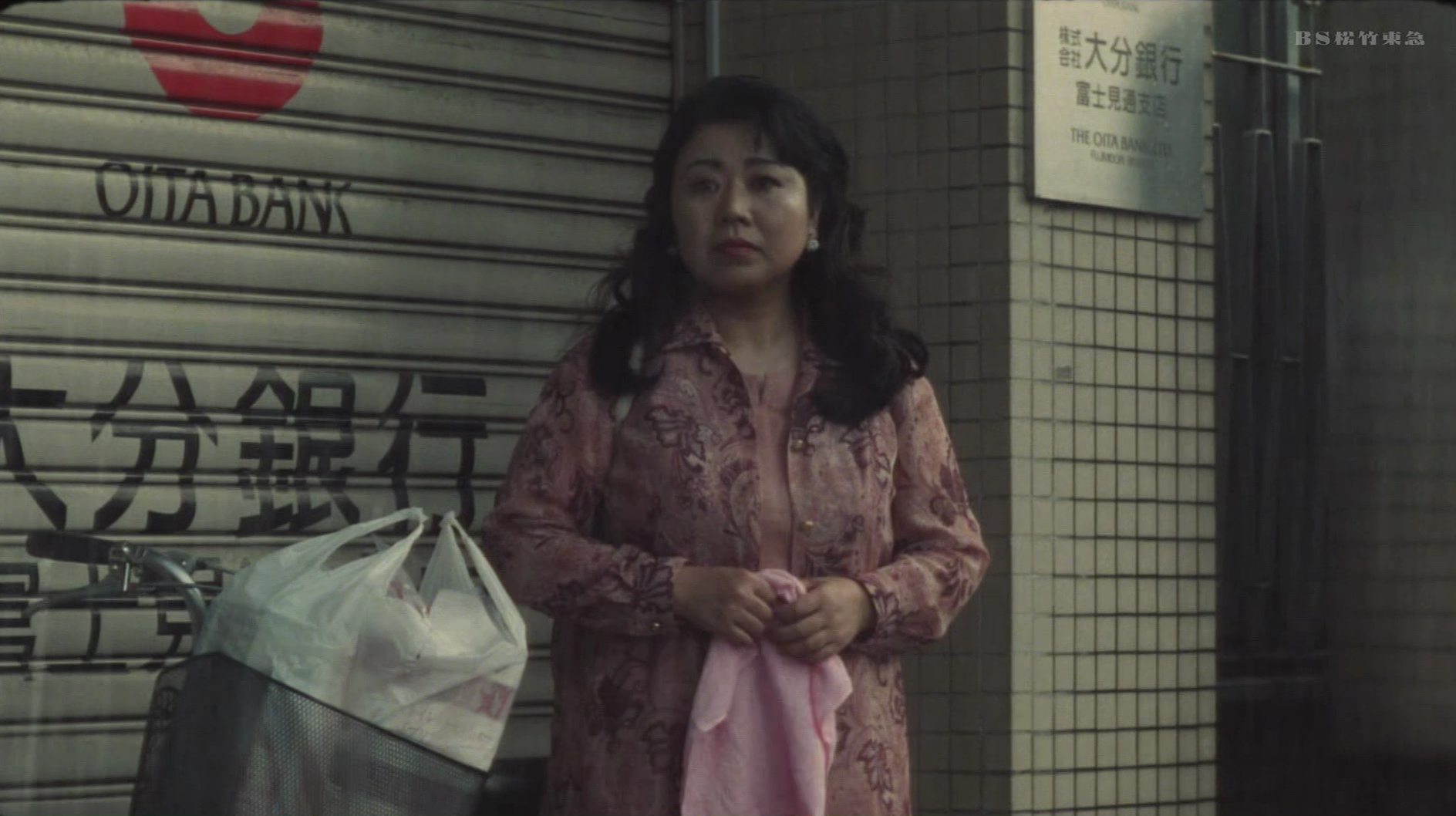
Face (顔, Junji Sakamoto, 2000)

In some ways an innocent’s voyage through the nihilistic landscape of mid-90s Japan, Junji Sakamoto’s Face (顔, Kao) is also a character study of a woman who developed a fear of being seen, in large part because of social prejudice. In a heartbreaking moment, Masako (Naomi Fujiyama) reveals that her father, who left when she was 10, told her that she didn’t have to learn to swim or ride a bike if she didn’t want to. But Masako did want to learn, she just felt she couldn’t because people found her clumsiness “embarrassing”. It’s not completely clear whether Masako’s father said that because he felt bad seeing Masako being picked on by the other kids, or if he too felt ashamed that his daughter was evidently a little different from the other children.

It’s this sense of rejection and loathing that’s manifested in Masako’s bar hostess sister, Yukari (Riho Makise) who is exploitative of her, pressuring her to mend clothing belonging to one of her customers, and becoming physically abusive by tripping her when she refuses. Yukari lies that their mother agrees Masako should be institutionalised, provoking her into a rare trip out of her house running out into the snow in only her slippers and taking a round-trip on a train until Yukari’s gone. The two women are almost polar opposites, and in some ways Yukari’s cruelty may be motived by seeing in Masako’s face the elements of herself that she most fears and dislikes.

Nevertheless, when their mother dies and Yukari implies she plans to turn the family dry cleaner’s into a cafe evicting Masako in the process, Masako ends up snapping and strangling Yukari with her unfinished knitting. In killing Yukari she has, in a sense, freed herself from the oppressiveness of her hate and the inferiority complex it produced in her. Forced on the run on the eve of the Kobe earthquake, she believes the disaster to be her fault, but also takes advantage of the chaos to disappear into a crowd of other displaced persons making their way towards Osaka. It’s there she ends up getting a job at a love hotel under the name of new wave actress “Mariko Kaga,” but every time she starts to settle into a new life and blossoms when surrounded by more supportive presences, her new family quickly crumbles and she’s forced back on the run.

In an ironic twist, many of the ruined men she comes across, some of whom sexually assault her, take on the role of the father she never had. The manager at the love hotel (Ittoku Kishibe) tries to teach her how to ride a bike, though he is privately drowning in gambling debts and about to lose everything. Later she’s sold by a man trying to escape his life as a yakuza to a regular at a bar where she’s been working who bizarrely also begins to teach her to swim. The man who assaulted her originally had lost work because of the earthquake and tried to exorcise his sense of powerlessness by forcing himself on Masako. Her decision to hand him some of the funeral condolence money she stole before leaving is her way of reasserting power over the situation, paying him for this life lesson and shifting the stigma back onto him rather than accept it herself. 

Hiroyuki (Etsushi Toyokawa), the former yakuza, may have sold her as a kind of revenge seeing as he seems to resent her for her difference, but also identifies with her seeing them both as “losers”, which is a label Masako no longer really agrees with. But unlike her, Hiroyuki can no longer escape his fate and the yakuza is not often an occupation you can just give up even if it were not for vague hints at trouble in the city that’s forced him back to pleasant onsen town Beppu on the southern island Kyushu. Even the man that Masako takes a liking to simply because he’s kind to her (Koichi Sato) has recently been made redundant. His wife has left him with their young son and he’s resorted to blackmailing his former employer to get what he’s owed. This breach of the employer-employee contract exemplifies the sense of betrayal among people of this generation who were promised jobs for life under the post-war salaryman model but have been chewed up and spit out by the post-Bubble economy.

Masako, however, is flourishing during her life on the run. Her family had treated her as if she had some kind of learning difficulties and had forced her into a kind of arrested development in which she feared the outside world and had poorly developed social skills. The scars of her trauma are literally manifested on her face after she falls off her bicycle, but it’s true enough that through her various experiences she is able to take on different personas only for her actual face to give her away in the end. Just as after she’d run away, Masako encountered a strange and possibly over-friendly woman in a cafe who is later revealed to be a fugitive, like her on the run for murder, modelled in the real life murderer Kazuko Fukuda who evaded the police for over 14 years through having repeated plastic surgery. Masako never alters her face, in fact it’s ironically her true face that becomes further exposed as she comes into herself thanks to those she meets, but is able to become various other people hinting at all the lives she was denied as Masako the despised sister hunched over a sewing machine. Though contemporary Japan may seem to be a bleak and hopeless place, denying Masako the romantic fulfilment and happy life she longed for, it’s she alone who wants to live, desperately swimming out to sea having been pushed all the way out of Japan but forever in search of new horizons.

Thus Another Day (今日もまたかくてありなん, Keisuke Kinoshita, 1959)

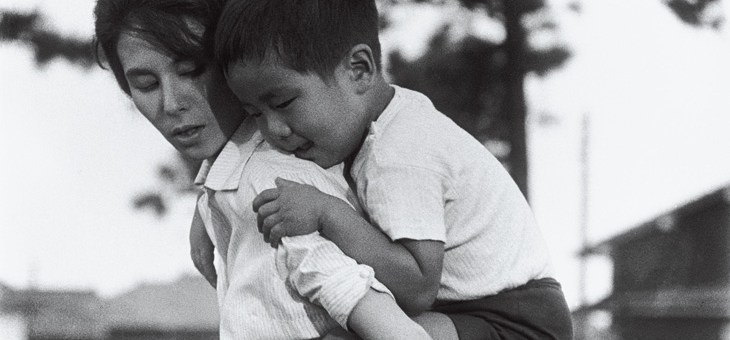
Thus Another Day vertical bannerThe cinema of the immediate post-war era, contrary to expectation, is generally hopeful and filled with the spirit of industry. Keisuke Kinoshita might be thought of as the primary proponent of post-war humanism in his fierce defence of the power of human goodness, but looking below the surface he’s also among the most critical of what the modern Japan was becoming, worried about a gradual loss of values in an increasingly consumerist society which refuses to deal with its wartime trauma in favour of burying itself in intense forward motion.

The housewife at the centre of Thus Another Day (今日もまたかくてありなん, Kyo mo mata Kakute ari nan), Yasuko (Yoshiko Kuga), is a perfect example of this internal conflict. She and her husband Shoichi (Teiji Takahashi) have built a modest house way out of the city in the still underdeveloped suburbs for which they are still burdened by an oppressive mortgage. Shoichi has a regular job as an entry level salaryman but his pay is extremely low and Yasuko is forced to scrimp and save just to get by. The central conflict occurs one summer when Shoichi’s boss declares he’s looking to rent a summer house in the quiet area where the family live. Shoichi thinks it would be a great idea to rent out their house to his boss earning both money and favour. Yasuko can go stay with her family who live in a pleasant resort town while he will stay with a friend in a city apartment. Yasuko does not really like the idea, but ends up going along with it.

Shoichi is trying to live the salaryman dream, but it isn’t really going anywhere. Yasuko is home alone all day with the couple’s small son, Kazuo, who is too young to understand why the family lives the way it does and continuously asks probing questions which upset and embarrass his mother. Watching her painstakingly washing clothes by hand, Kazuo wants to know why they don’t have an electric washing machine like some of his friends’ mothers do. Yasuko tells him they’re saving money to get one, at which point he pipes up that he personally would rather have a TV set. Like his father, he is rather self-centred but being only four can perhaps be forgiven. Nevertheless, Yasuko is constantly embarrassed by the family’s relative poverty. When another neighbour spots her out shopping and decides to accompany her, she is visibly distressed that the stall she takes her to is a little more expensive than the one she had in mind. Wanting to save face, she buys expensive fish but is mindful of there being less money for the rest of the week.

Meanwhile, Shoichi is obsessed with “getting ahead” by ingratiating himself with his bosses – hence why he decided to let out his own house over the summer. The house is, after all, Yasuko’s domain and she perhaps feels family atmosphere isn’t something you should be selling. She resents that the family will be split up over the summer even if it gives her an opportunity to visit her mother and sister out in the country. Even when Shochi arrives to visit, he makes them trot out to a neighbouring town to visit his boss’ wife also on holiday in the area, and stays there all day playing mahjong while Yasuko and Kazuo are bored out of their minds sitting idly by. The second time he doesn’t even bother to invite them.

The small resort town itself is something of a haven from the demands of the city but there is trouble and strife even here. Shortly after her arrival Yasuko meets a strange, rather sad middle-aged man who is a stay at home dad to his beloved little girl, Yoko. Takemura (Nakamura Kanzaburo XVIII) came of age in the militarist era, attending a military university to become one of the elite. The world changed on him and he remains unable to reconcile himself to the demands of the post-war society. Experiencing extreme survivor’s guilt, Takemura is filled with regret and resentment towards the ruined dreams of his misguided youth in which he abandoned a woman he loved to marry a wealthy man’s daughter who he has also let down by refusing his military pension, forcing her into the world of work and eventually onto the fringes of the sex trade as a hard drinking bar girl.

As if to underscore the looming danger, a thuggish gang of yakuza have also decided to spend the summer in the resort, holing up at the inn where Takemura’s wife is working. The young guys terrorise the youngsters of the town, disrupting the well established social hierarchy with acts of violence and intimidation. The punks cause particular consternation to Takemura who remembers all the men their age who went to war and never came back only for the successive generation to live like this. Having lost everything which made his life worth living, Takemura decides to take a stand against modern disorder, hoping to die in battle the way he feels he ought to have done all those years ago.

Thus Another Day is among the darkest of Kinoshita’s post-war dramas, suggesting that there really is no hope and that past innocence really has been lost for good. The values of Takemura’s youth, however, would not perhaps line up particularly well with those most often advanced in Kinoshita’s cinema, as kind and melancholy as he seems to be. Yasuko goes back to her crushing world of unfulfillable aspirations with her obsequious husband and demanding son with only gentle wind chimes to remind her of happier days while she tries to reaccommodate herself to the soullessness of post-war consumerism .


Original trailer (no subtitles)

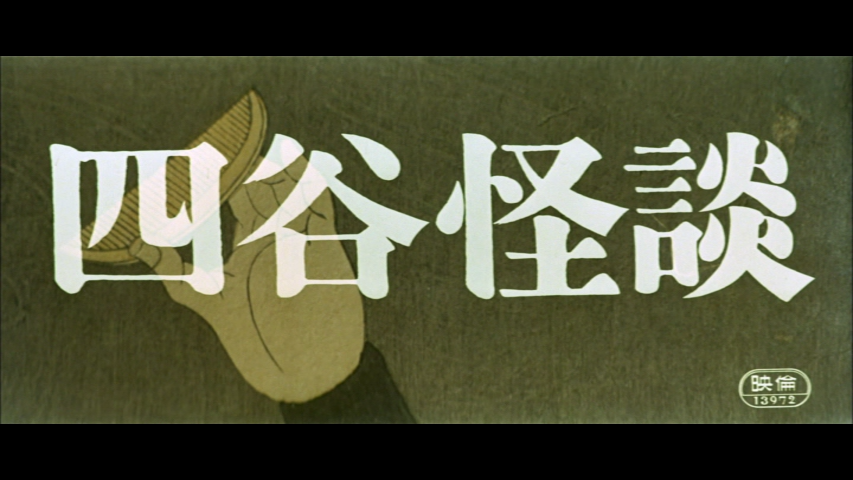
Illusion of Blood (四谷怪談, AKA Yotsuya Kaidan, Shiro Toyoda, 1965)

vlcsnap-2017-07-01-00h50m36s347Shiro Toyoda, despite being among the most successful directors of Japan’s golden age, is also among the most neglected when it comes to overseas exposure. Best known for literary adaptations, Toyoda’s laid back lensing and elegant restraint have perhaps attracted less attention than some of his flashier contemporaries but he was often at his best in allowing his material to take centre stage. Though his trademark style might not necessarily lend itself well to horror, Toyoda had made other successful forays into the genre before being tasked with directing yet another take on the classic ghost story Yotsuya Kaidan (四谷怪談) but, hampered by poor production values and an overly simplistic script, Toyoda never succeeds in capturing the deep-seated dread which defines the tale of maddening ambition followed by ruinous guilt.

As usual, Iemon (Tatsuya Nakadai) is a disenfranchised samurai contemplating selling his sword due to his extreme poverty. Iemon had been married to a woman he loved, Oiwa (Mariko Okada), whose father called her home when Iemon lost his lord and therefore his income. Oiwa’s father is also in financial difficulty and Iemon has now discovered that he has been prostituting Oiwa’s sister, Osode (Junko Ikeuchi), and plans a similar fate for Oiwa.

Still in love with his wife, Iemon decides that his precious sword is not just for show and determines to take what he wants by force. Murdering Oiwa’s father, Iemon teams up with another reprobate, Naosuke (Kanzaburo Nakamura), who is in love with Osode and means to kill her estranged fiancee. Framing Osode’s lover Yoshimichi (Mikijiro Hira) as the killer, Iemon resumes his life with Oiwa who subsequently bears their child but as his poverty and lowly status continue Iemon remains frustrated. When a better offer arrives to marry into a wealthier family, Iemon makes a drastic decision in the name of living well.

The themes are those familiar to the classic tale as Iemon’s all consuming need to restore himself to his rightful position ruins everything positive in his life. Tatsuya Nakadai’s Iemon is among the less kind interpretations as even his original claims of romantic distress over the loss of his wife ring more of wounded pride and a desire for possession rather than a broken heart. Selling one’s sword is the final step for a samurai – it is literally selling one’s soul. Iemon’s ultimate decision not to is both an indicator of his inability to let go of his samurai past and his violent intentions as the fury of rebellion is already burning within him.

Iemon defines his quest as a desire to find “place worth living in”, but he is incapable of attuning himself to the world around him, constantly working against himself as he tries to forge a way forward. Oiwa’s desires are left largely unexplored despite the valiant efforts of Mariko Okada saddled with an underwritten part, but hers is an existence largely defined by love and duty, pulled between a husband and a father. Unaware that Iemon was responsible for her father’s death, Oiwa is happy to be reunited with him and expects that he will honour her father by enacting vengeance. Only too late does she begin to wonder what her changeable husband’s intentions really are.

An amoral man in an amoral world, Iemon’s machinations buy him nothing. Haunted by the vengeful spirit of the wife he betrayed, Iemon cannot enjoy the life he’d always wanted after purchasing it with blood, fear, and treachery. Despite the odd presence of disturbing imagery from hands in water butts to ghostly presences, Toyoda never quite achieves the level of claustrophobic inevitability on which the tale is founded. Hampered by poor production values, shooting on obvious stage sets with dull costuming and a run of the mill script, Illusion of Blood has a depressingly unambitious atmosphere content to simply retell the classic tale with the minimum of fuss. Only the final scenes offer any of Toyoda’s formal beauty as Okada appears under the cherry blossoms to offer the gloomy message that there is no true happiness and her husband’s quest has been a vain one. Achieving her vengeance even whilst Iemon affirms his intention to keep fighting right until the end, Oiwa leaves like the melancholy ghost of eternal regret but it’s all too little too late to make Illusion of Blood anything more than a middling adaptation of the classic ghost story.