
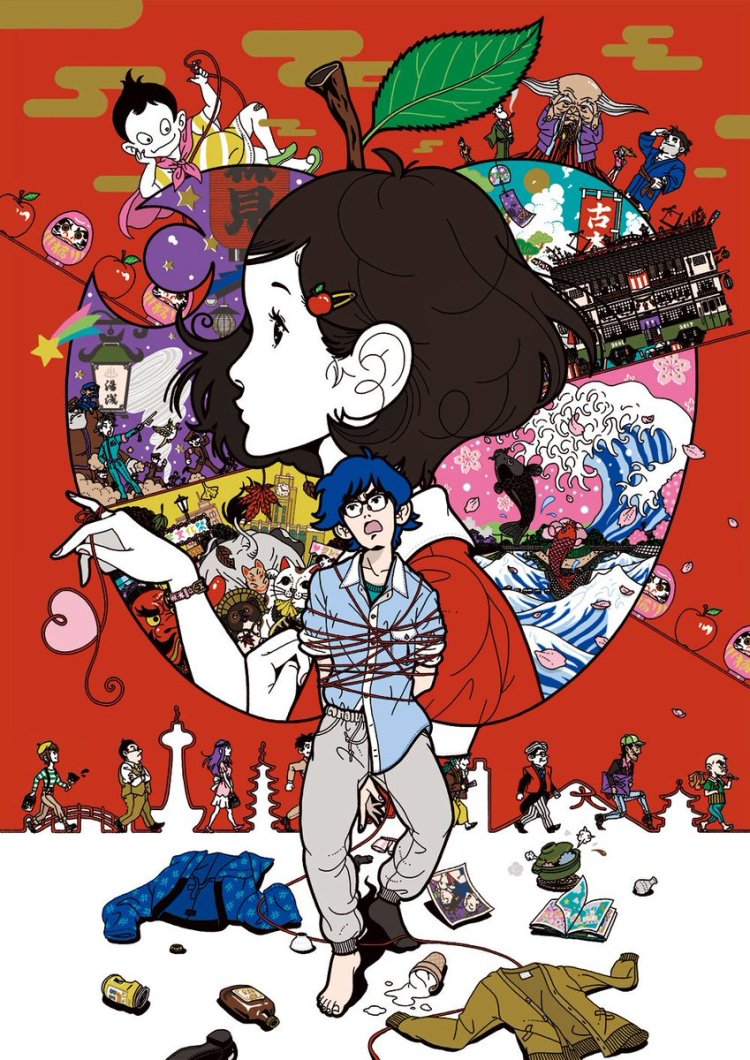
 Have you ever had one of those incredibly long nights that seemed to pass in an instant? Masaaki Yuasa returns to the absurd world of Tomihiko Morimi with the charming one night odyssey, The Night is Short, Walk on Girl (夜は短し歩けよ乙女, Yoru wa Mijikashi Aruke yo Otome), which takes place in the same world as Yuasa’s TV anime adaptation of the author’s Tatami Galaxy. The Girl with Black Hair dreams her way through Kyoto, relentless as a steam train in her pursuit of new experiences, but perhaps the speed at which she travels leaves her horizons perpetually unclear.
Beginning where many stories end, The Night is Short, Walk on Girl, opens with a wedding. “Sempai” (Gen Hoshino) longs for the “Girl With Black Hair” (Kana Hanazawa). He doesn’t know her name or really very much about her at all other than she’s in the year below him and they belong to the same club, but this is a love for the ages fated to come true. To this end, Sempai has been engineering “coincidental” meetings with the Girl so that she knows he exists, in a “there’s that guy again!” sort of way, hoping to travel into her heart by means of osmosis. Until then he’ll just stare at her lovingly from three tables away at social events involving mutual friends…
The Girl, however, has her own plans. She’s determined to make her way into the world of adulthood this very night, travelling by the power of alcohol (for which she seems to have a seriously impressive tolerance). For the Girl, the night is filled with possibilities. She’s open to everything and everyone, ready to say yes to whatever strange adventure the gods have in store for her. Which is lucky, because this is going to be a very strange night indeed.
The Night is Short pivots around the idea of connection as its two poles – Sempai and The Girl, are perpetually kept apart, orbiting each other in an endless search for a home. The Girl drinks and claims she feels the interconnectedness of all things, at one with the world and everybody in it. The miserly, miserable local god she’s in the middle of a drinking contest with understands her reasoning but has lived too long to agree with it. After all, at some point you have to stop drinking and the world is cold and lonely. The old man tastes only life’s nothingness, for him life is fruitless and nearing its end but for the girl all the world is flowers and warmth, filled with promise and possibility.
If the old man is right and alcohol provides only a fleeting, essentially fake feeling of contentedness, then perhaps there are other routes to true connection – such as the universal circulation of books. Books carry ideas between people and take feelings with them yet there are those who try to staunch the flow – namely book collectors who try to stem the system by hoarding copies to push up the price. Sempai and the Girl each find themselves caught up in this act of anti-human profiteering as allies or enemies of the strange little creature who presides over the great book fair of life.
Even those, like the old man, who feel themselves to be excluded from human society prove themselves connected by one very special unifying factor – the passage of disease. The Girl is committed to spreading happiness wherever she goes, healing the sick and ministering to the lonely, but even those who feel they have nothing to give have still given away a part of themselves in the form of the common cold as it rips like wild fire through old Kyoto with the desperate force of a lifetime’s painful rejection. It’s kind of beautiful, in a way, as the old man’s life suddenly brightens in not feeling so alone anymore after casting himself as patient zero.
Yuasa’s drunken night in Kyoto is strange and surreal. Time runs inconsistently, revealing the uncomfortable truth that it speeds up as you grow older and night approaches dawn to the still young Girl, too full of life and possibility to think of looking at a clock. Sempai remains a cypher, his only clear personality trait being his certain love for the strange girl who’s always too busy chasing dreams to see him. His friends are also facing their own strange nights from the one who’s decided not to change his undies until he’s reunited with his one true love with whom he shared but one fateful encounter, and the other whose taste for female attire receives a slightly muddled reception, but they each find themselves caught up with three level pagoda trains, guerrilla theatre practitioners (or “school festival terrorists”) whose protest turns out to be romantic rather than political, not to mention the persistent threat of underwear thieves. Is this fate, or mere “coincidence”? In the end perhaps it doesn’t matter, but the night is short. Walk on Girl, just slow down a little, you have all the time you need.
The Night is Short, Walk on Girl is released in selected UK cinemas on Oct. 4 courtesy of Anime Ltd. Check the official website to see where it’s screening near you.
Original trailer (English subtitles)
 Masamune Shirow’s cyberpunk manga Ghost in the Shell burst onto the scene in 1989 and instantly became a genre classic. Mamoru Oshii then adapted the manga into a much lauded anime movie in 1995 which almost came to define cyberpunk animation even if it emerged towards the end of the genre’s heyday. A sequel, Ghost in the Shell: Innocence followed in 2004 as well as a TV anime spin-off Ghost in the Shell: Stand Alone Complex. Now with the 20th anniversary of the original animated movie, the series has yet again been adapted into a series of entirely new anime OVAs under the name of Ghost in the Shell: Arise. Ghost in the Shell: The New Movie (攻殻機動隊 新劇場版, Kokaku Kidotai – Shin Gekijoban) is the big screen outing of this latest incarnation scripted by Tow Ubukata who also produced the very GITS influenced Mardock Scramble.
 Windows on Worlds