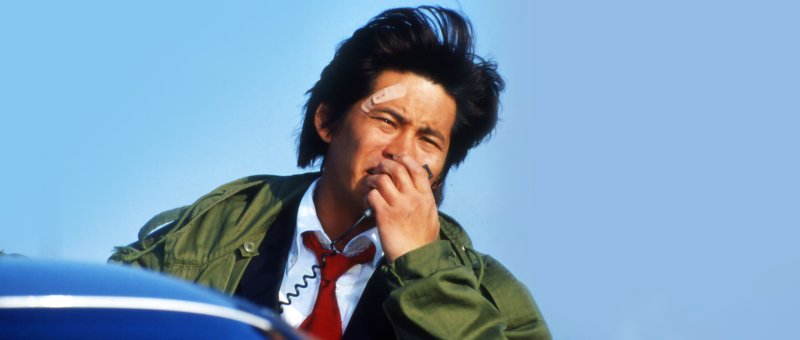

A big screen outing for a popular TV drama, Bayside Shakedown proved a runaway box office hit on its release in 1998. Five years later the team at Wangan Police Station are back and much seems to have changed even as the sequel cleverly mirrors the first instalment, but where the earlier film had satirically taken aim at chronic underfunding and excessive bureaucracy, Bayside Shakedown 2 (踊る大捜査線 THE MOVIE 2 レインボーブリッジを封鎖せよ!, Odoru Daisosasen the movie 2: Rainbow Bridge wo Fuusa seyo!) ultimately ends a defence of authority in the face of criminal anarchy.
Five years on, the team are faced with yet another difficult serial killer case in which top CEOs are being bumped off and artfully posed in public places next to a rotten apple, once again necessitating the arrival of the guys from HQ. This time, however, Muroi (Toshiro Yanagiba), a friend of earnest detective Aoshima (Yûji Oda), has been pushed to the sidelines in favour of the big wigs’ latest favourite, Okita (Miki Maya), who has a much more authoritarian view of policing than many at Wangan are comfortable with. Meanwhile, Sumire (Eri Fukatsu) and Aoshima are busy with their own cases, a pickpocketing family and a “vampire” who bites high school girls’ hair and then runs off respectively, but all the office is a twitter over a love letter penned by their boss and accidentally emailed to everyone in the station because of a computer virus.
Former Wangan guy Mashita (Yusuke Santamaria), who had transferred to the city, returns having trained as a negotiator but for some reason mostly doing profiling and eventually figuring out that their killers are likely disenfranchised salarymen made redundant by their companies amid the backdrop of a stagnant economy. With no hope for the future, they’ve turned against society and started an anarchist revolution as a collective without leaders. “No bosses, no workers. No ordering, no obeying. No firing, no being fired,” they explain of their principle of equality, adding, “when there’s a leader the individual means nothing”. On one level the film sympathises with them in recognising the pressures they’re facing and unfairness of the economic reality, while simultaneously condemning the idea of a horizontal society. “If the leader is good then the group is strong,” Aoshima explains to them though of course they don’t agree.
Then again, he says this immediately Muroi has resumed command in the knowledge that he is a “good” leader precisely because he trusts those under him and gives them the freedom to exercise their own judgement in contrast to Okita whose authoritarian micromanaging is soon exposed as a cover for under confidence. A police officer is seriously injured during an operation because she hesitates to make a decision, while both Sumire and Aoshima are forced to let their suspects escape when Okita orders them to stay at their post trying to protect a woman she has effectively decided to use as bait. “Organisations don’t need emotion,” she insists, later irritated by the officers’ reluctance to follow her command when she simply instructs them to “replace” the critically injured officer as if their life were completely disposable.
Just in the first film, Sumire and Aoshima are forced to question the value of local policing in the face of Okita’s elitism as she tells them that their individual cases can wait because the murder takes priority, describing them as “just local stuff”. “Punch ups and pickpockets, what a waste of police time,” she adds leaving each of them feeling as if their work has no meaning and is not useful to or valued by the community. Aoshima only gets his mojo back after remembering an act of kindness done to him by someone he’d helped in the past, realising that even small things have a positive effect on the society and are always worth doing. That said, he’s not especially sympathetic towards the teenage “vampire” victim largely because he only bit her hair but later gets on the case after more girls turn up with bite marks on their necks.
In the end it is indeed the local which is good, Okita’s failure allowing Muroi to make good on his promise and allow the local police to do their jobs rather than being relegated to boring legwork such as traffic stops and trawling surveillance footage. Despite having rejected the leaderless anarchy of the villain’s horizontal society, Muroi’s first instruction is to “forget rank, forget class” and have everyone work together encouraging the local cops to help them identify the kinds of places only a local would know which might not be on the map and may be a good hideout for the assassins. There might be something uncomfortable in Aoshima’s insistence on the necessity of a leader in the implicit defence of the hierarchal society, but then Muroi is a good leader who can indeed be trusted wield his power well largely because he trusts those below him, while a weak leader like Okita who holds tight to power because they don’t have the confidence to wield it freely is worse than no leader at all. Once again ending on a note of ironic police accountability, Bayside Shakedown 2 takes aim at the inequalities of the modern society but ultimately makes the case for the value of compassionate local policing in which all crimes at least are treated equally.
Original trailer (no subtitles)
 “It’s not all about tofu!” screams the heroine of Akanezora: Beyond the Crimson Sky (あかね空), a film which is all about tofu. Like tofu though, it has its own subtle flavour, gradually becoming richer by absorbing the spice of life. Based on a novel by Ichiriki Yamamoto, Akanezora is co-scripted by veteran of the Japanese New Wave, Masahiro Shinoda and directed by Masaki Hamamoto who had worked with Shinoda on Owl’s Castle and Spy Sorge prior to the director’s retirement in 2003. Like the majority of Shinoda’s work, Akanezora takes place in the past but echoes the future as it takes a sideways look at the nation’s most representative genre – the family drama. Fathers, sons, legacy and innovation come together in the story of a young man travelling from an old capital to a new one with a traditional craft he will have to make his own in order to succeed.
 Windows on Worlds