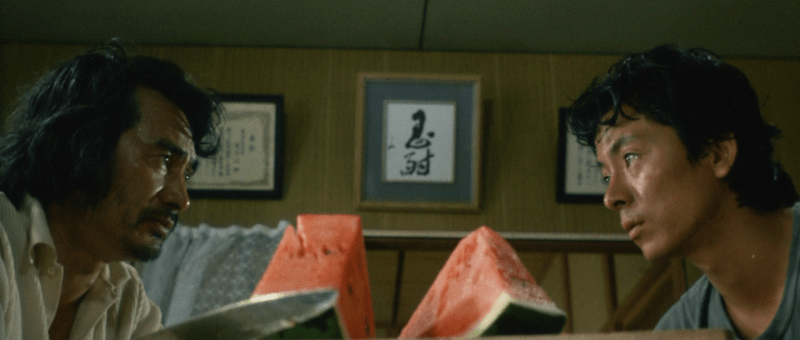
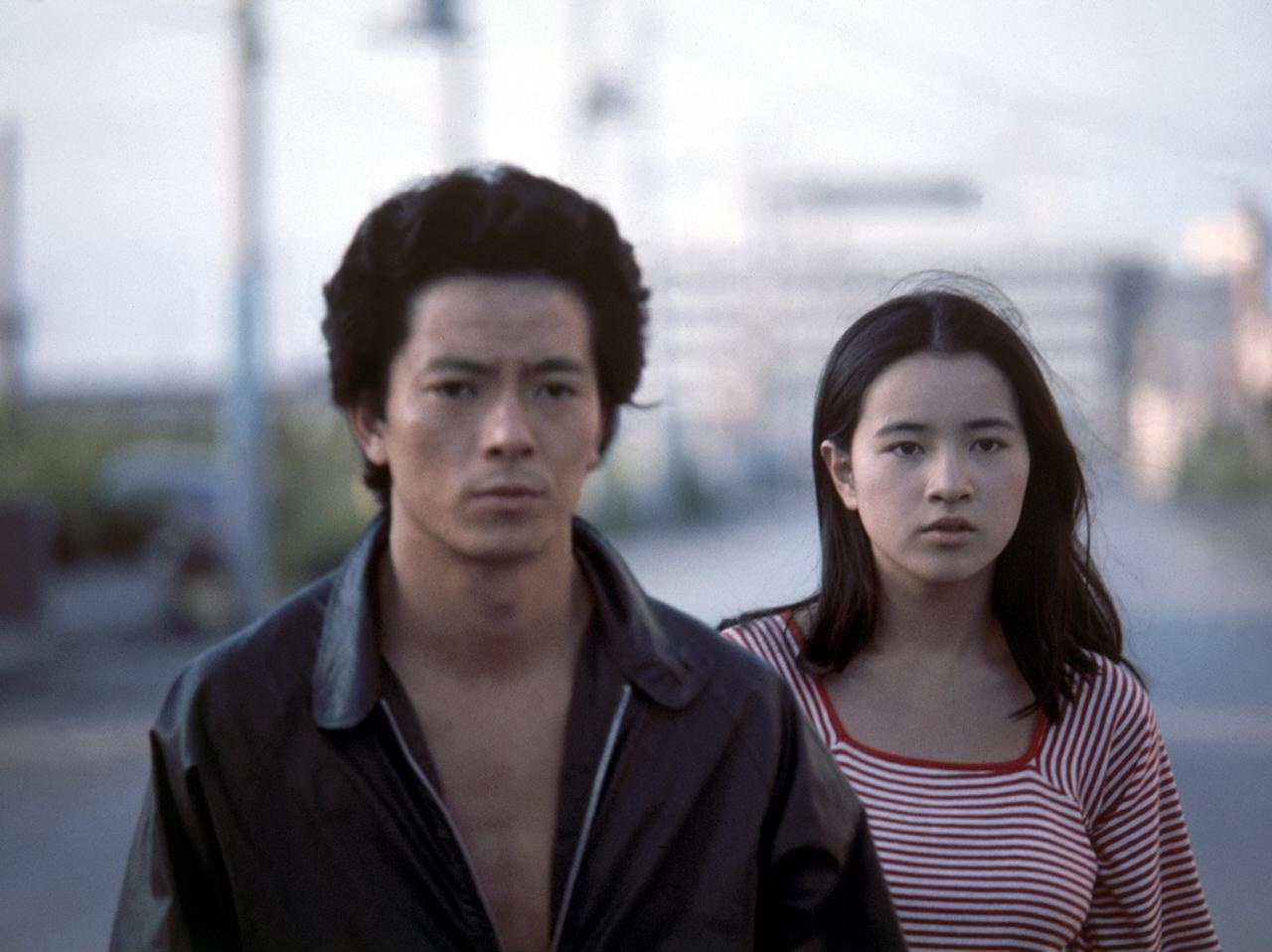
An angry young man railing against “family imperialism” eventually kills both parents in a moment of intense frustration, abandons his girlfriend, and ends up alone, but what he discovers maybe less the freedom he was seeking than only more loneliness and despair. Adapted from a story by Kenji Nakagami that was itself inspired by a real-life case of patricide, Kazuhiko Hasegawa’s The Youth Killer (青春の殺人者, Seishun no Satsujinha) is imbued with the nihilistic sense of powerlessness that coloured the 1970s as its Hamlet-like hero tries to free himself from an oppressive social system only to find it indifferent to his existence.
Part of Jun’s (Yutaka Mizutani) problem is a protected adolescence as evidenced in the opening scenes in which he and his girlfriend Keiko (Mieko Harada) run round playfully reciting nursery rhymes. The irony may be that his name means “pure”, and that he is too thin-skinned to survive in this overly complex world. His father (Ryohei Uchida) stopped him from going to university like many of his friends, preventing him from moving on into a more settled adulthood. He did this, he says, because of the student protests not out of fear that harm would come to him but fear that he would cause it. The farmland surrounding Jun’s parents has been earmarked for Narita airport and despite angry clashes between local farmers and an uneasy alliance with student protesters, will eventually go ahead. Those like Jun are being squeezed off of their land and have nowhere else to turn.
Perhaps sensing his listlessness, Jun’s father gives him the money to open a bar and capitalise ion the new custom from the airport, but this too leaves Jun feeling childish and emasculated, as if it’s his father who will actually be in charge. The two men hug and wrestle, alternately showing affection and tussling for power. His secondary problem is that his parents apparently don’t approve of his girlfriend Keiko with whom he is running the bar. His father has hired a private detective who tells him that Keiko was raped by her mother’s lover resulting in her mother hitting her and causing her to lose the hearing in one ear. Jun’s father does not believe that Keiko was raped and insists that it was Keiko who seduced her mother’s lover.
It seems to have been this fracture point that caused Jun to snap and kill his father, less because of his attachment to Keiko than because of the challenge to his masculinity implied by the suggestion that his girlfriend simply sleeps with anyone she pleases. In fact, Jun doesn’t seem to particularly like Keiko and is wary of committing to relationships owing to his fear of “family imperialism”. He becomes fixated on the question of her deafness, niggled by the possibility she lied about its cause and his father is right. Never examining why Keiko might choose to create a different truth around what happened to her, he in fact tries to rape her himself and is obsessed with tying to find out whether not there was a fig tree near their old home as Keiko says or an azalea as others would have it.
The conflict he has with Keiko is not so different from that with his mother who, on learning of her husband’s death, quickly shifts to protecting her son, but then seizes on it as a chance to claim her own freedom. Sick of the drudgery of working at the family’s auto repair shop, she suggests running away with Jun to start a new life in a new place just the two of them. Her language becomes increasingly romantic before she eventually asks Jun to make love to her. When he eventually kills her, she tells him to stick it in and be gentle as if she were talking to a lover. But she too also doubts him, fearing he means to take the money from the safe and escape alone. Not even maternal love can overcome this kind of cynicism in a society ruled by money.
Hasegawa frames Jun’s progress as a series of confrontations, between his father, his mother, Keiko, and eventually himself in which he discovers he is still a child. He has killed his parents, but has failed to become a man. Sitting on a beach with Keiko he is overwhelmed by loneliness remembering a happy family moment when his father sold ice lollies rather than toiling at the garage. Scenes in his student film contain imagery echoing self-immolations and this is what he eventually tries to do himself in setting the bar on fire with him inside it only to be rescued by Keiko. After fleeing the scene he stows away on a truck and removes the bandage from his hand symbolising the transgression of his parents’ murder, but he is quite literally being driven to a destination not of this own choosing. Rather than freedom in solitude, he’s discovered only loneliness and despair. Condemned to a limbo state, he has nowhere to go and can only travel in circles looking for an elusive exit from this very particular kind of hell.
The Youth Killer screened as part of Japan Society New York’s Kazuhiko Hasegawa’s Anarchic Ethos.


 In the post-
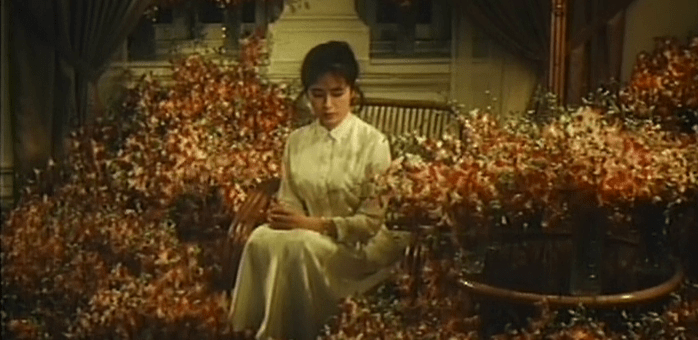
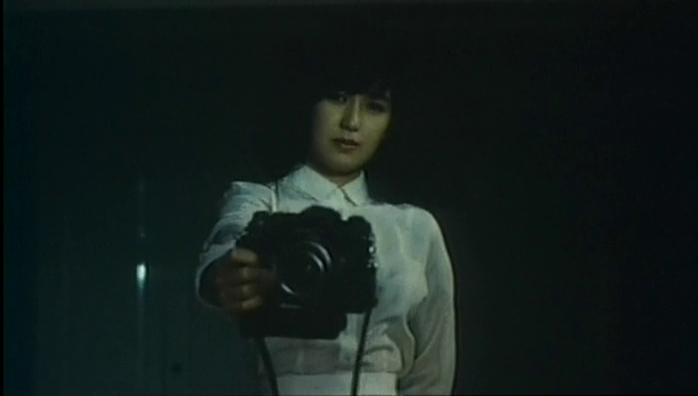
 “It’s not all about tofu!” screams the heroine of Akanezora: Beyond the Crimson Sky (あかね空), a film which is all about tofu. Like tofu though, it has its own subtle flavour, gradually becoming richer by absorbing the spice of life. Based on a novel by Ichiriki Yamamoto, Akanezora is co-scripted by veteran of the Japanese New Wave, Masahiro Shinoda and directed by Masaki Hamamoto who had worked with Shinoda on Owl’s Castle and Spy Sorge prior to the director’s retirement in 2003. Like the majority of Shinoda’s work, Akanezora takes place in the past but echoes the future as it takes a sideways look at the nation’s most representative genre – the family drama. Fathers, sons, legacy and innovation come together in the story of a young man travelling from an old capital to a new one with a traditional craft he will have to make his own in order to succeed.
