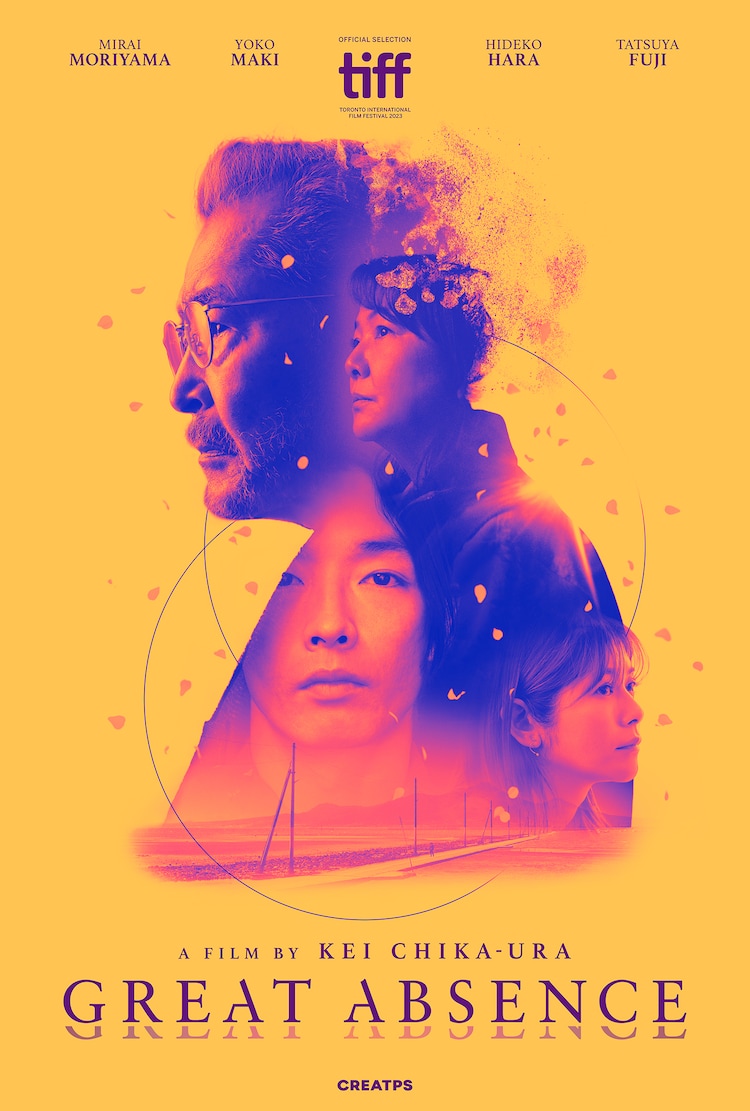
Great Absence (大いなる不在, Kei Chikaura, 2023)

“She’s not here. That’s everything,” is what the hero of Kei Chikaura’s poetic drama A Great Absence (大いなる不在, Oinaru Fuzai) is told when enquiring about the whereabouts of his missing stepmother and in the end is forced to accept it. That’s all there is, she isn’t here. The ways that Naomi (Hideko Hara) is there and at the same time not become central to the narrative in which absence is also of course a deeply felt presence.

That might also describe Takashi’s (Mirai Moriyama) relationship with his estranged father whom he’s barely seen since his parents divorced when he was 12. Yohji (Tatsuya Fuji) was evidently a difficult man, fussy and superior. Every line that comes out of his mouth is delivered as a mini lecture and generally filled with barbed criticism even if that might not really be what he meant to say. That might be why Takashi has stayed out of contact with him, though he has little choice but to respond after being contacted by the police who tell him that Yohji called them claiming he and his wife were being held hostage. Apparently suffering with advanced dementia, Yohji has now been placed in an eldercare facility though no one seems to know what’s happened to Naomi with a vague idea that she had been hospitalised sometime after falling ill and that living alone exacerbated Yohji’s cognitive decline.

Someone later asks Takashi why he came given that with the long years of estrangement no one would have blamed him for saying it was no longer any of his business, but there does seem to be latent desire for some kind of connection albeit one frustrated by awkwardness and the unhealed wounds of the past. Yohji had been a ham radio enthusiast which suggests that he was trying to reach out to people though struggled with communication and only ever found the words in writing as evidenced by the unexpectedly poetic love letters Takashi finds stapled into the diary which once belonged to Naomi but now somehow rests with him. 

Takashi spends much of the rest of the film wanting to return the diary as if he would be abdicating responsibility for it, refusing this particular inheritance along with any curiosity about the man his father is both then and now. In the care home, Yohji believes he is being held prisoner by a foreign power and offers only bizarre and disturbing explanations for what might have happened to Naomi, while attempts to communicate with the sons from her previous marriage are frustrated by longstanding resentment. Takashi’s stepbrother informs them that Yohji refused to contribute to her medical fees claiming he didn’t see why he should though it seems that he is trying to enact some kind of revenge or is seeking compensation for what he feels Yohji took from him. He also blames Yohji for the decline of his mother’s health convinced that the strain of living someone so casually cruel even before the intensification of his dementia eventually caused her to become ill.

He might in a way have a point, though it seems it was absence that also ate away at Naomi as the man who wrote her all those long and profound letters began to slip away, becoming aggressive and irritable. He may not have forgotten her, but also did not quite recognise the woman she was. It may be that it became impossible for her go on living with someone who was no longer there just as Yohji feels the ache of her absence and is mired in the regret and longing of the young man he once was who first let her slip through his fingers. 

This sense of absence may also have crept into Takashi’s own marriage with his wife (Yoko Maki) complaining that he may not have told her what had happened with his father if he had not needed to cancel another family event, nor did he want her to accompany him though eventually she insisted and perhaps succeeds in closing a gap through their shared attempts to unravel the secrets of Yohji and mysteries of the past. The sequences from the play which Takashi is performing that bookend the film, he speaks of a broken king who may not even be a king at all and echoes the sense in which Yohji has finally become absent from himself. At times profound and elegiac, the crisp 35mm photography adds to the sense of ongoing melancholy and irresolvable loss if tempered by an elusive serenity.


Great Absence screened as part of this year’s Toronto Japanese Film Festival. It will also be making its New York Premiere as part of this year’s Japan Cuts on July 18 ahead of its theatrical opening in the US on July 19.
Complicity (コンプリシティ, Kei Chikaura, 2018)

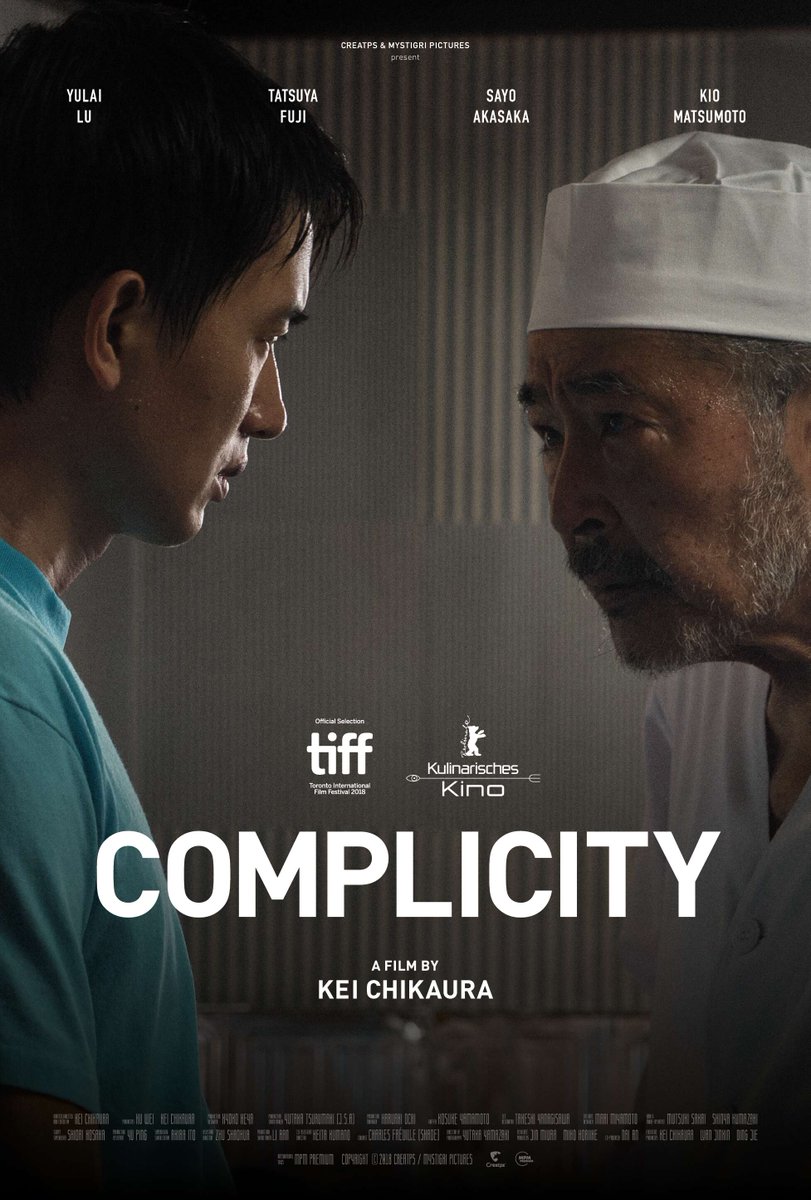
Complicity posterWith an ageing population and an economy trapped in a long period of stagnation, Japan has found itself in an awkward moment of possible crisis as it begins to realise it will need to embrace immigration or face a serious labour shortage. Like many nations, unfortunately, much of Japan remains uncomfortable with the idea of overseas labour especially when it comes to “low skilled” work in construction, manufacturing, and casual jobs such those in restaurants and convenience stores. Given government intransigence and pressing need, workers from other areas of Asia are often employed illegally and subject to exploitation by gangs or unscrupulous employers.

The hero of Kei Chikaura’s Complicty (コンプリシテ), Chen Liang (Lu Yulai), finds himself in just this position as he leaves his sickly mother and feisty grandma alone in rural China in the hope of making enough money in Japan to come home and restart the family business. What he discovers, however, is that he’s essentially been trafficked as cheap labour and is already in hock for an ID card he was conned into paying three times the going rate for on the pretext it was “safer”. Now living under the name Liu Wei, Chen Liang is disturbed to receive calls on his new phone intended for his namesake but is tempted when Liu Wei receives a job offer from an employment agency. Passing himself off as his cover identity, Chen Liang takes the job only latterly realising it’s the rather incongruous position of a trainee chef in a family-owned soba restaurant.

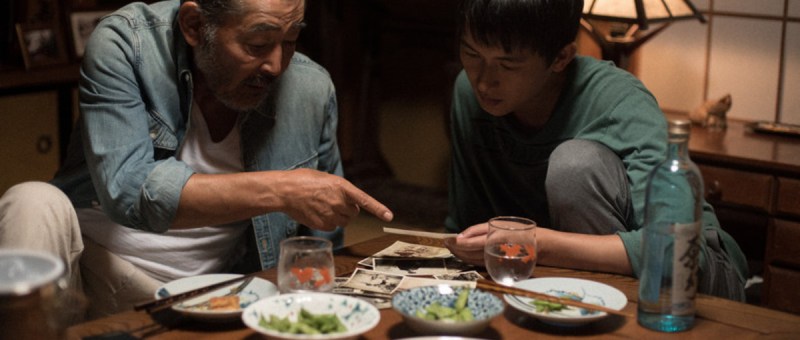
Against expectation, ageing soba chef Hiroshi (Tatsuya Fuji) and his daughter Kaori (Kio Matsumoto) are warm and welcoming people who are actually a little bit excited that someone from China wants to learn about soba. Taken in almost as a member of the family, Chen Liang begins to feel conflicted – he is after all lying to them, at least about his name and circumstances, and his presence in their home might cause them trouble if he is ever found out. Meanwhile, he also strikes up a friendship with an artist who is learning Mandarin but has to lie to her too, pretending they may one day meet up in Beijing when in reality he has never even been there.

His burgeoning romance with Hazuki (Sayo Akasaka) is what precipitates his downfall as she, unaware he is undocumented, reports his stolen wallet to the police. The lies do not stop there – Chen Liang is also lying to his worried mother back at home who thinks he’s working in an office, while she is simultaneously lying to him in pretending everything’s fine in order to facilitate his “happy” life in Japan where he is supposed to make lots of money and come back a wealthy man. In order to make his dream succeed, Chen Liang must become Liu Wei at the exclusion of all else, forsaking his life as Chen Liang and living carefully as if he has nothing to fear.

Chen Liang is onto a good thing and has fared much better than some of his friends who either got themselves picked up by the police for doing the gang’s dirty work or found themselves out in the cold with no feasible way to get back “home”. Hiroshi’s son, with whom he seems to have some kind of bad family history, looks down on Chen Liang unable to understand why his father employed someone from China when the business is on the rocks. His attitude seems to be one shared by many (though not the universally supportive customers in Hiroshi’s soba shop) who see only difference rather than commonality. Despite the language barrier, Hiroshi and Chen Liang are often able to communicate through written characters, while another poignant moment of bonding sees Chen Liang sing the Mandarin lyrics over the top of Hazuki’s cheerful refrain of a popular Japanese song by Teresa Teng beloved all across Asia. Hiroshi himself was born in Beijing at the end of the war – a painful reminder of the complicated history between the two nations, but also one of how much they are interconnected and how little place of birth has to do with cultural identity.

Emphasising how much they have in common rather than the various ways in which Chen Liang differs from the world around him, Chikaura paints a much more sympathetic portrait of a migrant worker than the one usually found in the media. Filling the void left behind by Hiroshi’s own resentful son, Chen Liang becomes a valued and trusted member of the family who are in a sense “harbouring” him but to protect rather than exploit. Pushed to go to Japan despite his misgivings and drifting into the soba shop job through accidental opportunism, Chen Liang had in a sense abandoned his identity in avoiding making concrete decisions. Being Liu Wei was also a way to hide from his insecurities and fears for the future, but only through the unconditional love he received under false pretences is he finally able to reclaim his name, fugitive but free at last. A powerful plea for empathy and cross cultural connection, Complicity is a beautifully drawn character study in which kindness and compassion eventually open new paths for a conflicted young man trying to find his place in an often hostile world.


Complicity was screened as part of the 2019 Nippon Connection Film Festival.

Original trailer (English subtitles)

Teresa Teng’s – Toki no Nagare ni Mi wo Makase

Mandarin version – I Only Care About You