Angel Guts: Red Classroom (天使のはらわた 赤い教室, Chusei Sone, 1979)

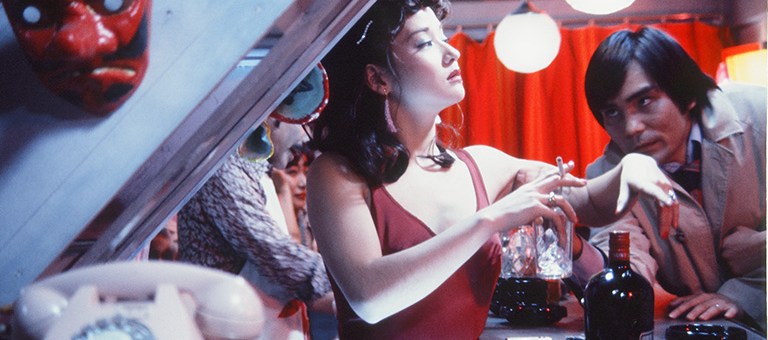
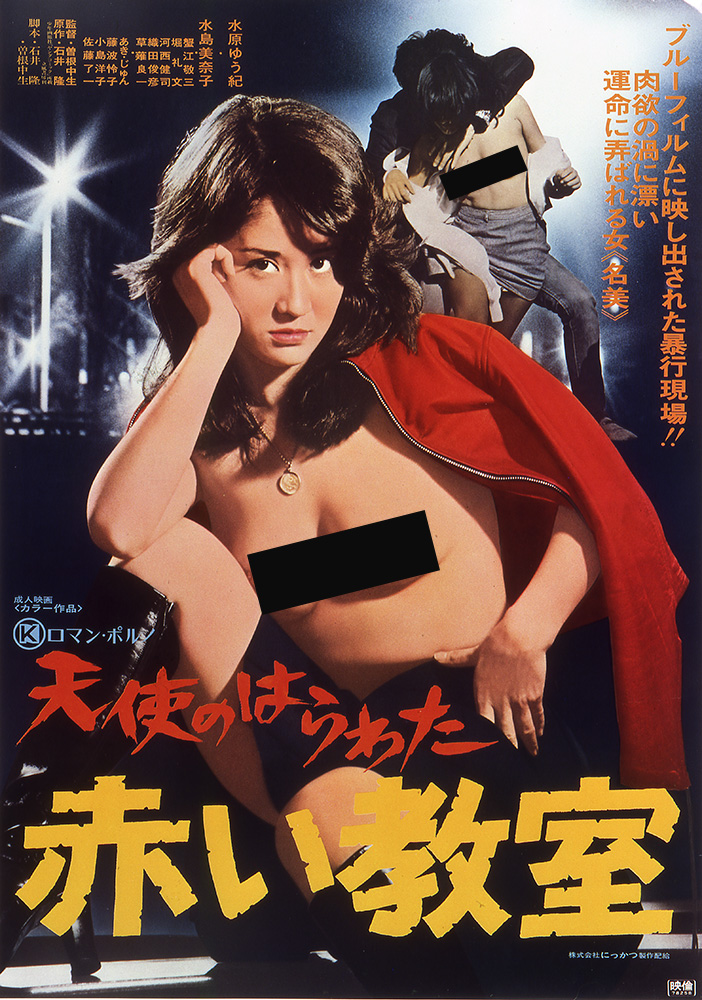
Chusei Sone’s Angel Guts: Red Classroom (天使のはらわた 赤い教室, Tenshi no Harawata: Akai Kyoshitsu) opens with grainy 8mm footage of a woman being gang raped, but this turns out to be a film being watched by the protagonist, Muraki (Keizo Kanie), rather than the one we’re actually watching. Nevertheless, in presenting the footage in this way, the film has made us somewhat complicit in witnessing this woman’s exploitation for the purposes of entertainment. A producer of pornographic magazines, Muraki is captivated by the woman’s ruined innocence and becomes obsessed with the idea of finding her.

Though he says he doesn’t think she belongs in this world, Muraki does not so much want to save Nami (Yuki Mizuhara) as get her to work for his magazine. He declares that years of this kind of work have left him numbed and desensitised. Watching her video was the first time he’s felt moved in years. However, it turns out that this may be because the video wasn’t a movie in which the actress had consented to appear, but raw footage of an actual gang rape committed against a trainee teacher. The implication is that this traumatic incident has numbed Nami in the same way Muraki has been numbed by his exposure to pornography, leaving her with a permanently vacant, inscrutable expression and reducing her to nothing but a sexual object. Though the 8mm “blue movie” is an illegal form of pornography that can be watched only in underground clubs, she claims to have run into several men like Muraki who recognise her and has concluded that the only way to get rid of them is to satisfy their desire by sleeping with them. She says she won’t feel anything anyway, but has scars on her wrist and seems to have turned to potentially dangerous sex with random men as a means of self-harm.

Muraki refuses to sleep with her, but in Nami he seems to be looking for his own buried innocence and masking the shame he feels towards his line of work. His parents think he publishes books for children, he tells Nami, but rants to another woman that his magazines are all the same and he doesn’t know how to make them better. He can’t take the kind of pictures he wants to, because he wouldn’t be able to publish them under the increasingly strict censorship laws. Repeated references are made to the need to avoid showing any pubic hair which is considered obscene under Japanese law, though they’re otherwise free to depict scenes of sexual violence and degradation. Ironically, Muraki is unable to meet Nami at their rendezvous because he’s been arrested for breaking the Protection of Minors Act after having photographed a 15-year-old girl, though Muraki claims he was just trying to help her. He says she told him she was 19, recently arrived from Aomori and had been reduced to shoplifting, so he gave her a job out of the kindness of his heart.

It’s things like this that might have Muraki desperate to prove he’s not “scum” but a good man and an artist rather than a purveyor of pornography and exploiter of women. The film has its cake and eats it too, critiquing female exploitation but simultaneously trading on it, if doing its best to make the viewer feel at least conflicted. Three years later, Muraki is in a relationship with a woman he once exploited who couldn’t let him go and has fathered a child, but the papers are full of news about suicides and domesticity does not seem to him provide much of a refuge. He continues to search for Nami in order to reclaim his innocence, but discovers that she has become a vacant sex worker, ironically working at a bar called “blue” and the plaything of a man in a James Dean-style red jacked who has broken dreams of his own. Unlike Muraki, she has only fallen further, and he is ultimately forced to watch what his business has reduced her to as a group of men set on a captive high school girl like a pack of wolves, ironically echoing the opening sequence. Yet in the end, it’s Nami who frees him by literally showing Muraki the way out of this place as he urges her to leave though she seems to say it’s already too late. Looking at her own distorted image in a puddle, she no longer knows who she is and has no identity that is not forced upon her by a violent male gaze.


Angel Guts: Red Classroom is available as part of The Angel Guts Collection released on blu-ray 23rd February courtesy of Third Window Films.
Funeral Parade of Roses (薔薇の葬列, Toshio Matsumoto, 1969)

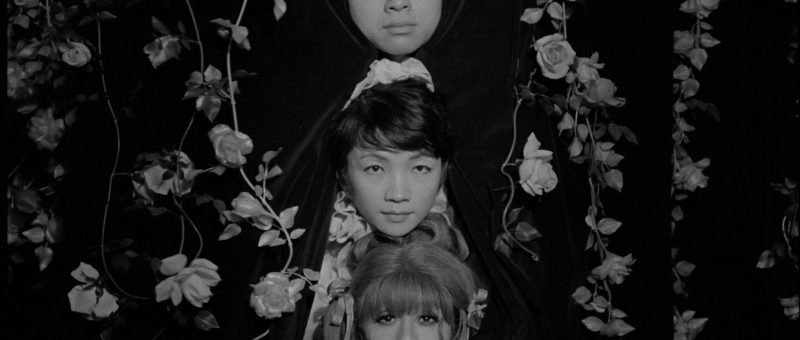
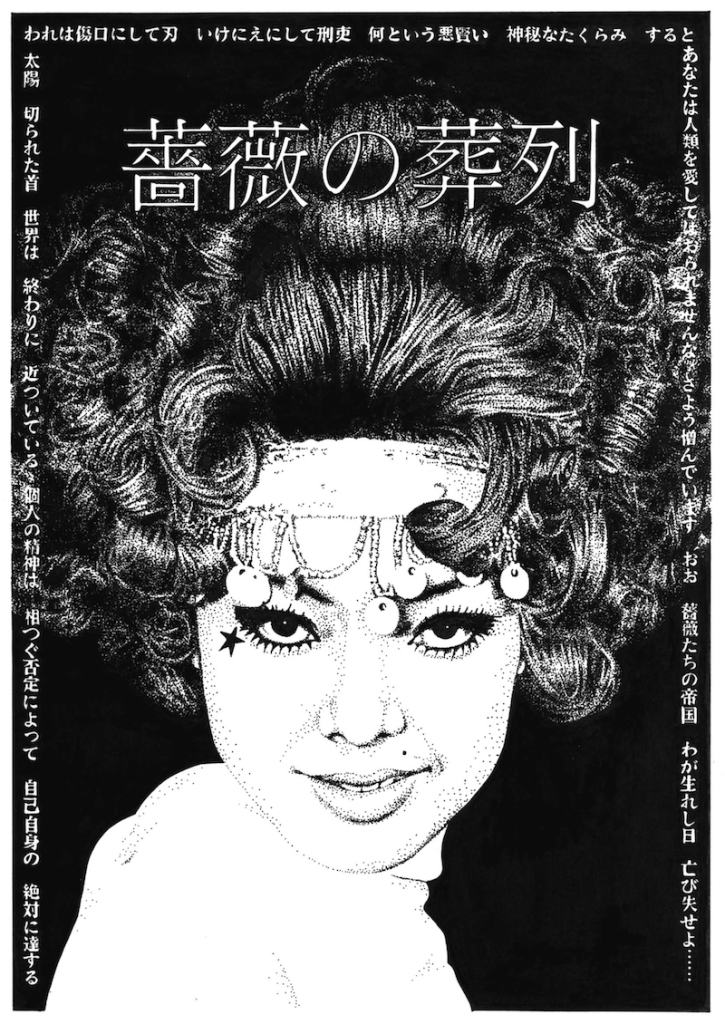
“The spirit of an individual reaches its absolute through infinite negation” according to the title card which concludes Toshio Matsumoto’s anarchic voyage through the counter culture underworld of late ‘60s Tokyo, Funeral Parade of Roses (薔薇の葬列, Bara no Soretsu). Repurposing Oedipus Rex as mediated through Pasolini as an exploration of the crushing impossibility of true authenticity, Funeral Parade of Roses is also an atypical portrait of a city in transition. Like many a post-war melodrama, it’s a story of Tokyo bar hostesses only we find ourselves not in the comparatively upscale Ginza where unlucky women dream of escape into more conventional lives, but the grungier Shinjuku in which those who have no desire to attain conventionality, of that kind at least, have found a kind of freedom to become their truer selves. 

Our hero, Eddie (Peter), is something of an ephebe pursuing his destiny as a “gay boy” (cross-dressing bar hostess) at bar Genet where he has entered a relationship with the much older proprietor, Gonda (Yoshio Tsuchiya), who is growing tired of his current lover, Leda (Osamu Ogasawara), the bar’s mama-san. At the risk of mixing our metaphors, or at least allegories, in Greek mythology Leda was the mother of Helen of Troy, raped by Zeus in the guise of a swan. In any case, the primary crisis is one familiar from any other bar girl drama where Leda might be the melancholy heroine, facing the tragedy of her fading youth and an increasingly uncertain future. We see Eddie leave an apartment arm in arm with Gonda, a hearse passing ominously in front of them, while Leda looks on with scorn perching in front of a street corner convenience store to confirm that her suspicions are in fact correct. 

Leda is or will be the victim of Eddie’s quest for a place of his own, displaced within a world of displacement. She will eventually find her own kind of escape, dressed in a wedding dress and surrounded by white roses but drenched in romantic tragedy. Eddie meanwhile is plagued by visions of a traumatic past and a feeling of alienation. “I feel abandoned by life” he later complains to a counter culture friend, Guevara (Toyosaburo Uchiyama), who has adopted a strange fake beard in addition to his fake name. In the gallery in which Eddie meets him, a record is playing to remind us that we are each wearing a mask and that perhaps our mask may fit us so comfortably that we have forgotten the shape of our own face. We can never be sure if we are seeing those in front of us as they truly are or merely observing the masks they have chosen to wear. Beneath one mask may lie another, and another, into infinity hiding even from ourselves our truest identity in the truest form of loneliness.

Eddie too is searching for himself, though the implication that his present persona is just that may be an uncomfortable one. To undercut it, Matsumoto frequently breaks the fourth wall to interview some of his non-professional actors and other men in the street in this particular corner of Shinjuku. They tell him that perhaps they don’t have a “reason” for becoming a “gay boy”, only that it’s who they are and have always been and in that it makes them happy (aside from one self contradictory woman who gives answers only filled with nihilistic despair). The central thesis, however, is that an identity only reaches its absolute through its own negation, which is to say that Eddie must destroy himself to become himself. Something which he perhaps does on learning the ironic truth to which he was blind that has led him towards his grim destiny. 

A film critic making an unexpected, meta appearance talks to us of the “cursed destiny of man” while Eddie walks through a burial ground sinking into the sea and casually wishes that the whole country would sink to the bottom of the ocean. A student protestor justifies his use of violence as an essential good because it works towards the end of violence and not its perpetuation, but Eddie’s violence solves nothing and eventually becomes an act of self harm that propels him towards his nihilistic destiny. Yet this is a violent age in which opposition is the only sign of life. Eddie rebels against himself to rebel against the society, a rose wounded by his own thorns, whose only refuge lies in the artifice which mirrors authenticity. 


Funeral Parade of Roses is released on blu-ray in the UK on 18th of May courtesy of the BFI in a new 4K restoration. The set also includes an audio commentary by Chris D, the original Japanese trailer plus the US trailer for the 2017 restoration, and eight Toshio Matsumoto shorts including Nishijin (1961), The Song of Stone (1963), Ecstasis (1969), Metastasis (1971), Expansion (1972), Mona Lisa (1973), Siki Soku Ze Ku (1975) and Atman (1975). The two-disc edition also comes with a 34-page booklet featuring essays by Jim O’Rourke, the BFI’s Espen Bale, Hirofumi Sakamoto with Hiroshi Eguchi, and Koji Kawasaki.

Original trailer (English subtitles)