
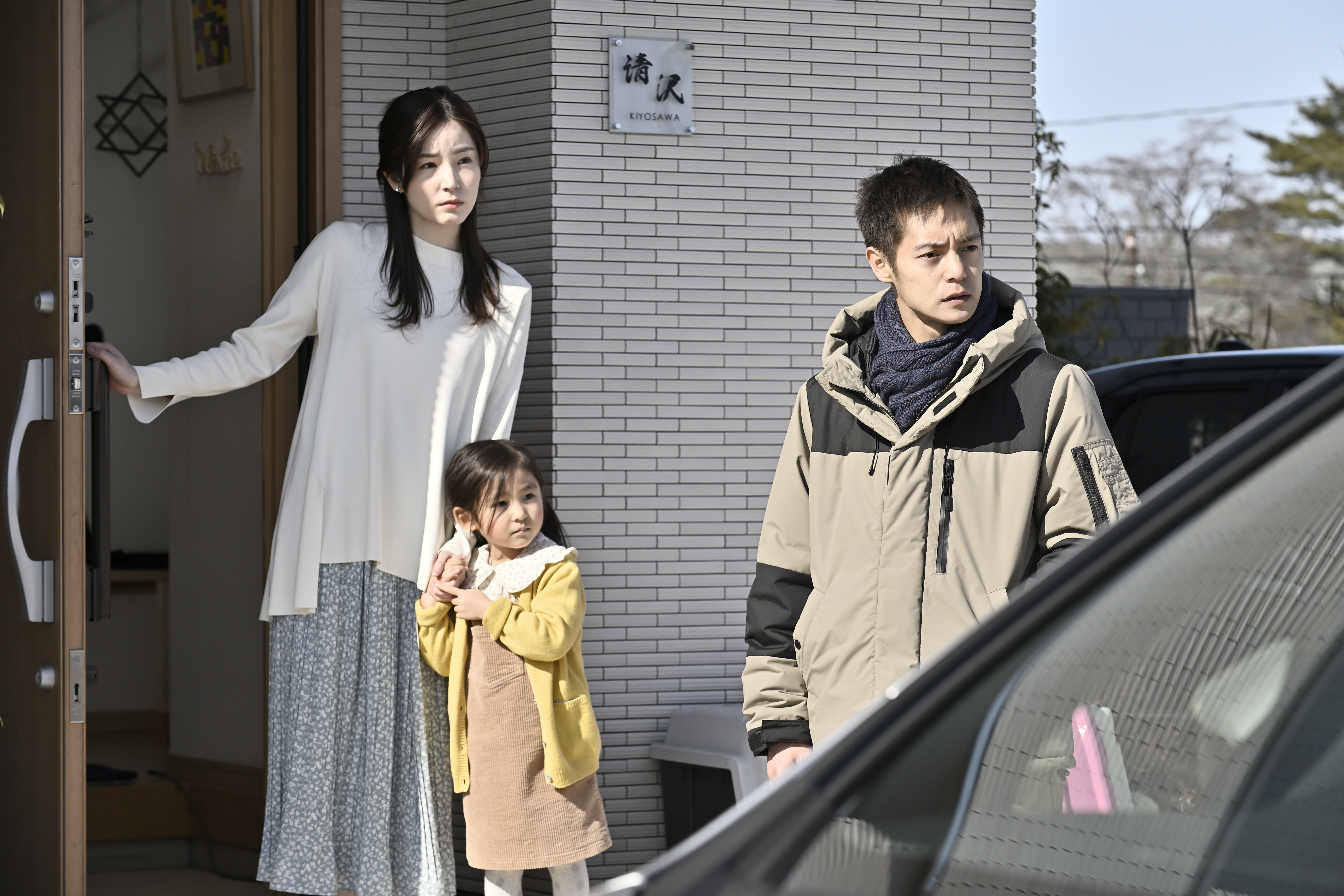
“The secret is in the basement” is not a phrase which inspires confidence when viewing a potential new living space, but as it turns out the cellar is the least of their worries in Takumi Saitoh’s eerie adaptation of Rinko Kamizu’s mystery horror novel, Home Sweet Home (スイート・マイホーム). The Kiyosawas are just looking for somewhere warm where they can enjoy life as a family in comfort and security, but if something sounds too good to be true then it usually is as they will discover to their cost.
The saleswoman at Magic Homes describes the Kiyosawas as “the ideal family” for whom she is glad to build an “ideal” home. To many they may look “ideal” in that husband Ken (Masataka Kubota) has a steady job as a personal trainer while wife Hitomi (Misako Renbutsu) is a stay at home mum to four-year-old Sachi. But of course nothing’s quite as it seems and there are already cracks in the foundations of this happy family home as Ken has been having a years’ long affair with co-worker Yurie (Ririka). After finally deciding to take the plunge on the house, the affair comes to a natural end point as Yurie too decides to marry her longterm boyfriend with the aim of starting a family. But not long after the Kiyosawas have moved in to their new “magic home” complete with new addition Yuki, Yurie’s husband receives a video showing an unrecognisable Ken entering her apartment with the presumed motive of blackmail lending a note of anxiety to his moment of familial bliss.
To begin with, the house itself takes on a eerie quality especially with the ominous rumble of the single AC unit in the pitch-black basement. The home does not seem to have been particularly well thought out for families with small children as the tiny doors leading to the hatch are at a toddler’s height and don’t appear to have any kind of safety locks in place. Everything else is run off the central smart system including a network of CCTV cameras sold to the family as a convenience that would allow them to keep an eye on the children wherever they might be in the house while getting on with other things, but also undoubtedly a privacy worry and no one likes to feel watched in their own home. Watched is exactly how they start to feel, Hitomi convinced someone’s been in the house while looking around realising how many vents and ducts there are ominously staring down at them in every room.
Ken’s brother Satoru (Yosuke Kubozuka) is suffering with a mental illness that makes him paranoid, repeatedly insisting that there are people watching them and they need to protect the family because they are everywhere in the ceilings and the floors. Though it first seemed to us that the house was the problem, the family’s desire for conventional suburban living biting back at them, we wonder if the problem is Ken and his reckless endangerment of his family through his affair. When first viewing the house, the couple had been accosted by a creepy salesman, Amari (Yohei Matsukado), who makes barbed remarks about looking after the family that have Ken suspecting he’s got it in for them because they chose someone else to handle their sale or perhaps resents them for not being “ideal” enough to live in one of his “magic homes”.
But then what is the “ideal” family, who gets to decide that? Why should the Kiyosawas have to fulfil a stereotypical ideal just to be judged worthy of homeownership? There might be something chilling in the uniformity of the house’s design, a utopian vision of suburban bliss founded on outdated patriarchal social norms of the nuclear family though in this case slightly adjusted for a new era, but then again the call is coming from within the house in more ways than one in Ken’s delayed response to traumatic childhood incident and concurrent anxiety around being able to protect his family in fulfilment in the social “ideal” for fatherhood. It’s the “ideal” that is the true enemy from the generic house design to the unfair expectations placed on the Kiyosawas to live up to a particular kind of suburban properness in order to qualify for the right to live there. Paranoid and eerie, Saito conjures a world of constant tensions in which we are all being “watched” if not to say judged and any bug in the system must be quickly removed so that the “ideal” may prevail.
Home Sweet Home screens July 27 as part of this year’s New York Asian Film Festival.
Original trailer (no subtitles)
Images: ©2023 Rinko Kamizu, KODANSHA Ltd./ “Home Sweet Home” Film Partners
 Windows on Worlds