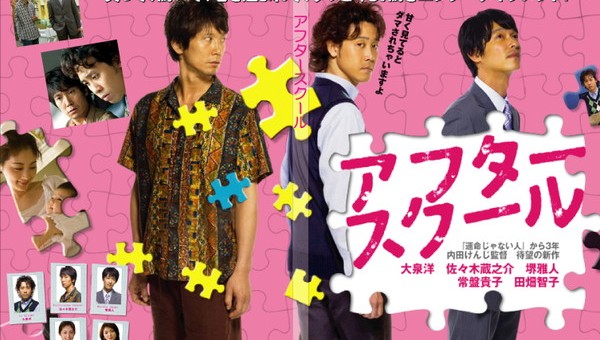
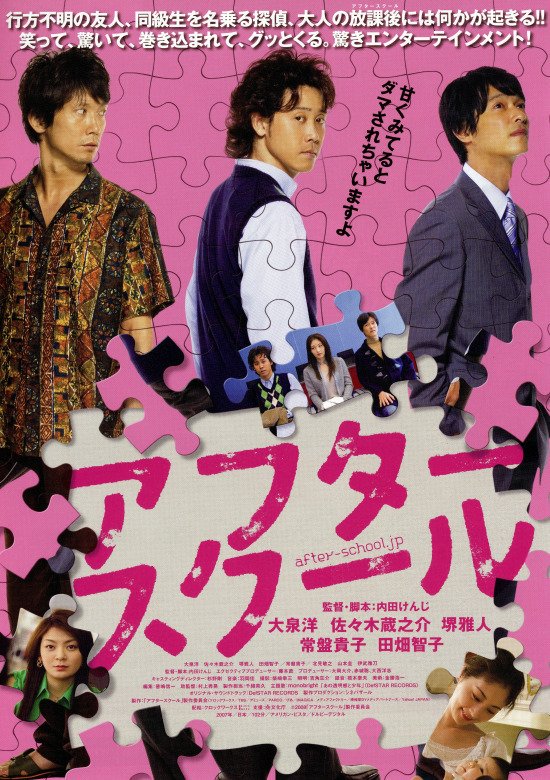
 Kenji Uchida is well known for intricately constructed farces but he takes intrigue to new heights in After School (アフタースクール), allowing a mid-way twist to completely reverse everything you thought you knew. Yet at heart Uchida’s film is as uncynical as it’s possible to be even when our heroes find themselves embroiled in a large-scale conspiracy of corporate corruption, organised crime, and police machinations. What begins with a confession spirals outwards into a complicated web of deception and counter-deception proving it really is all connected, even if not quite in the way you first thought.
A salaryman, Kimura (Masato Sakai), enters a reverie staring at the pregnant woman (Takako Tokiwa) sitting opposite him over breakfast, flashing back to a breezy middle school day when she (presumably) nervously handed him a letter. Kimura leaves for work and borrows the fancy Porche belonging to his high school teacher middle school friend, Jinno (Yo Oizumi), to go to a work meeting in Yokohama. While he’s away the woman goes into labour leaving Jinno to take care of everything but alarm bells start ringing when no one can reach Kimura the following morning. Meanwhile, Kimura has been seen with a mysterious woman at a hotel which seems to have right royally spooked his bosses who have hired a shady private detective, Kitazawa (Kuranosuke Sasaki), to track Kimura down. Kitazawa thinks his best bet is to start at Kimura’s old middle school – which is where he runs into Jinno who agrees to help look for his friend.
As might be assumed, all is not quite as it seems. Shady PI Kitazawa is in deep with the yakuza to whom he apparently has massive gambling debts. At a low ebb, he decides to ask his male assistant to run away with him to Sapporo (which he agrees to do) but this case just might be his salvation, especially once he works out that both ends are connected and he could technically double his pay out with a little strategic blackmail. Kitazawa is as cynical as they come. He thinks nothing of invading Kimura’s life and is fully prepared to make use of Jinno’s seeming innocence, claiming that naivety and pureheartedness make him sick. Later he attempts a pathetic act of petty revenge against Jinno for no real reason that could have ruined his entire life but instead ends up another cog in the grand wheel of Uchida’s finely crafted farce.
Kitazawa’s cynicism is eventually what leads to his downfall. His detective brain so wired for motives and gains is unable to process the idea that some actions are merely altruistic and offer no further reward than the pleasure of helping a friend. Jinno, at first a goofy school teacher with an improbably expensive car, soon becomes the film’s MVP and the only still point in a constantly turning world. Taken to task by Kitazawa for his continuing goodness, Jinno offers a perfectly schoolmasterly reply to the effect that there’s a snotty kid like him in every class, sneering away too cool for school and decrying everything as boring when really the problem isn’t school, it’s Kitazawa.
What eventually looked like a sordid affair turns into a beautiful romance as the truth is gradually revealed. The title refers not just to the setting of the initial flashback, but also to the entirety of adult life. Jinno’s innocence and goodness are belittled by Kitazawa who accuses him of being stuck in middle school with a childishly naive way of seeing the world. This is in a sense true, Jinno has never lost his childlike sense of justice and fair play, willing to go great lengths to help his friends even if it puts him in danger and forces him into some sticky situations which are not his natural milieu, but Jinno’s faith and loyalty are the qualities which eventually see him through and make possible the poignant, hopeful ending despite all that has gone before. Corrupt politicians preaching “family values” whilst associating themselves with dodgy corporations who are taking back handers from the yakuza, hidden policemen, shady PIs – there’s certainly a lot of darkness here but if anything is going to beat it, it’s sincerity and goodness rather than guile and cunning.
Screened as part of the Japan Foundation Touring Film Programme 2018.
Screening again:
- Queen’s Film Theatre – 18 February 2018
- Filmhouse – 6 March 2018
- Showroom Cinema – 18 March 2018
Original trailer (no subtitles)
 When it comes to intelligent farce, Kenji Uchida is Japan’s undisputed master so remaking his 2012 tale of love, crime, and mistaken identity Key of Life was always going to be a tall order. Thankfully it’s one Lee Gye-byeok largely manages to meet as he skilfully relocates the tale to South Korea and swaps Uchida’s complicated farce for a more lateral double sided comedy. While not as accomplished as Uchida’s hilariously intricate original, Luck-key (럭키) manages to charm with its thoroughly romantic, comically absurd, approach.
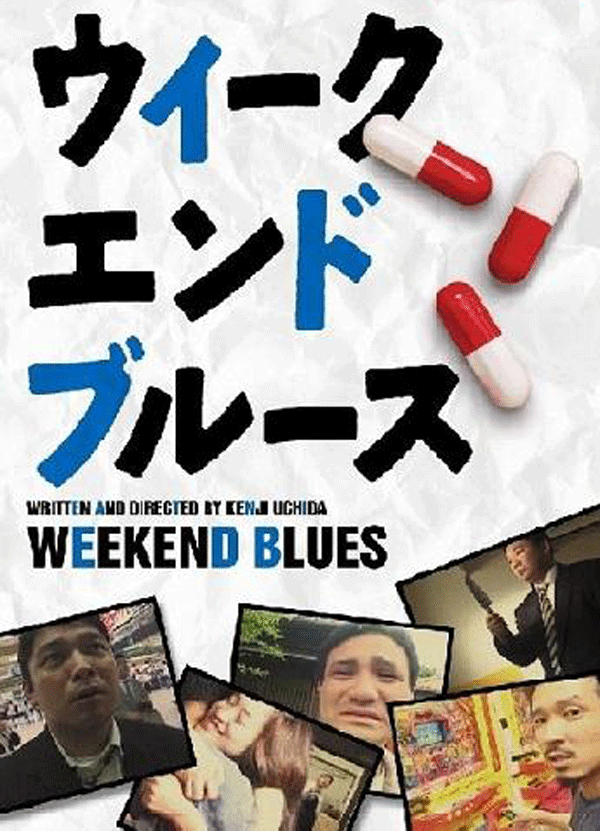 Kenji Uchida travelled to America’s San Fransisco State University to study filmmaking before returning to Japan and making this, his debut film, Weekend Blues (ウィーク エンド ブルース) which later went on to claim two awards at the prestigious Pia Film Festival for independent films earning him the scholarship which enabled his next film,
 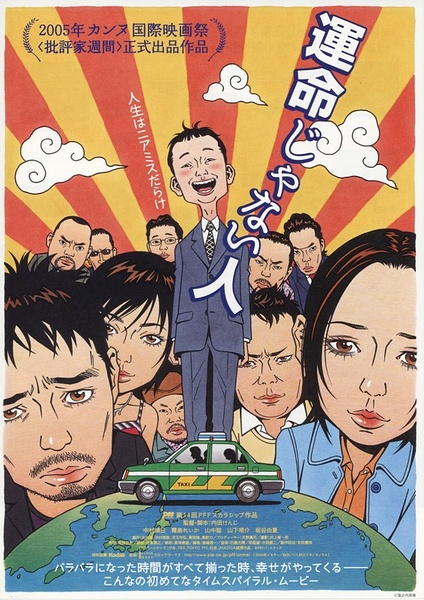 Sometimes life throws you a pretty crazy night but unbeknownst to you the whole world has gone crazy too. For the disparate group of people at the centre of Kenji Uchida’s A Stranger of Mine (運命じゃない人, Unmei Janai Hito) , this proves to be more than usually true. A cute romantic encounter may end up going in a less than cinematic direction while ex-girlfriends, detectives and even the yakuza all conspire to frustrate the lovelorn dreams of a nice guy businessman who never even realises the total chaos which is ensuing all around him.
 Windows on Worlds