Kiju Yoshida: Love + Anarchism

133365_frontGeneral review of Arrow’s Kiju Yoshida: Love + Anarchism box set up at UK Anime Network.


Kiju (also known as Yoshishige) Yoshida is one of the primary names in Japan’s 1960s art movie boom though he’s comparatively unknown and, in fact, little seen outside of Japan. Though some of this is down to Yoshida’s fierce self ownership of his own back catalogue, this new HD blu-ray box set from Arrow Films is the first time any of his films will be readily available with English subtitles. Titled Love + Anarchy, the box set includes both the original director’s cut of Yoshida’s magnum opus Eros + Massacre as well as the shortened theatrical cut of the film, his examination of ’60s radical leftist politics in Heroic Purgatory and his look at a failed ‘30s rightist insurrection in Coup d’Etat.

Eros + Massacre is the film Yoshida has become best known for and the one with which he is most closely associated. The film tells two parallel stories beginning with the 1960s students Eiko and Wada who are running an extra curricular research project into the lives of a group of Taisho era anarchists including feminist Ito Noe and poet Osugi Sakae who was an early exponent of free love which is something that particularly interests Eiko. The Taisho era scenes are less a historical examination than they are the results of the research project conducted by Eiko and Wada and so are a sum of their refracted perceptions. The film is full of surrealistic touches like the Taisho characters suddenly turning up in modern day Tokyo or unexpected scenes of expressionism breaking in without warning. A fantastic example of ‘60s avant-garde cinema, Eros + Massacre is a film which should have been more widely seen and now hopefully will be.

The first question – why two versions? The answer is not the one you’re thinking of. Though the film is undoubtedly long at over 3.5hrs, Yoshida largely financed the film himself and intended to release it in his original version. However, though Ito and Osugi were assassinated along side Osugi’s six year old nephew in the chaos following the Great Kanto Earthquake in 1923, another of Osugi’s mistresses, Kamichika Ichiko, was still very much alive (though obviously an old woman) and a serving politician. She got wind of the film and after seeing it threatened to sue over her portrayal. Yoshida voluntarily recut the film to minimise her scenes, renamed her character and exhibited the shortened version to great acclaim. Though the director’s cut is truest to Yoshida’s vision, even in the shortened version his artistry shines through.

The second film in Yoshida’s “political trilogy” is the even more avant-garde Heroic Purgatory. Far less accessible than the other two films in the set, Heroic Purgatory spans three distinct time periods from the recent past to the present and the near future and focuses on the current Japanese leftist movement with particular reference to its opposition towards the renewals of the Japanese and American mutual defence treaty. However, what all of this really amounts to is paean to love and marriage. Full of strange and beautiful photography Heroic Purgatory is the iconic avant-garde film. Which is to say it’s undoubtedly difficult, inscrutable and perhaps more experienced than understood.

By contrast Coup d’Etat is the most straightforward of the films presented. Marking the only time in his career where Yoshida was not involved in the screenplay, the film moves across the political divide and examines the final days of right wing intellectual Ikki Kita. Ironically enough, the thrust of the film concerns an attempted political coup by a group of young army officers who disapproved of the government’s treatment of its people and particularly of its failure to properly provide for the poor. Their revolution was in the name of the emperor, they merely wanted to eject the sitting government. Despite his repeated protestations and lack of direct involvement in the planning of the coup, Kita still paid the price as his stature and the influence of his writings were simply too strong making him a dangerous individual and a pretty fitting scapegoat. The last film Yoshida would make with ATG (and in fact the only one which was entirely produced with them), Coup d’Etat retains his characteristically complex imagery even if it ejects his surreal storytelling style. It also loses his wife, Mariko Okada, but gains the towering presence of star character actor Rentaro Mikuni.

Available for the first time with English subtitles and in HD this new box set from Arrow Films is a long overdue opportunity to finally witness the challenging yet hugely important work of this hitherto neglected filmmaker. Yoshida’s work is not easy to digest (it will also help to have a little knowledge of 20th century Japanese history or to make careful use of the excellent essays included with the box set) but is always beautiful. The unseen genius of the ‘60s avant-garde art scene, Yoshida is an uncompromising figure which may be why it’s taken so long for work to reach us, but now that it has, it’s an opportunity that should not be ignored.


Links to individual reviews of each of the films:


Coup d’Etat (AKA Martial Law, 戒厳令 Kaigenrei, Kiju Yoshida 1973)
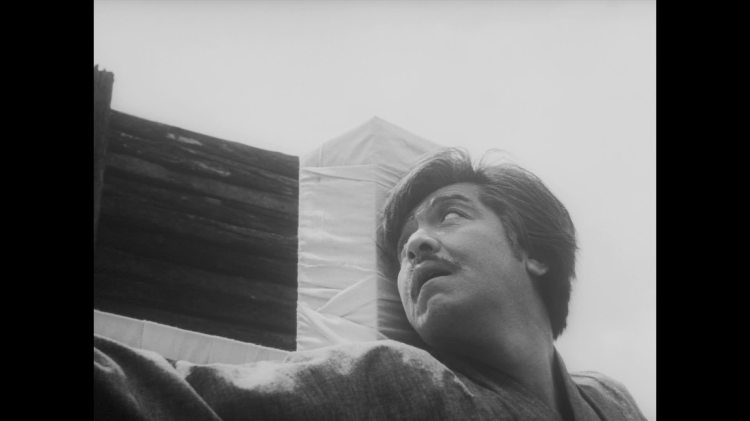
Snapshot-2015-11-18 at 01_34_49 PM-1660087891Having taken avant-garde story telling to its zenith in Heroic Purgatory, Yoshida returns to the realm of politics with a far more accessible effort in Coup d’Etat (AKA Martial Law, 戒厳令 Kaigenrei). Inbetween the two films, Yoshida had made another more mainstream offering, Confessions Among Actresses, which had been moderately successful with both audiences and critics but with Coup d’Etat he came back to the artistic fare he’d been pursuing since leaving Shochiku. Unlike the other two films in Arrow’s Love + Anarchy boxset, Coup ‘Etat deals with a right wing rebellion rather than the communists and anarchists which are more familiar to the post-war world.
The film begins with a nervous young man brutally stabbing an elderly businessman in the street before taking his own life. On claiming his remains, the man’s sister finds a letter addressed to Ikki Kita – a well known right wing intellectual in favour of the institution of martial law. Kita, or more particularly his work, becomes a figurehead for a putative revolution organised by young army officers who have become disillusioned with the elected government, its plans for increasing Westernisation and treatment of the poor. They seek to overthrow parliament and put the Emperor back in charge for a kind of paternalistic socialist state. Kita remains on the fringes of this movement, coming into contact with a young soldier who wants to join the revolution and advising him but repeatedly making it clear that he is not involved with the coup itself. Nevertheless, even if not directly involved, Kita will still pay the price for his radical ideas.

Less an examination of the historical events of the time or the coup itself, Coup d’Etat is a psychological portrait of Kita’s last days. Marking the only time Yoshida was not involved in the screenplay (this time leaving things entirely to playwright Minoru Betsuyaku) the film follows a much more linear structure rather than playing with time in the same way as Eros + Massacre or Heroic Purgatory. Kita had written a hugely influential book which advocated moving to a system of martial law under the paternalistic care of the emperor alongside nationalisation of industries, minimisation of private property and a better welfare state. However, Kita is a public intellectual not an activist. He takes no personal part in the armed struggle (though he is aware of each of the actions and close to the people who facilitated them), yet still he pays the price. Whether this is an indictment of his lack of physical commitment to the ideals that he spoke of, or an indictment of a system which seeks to shoot the messenger is up for debate but in any case Kita is “betrayed” by the very same emperor that he worshipped as a god.

Having said that, it’s Emperor Meiji who hangs on Kita’s wall. What Kita and the officer class wanted was a “Showa Restoration” in line with the “Meiji Restoration” but almost the reverse as they returned to a form of paternalistic government where personal freedoms were restricted but everyone was well cared for. We actually don’t learn a lot about Kita during the film (a strange thing to say about a “biopic” which is often how the film is described) but it seems that he had a strict childhood in which he was prohibited from feeling fear – each time a boy was a afraid, he was supposed to cut himself as a punishment. Yet Kita is afraid and this tension between intellectual thought and irrepressible emotion is one that restricts his physical actions to the point that he remains a solitary figure entrapped by his own ideology. That he is then betrayed by the very figures that he sought to exult is the very highest form of tragedy and it’s difficult not to believe that the real coup d’etat is being perpetrated against Kita himself.

Perhaps because of its relative narrative simplicity, Coup d’Etat is a visual masterpiece taking Yoshida’s especial gifts for composition to new heights of beauty. Once again shot in black and white 4:3 Academy ratio, the film is an unsettling maze of shadows and light coupled with uncomfortable angles and a musical score that’s almost like a science fiction film. Yoshida’s prognosis is indeed bleak – the young soldier for example who’s unable to carry out his part of the mission and eventually falsely confesses to having been a spy simply because he felt insignificant and wanted to be a part of something is symptomatic of the self-centred ineffectuality of the younger generation. Once again, youth has been evaluated and found wanting though age doesn’t fare much better in the end. The filming of Coup d’Etat was delayed for sometime as Yoshida underwent an operation to remove a tumour from his stomach. His ultimate satisfaction with the film and the feeling of having come to the end of a cycle coupled with the need to recuperate more fully kept Yoshida away from the director’s chair until 1986 though he’d never return to it with the same intensity as in his political trilogy.


Available now on blu-ray in the UK as part of Arrow Films’ Kiju Yoshida: Love + Anarchism box set.

Scene from near the end of the film:

http://www.youtube.com/watch?v=L4A0rZwpOqc

Reviews of the other movies in the set:

Heroic Purgatory (煉獄エロイカ, Kiju Yoshida, 1970)

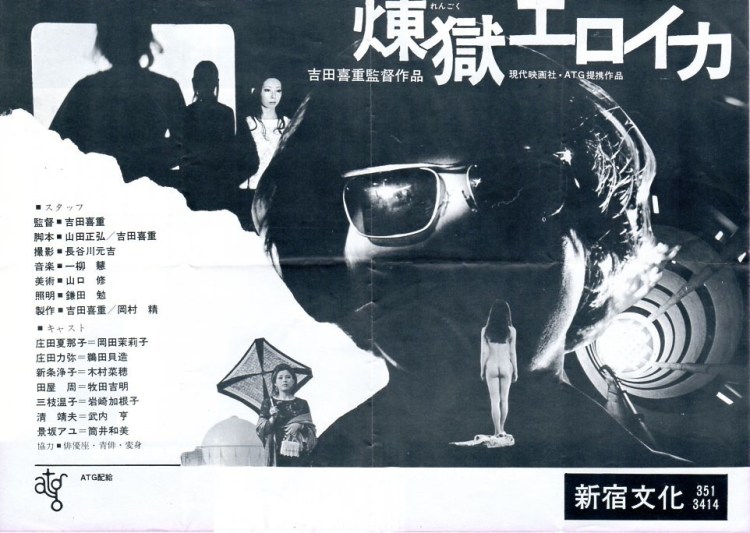
Heroic Purgatory PosterThe second film contained within Arrow’s Kiju Yoshida boxset is perhaps his least accessible. Ostensibly, Heroic Purgatory (煉獄エロイカ, Rengoku Eroika) is an examination of leftist politics in the years surrounding the renewal of the hugely controversial mutual security pact between Japan and America. However, it quickly disregards any kind of narrative sense as time periods blur so finely as to leave us with no objective “now” to belong to and characters switch identities with no warning or discernible reason. Yoshida is not really after objective truth here – there is no truth in cinema, film lies repeatedly until it finally exposes the truth.
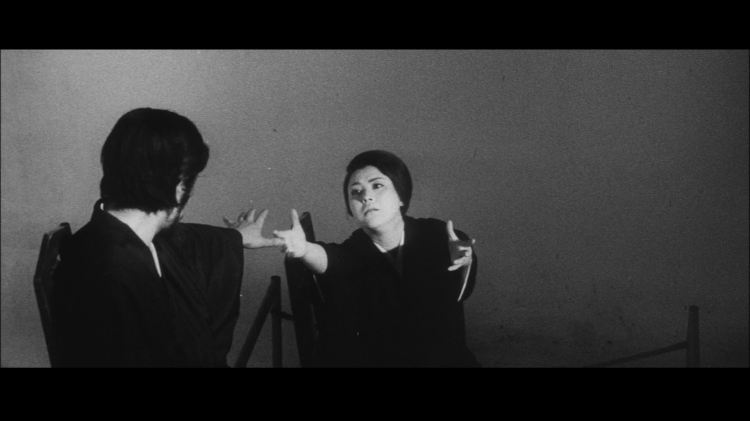
What there is of a plot begins with the scientist Rikiya Shoda who, it seems, may have been a part of a left wing activist group in the ‘50s who were intent on assassinating an ambassador but may or may not have had a mole in their midst. Now, in the contemporary ‘60s era his quiet life is disturbed when his wife, Nanako returns home with a distressed teenage girl who begins insisting Rikiya and Nanako are her parents. Sometime later another man arrives claiming to be Ayu’s father – he’s even installed a spy cam on her because this is apparently something she does quite often. The “father” eventually leaves without Ayu but then we jump back to the ‘50s where Rikiya and the “father” seem to be part of the same left wing cell but for some reason did not recognise each other in the modern part of the film. There are repeated interrogations regarding a spy, confessions, reversals, executions and betrayals but where does it get us in the end?

There’s no making sense of Heroic Purgatory, that’s not really what it’s about. It’s the very essence of avant-garde, gently eschewing literal narrative in favour of a deeper meaning. At the end what we’re left with is a scientist who professes love to be the highest calling and a wife who answers the question “what do you do when your husband’s working?” with “Think about my husband”. This isn’t some kind of anti-feminist statement in so much as a defence of a thirty year marriage which has, apparently, survived all this chaos. What has clearly perished is the left wing student movement which has ultimately failed to instigate any real kind of social change. The film wraps itself around the dates at which Japan’s defence treaty with America was or would be renewed – something to which the leftwing movement was completely opposed to and failed to prevent. Not only did they not succeed in breaking the American security pact in the ‘50s but interest in the protests themselves slowly dwindled. The film ends with a sign reading “Dead End” which you can only read as being in reference to the eventual demise of armed leftwing rebellion in Japan.

Though Heroic Purgatory is in no way Yoshida’s most easily digestible effort, it may be one of the most beautiful. Shot in 4:3 academy ratio and in glorious black and white with Yoshida’s preference for over exposure, every scene of Heroic Purgatory drips with elegance in its exquisite framing. Yoshida pushes focus to the bottom of the frame, rarely having anything other than empty space above the halfway line. Further adding to the sense of pressured claustrophobia and confusion, Yoshida’s gift for strange compositions is the perfect match for his dreamlike, incoherent, floating tale. Pushed to the edges of the frame, the actors are literally left with nowhere to run in Yoshida’s largely industrial wasteland of a stage set.

The film begins with what looks like a suicide, but turns out not to be. Accompanied by violent, stinging music, we’re trained to expect something terrible to have happened though once again Yoshida has fooled us with clever camera trickery. The music throughout is more like something from a horror film, low level thrumming strings and brief breaks of choral singing set us on edge and make us even more uncomfortable than we already were.

Heroic Purgatory is a poem of beautiful incomprehensibility. Strange and elliptical, the film is visual experience which demands emotional over intellectual engagement. Beautiful, fascinating and ultimately inscrutable Heroic Purgatory is a film that haunts with its refusal to explain itself and is likely to reverberate in the mind long after the final credits have rolled.


Available on blu-ray and DVD as part of Arrow Films’ Kiju Yoshida: Love + Anarchism box set.

Original unsubbed Japanese trailer (slightly NSFW – contains nudity)

http://www.youtube.com/watch?v=544O9Nj4-ks

Reviews of the other movies in the set:

Eros + Massacre (エロス+虐殺, Kiju Yoshida, 1969)

Snapshot-2015-11-17 at 11_12_15 PM-1889818228One of the foremost avant-garde filmmakers of the New Wave era (though he detested this term which, in fairness, is a retrospective and often arbitrary label), Kiju (Yoshishige) Yoshida has remained largely unseen in the West. Some of this is his own fault – fiercely independent, Yoshida nevertheless found himself working with ATG after leaving Shochiku but the relationship was an unusual one and often far from easy. All but the latest film in Arrow’s Kiju Yoshida boxset, Coup d’Etat, were completed more or less independently and only distributed though ATG and as such not truly “ATG” films. Though it bears many of the hallmarks of a late ‘60s ATG movie, Eros + Massacre (エロス+虐殺, Erosu Purasu Gyakusatsu) is one such effort and the one which helped to make Yoshida’s name even if it was only seen in an abridged version.

Structurally complex, Eros + Massacre mixes the world of the Taisho anarchists, Osugi Sakae and Ito Noe, with the contemporary Tokyo of the sixties through the prism of two modern students who are running a research project into the events surrounding their ultimate assassination during the panic after the great Kanto Earthquake of 1923. Eiko is a sexually liberated modern woman who engages in casual prostitution and her boyfriend, Wada, is a sexually impotent young man with a traumatic past and habit of playing with fire. The vision we see of the Taisho era is filtered through the perceptions of Eiko and Wada and, in fact, we start to see them as living with us in a real sense as Ito wanders around modern Tokyo, observing the fruits of her struggle and in one notable episode being interviewed by Eiko.

The film exists in two distinct versions – this is less to do with any kind of censorship, either commercial or political, than a legal or possibly moral issue. The fact is, the other of Osugi’s mistresses, Kamichika Ichiko, was still alive at the time the film was completed and had also become a serving politician. Unhappy with her portrayal in the film and unwilling to have a potentially embarrassing event from her previous life dragged back into the spotlight, she threatened to sue and Yoshida voluntarily decided to recut the film to remove many of her scenes as well as renaming the character to distance her from her real life counterpart. The shorter version of the film is the one which helped make Yoshida’s reputation and though nothing in the shorter version is not in the longer one, this version feels a little less “avant-garde” in tone than the intended full cut of the film.

Yoshida often gives way to surreal incidents such as the clash between the Taisho era followers of Osugi and a group of young rugby players tussling over the white wrapped remains of Osugi, the expressionist scene in which the mistress, Itsuko, clutches at a knife hovering in mid air causing the screen to fill with blood raining down from above or the repeated stabbings of Osugi each re-imagined in differing scenarios. His framing is always beautifully idiosyncratic as he makes use of the edges of the frames, disembodying his actors or dividing them with walls and windows. There is no sense of conventional narrative as timelines blur into each other becoming evermore indistinct and the dialogue is often elliptical or poetic rather than offering naturalistic content. Nevertheless, the shorter version retains fewer of these flourishes than are present in the original cut of the film.

Eiko is interested in Osugi because of his free love philosophy rather than any other political aim. Other than their interest in sexual politics, Eiko and Wada do not appear to be particularly politically active in any other way. Osugi’s ideas of total freedom do not even go down very well with his comrades who don’t approve of the way he treats his various women and his disingenuous denial that there is any discord between his band of concubines seems wilfully naive. Osugi’s treatment of the three women in his life – his wife, Yasuko, mistress Itsuko (who is financially supporting both Osugi and his wife despite Osugi’s advocacy of free love insisting on financial independence of all parties), and now his latest lover Noe, is extremely self-centred and unfair. As the first to live in this unorthodox fashion, it’s unsurprising that the arrangement comes in for criticism from all quarters. Yoshida posits that it was Osugi’s free love lifestyle that eventually lead to his shock execution during the chaos following the Great Kanto earthquake as his modern ideals threatened the very idea of the traditional family and ultimately the state itself.

By contrast, Eiko’s modern sexuality appears merely an attempt to ward of her sense of ennui. Where for Osugi sex was a political action (or so he would have it), for Eiko it’s a means of trying and failing to add some kind of meaning to her life. Eiko and Wada are not committed to any kind of rebellious action – they’re simply bored. They literally play with fire without understanding its consequences. Yoshida’s other central tenet is that youth is not beautiful – it is destructive. By implication, Eiko and Wada’s selfish pursuit of personal freedom and the modern commodification of desire is nothing more than willful self destruction.

Yoshida has stated that his primary idea for the film is how to bring about a revolution and to ask the question of what it is that needs to change. Osugi is shown up as a hypocrite whose ideals are imperfect and self centred, though his eventual murder is dictated by his refusal to conform. The fact that he envisioned a different future, wished to live in a different way, was sufficient enough to necessitate his death. The modern couple misuse their own freedom and are willing to watch the world burn just to feel the heat. They are incapable of effecting real social change because their focus is always inwards rather than a dedication to the betterment of all mankind. Confounding, intriguing and beautifully shot Eros + Massacre is far from easy to digest but is an essential entry in the history of Japanese avant-garde cinema.


Available now in the UK as part of Arrow Films’ Kiju Yoshida: Love + Anarchism box set.

Reviews of the other movies in the set: