Industrial Spy (産業スパイ, Eiichi Kudo, 1968)

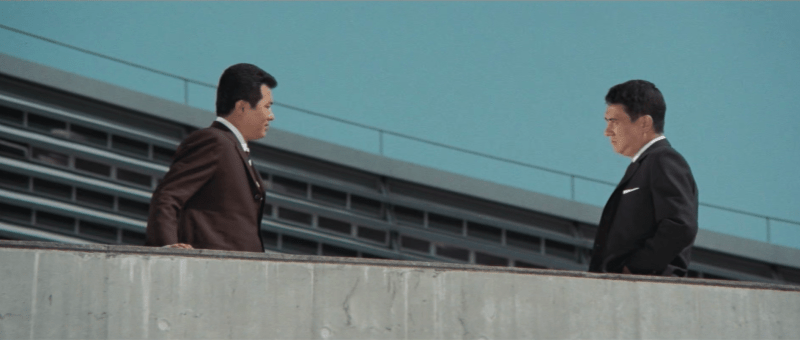
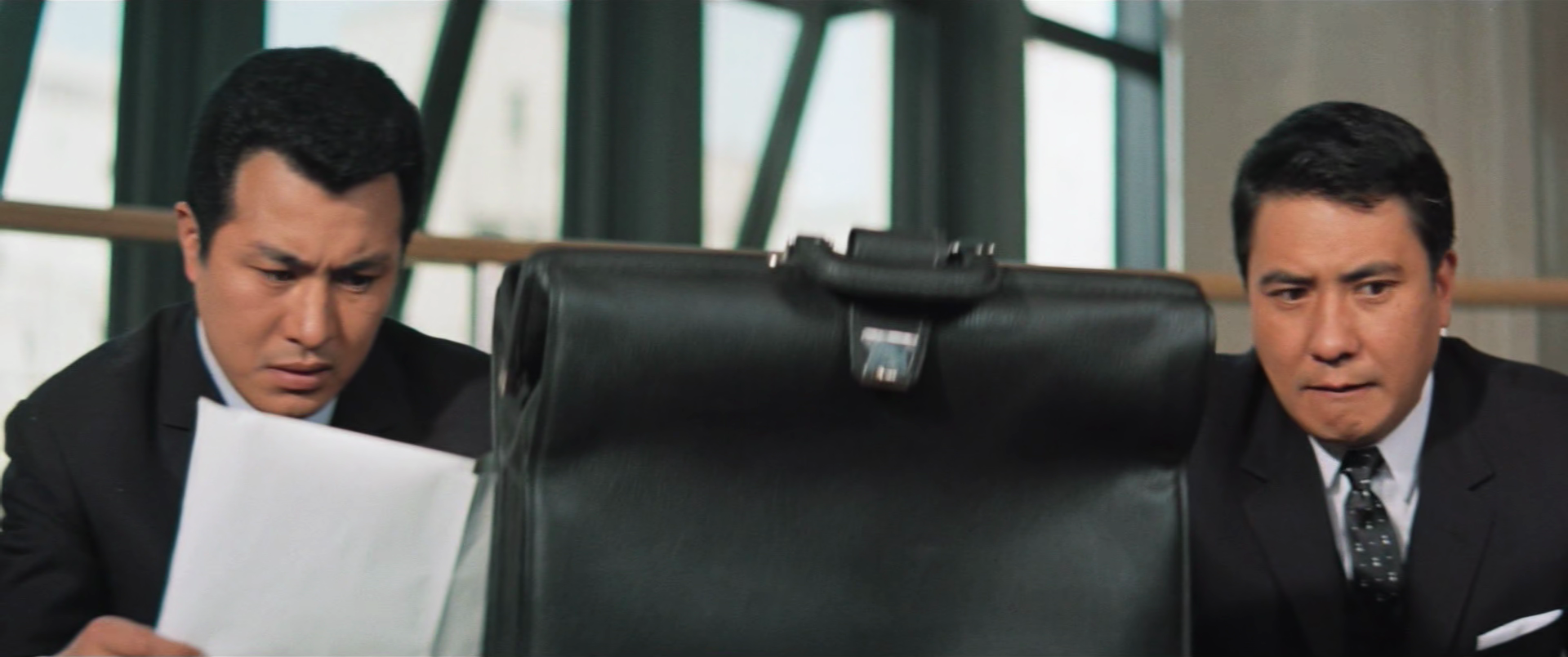
Cynical corporate spies find themselves in a battle of wits when one attempts to use the other in a psychedelic effort from Eiichi Kudo, Industrial Spy (産業スパイ, Sangyo Spy). A deliberate attempt to hop on to an ongoing trend sparked Bond mania and the success of Daiei’s “Black” series, along with the novels of Toshiyuki Kajiyama which inspired them, the film was intended as the first in a franchise vehicle for Tatsuo Umemiya whose Youth of the Night series had run out of steam. 

As such, he stars as a jaded young man working as a corporate spy stealing trade secrets on behalf of rival companies. He does not infiltrate them by gaining employment, but makes use of connections, seducing women in administrative positions, and setting honey traps for blackmailing executives sometimes even using his own girlfriend Masami (Reiko Oshida). His main justification is consumerist desire. He tells Masami that if they want nice things they have to take them. They weren’t born with a silver spoon in their mouths, so they can’t afford to act refined and expect what they want to come to them. They have to do whatever it takes or resign themselves to a life of poverty. Masami, however, is beginning to tire of this arrangement and is hurt, more than anything else, when she realises that Kogure has only bought her a new handbag, necklace, clothes and shoes to head off his guilt because he’s about to ask her to sleep with the director of a project to create an experimental engine as part of a job he’s been manipulated into by Sawada (Fumio Watanabe), the head investigator of Nisshin Industries. 

Rather childishly, Sawada convinces him to take the job basically by implying it’s too difficult for him. “There are secrets you just can’t steal,” he sighs, knowing that it’s like catnip to a man like Kogure who can’t resist a challenge even if he’s paying him less than a third of what he asked for. But Kogure has badly underestimated Sawada. When Kogure returns for his payment, he realises that Sawada sold the trade secrets back to the same company he stole them from to curry favour in the hope of worming his way in so he could take it over.  

Both men are in differing ways unsatisfied with their circumstances. Kogure resents his poverty and wants to be allowed into the increasingly consumerist society of Japan’s high prosperity era, but at the same time he isn’t especially greedy. Sawada tells him he’s doing this because money alone is no longer enough for a man to live a full life in the modern era, he must obtain a powerful position too. All Kogure wants is to sleep with the woman he loves, eat good food, and have a good time. Which is to say he only wants to be comfortable rather than wealthy but feels that that life is unattainable to him outside of his current underhanded occupation. Poignantly, after asking Masami to sleep with his mark to obtain information, he realises that he actually does love her and resolves to marry her after the job is done. But for her this was the final straw and she only did as he asked so she’d hate him enough to leave. 

Nevertheless, on learning he was tricked by Sawada, Kogure vows revenge by deliberately messing up Sawada’s plans to win a bid for a dam project on behalf of Nisshin by setting up a rival candidate and getting hold of their offer so they can make a better one. Only, Sawada always seems to be one step ahead and is even more ruthless than he is. While Kogure mourns Masami and is full of regret, pondering how he might win her back while his more straight-laced corporate lackey friend decides it’s time to shoot his shot, Sawada breaks up with his actual girlfriend to foil Kogure’s plan to photograph them together and blackmail him after he’s cynically married the disabled granddaughter of the Chuo Electric CEO who is mediating the dam bid. The older Mr Matsui (Takashi Shimura) is not completely blind to Sawada’s schemes, but blames himself for his granddaughter’s injury and believes it will be difficult for her to marry, so he’s willing to compromise himself corporately if only Sawada will ensure his granddaughter’s happiness.

Of course, that’s not really very high on Sawada’s list and only ever a means to an end. In this, he’s slightly different from Kogure who is equally heartless in some ways, humiliating a young woman who took an interest in him because she was of no use and he thought her cheap and vulgar, but clearly still has some vestige of human emotion even while realising he should probably let his friend chase Masami if he really loves her because she’s better off with him and his steady if dull corporate existence. In the end, though, neither man gets what he really wants and both ultimately lose out on both the money and the prize with Kogure vowing revenge against new enemies by whom he feels, a little unfairly, betrayed. Nevertheless, by ending with some monochrome stock footage of workers at the station, Anpo protestors being beaten by the police, and shots of US jet fighters, Kudo implies Kogure’s actions are a kind of rebellion against capitalism itself and the contemporary state of Japanese society even as he too becomes just another face in the crowd, an anonymous cog in this great shuffling machine.
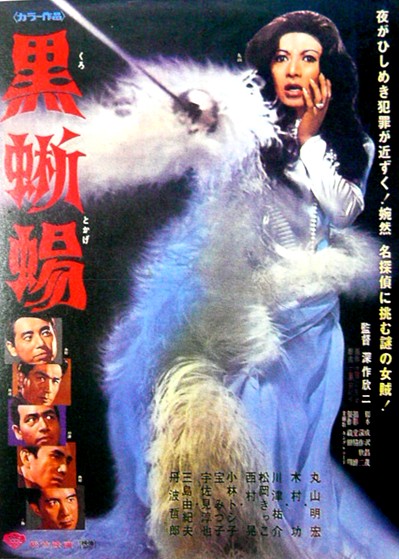
Black Lizard (黒蜥蝪, Kinji Fukasaku, 1968)

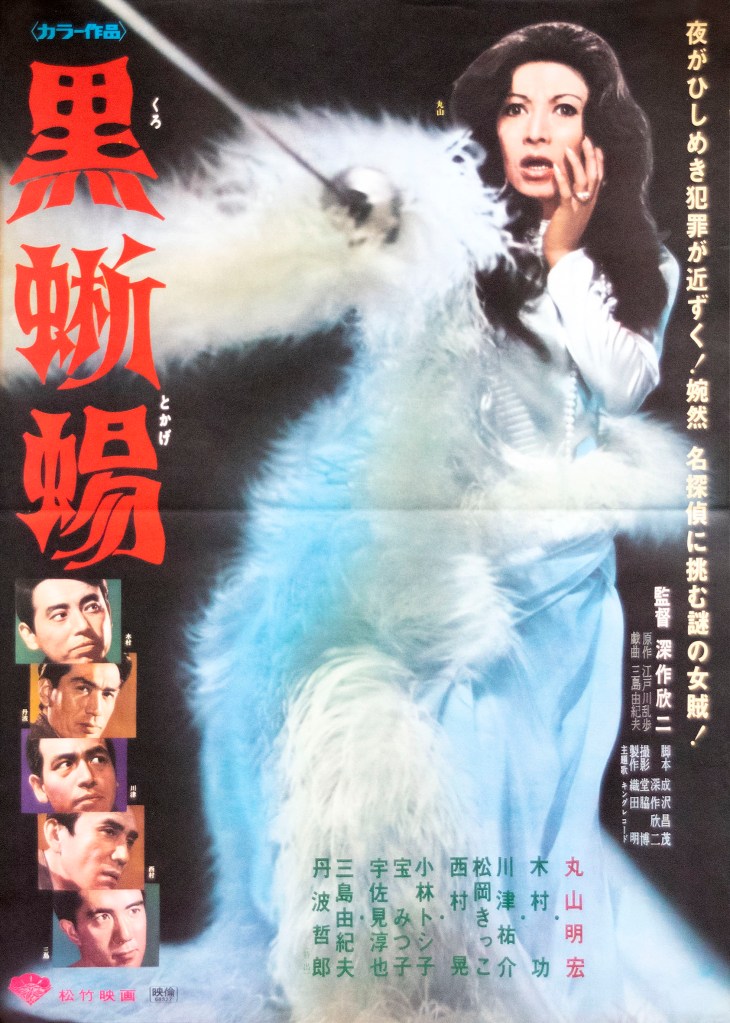
“Are you a critic?” asks the proprietress of of a lively night club, “Why?” replies a lonely man sitting at the bar, “Beauty fails to intoxicate you” she explains before wandering off to find a prettier prize. Nevertheless, a connection has been forged as two masters of the craft confront their opposing number. Black Lizard (黒蜥蝪, Kurotokage), based on the 1934 story by Edogawa Rampo, had been brought to the screen by Umetsugu Inoue in 1962 in a version which flirted with transgression but was frothy and fun, adding a touch of overwrought melodrama and gothic theatricality to Inoue’s well honed musical style.

Inoue’s version had been co-scripted by Kaneto Shindo and Yukio Mishima who had also written the stage version. Once again crediting Mishima’s stage adaptation, Fukasaku’s 1968 take on the story is, as might be expected, far less interested in class connotations than it is in notions of love, beauty, and aestheticism. Consequently, we open in a much harsher world, dropped straight into Black Lizard’s edgy nightclub which Akechi (Isao Kimura), Edogawa Rampo’s famous detective, has visited on a friend’s recommendation. He is shocked to read in the paper the next day that a young man he saw in the club has apparently committed suicide, while another article also mentions the shocking disappearance of a corpse from the local morgue. 

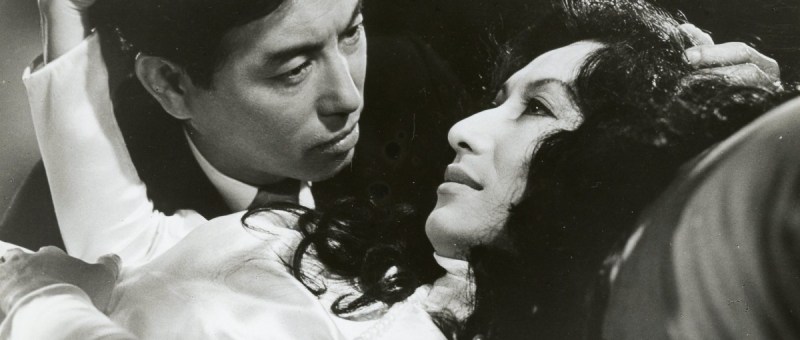
Meanwhile, Akechi is brought in on a retainer to protect the daughter of a wealthy jeweller who has been receiving threatening letters informing him of a plot to kidnap her. Unlike Inoue’s version, Iwase (Jun Usami) is a sympathetic father, not particularly demonised for his wealth. Rather than drinking too much, he simply takes his sleeping pills and gets into bed without realising that his daughter is already missing. As transgressive as ever, however, Black Lizard (Akihiro Miwa) wastes no time sizing up Sanae (Kikko Matsuoka), running her eyes over the “splendid curve” of her breasts and lamenting that beautiful people make her sad because they’ll soon grow old. She’d like to preserve that beauty forever, convinced that people age because of “anxieties and spiritual weakness”. The reason she loves jewels is that they have no soul and are entirely transparent, their youth is eternal. Now Black Lizard has her eyes on the most beautiful jewel of all, the Egyptian Star, currently in the possession of Iwase which is why she’s planning to kidnap Sanae and ask for it as a ransom. 

Though the Black Lizard of Inoue’s adaptation had been equally as obsessed with youth and beauty, she was a much less threatening presence, never actually harming anyone in the course of her crime only later revealing her grotesque hobby of creating gruesome tableaux of eternal beauty from human taxidermy. This Black Lizard is doing something similar with her “dolls”, but she’s also cruel and sadistic, not particularly caring if people die in the course of her grand plan even running a sword firstly through a body she believes to be Akechi’s, and then through a minion completely by accident. She picks up Amamiya (Yusuke Kawazu) in the bar because of his deathlike aura, his hopelessness made him handsome, but once he fell in deep love with his “saviour” she no longer found him beautiful enough to kill. 

Akechi, meanwhile, is captivated by her in the same way Holmes is captivated by Irene Adler. He admires her romanticism, and recognises her as someone who thinks that crime should come dressed in a beautiful ball gown. She, by turns is drawn to him but perhaps as to death, each of them wondering who is the pursuer and who the pursued but determined to be victorious. Casting Akihiro Miwa in the female role of Black Lizard adds an extra layer of poignancy to her eternal loneliness and intense fear of opening her heart, finally undone not by the failure of her crimes but by a sense of embarrassment that Akechi may have heard her true feelings that leaves her unable to go on living. 

Meanwhile, Amamiya attempts to rescue Sanae not because he has fallen in love with her, but because he too is drawn towards death. Showing the pair her monstrous gallery of taxidermy figures of beautiful humans, she pauses to kiss one on the lips (played by Yukio Mishima himself no less), leaving Amamiya with feelings of intense jealousy and a longing to be a cold and inanimate shell only to be touched by her. “Sanae”, meanwhile, who turns out to be a perfect mirror in having being picked up at rock bottom by Akechi for use in his plan, guides him back towards life. They did not love each other, yet their “fake” love was set to be immortalised forever as one of Black Lizard’s grim exhibitions. She wonders if the fake can in a sense be the real, that they may free themselves from their respective cages through love in accepting a romantic destiny. For Black Lizard, however, that seems to be impossible. Akechi has “stolen” her heart, but she cannot take hold of his, holding him to be a cold and austere man who has “trampled on the heart of a woman”. “Your heart was a genuine diamond” Akechi adds, lamenting that the true jewel is no more. Black Lizard meets her destiny in a kind of defeat, too afraid of love and the changes it may bring to survive it, but paradoxically grateful that her love is alive while taking her leave as a romanticist in love with the beauty of sadness. 


Opening and titles (English subtitles)

Black Rose Mansion (黒薔薇の館, Kinji Fukasaku, 1969)

3187_largeThose who only know Kinji Fukasaku for his gangster epics are in for quite a shock when they sit down to watch Black Rose Mansion (黒薔薇の館, Kuro Bara no Yakata). A European inflected, camp noir gothic melodrama, Black Rose Mansion couldn’t be further from the director’s later worlds of lowlife crime and post-war inequality. This time the basis for the story is provided by Yukio Mishima, a conflicted Japanese novelist, artist and activist who may now be remembered more for the way he died than the work he created, which goes someway to explaining the film’s Art Nouveau decadence. Strange, camp and oddly fascinating Black Rose Mansion proves an enjoyably unpredictable effort from its versatile director.

The sense of foreboding sets in right from the beginning as Kyohei, club owner and family patriarch, narrates a scene draped in a harsh red filter in which the lynchpin of the entire film, Ryuko, disembarks from a boat onto a jetty to meet him. He warns us that the sight of her was the “calm before the storm”, already anticipating the tumultuous events which are to follow. Having spotted her in a club in Yokohama, Kyohei poached Ryuko to work at his private members bar as a cabaret artist where she duly fascinates the customers seemingly knowing how to appeal to each of their own particular tastes in turn. A short time later, other suitors from the other bars begin to turn up but Ryuko refuses to recognise any of them. She is waiting for true love and believes the black rose she carries will turn red once she meets her prince charming. After a while she decides to move on but Kyohei convinces her to stay and maintain her “illusion” of perfect love rather than continually bursting its bubble, and so the two become a couple. However, when Kyohei’s wayward son Wataru returns and also becomes infatuated with Ryuko, a new chain of tragic events ensues…

Just to add fuel to the fire, the role of Ryuko is played by female impersonator Akihiro Miwa (formerly Akihiro Maruyama) who had also worked with Fukasaku on the notorious Black Lizard. Ryuko is mysterious, exotic maybe, etherial – certainly. She seems to shed identities only to pick up new ones perfectly tailored to whichever man she’s courting hoping each is the one who will turn her black rose red. Each of the previous suitors has failed to make her flower bloom and has so been discounted – erased from her memory whether willingly or unconsciously. When one of them is killed in front of her and her rose splashed with blood turning temporarily red, only then does she look on him lovingly. She loves them as they die but not before or after. Has each of these lonely, “different” men fallen for a siren call from the angel of death, or is Ryuko just another unlucky femme fatale who always ends up with the crazies?

Camp to the max and full of that rich gothic melodrama that you usually only find in a late Victorian novel, Black Rose Mansion is undoubtedly too much of a stretch for viewers who prefer their thrills on the more conventional side. However, there is something genuine underlying all the artifice in the story of obsessive, all encompassing love which develops into a dangerous sickness akin to madness. Ryuko is an unsolvable mystery which drives men out of their minds though they never seem to probe very far into her soul preferring to conquer her body. Only Kyohei who, at the end, is cured of his obsession with her, recognises that Ryuko is a woman who only exists in men’s minds and what you think of as love is really only lust like an unquenchable thirst.

Fukasaku attempts to invert classic gothic tropes by shooting the whole thing in lurid, brightly coloured decadence. Every time Kyohei thinks back on Ryuko he sees her bathed in red, like a beautiful sunset before a morning storm. Like Kyohei and pretty much everyone else in the picture, we too become enthralled by Ryuko and her uncanny mystery, seduced by her strangeness and etherial quality. Yes, it’s camp to the max and drenched in gothic melodrama but Black Rose Mansion also succeeds in being both fascinatingly intriguing and a whole lot of strange fun at the same time.


Black Rose Mansion is available with English subtitles on R1 US DVD from Chimera and was previously released as part of the Fukasaku Trilogy (alongside Blackmail is My Life and If You Were Young: Rage) by Tartan in the UK.