Jeong-sun (정순, Jeong Ji-hye, 2022)

“Is it a crime to be old?” a middle-aged woman asks after finding herself the centre of scandal in Jeong Ji-hye’s timely drama, Jeong-sun (정순). Surrounded by an ageist and misogynistic society, Jeong-sun has always bided her time and played by the rules but is acutely aware of her predicament as an older woman knowing that if she loses her factory job no one else will hire her and therefore submits herself to all the petty microaggressions of life on the margins. 

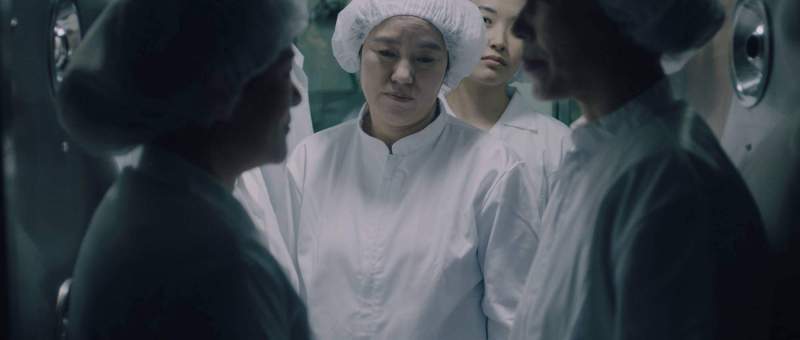
Chief among them would be her obnoxious floor manager Do-yun, little more than a teenager with a clipboard and an inflated sense of his own importance. She and the other women gossip about Do-yun’s dubious love life which partially relies on abusing his authority to date factory girls whom he gives preferential treatment and then discards once he’s bored. There’s also a rumour going around that the managers plan to fire some of the older workers like Jeong-sun after hiring permanent employees while a generational divide is developing between the full timers and the college students who turn up for the summer and secretly think they’re better than this. Jeong-sun accidentally offends one of them by playfully making fun of her putting on makeup in the changing room given that they’re all about to put on identical white uniforms and go through decontamination to head to the factory floor. 

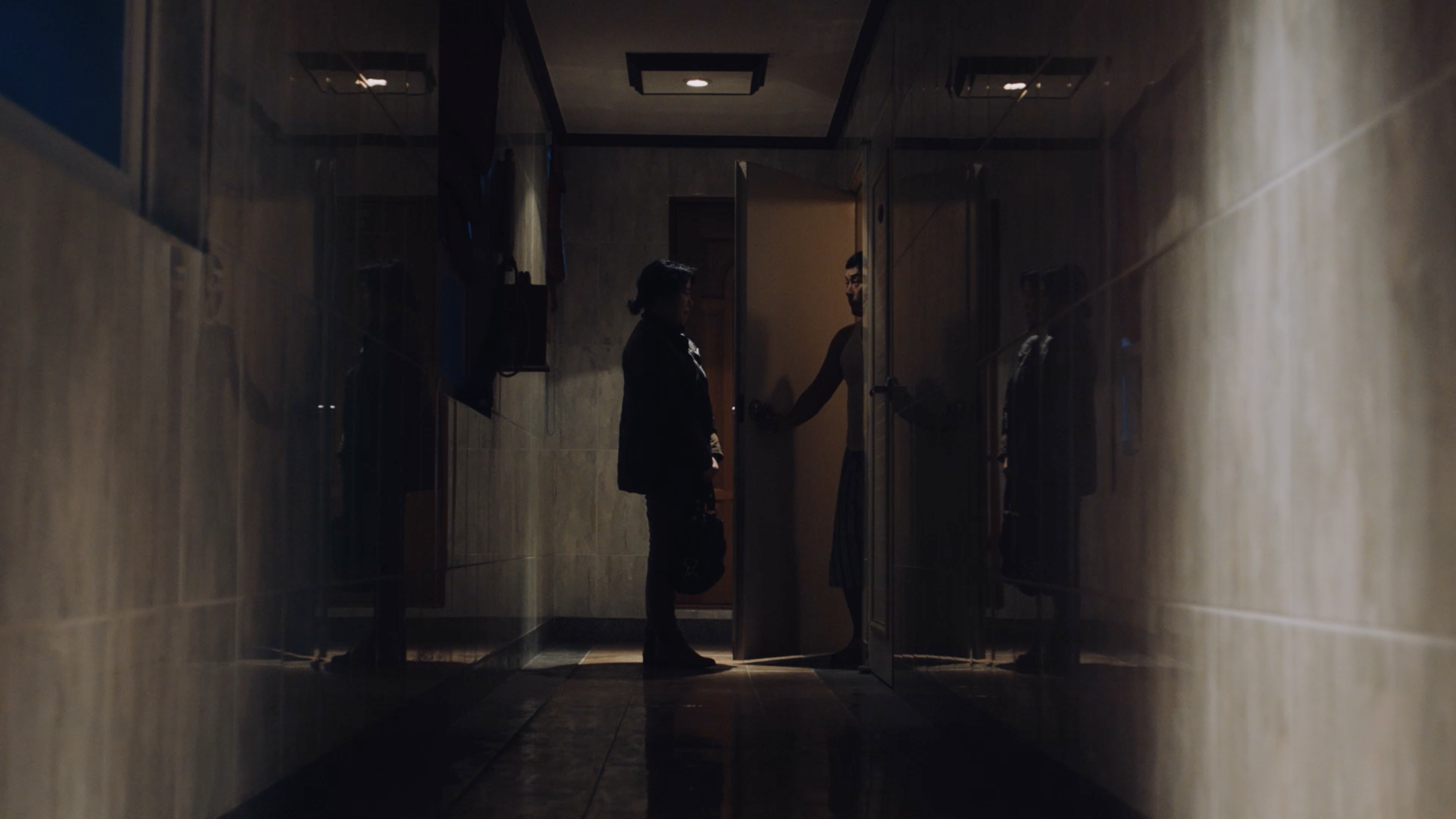
The irony is that she begins to bond with new employee Yeong-su out of their shared sense of alienation as marginalised middle-aged people. Around her age, Yeong-su previously worked casual jobs in construction but has switched to the factory because of knee damage caused by years of manual labour. His physical injury has further damaged his sense of masculinity leaving him deeply insecure and desperate for approval from other men including that from the continually obnoxious Do-yun. When Do-yun asks him if he has a girlfriend, Yeong-su sheepishly replies that he’s too old for all that only for Do-yun to insultingly add that he doubts he has the time or money considering he just works on the shop floor. When Jeong-su’s daughter Yu-jin (Yoon Geumseona) and her fiancé ask her if she might have a boyfriend, Jeong-sun gives a similar reply seemingly feeling a degree of shame about being an older woman daring to date. She tells Yeong-su that they should slow down because she’s embarrassed to hear the other workers gossiping about them, but Yeong-su takes it the wrong away assuming that she too looks down on him for being a penniless factory worker with not much to his name.  

It’s this combination of ageism and sexism that gradually destroys their relationship. Mocked by Do-yun who calls him a “naive” man, Yeong-su shows him a video Jeong-sun had allowed him to take of her singing in her underwear in a moment of empowerment. Soon, it’s leaked online and Jeong-sun becomes the talk of the town, a figure of fun just for being a middle-aged woman embracing her sexuality. While the younger women laugh at her, Jeong-sun’s daughter and friends are universally sympathetic as is the policeman Yu-jin reports the incident to, but she later finds that not even the police really take the case seriously despite Jeong-sun’s increasingly precarious mental state. “I’m sorry to say this, but younger females are usually the victim” the policeman adds as they push Jeong-sun to settle, implying that no one’s all that interested in Jeong-su’s video and the taboo incident is somewhat embarrassing even to him. Yeong-su meanwhile offers a pleading “apology” before trying to convince Jeong-sun not to press charges because he’ll never work again with bad knees and a criminal record. 

Yeong-su said he’d move away and that it would all blow over, but Jeong-sun later catches sight of him laughing and joking with Do-yun and the other guys from the factory very much one of the boys. Her life has been ruined, but they’ve got off scot free. “Why should I stay put?” Jeong-sun finally asks in directly standing up to Do-yun who is after all a cowardly boy who bullies other men to bolster his fragile sense of masculinity. He responds by calling her a “crazy bitch” while she destroys his false authority and plays him at his own game, somehow taking something back if only in a moment of self-destruction. Where she finds herself is literally in the driving seat of her own life, seizing the opportunity for freedom and independence that comes with age but also the breaking of a spell that had been designed to keep her in her place. 


Jeong-sun screened as part of this year’s Red Lotus Asian Film Festival.

International trailer (English subtitles)
Limecrime (라임크라임, Lee Seung-hwan & Yoo Jae-wook, 2020)

Two teens from across the class divide form an awkward friendship through a shared love of hip hop but find their connection undermined by their differing circumstances and opportunities in Lee Seung-hwan and Yoo Jae-wook’s indie coming-of-age drama Limecrime (라임크라임). Loosely inspired by their own life experiences, Lee and Yoo once performed as a rap duo under the name Limecrime, the directors eventually find unexpected positivity in the boys’ life trajectory as they each reach a point of understanding and thereafter overcome their differences while pursuing their musical aspirations. 

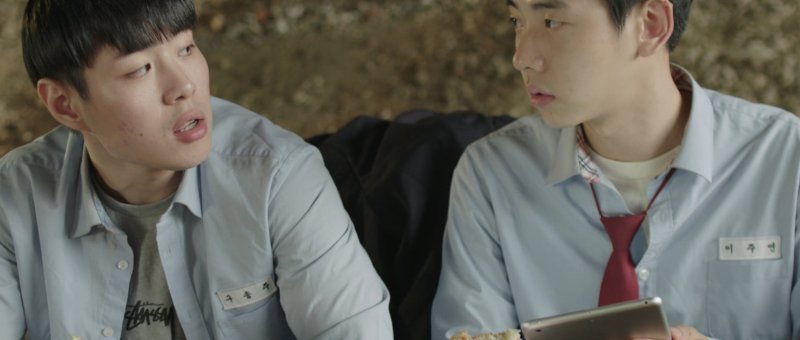
16-year-old Songju (Lee Min-woo) is a struggling middle school student with hip hop dreams currently working part-time in his father’s auto repair shop. He attracts the attention of the well-off, academically successful Jooyeon (Jang Yoo-sang) when performing a classic rap during a vocal evaluation underneath a sign stating that hip hop is forbidden. Being something of a hip hop geek, Jooyeon immediately makes contact lending a mystified Songju a retro discman and some of his favourite tracks before suggesting they team up as a hip hop duo and enter an online competition. 

The duo’s name, Limecrime, is taken from an accidental misreading of “rhyme crime” which eventually sticks and becomes in a way ironic. Nevertheless, it demonstrates an early divide between the boys, Jooyeon mocking Songju for his rookie mistake while insisting that the art of rhyme is central to rap, demanding precision while Songju prefers the anarchy of freeform improvisation. To begin with they bond over their shared love of music, but over time the differences between them become increasingly obvious with Songju often uncomfortable among Jooyeon’s wealthier friends. Though they are mocked by some of their classmates at an early performance, a graduating hip hop club from a local high school offers to befriend them, but their rappers are much more intellectual than either of the boys sitting down to discuss philosophy while Songju feels left behind having no real idea what’s going on. He gets up to fix a broken mic stand, only for Jooyeon to tell him off insisting the repairman will take care of it while rolling his eyes as if implying he thinks Songju has shown himself up in front of their new friends. 

Jooyeon is indeed the sort used to having everything done for him, regarding it as somehow inappropriate to fix something yourself. His parents do not appear to be physically present in his life, heard only via infrequent telephone calls, while leaving the housekeeper to watch over him though she later quits abruptly having reached her limit when Jooyeon and Songju thoughtlessly trash the kitchen and leave the mess for her to clean up. Cleaning up after himself is not something Jooyeon has ever been taught to do and given his family’s wealth he’s also got the idea that all problems can be solved with money. Wanting Songju to attend the high school with the best hip hop club he crassly offers to pay for cram school classes, little realising how his suggestion makes Songju feel or how he’s effectively using and manipulating him to achieve his own aims. Irritated by his practicality, he finally relegates Songju to the space recently vacated by the housekeeper after he kindly fixes up his bike for him. 

Songju meanwhile is both attracted and repelled by Jooyeon’s upperclass world while finding his existing friendships strained when his buddies fall in with a local petty gangster and are pulled towards small scale street crime ironically selling counterfeit fashion from hip hop brands. Given Songju’s example some of the other boys dare to dream of different futures, even the most delinquent revealing he’d like to become an actor, but each is later forced to face the crushing reality that no matter their ambition they do not have the same opportunities as boys like Jooyeon whose family can afford to pay for fancy schools and private tuition. 

Matters finally come to a head when Songju ends up in trouble with the law and Jooyeon gets his father to pull strings on his behalf only to abruptly abandon him when he expresses anxiety over his less well-connected friends. There is something quite ironic in Jooyeon’s love of hip hop, declaring that he wants to “change what’s absurd in this world” through the power of music but later having no answer when asked if he wouldn’t be better to become a politician or activist than an indie musician reliant on being able to generate a platform. After deciding to give up, Songju nevertheless comes into his own and finds his voice but at the same time refuses to leave Jooyeon behind even when discovering solo success. Though the leads may be a little past convincingly passing for 16 (Jang Yoo-sang is 30, Lee Min-woo is 28), Lee and Yoo nevertheless craft a refreshingly positive coming-of-age tale which allows the boys to salvage their friendship and their musical dreams even if perhaps only by sidestepping the issues which initially divided them. 


Limecrime screens 15th November as part of this year’s London Korean Film Festival.

Trailer (no subtitles)