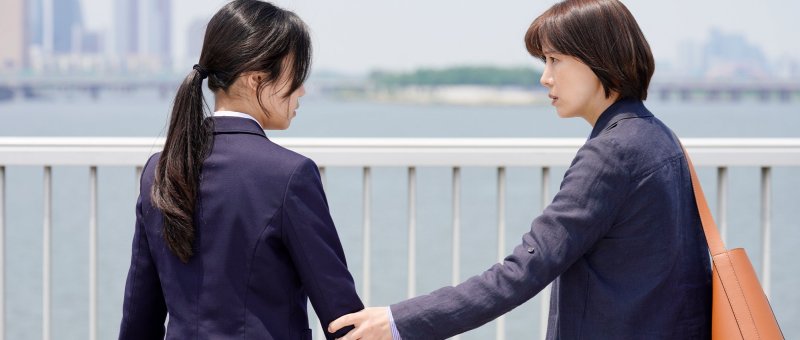

A lonely young woman finds a new place to belong while discovering the meaning of life after being taken in by a cheerful community of patients at a hospice for those with terminal illness in Cha Bong-ju’s lighthearted drama Good Morning (안녕하세요, Annyeonghaseyo). “Good morning” is to the patients an affirmation of life and way of greeting the new day as gift rather than a burden as the heroine had come to see it while unable to escape her sense of hopelessness and futility.
High schooler Su-mi’s (Kim Hwan-hee) desire to end her life is born largely of the circumstances she finds herself in as an orphan. Not only is she rejected by others her age who mock her for having no family, but she is trapped in an exploitative situation at a care facility where she is molested by the man who’s supposed to be taking care of her and also forced to work in his restaurant where she is expected to put up with inappropriate behaviour by drunken customers. Even if she were able to continue enduring it, she knows that she will soon come of age at which point she will be roughly ejected from the care system and expected to support herself with no further help available to her. It’s this sense of hopelessness that brings her to a nearby bridge from which she intends to jump only to be stopped by a middle-aged woman, Seo-jin (Yoo Sun), who manages to talk her down largely by promising that she will show her how to die.
That is in a sense what she does. Seo-jin works in a hospice caring for those with terminal illnesses who have each come to an acceptance of death and their path towards it. The patients are determined to live out their remaining days as best they can, remaining cheerful and committing themselves to accomplishing something be it learning English, writing a book, or finishing a painting. Su-mi bonds most closely with an elderly man (Lee Soon-jae) who had been illiterate and is working hard to learn to read and write while he still has time. What she discovers is that it is possible to find meaning in life even in the shadow of death, and that what gives her own life meaning is the sense of community she experiences at the hospice allowing her to feel part of a large family which had been denied to her during her time in the care system.
“You just need to give them a little attention” Su-mi advises of some struggling plants at Seo-jin’s apartment, herself blossoming under the attention Seo-jin and the patients are paying to her, though there may be something a little uncomfortable in the suggestion that Seo-jin may have been partly at fault for a traumatic event in her past in assuming that things grow on their own as long you provide adequate nutrition. She blames herself for not paying enough attention and failing to realise that there was something wrong until it was too late only latterly understanding that like the plants people need more than simple sustenance to grow. Nevertheless, she and Su-mi gradually help each other to rediscover joy and happiness in life while forming a familial bond that restores something to each of them and grants them the ability to move forward into a happier future.
Su-mi does learn “how to die” from the patients at the hospice, but what she’s really learning is how to live. The elderly man reminds her to live well and die without regret, making the most of every day doing what she wants to do and being happy while Su-mi gains a new perspective on life and death as she begins to step into herself gaining new confidence as a member of a community. Gentle and heartfelt, Cha’s lighthearted drama necessarily tackles some dark themes from suicide and terminal illness to the stigmatisation of orphanhood, difficulties experienced by those placed into the care system, and the inertia that can take hold while dealing with grief and loss but manages to lean towards the sunlight in embracing the healing qualities of relationships between people which give life its meaning.
Good morning streams in the US until March 31st as part of Asian Pop-Up Cinema Season 16.
International trailer (English subtitles)
 For the world’s more full of weeping than you can understand – the residents of Goksung, the setting for Na Hong-jin’s nihilistic horror movie The Wailing (곡성, Goksung), might be inclined to agree with Yeats if only because the name of their town is also a homonym for the “sound of weeping”. There is plenty to weep over, and in places Na’s film begins to feel like one long plaintive cry reaching far back to the dawn of time but the main wounds are comparatively more recent – colonisation, not only of a landscape but of a soul. When it comes to gods, should you trust one over another simply because of its country of origin or is your faith to be bestowed in something with more universal application?
 Windows on Worlds