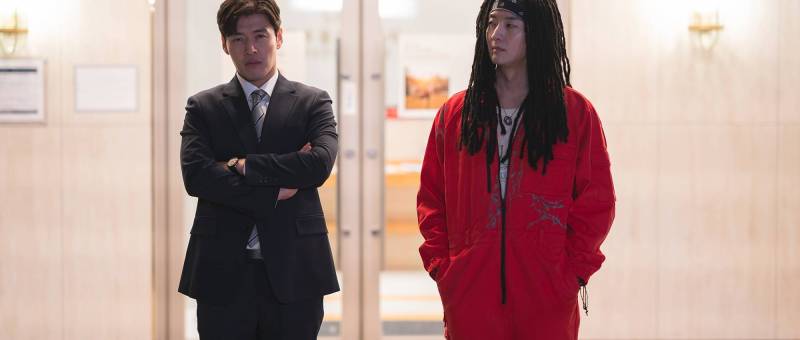
The Roundup: No Way Out (범죄도시 3, Lee Sang-yong, 2023)

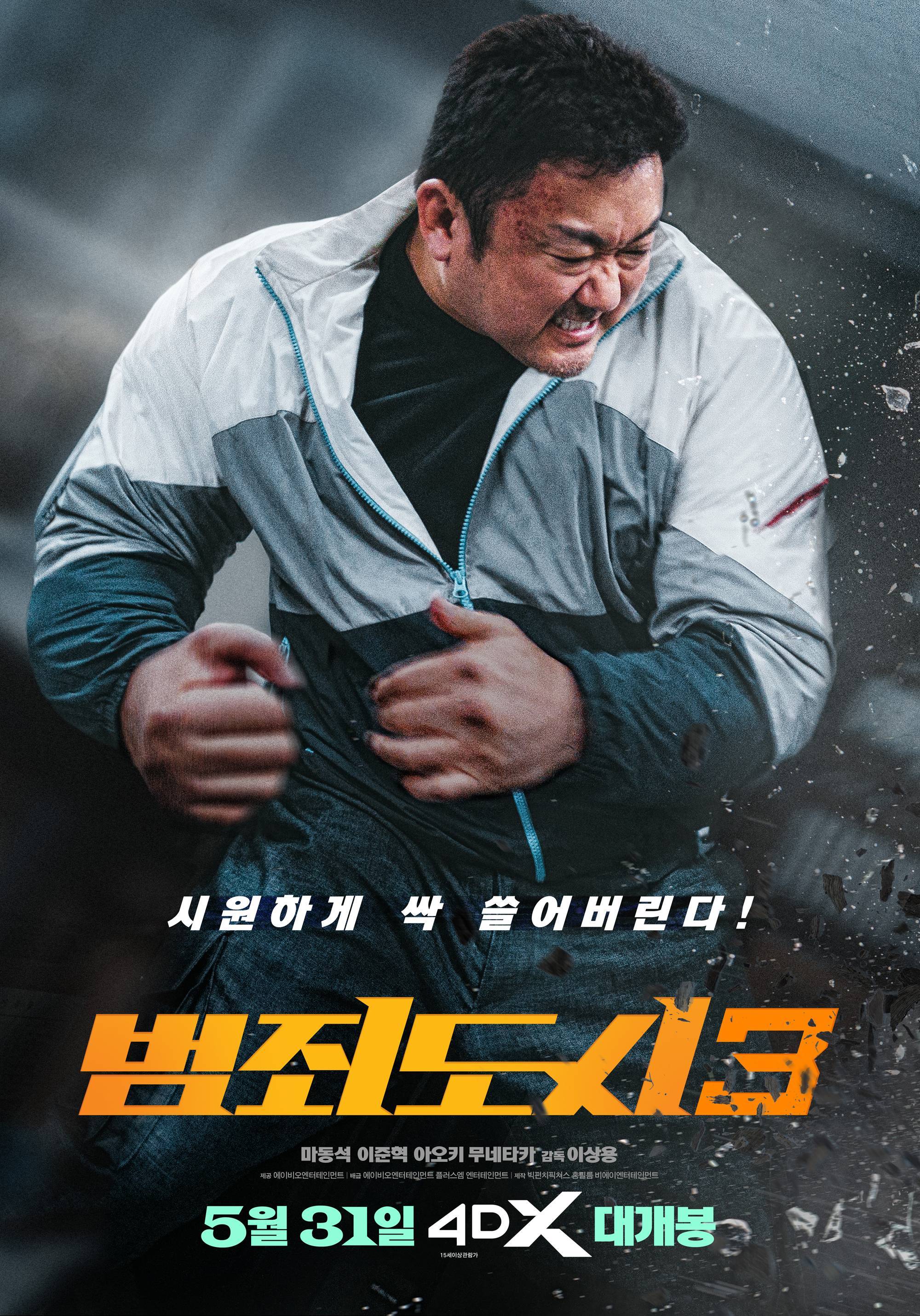
Ma Dong-seok has been cultivating an image of himself as an action star for quite some time. The kind of marquee name who generally plays the hero, Ma looks back to the genre’s heyday presenting an uncomplicated vision of righteous masculinity, a bruiser with a heart of gold. The Roundup: No Way Out (범죄도시 3, Beomjoedosi 3) is the third in a series of films that began with The Outlaws and is projected to total at least eight instalments each starring Ma as the maverick detective his superiors hate to love. 

It’s true enough that you can’t get away from the more problematic elements of his unreconstructed good bad cop persona. We often see Seok-do (Ma Dong-seok) beat information out of suspects which the film treats as a cheeky joke in an otherwise tacit endorsement of police brutality that suggests red tape is the reason the guilty often evade justice. Meanwhile, in a step back from other Ma vehicles there are almost no women in the film and none in the police force. The heart of the case is the death of a 28-year-old woman who “fell” from a hotel room window and is later discovered to have died of a heart attack after being drugged in a club and dragged off by a random man who then literally threw her away to distance himself from the crime. The murder which Seok-do is supposed to be investigating is totally forgotten in his all encompassing drive to find out where the drugs are coming from which eventually descends into a battle of wits with a corrupt police officer who’s teamed up with a Korean-Japanese yakuza to skim his boss’ supply of new designer drug Hiper. 

There is a distinctly uncomfortable thread of xenophobia that runs through the series even if in this case the villainy is discovered closer to home in the form of police corruption. This time around, the threat is once again Japan which is apparently where Hiper originated though petty yakuza Tomo (An Se-ho) now manufactures it in Korea where he’s cut a freelance deal with dodgy cop Joo (Lee Joon-hyuk) to distribute it in the local night life scene without the knowledge of his boss back in Japan, Ichijo (Jun Kunimura). Joo has also cut a deal to sell the drugs to a Chinese gang, so it’s quite bad news for him when Ichijo gets wind of the situation and Tomo takes off with a suitcase full of pills for his own protection. Unluckily for him, Ichijo has already sent his most intimidating assassin, Riki (Munetaka Aoki), to find out what’s been going on behind his back. 

Problematic as it may be, Ma’s retro take on the action star is undeniably entertaining with his frequent hero moments and penchant for one liners. The first time he appears, we see him break up a street fight but mostly interested in finding out if the guy on the ground started it the implication being that perhaps if he did it’s none of his business but otherwise he’s going to have to intervene. Then again as he tells his exasperated boss, his personal motto is “punish and serve” and he’s here to get the job done even if that means wading in all fists blazing without much thought for regulations or procedure. At one point Seok-do and his guys stumble on a crime scene and walk around it touching everything in sight without bothering to even put on so much as gloves. 

In any case, Lee makes every punch land and quite literally as the screen seems to vibrate on contact almost as if the camera itself were taking a blow. Ma’s thunderous fists clash with the sound of justice as he all too easily disables hardened gangsters with one well placed slap. At times, his invincibility borders on the ridiculous but he does eventually allow himself be “defeated” if only temporarily as in his miraculous recovery from being run over by a gangster’s car. In many ways, Joo is Seok-do’s mirror, a bad bad cop with crazy eyes who kills without a second thought and behaves with narcissistic recklessness, overconfident in his abilities to sort his problems through his status as a law enforcement officer. Bruiser he may be, but Seok-do likes arresting people and never uses lethal force even when the opportunity is presented to him, symbolically snapping Riki’s katana and then proceeding to slap him seven ways to Sunday leaving the ice cool assassin collapsed amid a display of Japanese parasols. An end credits scene set three years later in 2018 sets up a fourth instalment and the return of a familiar face besides that of Seok-do himself who continues to charm as the world weary bruiser slapping down crime wherever it rears its ugly head. 


The Roundup: No Way Out is in UK cinemas now.

International trailer (English subtitles)

Stellar: A Magical Ride (스텔라, Kwon Soo-kyung, 2022) [Fantasia 2022]

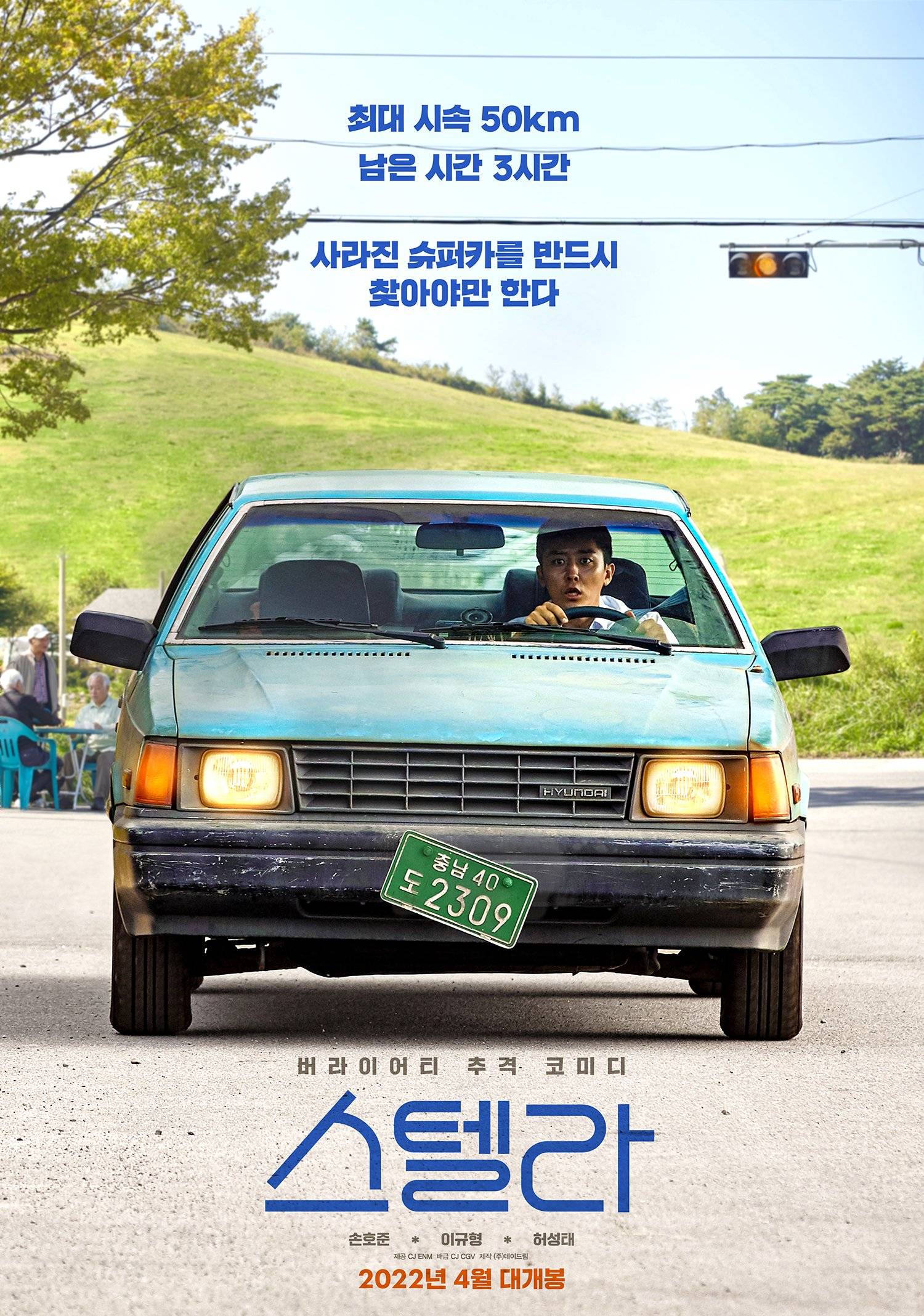
A cynical man learns to forgive the father he resented for abandoning him while on a road trip in his banged up ‘80s Hyundai Stellar in Kwon Soo-kyung’s quirky dramedy, Stellar: A Magical Ride (스텔라, Stellar). Not everyone is suited to being a parent, as he’s fond of saying not incorrectly, but even if his father’s love was imperfect it doesn’t mean it wasn’t there and just because he feels his own father failed him it doesn’t mean he’d do the same to his own child.

Young-bae (Son Ho-jun) makes a living repossessing luxury cars on behalf of shady gangsters. After unwisely entrusting a Lamborghini to his childhood friend Dong-sik (Lee Kyu-hyung) who now runs a logistics company, Young-bae’s life is derailed when he goes awol leaving him to deal with his violent boss. Meanwhile, he’s just found out his wife might be pregnant after stumbling on a pregnancy test in their bathroom and his sister has been in contact to let him know their estranged father has passed away. After the gangsters track him down to the funeral, he manages to make a daring escape by taking off in his father’s old Hyundai Stellar which is not exactly the most ideal getaway vehicle seeing as Young-bae struggles to get it over 30 and the driver’s side door doesn’t open anymore. 

In a way there might be a reason for that, Young-bae both driver and passenger as he shifts over into his father’s old seat at the wheel. For some reason he finds himself talking to the car without really understanding why while the car itself always seems to come to his rescue just at the right moment as a magical twinkling plays in the background. It’s difficult to avoid the interpretation that the car is possessed by his father’s spirit, though it may equally be the manifestations of Young-bae’s childhood memories as he remembers a happier time in his life when he spent time with his father in the car which he described as his family’s “star”. 

“Becoming a father is easy, but living as one is hard” Dong-sik laments having been somewhat humiliated in front of his own kids little knowing that Young-bae is facing just this dilemma as he tries to come to terms with impending fatherhood. As an older man looking back on traumatic childhood memories, he gains a new perspective if perhaps still struggling to forgive his father for abandoning him only later coming to the realisation that he may have shown his love in a different way in thinking that the best thing for his family might be to remove himself from it. 

The root cause of all these problems is however debt. Young-bae resents his father for getting into trouble with loansharks after a traffic accident disrupted his taxi business, while the reason Dong-sik double-crossed him with the car is because he is deeply in debt himself. Even a farmer’s wife he meets explains that they’re alive because they can’t die, now in masses of debt following several poor harvests and the onset of her husband’s lumbago. Young-bae technically makes a living off debt given that the reason most of these cars are being repossessed is that their owners have fallen into financial difficulty. One such man Young-bae targets is currently living in the car when he tries to repossess it having lost his life savings and everything he owned trying to pay for medical treatment for his wife. Young-bae unsympathetically tells him that he hates irresponsible and incompetent fathers projecting memories of his own onto him while unable to show any kind of compassion or mercy for the difficulties he is facing. As the film opens, he helps save a man who was planning to take his own life but only so he can get his signature on the repossession papers before he passes away. 

Literally having to take his father’s perspective by sitting in the driving seat of his car while interrupted by nostalgic songs from the tape deck which seems to have a mind of its own, Young-bae comes to an acceptance of paternity while making peace with his father’s memory. A quirky road trip movie with a series of strange characters who all have important lessons for Young-bae about the nature of friendship and family, Stellar is certainly a magical ride through frustrated grief and paternal anxiety finally arriving at a place of warmth and safety free of past trauma and resentment in the driving seat of a beaten up family car. 


Stellar: A Magical Ride screened as part of this year’s Fantasia International Film Festival.

International trailer (English subtitles)

Romang (로망, Lee Chang-geun, 2019)

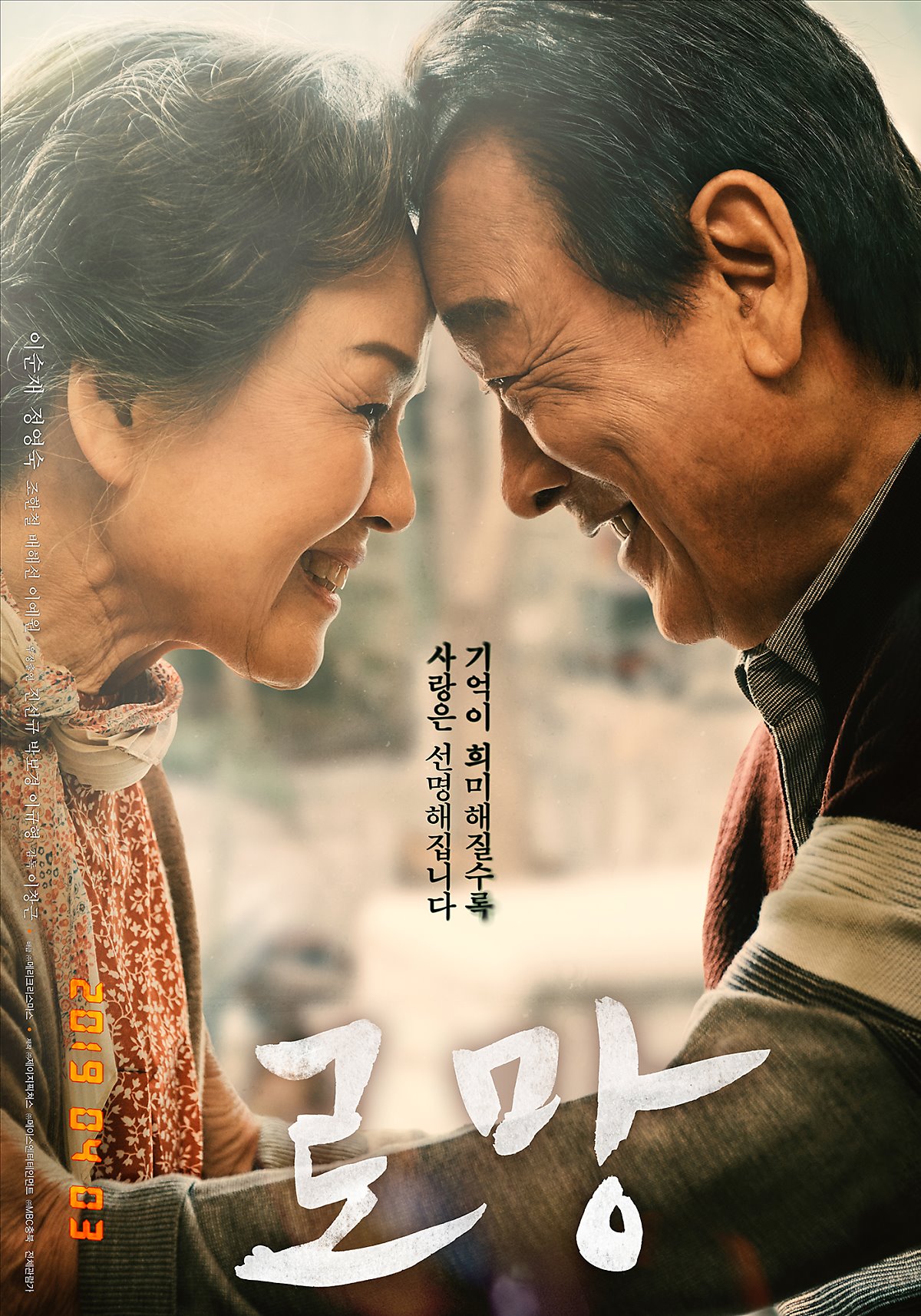
romang posterKorea, like many developed nations, is facing a demographic crisis as society continues to age at an unprecedented pace. While cultural norms demand deference to older people, the many problems they face in a society where welfare provisions are still minimal have often gone unaddressed in the assumption that family members have a duty to look after their relatives in their old age. This is, however, not always possible and there are occasions where considering opting for outside help becomes unavoidable.

This is the dilemma faced by elderly taxi driver Nam-bong (Lee Soon-jae) as he gradually comes to the conclusion that his wife, Mae-ja (Jung Young-sook), is suffering from dementia. The couple share their house with grown-up son Jin-soo (Jo Han-Chul), his wife Jeong-hee (Bae Hae-sun), and their young daughter Eun-ji who had mostly been cared for by Mae-ja while Jeong-hee was the family’s only breadwinner seeing as Jin-soo is an out of work academic (not particularly actively) looking for a new position. Mae-ja’s condition gradually declines to the point at which she begins to pose a danger to her remaining family members causing Jeong-hee to leave Jin-soo and take Eun-ji to her parents’ out of the way.

Gruff and insensitive, Nam-bong decides to send Mae-ja away to a hospice despite Jin-soo’s pleas but eventually reconsiders and brings Mae-ja home where he is committed to care for her himself. However, he too begins to experience the early signs of dementia and is at a loss as to how to proceed in the knowledge that it will become increasingly difficult for him to look after his wife or she him.

The onset of dementia, the film seems to imply, perhaps allows the troubled couple to begin to move past a central moment of trauma in their relationship which has left a lasting thread of resentment between them. Nam-bong, a chauvinistic, difficult husband is not well liked by his family members and most particularly by his son while Mae-ja had, maybe reluctantly, stood by him physically at least if not emotionally. His decision to send Mae-ja away is then a double betrayal in his abnegation of his duties as a husband and in his spurning of all Mae-ja has had to put up with over the last 40 years.

The distance between the couple has also had an effect on Jin-soo who always felt himself pushed out as an accidental victim of his parents’ emotional pain. It is clear that Nam-bong, a traditionally minded patriarch, has little respect for his son who, in his view, is a failure for not having secured a steady career which can support a wife and child, “allowing” his wife to work in his stead. For Nam-bong, being a man is all about “supporting” a family but not actually having to be around very much. For Jin-soo, a modern man, it’s very different. He wants to be there for his wife and daughter so that they have good memories of him hanging out and having fun rather than being that guy who turns up at dinnertime to shout at everyone and then leaves again.

Nevertheless, Nam-bong is eventually forced to accept his emotional duty to his family when he decides to care for Mae-ja. While their mutual condition begins to bring old, negative emotions never fully dealt with to the surface, it also allows them to rediscover the innocent love they had for each other as a young married couple. When Jin-soo eventually leaves the family home to return to his wife and child, the couple decide to isolate themselves, holing up in the living room and communicating via a series of poignant post-its which remind them to care for each other as the darkness intensifies.

Yet it’s not quite all sweetness and light as the elderly romantics rediscover a sense of warmth and connection they assumed long lost. Despite the support shown for Jin-soo’s modern parenting, there is a notably conservative spin placed on the story of Mae-ja and Nam-bong which may very well mark them out as simply being of their time but a late poignant scene in which the young Mae-ja declares her dream to be having a good husband while Nam-bong’s is to support a family sits uncomfortably in its unsubtle defence of traditional gender roles. To make matters worse, the final moments seem to suggest that there is no place for the elderly couple in contemporary society in allowing them (well, Nam-bong) to take control of their destinies only in the most final of ways. Maudlin and sentimental, Romang sparkles when embracing the unexpected cuteness of the late life love story but too often opts for easy melodrama over emotional nuance in its refusal to address its darker elements and eagerness to romanticise the business of ageing.


Romang (로망) was screened as part of the 2019 Udine Far East Film Festival.

International trailer (English subtitles)