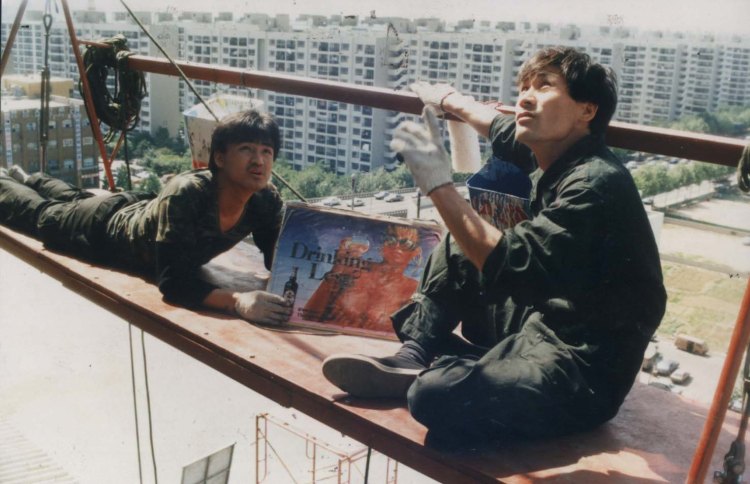
 Though not a big box office hit at the time of its release, Park Kwang-su’s Chilsu and Mansu (칠수와 만수, Chil-su wa Man-su) is not only fondly remembered by its contemporary audience chiefly because of the amusing performances of its still popular leading actors, but is also credited with kicking off what would become known as Korean New Wave. Released in 1988 and set sometime in 1987, this is the new Seoul emerging into democracy after decades of military rule and looking ahead to the glory of the 1988 Seoul olympics. However, as ever, the future has not been evenly distributed and there are those who find themselves unable to climb its ladder through no fault of their own.
Based on a story by (banned at the time) Taiwanese writer Huang Chunming, the film begins with the blaring sirens which denote a “civil defence drill” is about to take place. Chilsu is forced off the bus he’d been travelling on and takes refuge in a video arcade where he encounters college student Jina. After the drill ends Chilsu continues to pursue her at her job working part-time in a Burger King. When he gets back to work, Chilsu finds that his boss has paid someone else to cover the time he was missing. Chilsu argues with him and quits but pesters the man he’s just met, Mansu, to take him on as an assistant and help him find work. The pair become friends and begin working together as billboard painters but one fateful outburst seems fit to change both of their lives forever.
Chilsu is an animated fellow who’s constantly wandering off to do his own thing to the consternation of everyone else. He’s a chancer and an opportunist and, as it turns out, a compulsive liar. Almost everything he says is untrue. In order to get closer Jina, he tells her he’s an art student and tries to impress her by speaking English with stories of going to America to study where his brother has a house in Miami. He dresses like Bruce Springsteen and has Stars and Stripes patterned T-shirts but his taste for Americana is merely aspirational, he has no education or connections and his stories about going to America to study are a fantasy. He does have an older sister who has apparently been disowned by their father for fraternising with Americans and may have have gone to America with a man, but no one even knows if she’s alive or dead.
Mansu, by contrast is sullen and standoffish. He drinks too much and says little though his anger is of the subdued kind. His problem is that his father had, and continues to have, communist sympathies which he refuses to renounce. This causes a problem for Mansu because each time he receives a background check he gets flagged up and in one notable instance he’s refused a passport that would enable him to take an overseas job precisely because of his father’s record. He’s trapped in poorly paid menial work through no fault of his own simply because of something that his father did that is nothing at all to do with him.
Chilsu is also resentful of his father who worked as a “houseboy” for the American military but now does nothing much of anything at all. After Chilsu’s mother died, his father remarried and lives off his second wife’s earnings. A drunk and a layabout, Chilsu’s father sets a poor example for his son who is terrified of becoming just as feckless and miserable as his deadbeat dad. Both men are paying the price for the actions of the previous generation who have left them with nothing but barriers preventing them from escaping the years of difficulty for the bright and shining future that men like themselves are building for other people’s sons to prosper in.
The climax of the film occurs as the pair are just finishing a giant billboard for an alcoholic drink and are taking a break. Chilsu climbs up on top of the billboard and Mansu goes up to join him. The pair get chatting and Chilsu eventually confesses his lies as he realises all of his dreams have been shattered. He has no hope left, no possible future to consider. Mansu is now angry for both of them and takes this opportunity to scream in rage into the uncaring void that is the expanding city below. Obviously, they can’t be heard or understood but the pair’s wild gesticulations create quite a show for the people down below and a crowd starts to gather. This results in the police being called and a further agressive motion by Chilsu makes them think the pair have petrol bombs. Neither of the two quite realises the fuss they’ve caused by unwittingly making a “political protest”, possible suicide bid or perhaps both. This absurd misunderstanding will have profound consequences for both of them.
This final scene continues the tragicomical tone that has characterised the film so far which adds to its absurdist quality rather than pushing it into a harder political statement. Chilsu and Mansu was the first film of Park Kwang-su who had already been politically active during the dark years of the dictatorship and was committed to socially-conscious filmmaking. Kicking off a similar trend for years to come, Chilsu and Mansu is an early example of commercial realist cinema that although not a big hit on original release has gone on to be regarded as an enormously important step in the history of modern Korean cinema.
Chilsu and Mansu is the fourth in the Korean Film Archive’s series of remastered blu-ray releases and like the others in the series includes English subtitles on not only the main feature but also the commentary track with director Park Kwang-su and film critic Kim Young-jin. The discs also boast an image gallery and the set comes with a 42 page booklet in both English and Korean plus a 20 page photo booklet.
You can also watch the entirety of Chilsu and Mansu (pre-restoration version) with English subtitles for free via the Korean Film Archive’s YouTube channel
No trailer but here’s a prominent song from the film’s soundtrack which includes some early Korean rap:
 Aside from the original 1960 version of The Housemaid (and this perhaps only because of its modern “remake”), mid 20th century Korean Cinema has been severely neglected overseas. Ha Kil-jong’s The March of Fools (바보들의 행진, Babodeul-ui haengjin) is almost unknown abroad but consistently tops Korean lists of the country’s best cinema and has been both enormously influential on later filmmakers and fondly remembered by audiences.
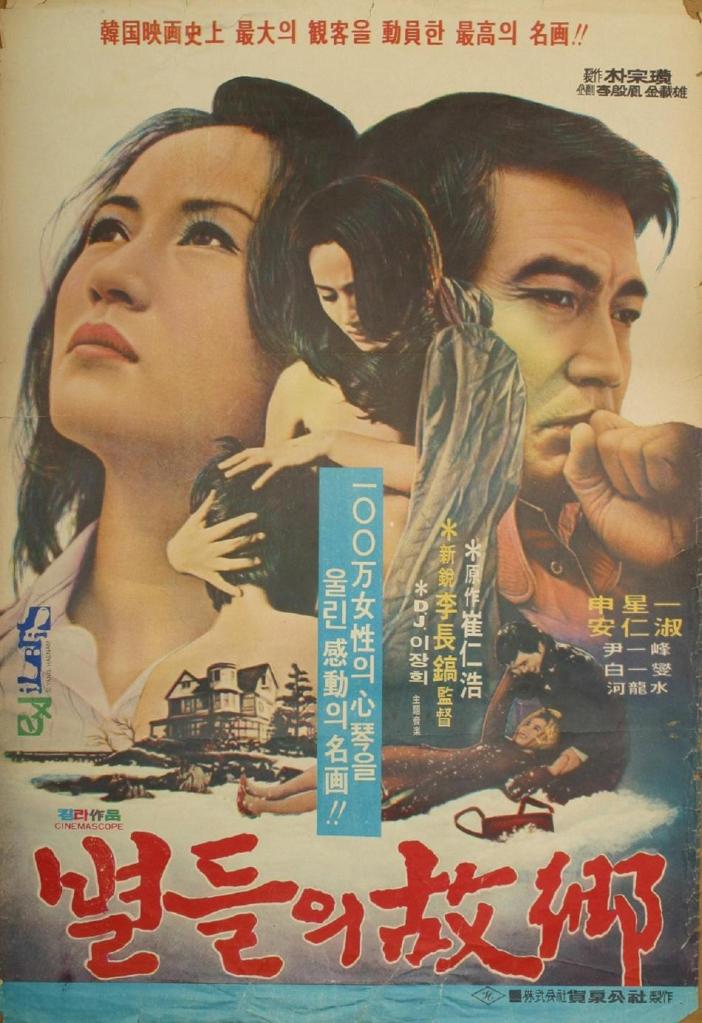 In writing the original novel which inspired Heavenly Homecoming to Stars, Choi In-ho stated that he wanted to tell the story of “a woman whom a city killed”. The novel itself was first serialised in a newspaper where it quickly became a must read and popular discussion point among readers of all ages. It’s perhaps less surprising then that this completely radical film adaptation by first time director Lee Jang-ho proved to be the big cinema hit of 1974. A new “youth culture” movement was beginning inspired by social and political developments from overseas and there was a growing appetite for films and novels which were equally revolutionary. Heavenly Homecoming to Stars managed to provide this but also, crucially, was able to appeal to older age ranges too thanks to its re-imagining of classical melodrama.
 Windows on Worlds