
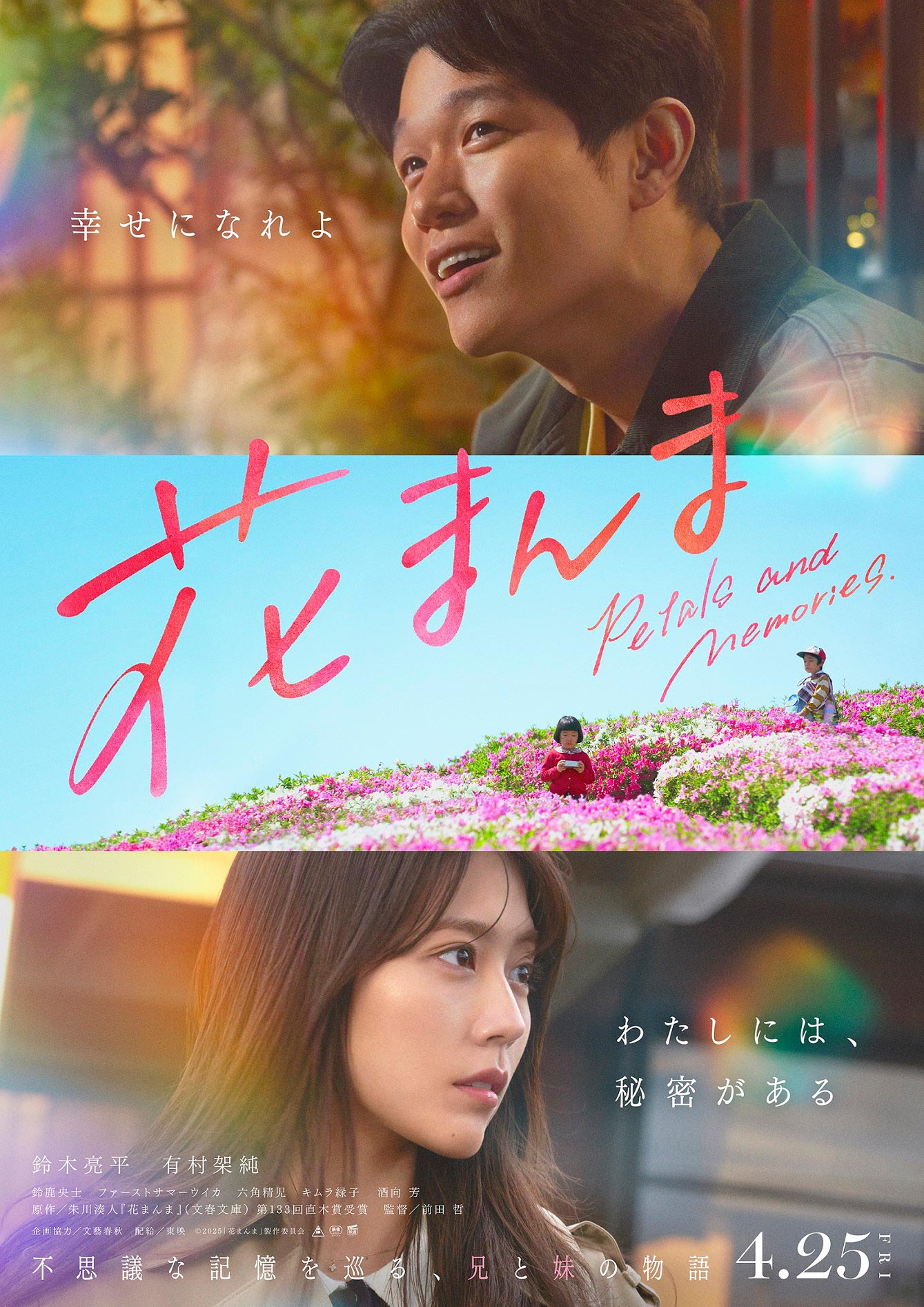
Petals and Memories (花まんま, Tetsu Maeda, 2025)

In many Japanese family dramas, there is an inherent sense of impending tragedy born of the notion that one family must necessarily be broken for another to be formed. Cultural sensibilities might insist that someone can only be part of one family at any time and any attempt to play a part in another is an act of betrayal. But reality is not so clean-cut and just because a woman gets married, it doesn’t really mean that she becomes a stranger to the people who raised her nor that they must completely sever ties with her even as they wish her well as she transitions to a new stage of life.

This is though what older brother Toshiki (Ryohei Suzuki) fears in Tetsu Maeda’s supernaturally tinged familial drama Petals and Memories (花まんま, Hanamanma). Adapted from a short story by Minato Shukawa, the story has an old-fashioned quality in which it could easily have been set back in the Showa era were it not for the fact that Kiyomi, the spirit that his sister Fumiko (Kasumi Arimura) claims to carry, was killed in the climatic year of 1995 which saw both the Kobe earthquake and sarin gas attack on the Tokyo subway. In any case, Toshiki has a distinctly Showa-era vision of masculinity and remains incredibly protective of his sister even if Fumiko has moved up in the world with her job in a university and engagement to a young professor who has the ability to converse with crows.

After their truck driver father was killed in an accident and their mother passed away in Toshiki’s teens, he’s essentially been forced into a parental position. Toshiki left school early and got a job in the factory where he still works in order to fulfil his father’s dreams of sending Fumiko to university. As such, he occasionally paints himself as a martyr and is keen to remind people how difficult it was for his mother to raise them on her own and that he’s sacrificed his future to provide for Fumiko. Her upcoming marriage is then to him a minor betrayal even if it’s also, culturally speaking, the fulfilment of his parents’ hopes for their daughter and thereby the end of his obligation.

The problem with that is Toshiki himself doesn’t have much of an identity outside of “big brother,” and is unable to see Fumiko as anything other than his little sister. When she tells him that she has memories of a previous life, he rejects them and says that he can’t bear to see his sister as “someone else”, repeatedly reasserting that she’s the daughter of his parents rather than those of Kiyomi. But Fumiko is also fiancée to Taro (Oji Suzuka) and friend to Komako (First Summer Uika). As she tries to counter him, more than anything she is simply herself which is something else Toshiki rejects in his categorisation of her only as his sister. Nevertheless, when she tells him that interacting with Kiyomi’s grieving father Mr Shigeto taught her what it was like to have a father seeing that she has no memory of her own is insensitive given that Toshiki has essentially been a father to her for most of her life. 

In clinging to his identity as a big brother, Toshiki may really be attempting to stave off his own fear of orphanhood as a man with no other family, but what he’s forced to reckon with is that his sister is “someone else” after all and not merely an extension of himself. In coming to terms with Kiyomi’s presence and extending compassion to her bereaved family rather than reacting in fear that they were trying to take his sister away from him, Toshiki begins to realise both that he didn’t actually raise Fumiko all alone but benefitted from the extended family of a community and that in her marriage his world is actually expanding rather than contracting. As the old adage goes, he’s not losing a sister so much as gaining a brother. In the “hanamanma” flower bento of the Japanese title, it becomes clear that Kiyomi’s love for her family transcended death and that she is not really lost to them even this most final parting but remains with them in spirit and memory. 


Petals and Memories screens as part of this year’s Japan Foundation Touring Film Programme.

Trailer (English subtitles)

Ice Cream Fever (アイスクリームフィーバー, Tetsuya Chihara, 2023)

“Cold and sweet” is the way a customer to Million Ice Cream describes their produce, but it might also be an odd way to describe its comforts echoing the melancholy of the series of women who pass through its doors in Tetsuya Chihara’s adaptation of a short story by Mieko Kawakami, Ice Cream Fever (アイスクリームフィーバー). For each of the heroines it represents a kind of purgatorial space as they find themselves torn between past and future while seeking new directions.

For Natsumi (Riho Yoshioka), who took the job working part-time at the ice cream shop after experiencing burn out in her career as a designer, that new direction appears in the form of Saho (Serena Motola), an alluring yet sullen woman dressed all in black who turns out to be a formerly successful novelist plagued by writer’s block. A series of flirtatious encounters seem to rejuvenate the creative impulses of both women with Natsumi returning to doodling new signs for the shop and Saho beginning to write again, though there remains something distant and elusive between them. Saho later describes herself as like a summer storm destined to pass by in an instant and soon forgotten though in an ironic way her aloofness and enduring mystery may in fact be a way to ensure she is not forgotten while she at least seems unable to embrace her romantic desires instead sublimating them into her literature.

This inability to forget has also marred the life of Yu (Marika Matsumoto), a similarly lost woman approaching middle age who is suddenly approached by a niece she’s never met because she cut ties with her sister after she stole her boyfriend. Her mother having now passed away, Miwa (Kotona Minami) has come to Tokyo in search of her father and though seemingly aware of the circumstances of her familial estrangement enlists her aunt to help find him thereby forcing Yu to confront the past and reassess her life. Like Natsumi she is also becoming disillusioned with contemporary working culture and contemplating making a change. While she is a devotee of ice cream, it’s the local bathhouse, “an oasis for working women” as she describes it, that her been her refuge. When it suddenly closes due to the elderly owner’s (Hairi Katagiri) own decision to pursue a different kind of life, Yu wonders if she might be happier giving up her high powered corporate job to take it over. 

The dilemma both women face is reflective of a generational shift away from a desire for conventional success achieved by hitting each of life’s landmark events to that for immediate individual happiness derived from small comforts such as an ice cream cone or a soak in a large bath. The irony is that Miwa comes to Tokyo in search of an absent father and finds her aunt, while Yu is able to make peace with her past and accept the new gift life has given her in accepting a maternal role in her niece’s life. What both women choose are pleasant lives rooted in community and giving pleasure to others rather ones of consumerist desire or external validation.

Still, that doesn’t necessarily mean romantic resolution. While one woman’s decision may reflect a desire to move on, the other’s may not but rather an intention to wait if also to do so in a happier and more fulfilling environment that unlike the Mexican salamanders in Saho’s tank she has chosen for herself. Gradually we come to understand these events are unfolding at differing time intervals though weaving through around each other, pursuing a logic of memory rather a more literal reality while driven by the natural rhythms of a life which continues onward around them in continual oscillation. Gradually spinning outward it ropes in the unfulfilled romantic desires of Natsumi’s punkish co-worker choosing to move on in the realisation that her feelings have not been acknowledged and are unlikely to be returned, along with the cruel irony of the happy life seemingly being lived by Miwa’s long absent father. With its gentle framing and pastel colours, the film has an atmosphere of calm and serenity that belies its underlying melancholy in the frosty sweetness of a dormant love kept in the deep chill waiting for summer’s return.


Ice Cream Fever screens in New York July 20 as part of this year’s JAPAN CUTS.

Original trailer (English subtitles)