Hoyaman (さよなら ほやマン, Teruaki Shoji, 2023)

According to Hoyaman, a kind of superhero in the guise of a mutated sea squirt, the sea squirts’ lifecycle involves swimming around like tadpoles after hatching from an egg and then finding a nice rock to sit on at which point they lose their brains. This is what the hero of Teruaki Shoji’s quirky island comedy Hoyaman (さよなら ほやマン, Sayonara Hoyaman) is becoming afraid of, worried he’s about to lose his brain forever stuck in the home he inherited from his parents but also afraid to leave its safety to venture forth and explore some other rocks before it’s too late.

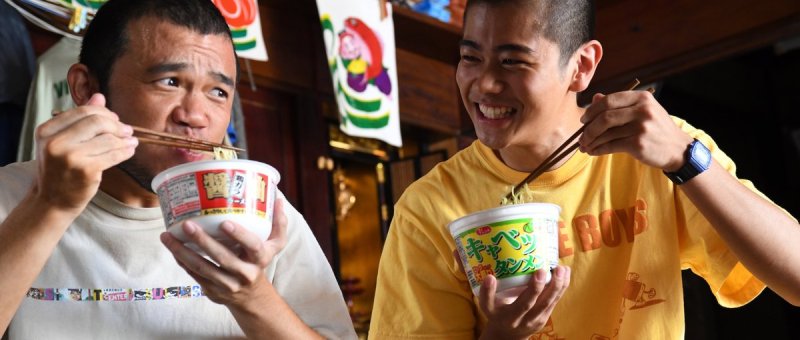
He’s jolted out of his sense of inertia by a mysterious woman, Mahiru (Kumi Kureshiro), who suddenly arrives and tries to buy his house off him though of course Akira (Afro) is not willing to sell despite being so heavily in debt he’s about to lose his fishing boat (and therefore his means of supporting himself) and he and his brother Shigeru (Kodai Kurosaki) are subsisting on a single pot of instant ramen a day. The house itself is like a kind of rock pool where the brothers are trapped in a protracted adolescence having lost their parents in the 2011 tsunami, thereafter floundering around unable to move on with their lives. As their bodies were never found, Akira hasn’t even got round to registering his parents’ deaths or dealt with any of the practical matters surrounding their living arrangements but now realises that he’ll have to something to secure a financial future for himself and Shigeru who seems to have some kind of learning difficulties and is unable to work.

That’s one reason he decides to accept the deposit from Miharu, a manga artist fleeing her life in Tokyo feeling all washed up as she too drifts onto the shore looking for a good rock to sit on. They are all looking for a kind of escape but unsure where to to find it, Akira wondering if it’s time to leave the island just as Miharu arrives. The old woman next door, Haruko (Yoneko Matsukane), who acts like a kind of surrogate mother figure to the boys, confesses that she would have liked to try living off the island and was resentful when their father mentioned the possibility of leaving. She encourages Akira to swim out into deeper waters but he continues to struggle with himself consumed by the trauma of the earthquake, his guilt, and complicated feelings about the responsibility of looking after Shigeru who likely would not be able to adjust to life outside of the island or remain behind on his own.

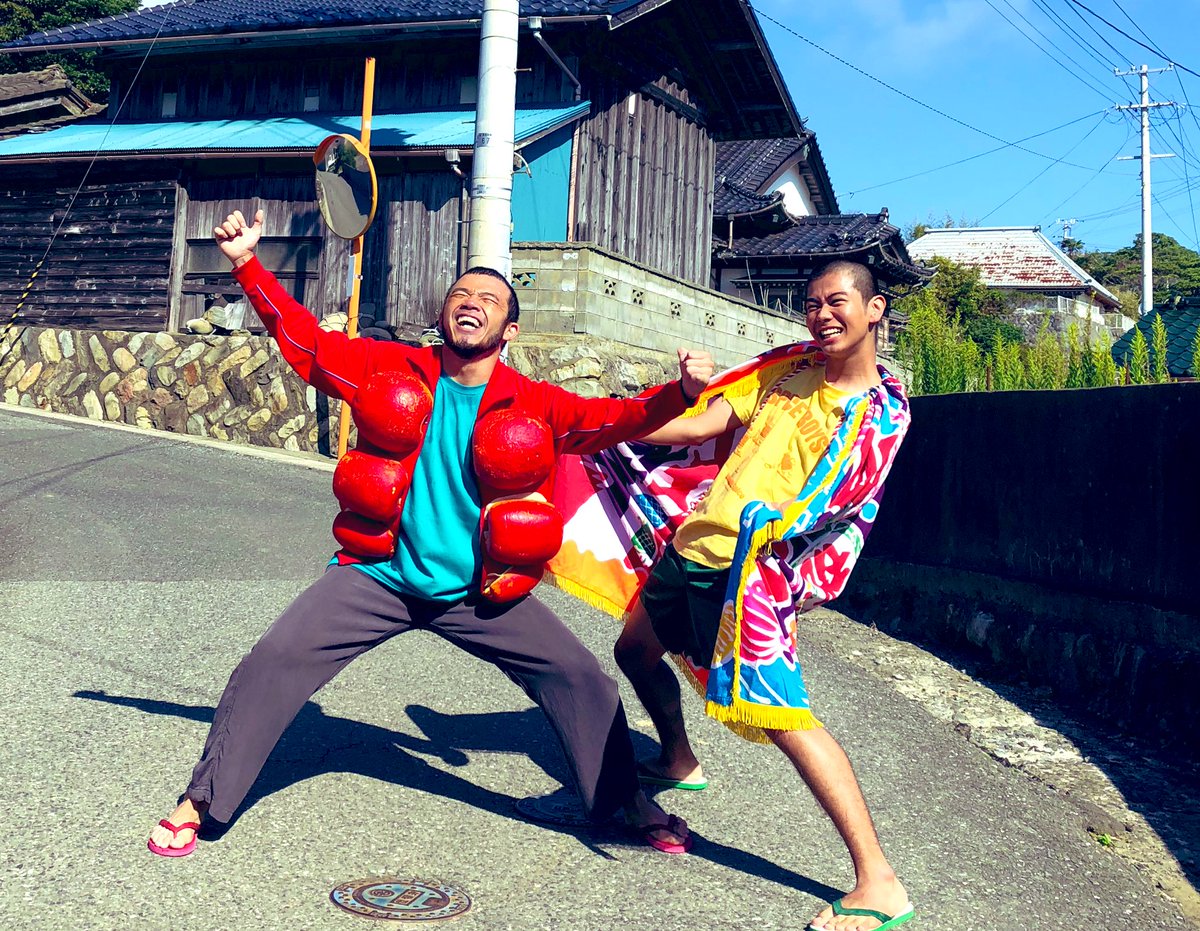
Madcap schemes ensue including an unlikely bid to become YouTube stars by resurrecting a mascot character created by their father to promote the island, Hoyaman. Miharu tries to explain to them that like everything else in the village they’re ten years behind the times, but the boys are naively excited about their prospects while simultaneously trying to recapture the past in the same way Miharu may be in admitting that she based her manga on her own younger brothers of whom Akira and Shigeru remind her. Well meaning gestures eventually backfire, but also lead to a kind clarity that allows each of them to realise who they are and where they want to be or at least what kind of rock they want to be sitting on when it’s time to jettison their brains. 

Even so, it’s not all rainbows on the island as Akira discovers when his bid for YouTube success turns sour and the villagers turn against him for embarrassing them on national scale while Miharu also has her fair share of haters along with a troubled past she’s struggling to overcome. What they rediscover is a sense of community and solidarity among those who wash up on the island whether by virtue of birth or some other happy accident. Meeting his trauma head-on, Akira is able to find an accommodation with his guilt and loss but also a way forward that might not necessarily be the one most would expect as does Miharu though buoyed by her serendipitous connection with the zany brothers, nice old lady, and the gentle rhythms of an island life.


Hoyaman screens Feb. 18 as part of Family Portrait: Japanese Family in Flux

Original trailer (no subtitles)
colorless (猿楽町で会いましょう, Takashi Koyama, 2019)

“I think I could capture the real you” a photographer pleads of a subject he has become obsessed with, little knowing the deeply problematic implications of his statement. Shot with a photographer’s eye, Takashi Koyama’s colorless (猿楽町で会いましょう, Sarugakucho de Aimasho), paints its heroes as just that, wandering zombies of modern day Tokyo as estranged from themselves as they are from others, but even as it attempts to draw similarities between their mutual lifelessness cannot help but reflect a misogynistic world view in which the conflicted heroine remains little more than an empty shell, a blank canvas onto which various men project their inner desires leaving her essentially robbed of an identity by an exploitative society. 

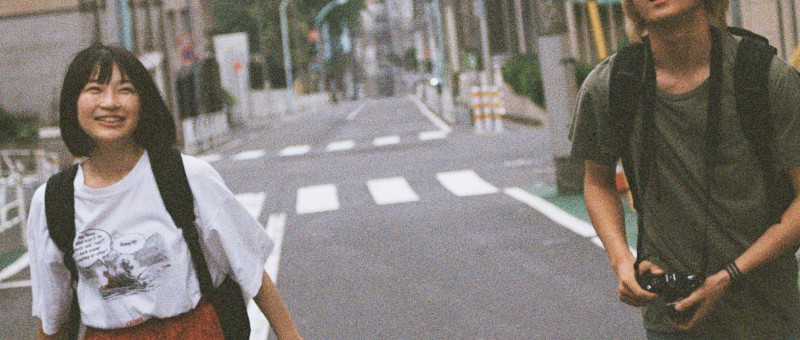
When we first meet aspiring freelance photographer Shu (Daichi Kaneko), he is in much the same position, kept waiting by an arrogant magazine editor who has stepped out of the office despite having arranged an appointment to look over his portfolio. When he eventually arrives, Kasamura (Kenta Maeno) rudely dismisses his work, claiming that the selection of photos he’s assembled doesn’t make sense in that it gives no clear indication of his style or intent and aside from that his shots are cold and lifeless. He attributes this lack of passion to the likelihood that Shu has never truly been in love, something which turns out to be true though as we later discover Kasamura is also a cold and cynical man who proudly proclaims the same of himself. Nevertheless, he hooks Shu up with a side job shooting publicity shots for an acquaintance, Yuka (Ruka Ishikawa), hoping to become a “reader’s model” as a path to fame. 

For whatever reason, Yuka seems to incite in him the passion which Kasamura claimed was missing in his work, becoming both muse and object of desire. She describes herself as colourless and wonders if there is a “her” that can be captured, while Shu assures her that he feels much the same but fails to appreciate the various ways in which he is attempting to colour her with his camera, filled with nothing but jealous anxiety when confronted by the possibility that she exists outside of the image he has created of her. The incongruities between what she tells him of herself, his own self created vision, and the evidence presented to him by others bring out an unpleasantly chauvinistic side of him which he perhaps does not even like in himself, abruptly attempting to stop her leaving his apartment without consenting to sex by threatening to withhold the data for the pictures he took, breaking into her phone to check her messages, and later feeling humiliated in realising that she may have hidden from him a prior (or current) life in sex work.

Yuka, meanwhile, remains a cipher. Unexpectedly interviewed as part of an audition she is asked to describe herself but can only reply in terms of the way others see her, answering only that she is often said to have a sunny disposition. We see her parrot back lines she’s heard from one man to another in an attempt to please him, as if wilfully erasing her essential identity to better conform to male desires in an attempt to keep herself safe but also perhaps betraying that she has few words of her own to offer. Yet in private we see a much less complimentary side of her in which she is petty and jealous, resentful of a friend’s success while she seems to get nowhere and, the film uncomfortably insists, willing to use men by exploiting their desire for her which is in essence a desire for a colourlessness they can dye with their own self projected ideals. 

Yuka claims that she does not want to know who she really is, perhaps afraid to know or realising that there really is no value in knowing because her existence is defined by male desire. Her tragedy may be that she isn’t cynical enough, unable to manipulate men to the same extent as her more successful friend, still longing to be known and loved for who she is even while insisting that she does not exist and wilfully misrepresenting herself to those around her out of embarrassment and dissatisfaction with her life. The story she tells in her interview implies a lasting trauma of male abuse which has caused a rupture in her sense of self, unable to grasp an identity other than that granted by others, but still we’re largely left with Shu’s resentment in his inability to “capture” that which cannot be captured in his desire to possess not only Yuka’s body but her image by replacing it with that of his own creation. A dark and cynical take on modern romance, colorless leaves its heroes much where it found them, floundering in an inherently patriarchal society itself devoid of the colour they each desire. 


colorless streamed as part of this year’s Udine Far East Film Festival.

International trailer (English subtitles)