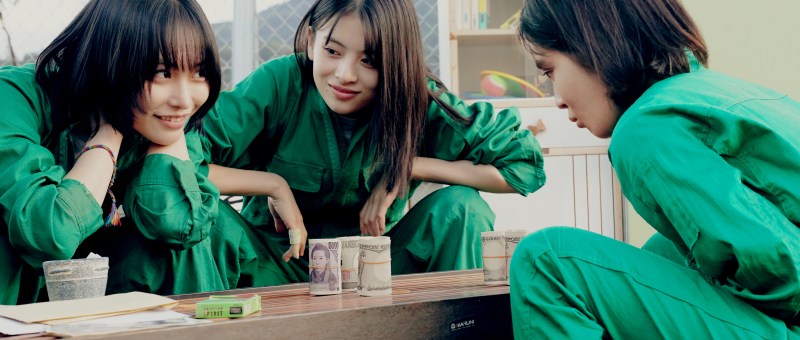

All Greens (万事快調〈オール・グリーンズ〉, Takashi Koyama, 2025)

Consumed by rural ennui, three teenage girls set on a dramatic plan for escape in Takashi Koyama’s darkly comic youth drama, All Greens (万事快調〈オール・グリーンズ). The title turns out to be apt, not only in ironically referencing the drugs at the film’s centre, but also that the girls are all still fairly naive and just trying to figure out their place in the world. Whatever that may turn out to be, it’s clear that each of them is constrained by their circumstances from abusive fathers to absent parents and outdated patriarchal ideals.

The reduced horizons of their lives are evident in Hidemi’s (Sara Minami) description of the school as a place where everyone’s either given up on exams or is too poor to access better education. She and Mako (Mizuki Yoshida) seem to resent popular girl Milk (Natsuki Deguchi) and her seemingly perfect life, but are unaware that circumstances are similar to theirs or that she too is longing to escape this dead-end town. Hidemi is sick of her abusive father and submissive mother and finds release through rap music. Mako wants to be a manga artist, but is under pressure from her family who expect her to marry a man to take over their farm. And Milk has become a mother to her mother who appears to have had a mental breakdown following the death of her husband, a nuclear plant worker caught up in a radioactive incident. 

The attitude of Mako’s family may seem excessively old-fashioned, but seems to reflect the traditional culture of the village. When the teacher warns their class about a flasher, he tells the girls to travel in groups and avoid going home alone while ensuring their skirts are not too short as if that had anything to do with the likelihood of being flashed. The three girls are briefly united when they witness a woman and her small child being dumped in the middle of an intersection by an abusive spouse. They hear later that the woman snapped, killed her abusive husband and burnt his house down before drowning herself and her daughter in the river. Each of them fear ending up like this woman, as if the village itself were an abusive spouse from whom they can’t escape. Hidemi’s dreams of rap stardom are even disrupted when she’s offered a promising opportunity with a “beat master” who first tells her he’s quitting the business because he’s getting married and needs a more stable line of work, and then matter-of-factly says that the job is conditional on sleeping with him. He even tried to drug her drink, but Hidemi has a healthy level of suspicion regarding men who offer help, so she switched their drinks which is how she finds out he has a safe full of marijuana seeds.

The drugs offer a more literal kind of escape in the prospect of a small business the three girls could operate illicitly together without really thinking about the consequences beyond the hope of making enough money to leave town. Later they bring in two fellow students who need money because they are gay and want to move in together to escape their oppressive families, though Hidemi’s assertion that karma isn’t real may seem hubristic while playing into her sense of the world as a lawless place in which there are no real consequences for anything because she’s used to seeing bad guys get away with their crimes. In trying their luck in the big city, however, the girls find themselves out of their depth as their small-town gangster dreams implode in the face of the realities of urban crime. 

In the end, the only real answer may be to burn it all down, but the sense of solidarity between the girls has at least given them the courage to chase their dreams even if they may still prove elusive. As the fumes make their way through the school, it provokes a sense of liberation as the old codes of conformity begin to dissolve and people say what they really feel. It may be only temporary and perhaps lead nowhere at all, but for the moment at least the road ahead is wide open.


All Greens screened as part of this year’s Nippon Connection

Trailer (no subtitles)
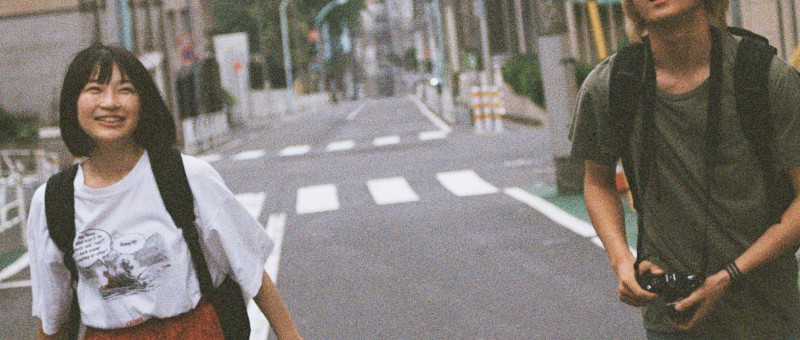
colorless (猿楽町で会いましょう, Takashi Koyama, 2019)

“I think I could capture the real you” a photographer pleads of a subject he has become obsessed with, little knowing the deeply problematic implications of his statement. Shot with a photographer’s eye, Takashi Koyama’s colorless (猿楽町で会いましょう, Sarugakucho de Aimasho), paints its heroes as just that, wandering zombies of modern day Tokyo as estranged from themselves as they are from others, but even as it attempts to draw similarities between their mutual lifelessness cannot help but reflect a misogynistic world view in which the conflicted heroine remains little more than an empty shell, a blank canvas onto which various men project their inner desires leaving her essentially robbed of an identity by an exploitative society. 

When we first meet aspiring freelance photographer Shu (Daichi Kaneko), he is in much the same position, kept waiting by an arrogant magazine editor who has stepped out of the office despite having arranged an appointment to look over his portfolio. When he eventually arrives, Kasamura (Kenta Maeno) rudely dismisses his work, claiming that the selection of photos he’s assembled doesn’t make sense in that it gives no clear indication of his style or intent and aside from that his shots are cold and lifeless. He attributes this lack of passion to the likelihood that Shu has never truly been in love, something which turns out to be true though as we later discover Kasamura is also a cold and cynical man who proudly proclaims the same of himself. Nevertheless, he hooks Shu up with a side job shooting publicity shots for an acquaintance, Yuka (Ruka Ishikawa), hoping to become a “reader’s model” as a path to fame. 

For whatever reason, Yuka seems to incite in him the passion which Kasamura claimed was missing in his work, becoming both muse and object of desire. She describes herself as colourless and wonders if there is a “her” that can be captured, while Shu assures her that he feels much the same but fails to appreciate the various ways in which he is attempting to colour her with his camera, filled with nothing but jealous anxiety when confronted by the possibility that she exists outside of the image he has created of her. The incongruities between what she tells him of herself, his own self created vision, and the evidence presented to him by others bring out an unpleasantly chauvinistic side of him which he perhaps does not even like in himself, abruptly attempting to stop her leaving his apartment without consenting to sex by threatening to withhold the data for the pictures he took, breaking into her phone to check her messages, and later feeling humiliated in realising that she may have hidden from him a prior (or current) life in sex work.

Yuka, meanwhile, remains a cipher. Unexpectedly interviewed as part of an audition she is asked to describe herself but can only reply in terms of the way others see her, answering only that she is often said to have a sunny disposition. We see her parrot back lines she’s heard from one man to another in an attempt to please him, as if wilfully erasing her essential identity to better conform to male desires in an attempt to keep herself safe but also perhaps betraying that she has few words of her own to offer. Yet in private we see a much less complimentary side of her in which she is petty and jealous, resentful of a friend’s success while she seems to get nowhere and, the film uncomfortably insists, willing to use men by exploiting their desire for her which is in essence a desire for a colourlessness they can dye with their own self projected ideals. 

Yuka claims that she does not want to know who she really is, perhaps afraid to know or realising that there really is no value in knowing because her existence is defined by male desire. Her tragedy may be that she isn’t cynical enough, unable to manipulate men to the same extent as her more successful friend, still longing to be known and loved for who she is even while insisting that she does not exist and wilfully misrepresenting herself to those around her out of embarrassment and dissatisfaction with her life. The story she tells in her interview implies a lasting trauma of male abuse which has caused a rupture in her sense of self, unable to grasp an identity other than that granted by others, but still we’re largely left with Shu’s resentment in his inability to “capture” that which cannot be captured in his desire to possess not only Yuka’s body but her image by replacing it with that of his own creation. A dark and cynical take on modern romance, colorless leaves its heroes much where it found them, floundering in an inherently patriarchal society itself devoid of the colour they each desire. 


colorless streamed as part of this year’s Udine Far East Film Festival.

International trailer (English subtitles)