Humanity survived a great flood once before, or so we’ve been led to believe. The mysterious forces at the centre of Kim Byung-woo’s The Great Flood (대홍수, Daehongsu) believe we can survive it again, albeit in an altered form. Or then again, maybe not. What begins as a disaster movie soon shifts into speculative fiction exploring the nature of “human emotion” and whether such a complex thing can ever really be replicated synthetically.
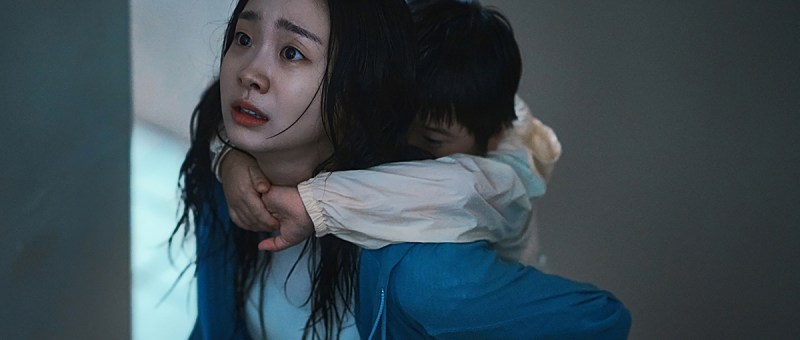
After their apartment is surrounded by floodwaters slowly climbing past their third floor flat, An-na (Kim Da-mi) tries to make her way to higher floors with her often uncooperative six-year-old son Ja-in (Kwon Eun-seong). As in recent similarly themed films, the apartment block becomes a microcosm of the contemporary society with An-na encountering stairs that have been blocked and neighbours who aren’t happy about those from lower floors encroaching on their space. Religious maniacs block access and insist this is God’s will. The only way out is a human sacrifice. Meanwhile, thuggish looters rob abandoned flats despite the fact that all of these previously valuable items are probably worthless now that no one knows when the waters will stop rising let alone when they will recede.
It turns out, however, that An-na is an important person because she works for the Emotion Engine Development Team at the Darwin Center which has apparently known about this all along and has planning ways for humanity to survive for quite some time. It’s soon revealed that Ja-in is not An-na’s biological son but an experimental AI child she’s been developing to create the Emotion Engine. After the initial flood, An-na and Ja-in become separated and she is plunged until a looping series of simulations structured like a video game in which she must reunite with her son to give the Engine maternal instinct and save humanity.
Whether intentional or not, this is all incredibly sexist. Though apparently a top researcher, An-na’s worth is now entirely defined by her ability to become a mother. A flashback reveals An-na asked her boss if she could give Ja-in back because motherhood isn’t for her, while in flashbacks to her time with him she’s shown repeatedly hurting his feelings by neglecting him for her work. He asks to use her work iPad to do his drawings because she doesn’t look at them otherwise, while she’s irritated by his badgering when she’s obviously busy. The conceit is that she can’t find Ja-in because she doesn’t understand why he left her. She worries that he might not want to go with her anyway because she “abandoned” him to go with the men from the Darwin Centre to be saved from the flood and continue her research to save humanity.
The man sent to save her, the unemotional Hee-jo (Park Hae-soo), was also abandoned by his mother and is cynically looking forward to seeing what decision An-na will make. He’ll feel reassured in some way if she chooses to leave Ja-in behind because it will mean that it wasn’t just him, this is the way “human emotion” works. An-na obviously has an opportunity to recast “human emotion” than just recreate it, if that weren’t perhaps against the spirit of what she’s doing. In any case, the earlier part of the film is full of these dilemmas as Hee-jo encourages her to leave struggling people behind so they can make it to the roof for the helicopter. Even so, she comes across people who haven’t abandoned their humanity such as an old man continuing to feed his wife who seems to have dementia with the waves approaching and a man who stays with his pregnant wife who has gone into labour. In the end, An-na can only complete this quest by embracing her humanity by saving the little girl who is trapped in the lift and helping the pregnant lady rather than by abandoning them to survive alone.
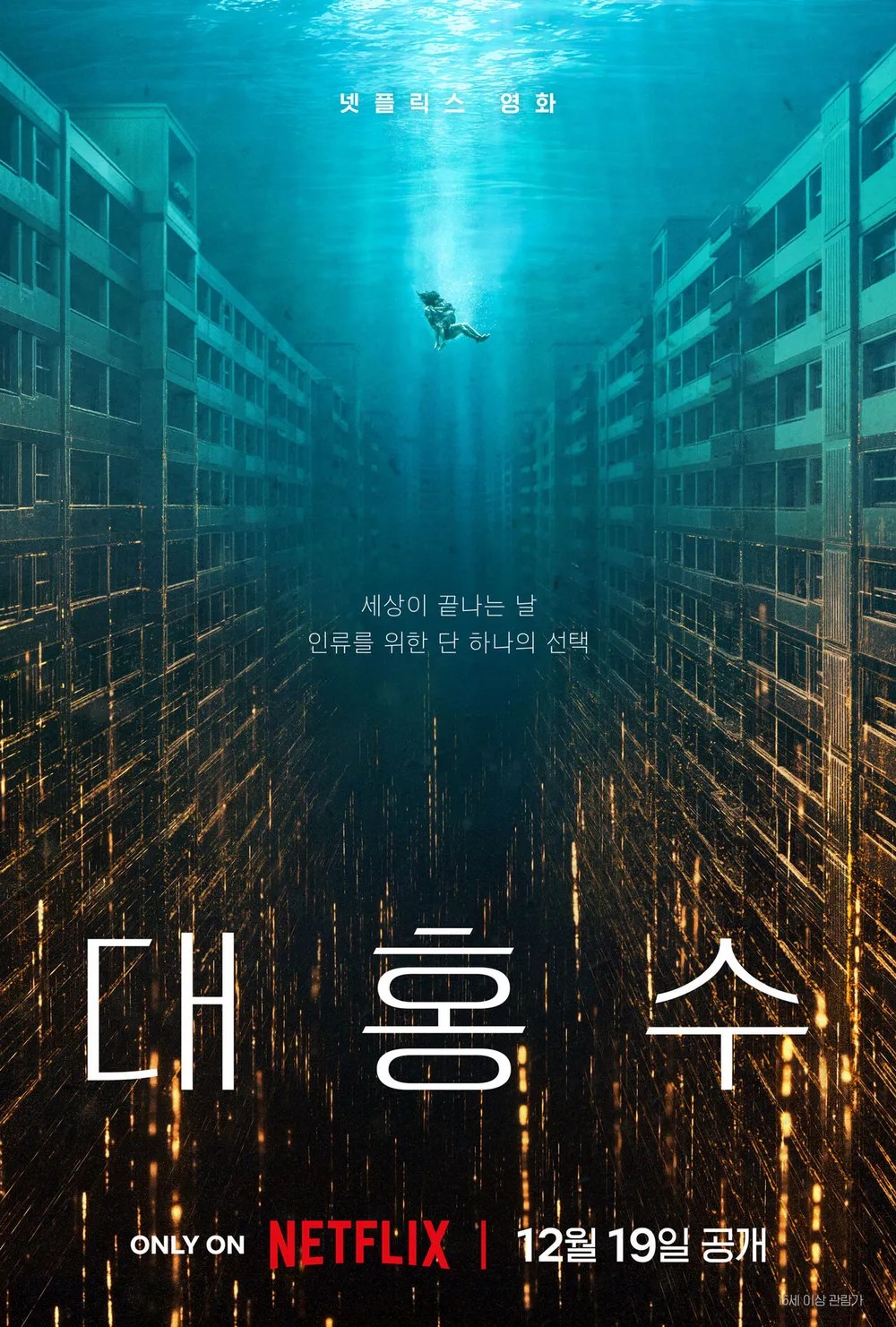
This is also true of overcoming her maternal anxiety to believe she can be a mother to Ja-in which is also positioned as becoming a mother to all mankind as a kind of eve in a new digitised world. The apartment blocks are shaped like datacentres and the water reinterpreted as fire as if this is where people live now. Even so, we can’t be sure whether any of this, even the first flood, was ever really “real” or part of the AI-training scenario in which the Engine must be trained by “real” experiences, or if the An-na who accepts her motherhood and asks to be the test subject sent with Ja-in is the “real” woman or the model from the simulations. In any case, is humanity really surviving by being recreated as AI or bringing about its own demise? In our world at least, the waters may already be rising.
Trailer (English subtitles)
 Windows on Worlds