The Apartment with Two Women (같은 속옷을 입는 두 여자, Kim Se-in, 2021)

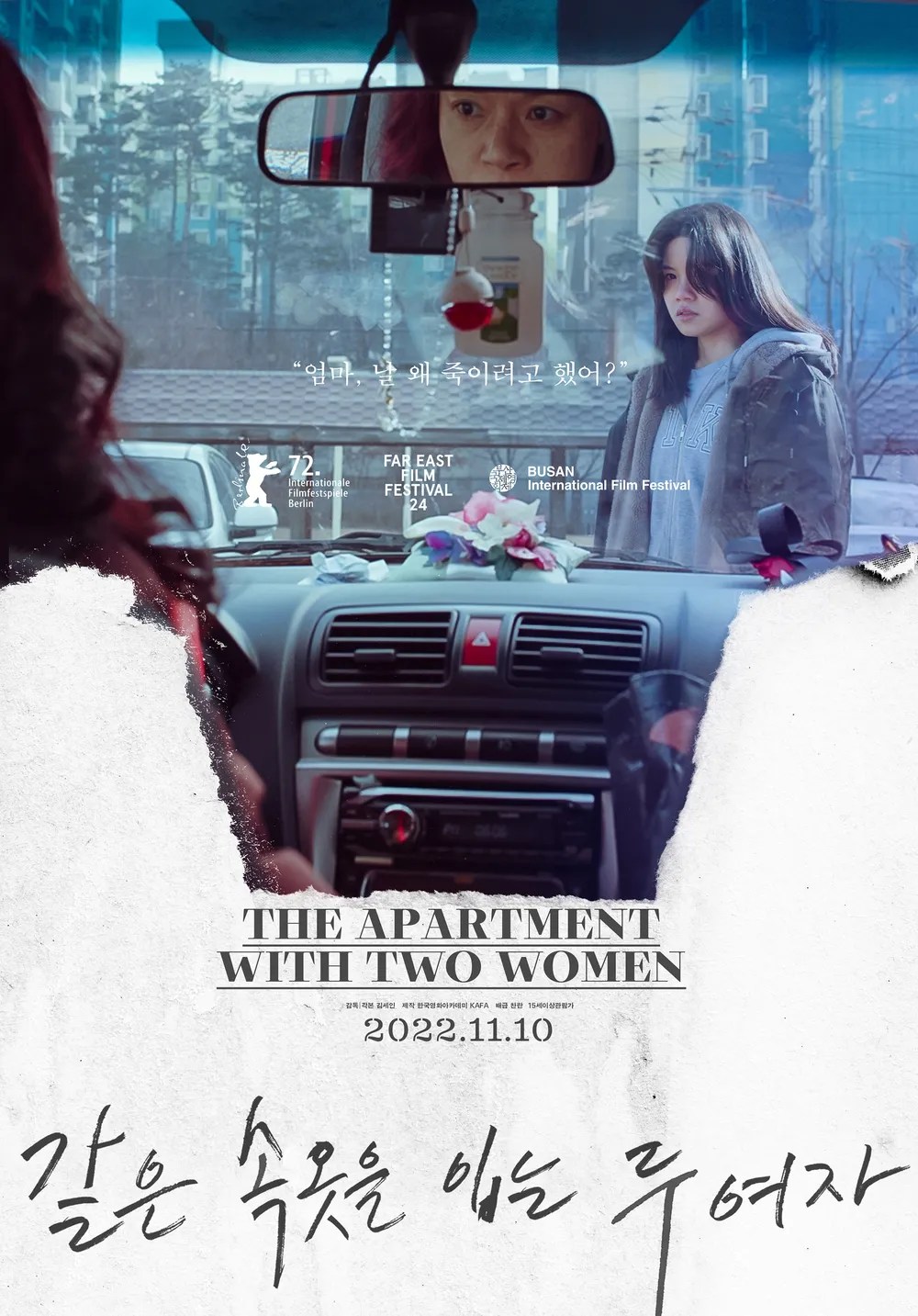
A mother and daughter remain locked in a toxic cycle of resentment and dependency in the debut feature from Kim Se-in, The Apartment with Two Women (같은 속옷을 입는 두 여자, gateun sogoseul ibneun du yeoja). While the English title may have an unfortunate sexist connotation implying that such a dysfunctional relationship is inevitable when two women live together, the Korean “two women wearing the same underwear” more closely suggests the awkward intimacy between them as they each seem to seek escape from the other but in the end are left with no option than to return or choose independent loneliness.

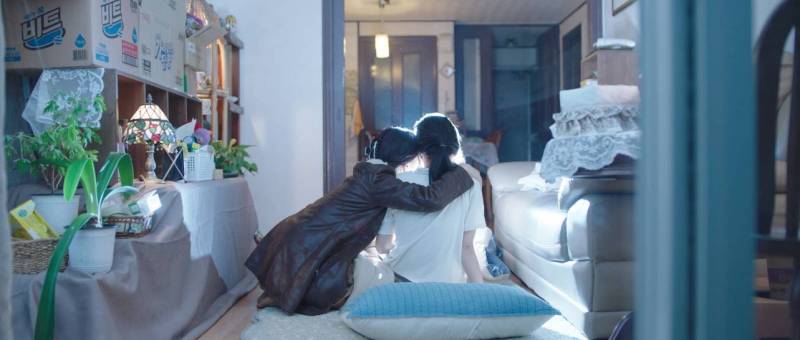
The awkwardness is obvious from the opening scenes as middle-aged, pink-haired mother So-kyung (Yang Mal-bok) chats to a friend on the phone while using the toilet even as her 20-something daughter Yi-jung (Lym Ji-ho) washes her undies in the bathroom sink. Once done, So-kyung slips off her underwear and simply throws them in with the others for Yi-jung to scrub, taking one of the newly washed but not yet dried pairs as a replacement before breezily leaving for work. So-kyung often becomes angry with her grown-up daughter for no ostensible reason, hitting and slapping her while a defeated Yi-jung can do nothing but cry no longer seeing much point in even asking what it is she’s done wrong. Matters come to a head when the pair argue in the car at supermarket car park. Yi-jung gets out and begins to walk away, but her mother suddenly jumps on the accelerator and hits her. So-kyung tries to claim the car malfunctioned but Yi-jung has long believed her mother would prefer it if she were no longer alive. 

During a blackout towards the film’s conclusion, So-kyung again insists the accident wasn’t deliberate reminding that Yi-jung that it wasn’t the first time she swore she’d kill her and forcing her to admit that she remained so calm because it wasn’t the first time she’d heard it. Later someone asks why she didn’t leave seeing as she is a grown woman with a salaried job capable of supporting herself and she answers that she thought she needed to save more money before making her escape but it’s also true that years of So-kyung’s emotional abuse have eroded her confidence in her ability to survive alone and that finally she is just so lonely that even her mother’s continual resentment is preferable to being on her own with no other friends or family to turn to. 

Yi-jung begins to bond with a woman at work who is in a similarly abusive situation with their employer, disliked by her co-workers and exploited by the boss who often hands her additional tasks to be completed for the next morning when everyone else is about to go home. But So-hee (Jung Bo-ram) evidently has troubles of her own, and in any case Yi-jung simply ends up in another apartment with two women while beginning to realise that So-hee is not interested in a close friendship with her for she too longs for “independence” and is turned off by her obvious neediness. So-kyung meanwhile is in a relationship with a genial man of around her own age, Yong-yeol, who has a teenage daughter, So-ra, to whom So-kyung more well disposed than to own but eventually cannot stand. So-ra is in many ways much like herself and So-kyung’s narcissistic tendencies prevent her from sharing Yong-yeol with another woman. When it comes to picking an apartment for them to live in after they marry, it comes as a surprise to her than Yong-yeol intended to bring So-ra to live with them roundly telling him that the “spare” room is for storage not a daughter. Given this ultimatum Yong-yeol choses So-kyung, agreeing that So-ra will live with her grandmother in a decision that shocks Yi-jung on discovering his letter prompting the realisation that her mother will happily abandon her too. 

Su-kyung is in many ways a narcissistic nightmare, refusing to apologise for who she is and always insisting other people are to blame for the way she treats them. All Yi-jung wants is an apology but what she gets is justification as her mother explains to her that her clients at her massage parlour dump all their negativity on her though she is also living a stressful life and so she dumps all of her negativity on Yi-jung whom she resents for trapping her poverty and loneliness as a reluctant single mother. Yi-jung asks her what she’s supposed to do with that, but her mother simply tells her she should have a daughter too. In any case it appears as if Yi-jung may finally be finding the strength to extricate herself from her toxic familial environment, finally being measured to figure out her correct bra size having presumably been forced to wear whatever her mother wore throughout all of her adult life in a moment which brings us back to underwear once again. At times darkly comic, Kim Se-in’s intense family drama circles around toxic dependency and an inescapable cycle of cruelty and resentment but does at least allow its heroines the glimmer of new beginnings in a more independent future.


International trailer (English subtitles)

Queen of the Night (밤의 여왕, Kim Je-young, 2013)

Queen of the NightThere are only two things which spring to mind on hearing the words “Queen of the Night” – Mozart and…something else. Anyway, Kim Je-yeong’s Queen of the Night (밤의 여왕, Bamui Yeowang) is about neither of these. It’s about a dreadfully self-centred IT guy who finds out something he didn’t previously know about his wife and then decides to go all CIA about it. It’s also about her boss who turns out to have a connection to her hidden past and a taste for date rape. Queen of the Night is a comedy in which in which nothing seems very funny, at least if you don’t happen to be a nerdy IT guy whose dream it is to marry a kind and “frugal” woman who will have just emerged from a nunnery or spent her formative years at a conservatoire where all male contact was expressly prohibited.

Young-soo (Chun Jung-myung) is a lonely, middle-aged computer guy whose continual search for love is often undermined by his money-saving mania which extends to leaving his lunchtime blind date waiting while he runs back to the office to retrieve the discount coupon he’d intend to use to buy her a cheap meal. All he wants is a wife who is “frugal” and kind. One day he ventures into a Subway and lays eyes on the girl of his dreams, Hee-joo (Kim Min-jung), who doesn’t seem to notice him and also seems to be the reason this is store completely packed out with middle-aged salarymen. Finally she sees him, the pair start dating, and eventually get married.

Everything is amazing, Young-soo has never been happier. The pair have bought their own apartment in Seoul and are even about to get rid of Young-soo’s horrible old fridge. Young-soo’s life begins to derail when his good-looking but sleazy boss, Park Chang-joo (Kang Sung-ho), asks him to install a dodgy surveillance app across the office network but it’s a trip to a uni reunion which plants doubts in Young-soo’s mind as to how well he really knows his wife.

Without giving too much away, Queen of the Night’s big secret is not what you think it is. In fact it’s nothing at all. All it amounts to is that Hee-joo was once young and a bit mixed up. She spent some time abroad, didn’t feel like she fit in, came back to Korea and felt even more out-of-place. So she started going to clubs and hanging out with delinquents – how scandalous! Of course, Young-soo wanted a nice, level-headed girl who was careful with money so this information disturbs him. Hee-joo has definitely outgrown her wild years and is exactly the woman he wants her to be, but Young-soo just can’t let it go.

The ironic thing is, spineless Young-soo is conflicted about employing the spy program but does it anyway while planning to write a blocking program to stop it working. Meanwhile he’s basically stalking his wife, googling her on the internet and trying to track down her old friends to find out who she really was before he met her. Simply asking Hee-joo does not occur to him.

The world Hee-joo is forced to live in is extremely misogynistic. Young-soo’s suspicions are first aroused when he is talked into making a rare appearance at a uni reunion after being assured he can take his new wife with him. Young-soo only wants to do this to show off that’s netted himself such a lovely, pretty girl but the reunion itself takes a turn for the strange when the wives (there is only one female computer engineer in the group and she apparently owes her graduation to Young-soo who supposedly ghostwrote her thesis for her, because you know women and computers, right?) are expected to participate in a bizarre talent contest to win white goods by showing off their special skill. Hee-joo ends up winning a kimchi fridge her mother-in-law had been desperate for by showing off her smooth moves on the dance floor, much to Young-soo’s surprise and mild displeasure.

Aside from being thrust into combat with the other wives of engineers, Hee-joo is also forced to contend with the unwanted attentions of Young-soo’s boss, Park. As part of his attempts to defeat the spying app, Young-soo discovers surveillance footage of Park taking women back to his office and spiking their drinks after which he assaults them. Despite seeming outraged, Young-soo does nothing at all about this. When Hee-joo looks set to become his latest victim, Young-soo busts a gut to save her but later descends into a bout of victim blaming, preferring to bring up the small amount of info he’s discovered about Hee-joo’s past to imply this was all her fault. Matters are made worse by Young-soo’s geeky friend (Kim Ki-bang) who spends too much time on the internet and assures him that the reason he and Hee-joo haven’t conceived is because of the anti-sperm antibodies in her system generated by promiscuity. Absolute and total rubbish, but Young-soo falls for it without reservation, largely because he has such low self-worth that he assumes any woman who falls for him must in some way be damaged.

Hee-joo is allowed to get her own back, to a point, by reuniting with some of her delinquent friends to scare the living daylights out of Park before telling Young-soo to get lost. He, of course, tries to win her back but he’ll have to learn to love her past too if he’s to have any chance of regaining his bright and happy future. This is a positive step, in a sense, as Young-soo seems to have acknowledged Hee-joo is a person and not just a personification of his hopes and dreams, but it’s also painted as a kind of forgiveness rather an acknowledgement of his totally inappropriate behaviour. Nothing about this is funny to anyone born after 1780, it is rather profoundly depressing. Queen of the Night may shine a little light on male/female relations in modern-day Korea but the picture it paints is far from inspiring.


Original trailer (English subtitles)

https://www.youtube.com/watch?v=PMPPvhe9ZOU

Revivre (화장, Im Kwon-taek, 2015)

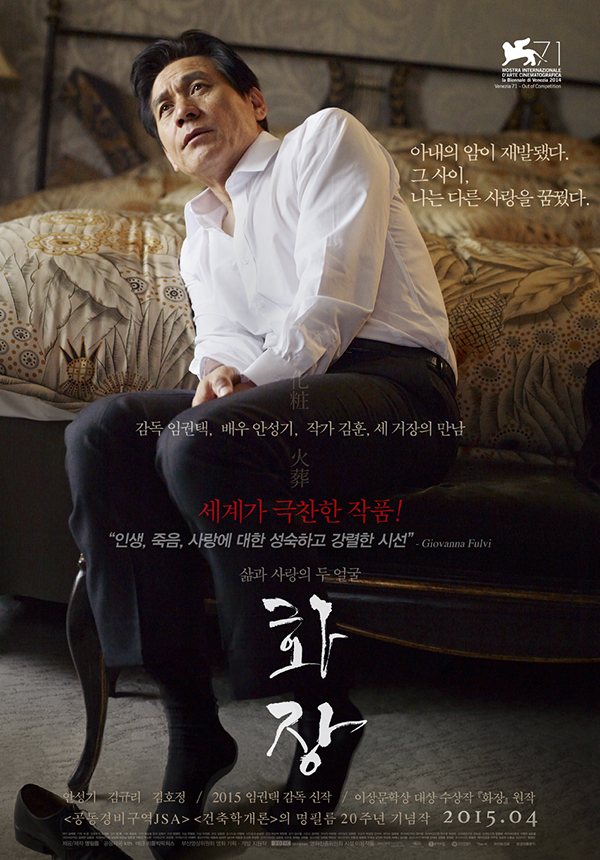
revivreThe 102nd film from veteran Korean film director Im Kwon-taek may appear close to the bone in its depictions death, suffering, and the long look back on a life filled with the quiet kind of love but Revivre (화장, Hwajang) is anything but afraid to ask the questions most would not want to hear as the light dwindles. The inner journey is just too hazy, as one man puts it, unknowingly commenting on the human condition, yet Im does manage bring us nicely into focus, if only for a moment.

Oh (Ahn Sung-ki), a successful salaryman working in marketing for a cosmetics company, finds himself slightly adrift as the brain tumour his wife, Jin-kyung (Kim Ho-Jung), had previously suffered from resurfaces. The treatment this time is apparently not as successful leading to prolonged hospitals stays as Jin-kyung’s condition deteriorates and she begins to require a greater level of medical care. While all of this is going on, Oh is still very much dedicated to his work but has also begun to indulge in an old man’s folly, fantasising about the pretty new girl at the office.

Much of Revivre is concerned with Oh’s inner life, the things he does not say (which are many because Oh is a quiet sort of man). Ahn Sung-ki captures this quality well in playing Oh with a kind of blankness that could be the numbing sensation of grief or an extension of his ordinarily reserved nature. This makes his impromptu verbal attack on the figure of his fixation, Choo Eun-joo (Kim Gyu-ri), all the more unexpected though his remorse over having acted in such an out of character way may actually help to generate a kind of relationship between the pair albeit more of a paternal than romantic one.

Oh’s continuing fixation on Eun-joo, the woman who becomes the accidental focus of his world even though his wife lying dies in a hospital, is intended to be a fantasy and nothing more. An early dream sequence sees Oh participating in an elaborate traditional funeral taking place in a desert in which all of the mourners are dressed in black, except, of course, for Eun-joo – the only fixed point of reference, clothed in vibrant purple and smiling back at him in contrast to the solemn faces of the other guests, each staring at the floor. In the real world time slows down for him as Eun-joo dances youthfully in a nightclub and as he leaves the party early, her’s is the lone still face, haunting him as he looks back at the other revellers still enjoying themselves heartily even outside the club.

Indeed, “looking back” with all of its various advantages and disadvantages becomes another central theme as Oh becomes a kind of Orpheus descending into his own personal hell in the hope of dragging back his departed Eurydice – an idea neatly recreated in one of the film’s few outright fantasy sequences in which Oh dreams himself into an avant-garde dance show. Like Orpheus, Oh cannot help but look back though he risks losing all in the process. What Eun-joo represents for him is perhaps not the woman herself but an image of his own youth and a desire to live again as he once lived before. The present and the past begin to overlap for him, Eun-joo becomes the future he cannot touch as well as the returning spectre of a past he cannot return to.

Oh’s daughter asks him at one point if he ever really loved her mother. His reaction to losing his wife is, it has to be said, restrained, practical. Yet this question is answered with an immediate cut to Oh helping his wife to the bathroom, performing the most intimate of tasks with unwavering devotion. As his wife fades, Oh’s fantasies become a shield against the growing fears of his own mortality as his body also begins to fail him. The melancholy sense of loss and loneliness coupled with the inevitability of the passage of time pervade as each of Oh’s points of reference slips away from him at exactly the same time.

Im opts for a non-linear approach beginning with Jin-kyung’s passing and thereafter moving freely, reflecting Oh’s fleeting memories and interior confusion as he deals with such a traumatic, life altering event. Neatly framing Oh’s dilemma within his work in which he faces a choice of sticking with the current marketing strategy or striking out in a bold new direction, Im plays with the eternal theme of transient beauty in a society which prizes bodily perfection above all else. The film’s Korean title plays on a pun involving a homonym which means both “cremation” and “makeup” perhaps harking back to the central theme that you dig a grave for yourself if you attach the wrong sort of importance to the impermanent, but is in a sense ironic as one represents a final acceptance and the other an attempt to hold off the inevitable. Poetic and intensely moving, Revivre is another characteristically multilayered effort from Im, still at his full strength even in this late career effort.


International trailer (English subtitles/captions)