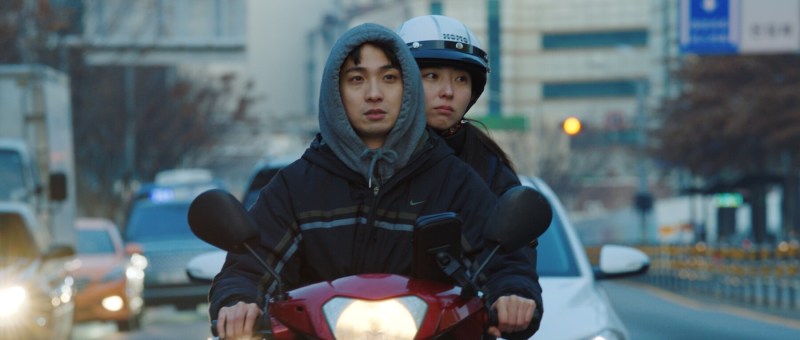
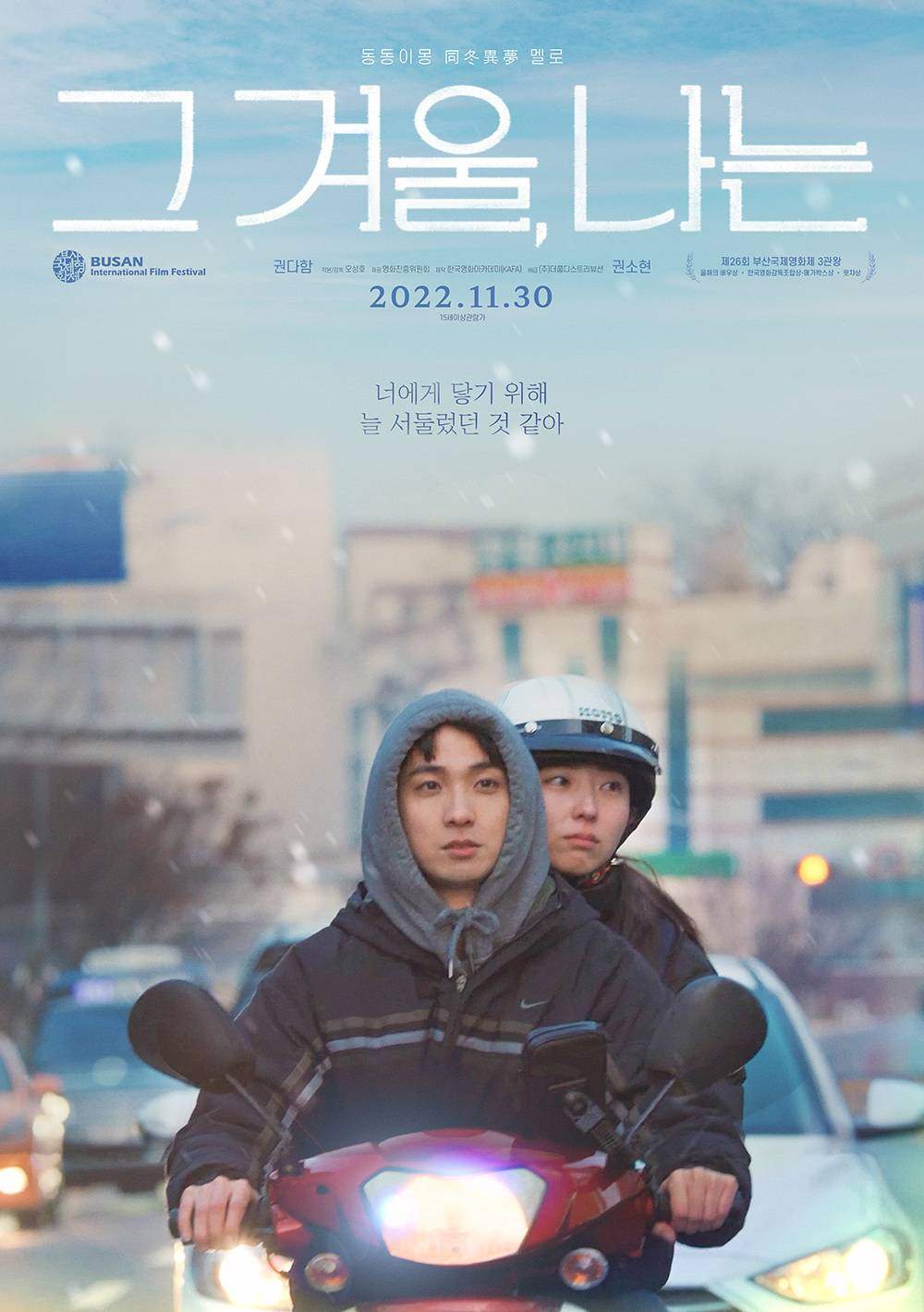
The previously close relationship between a young couple hoping to win steady government jobs is gradually eroded by the strain of living in a hyper-capitalist society in Oh Seong-ho’s empathetic indie drama Through My Midwinter (그 겨울, 나는, Geu Gyeoul, Naneun). Another in a series of recent films exploring the pitfalls of living on the margins of an otherwise prosperous society, Oh’s debut feature explores the ways in which money, employment, security, and the changing natures of classism and patriarchy continue to disrupt human relationships in the simple desire to live in relative comfort or else just survive in one of the wealthiest cities in the world.
Both approaching 30, Kyung-hak (Kwon Da-ham) and his girlfriend Hye-jin (Kwon So-hyun) are each studying for civil service exams he in the police force and she hoping for a job at the tourist board though it seems like even that wasn’t her first choice. Though they are each worried that their time is running out and they’ve left it too late to get settled, they appear to have a good relationship and are happy muddling through together. The crisis comes when Kyung-hak receives a call from a bank and discovers his mother has taken out a sizeable loan in his name on which she has defaulted and apparently disappeared leaving him liable for the entire amount plus interest. As a student it is not an expense he can afford, leaving him with no other option than to look for part-time work which disrupts his ability to study and further decreases the chances of his passing the upcoming police force exam.
Kyung-hak’s naivety is obvious when it’s clear he’s being ripped off by a friend who sells him a motorcycle for cheap claiming that he recently had it serviced though it sounds and looks like it’s seen better days. Accepting a job as a delivery driver he is resigned to taking the jobs no one else wants as the rookie new recruit, but is quickly frustrated by the way in which he is treated by his customers. The guard at one swanky building won’t let him use the lift in case the take away he’s carrying leaves a smell, forcing him to walk up 19 floors and possibly incur a customer complaint when the food is cold or damaged from its journey up the stairs. He is encouraged to be reckless in order to earn more money, putting his life and those of others in danger while his lack of sleep also makes him irritable and difficult to be around especially with Hye-jin who is experiencing problems of her own after deciding to give up on the government exam and take a job at a tech company.
Mirroring the final scenes of Kyung-hak operating a machine at a factory, the work Hye-jin is originally assigned is on a production line assembling USB sticks which is most likely not the kind of job she envisioned for herself as someone with a post-graduate degree. A further strain is placed on their relationship by the obvious disapproval of Hye-jin’s mother who thinks Hye-jin is wasting her time with a man like Kyung-hak who is “just” a delivery driver at age 30 and most likely is never going to pass the police exam. “Who marries for love these days” she exclaims in exasperation, simultaneously admitting that it was different for her generation who could make a lot of money together while young and save for the future, and resenting her daughter for not being smart and looking to hook up with someone “on her level”. Hye-jin appears to resent this, but deep down perhaps feels something similar, drawn to her boss at her new job who seems nice enough and like her speaks Japanese having spent some time living in Kyoto. When her new coworkers ask about her boyfriend she’s evasive, finally conceding that he’s studying for the police exam but clearly uncomfortable when they ask if they’ll be getting married once he finally passes.
The cracks may have already been there, Hye-jin accusing Kyung-hak of only using her for sex rather than committing to the relationship, while he is increasingly sullen and uncommunicative unwilling to accept help financial or otherwise humiliated in having his masculinity undermined by not being able to support himself independently. Eventually he’s forced to compromise himself morally, behaving like the colleague he resented in picking up the better jobs first and then resorting to criminality in agreeing to drive sex workers around for the money to fix his bike after an accident. When he realises the girl he’s driving is probably underage he tries to do something about it, but she needs the money as much as he does and asks him what “responsibility” he’s going to take. Will he give her the money so she can go home tonight? Even if he does, what about tomorrow and all the nights after that? She’s just as powerless as he is and at even more risk.
The film’s English-language tagline presumably referring to Hye-jin as “a woman who falls prey to money” may have its share of misogyny in suggesting that Hye-jin has somehow sold out in choosing to pursue a more middle-class life at the expense of her relationship with Kyung-hak, as if Kyung-hak has not also fallen prey to money in that it is the force which has destroyed his life and hopes for the future as it has for pretty much everyone. When he almost loses a hand at his factory job, his boss just asks if the machine’s alright not really caring that it’s Kyung-hak who might be broken by the inhumanity of rampant capitalism. It’s difficult to tell if the closing scenes are intended as hopeful or otherwise as Kyung-hak once again studies for the police exam hoping to escape his life of crushing poverty but also perhaps complying with the system that sent him there and may never grant him the right the better life he dreams of. Oftentimes bleak, depicting a society in which all relationships are transactional and friendship or romance luxuries most are unable to afford, Oh does at least suggest that this is only an extended midwinter and spring will eventually come for Kyung-hak even if he has to wait until he’s 49.
Through My Midwinter screened as part of this year’s London Korean Film Festival.
Original trailer (Korean subtitles only)

 Windows on Worlds