
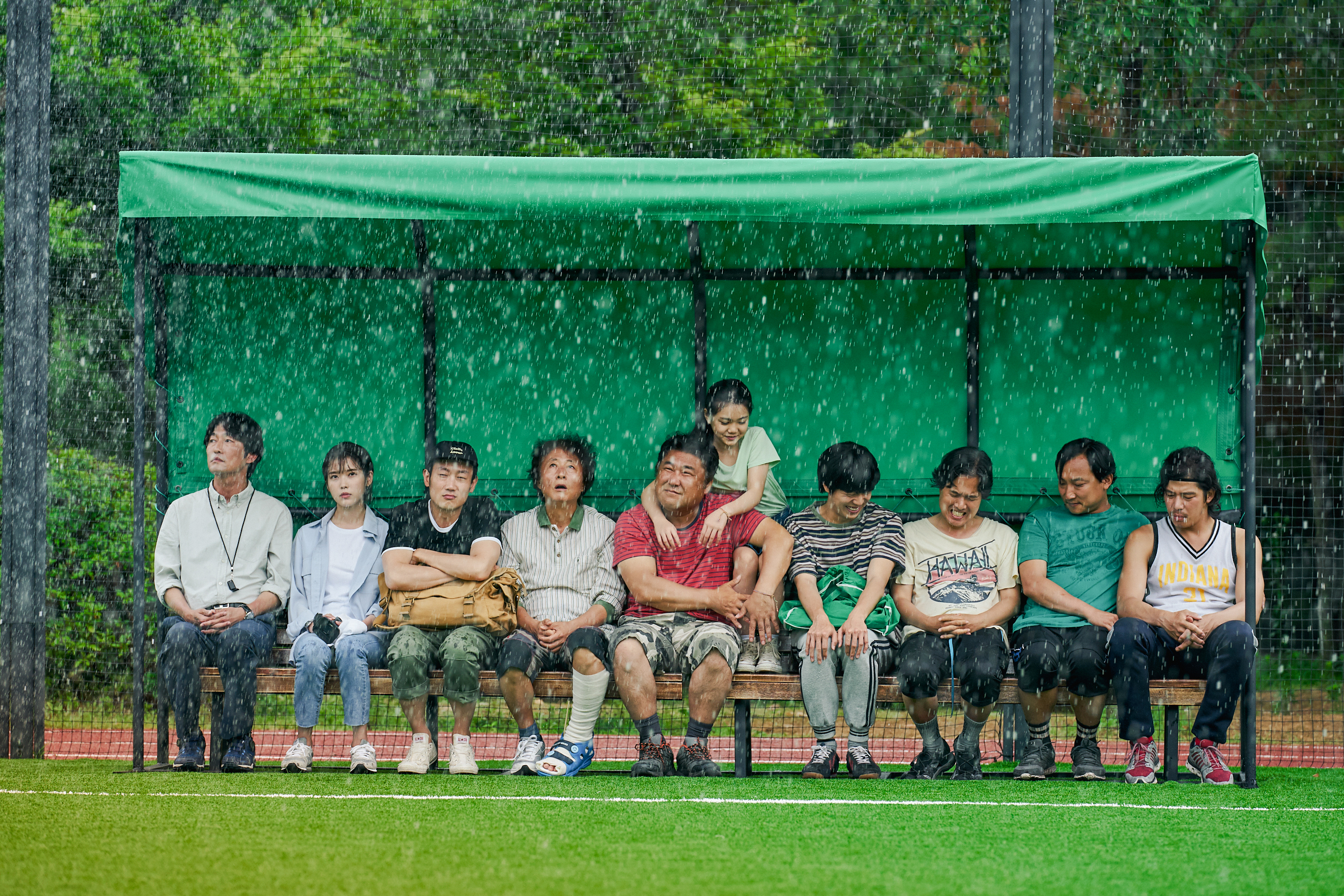
Dream (드림, Lee Byeong-heon, 2023)

A disgraced football player gets a shot at redemption after agreeing to coach a team hoping to take part in the Homeless Olympics in Lee Byeong-heon’s sporting drama, Dream (드림). The Homeless Olympics was founded in order to advocate for the end of homelessness while combatting discrimination and stigma and takes place annually with teams of homeless people from all over the world taking part. Set in 2010 and inspired by the first Korean delegation to participate, the film is essentially an underdog sports drama in which the act of scoring a single goal is the same as an overall victory.

It is also, meanwhile, heavily critical of celebrity and sensationalist media each of which have a habit of latching onto popular causes in order to further their own careers. Hong-dae (Park Seo-jun) was a popular footballer insecure in his talents, but gained notoriety after poking an obnoxious reporter in the eyes when he repeatedly brought up the topic of his mother who happens to be a fugitive from justice. Deciding to retire from the game, Hong-dae is picked up by a talent agency who want to make him a star and is convinced to become the coach of the homeless football team in order to improve his personal brand while documentarian So-min (Lee Ji-eun) hopes to do something much the same by producing a semi-scripted reality show following the team’s fortunes.

Accordingly, So-min instructs Hong-dae to let her “cast” the key players on the basis of their touching backstories rather than their sporting ability. She comes up with a selection of people who have each for various reasons ended up on the streets but are looking for a way to turn their lives around and repair fractured relationships with family members. One man turned to booze and women while riding high but found himself out of luck when the Asian Financial Crisis ruined his business, while another claims that he’s not really homeless just lying low for a while, and a third was scammed by a friend and saddened by the impending exit of his ex-wife and daughter who will shortly be moving to Australia with her new husband. The film strays into more interesting territory in exploring the story of 44-year-old Beom-su (Jung Seung-gil) who ended up on the streets after a workplace accident left him with a chronic illness he did not have the money to treat, but otherwise falls into the same trap as So-min’s documentary in taking a fairly superficial view of homelessness. By the end of the film many of the players have thankfully moved into stable accommodation but do so largely without explanation aside from having apparently managed to save up for a deposit. 

Positioning their battle for sporting success as a means of reclaiming their self-esteem might also uncomfortably suggest that the reason they’re on the streets is a matter of mental attitude while ignoring other systemic issues that led them there or prevented them from moving on (assuming that they wish to do so). Aligning their struggles with Hong-dae’s and to a lesser extent So-min’s might do something similar while they too are also battling cynicism and self-esteem issues, Hong-dae continuing to blame his mother for his problems complaining that he was born to be second place because she never put him first. As Hong-dae later points out, So-min is also to an extent exploiting the homeless in trying to create an inspirational narrative for her TV show before she like everyone else realises there are other ways to win besides the literal. 

The final message is more one of never giving up as the team finally travel to the Olympics and find themselves out of their depth before deciding to give it everything they have even if it’s very unlikely they will win. There had indeed been discrimination in Korea, a sponsor pulling out describing the homeless as “smelly and disgusting” and expressing a degree of squeamishness about involving them with their brand, but at the Olympics they become the most popular team despite their lack of skill purely because of their charismatic perseverance. One player’s late in the game announcement that he is gay but has now come to accept himself in the knowledge that the problem lies with the world that will not accept him also makes the case for a greater equality if perhaps clumsily conflating two different issues. Nevertheless, IU’s lively performance and the film’s warmhearted tone help to overcome any mild sense of discomfort in its otherwise genial tale of never giving up and regaining your self-esteem even if you feel as if the world has already abandoned you. 


Dream screens July 17 as part of this year’s New York Asian Film Festival.

International trailer (English subtitles)

Images: © 2023 PLUS M ENTERTAINMENT & OCTOBER CINEMA INC. ALL RIGHTS RESERVED.

The Moon in the Hidden Woods (숲에 숨은 달, Takahiro Umehara, 2018) [Fantasia 2019]

The Moon in the Hidden Woods posterNight is dark, but when you have the moon to light the way there is always the hope of a better tomorrow. When all hope is gone, how are you supposed go on? For a small group of villagers, the answer is to do the best they can, staving off the darkness with determination and guile. Directed by Japan’s Takahiro Umehara making his directorial debut, The Moon in the Hidden Woods (숲에 숨은 달, sup-e sum-eun dal) is a story about learning how to survive the darkness but also an oblique allegory about authoritarian corruption and the power that comes with embracing your essential identity. 

As the wise old granny tells us at the beginning, long ago the Moon watched over the villagers, protecting them from the terror of night, but then it suddenly disappeared. A terrifying monster, Muju, wrapped the night sky in red, devouring misfortunes and sending fearsome minions to plague mankind. Warriors set out to look for the Moon, but none returned. Meanwhile others learned how to profit from the new world and saw no need for a return to the past until gradually people forgot there had ever been a Moon to begin with.

One such profiteer was the evil Count Tar, who is determined to marry the Princess Navillera very much against her will. Escaping to the city, Navillera finds herself coming to the rescue of a musical trio caught up in an unfair competition to win some mystic water to use in their harvest festival, and making use of her telepathic super powers and natural musical ability at the same time. The Nova Folk Band are a small group of illegal meteor hunters from the village who are more interested in survival than they are in intrigue, but are nevertheless some of the only people still looking for the Moon. In any case, they end up taking Navillera with them as they flee, not quite believing that she is a princess and the intended bride of their tyrannical ruler.

While in the village, Navillera gets a crash course in class conflict, never having left the palace before and spent her entire life in a lavish comfort she assumed was available to all. This quickly puts her into conflict with musician Janggu who deeply resents the “spoiled” entitlement that sees her asking for extravagant luxuries like meat, fruit, and honey, while being entirely unused to farm work. She does, however, try her best even mucking in with the other villagers where she can but is obviously unable to contribute to the same degree given that she has never had to do a day’s work in all her life. Meanwhile, as Janggu points out, the gang have gone out hunting meteors full in the knowledge that it’s illegal because they need them to survive. The princess objects to their reckless lawbreaking, affirming that the kingdom will protect them with ore only for Janggu to point out an ore is worth half the year’s harvest and the only reason you’re not allowed to hunt meteors is so that the unscrupulous powers that be can sell you an alternative and thereby keep a grip on their power by keeping the poor in their place. Suddenly, Muju isn’t looking so much like a scary red monster but an eerie metaphor for late stage capitalism.

Meanwhile, the Navillera is also busy trying to escape an oppression she wasn’t even quite aware of in her attempt to reject the intentions of Tar. Through her time in the village, Navillera begins to lose heart, fearing that her cosseted life has left her powerless without skills or talents. What she discovers, however, is that she has a natural ability for dance that finds a perfect home in the cheerful village where such things are praised and becomes the key both to restoring her essential identity and defeating Muju to rediscover the Moon.

In opposition to the “nothingness” that Muju represents, Navillera draws strength from the camaraderie of the villagers as they adopt her as one of their own, urging her not to give in and marry the evil Tar but to join them in their rebellion, choosing the “path of life” as the joyous music of the villagers finally breaks the stronghold of Muju’s austerity. Finally seeing the light of a better tomorrow, the villagers look back on the past with stoical eyes, recognising that mankind’s greed gave rise to Muju and resolving to forgive those who were merely weak rather than actively evil in order to live on in the light of a new world. A perfect blend of Korean fantasy and Nausicaa-esque steampunk, The Moon in the Hidden Woods is a cheerful ode to the importance of hope and the pure joy of musical expression in a sometimes harsh existence.


The Moon in the Hidden Woods was screened as part of the 2019 Fantasia International Film Festival.

International trailer (English/korean/Japanese captions)