
Escape (탈주, Lee Jong-pil, 2024)

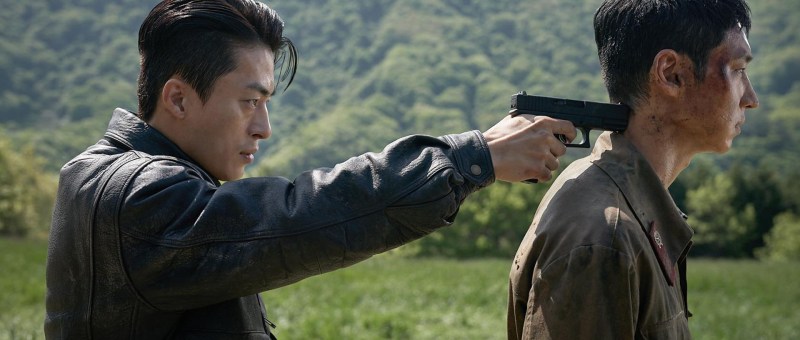
Lee Jong-pil’s existential action drama Escape (탈주, Talju) opens with scenes of a man running. He runs his way through the rest of the film, continually on the move and chasing a dream of freedom outside of the oppressive society in which he is otherwise trapped. The man who chases him, meanwhile, is himself running away. His movements are slow, calculated, and cold but also somehow tender and almost it seems an act of self harm. 

The fact that the oppressive regime is North Korea is almost irrelevant and the film is less about Communism than it is lack of autonomy that may be found in any other democratic or developed nation in which people are driven to erase a part of themselves in order to fit in or to prosper amid rigidly defined social codes. Nevertheless, there is a direct criticism of the Democratic People’s Republic in the ironic signage, a car ploughing straight through a sign that reads “for freedom and happiness of people”. But then, even if deserter Kyu-nam (Lee Je-hoon) finds happiness in the South we can’t be sure it’s really any better. The welcome message blasted through loudspeakers over the wall that marks the border doesn’t sound all that different from the propaganda messages on Kyu-nam’s radio, while the deserter’s phone positioned to appeal to men like him appears to be out of order. 

But to Kyu-nam, “the South” is only really an idea and it’s clear he intends to transcend those borders too, venturing on to the wider world and wherever it pleases him to go. What he rails against is fate, that his life is dictated by forces outside of his control or more accurately by Field Officer Hyun-sang (Koo Kyo-hwan) from State Security who takes him under his wing and tries to make something of him as a loyal soldier of the North. What becomes clear is that Hyun-sang is a man who fears freedom and that the presence of a man like Kyu-nam is a threat to him because he awakens his own deeply buried desire for liberation. 

From the longing looks he directs at a man with whom he studied abroad in Russia we infer that Hyun-sang is gay and the suppression of his authentic self in order to keep himself safe in a repressive culture has made him cruel and vindictive. Unfortunately, this presumably unintentionally plays into a homophobic trope which aligns queerness with sadistic villainy, but does nevertheless lend a kind of poignancy to Hyun-sang’s otherwise vindictive quest to prevent Kyu-nam’s escape precisely because he himself desires to be free but is too afraid to free himself. From a wealthy and prominent family and with an important position within the regime, this system otherwise works out well for Hyun-sang but he is also imprisoned by it and will forever be prevented from becoming his authentic self or gaining what he truly wants so long as he remains within North Korea. 

A homoerotic charge exists between the two men though what Hyun-sang may really be chasing is himself and half-hoping he’ll be caught. Kyu-nam meanwhile has a single-minded desire for autonomy and individuality, to live and die on his own terms rather than live with no right or power to decide his future. There are those who’ve found other ways to reject the system, a group of mostly female nomads seeking a new place to belong after being kicked out of their village but seemingly with no intention of leaving the country, but for Kyu-nam there is no freedom inside the walls and his determination to find it is what makes him so dangerous to Hyun-sang for whom the very idea of freedom is so painful he’s sublimated himself entirely into an oppressive regime.

With pulsing synth scores, Lee keeps the tension high as Kyu-nam runs and runs through minefields and bullets while pursued by the full force of the North Korean army and the steely Hyun-sang who always seems to be one step ahead. His passage takes on an existential quality, risking death rather than continue to live a “meaningless life” in which he has no power to decide his own fate. His escape is finally self-liberation, taking the decision to free himself because no one else is going to, while Hyun-sang remains a prisoner too afraid of freedom to actively pursue it though perhaps tempted by his encounter with Kyun-nam, a man free in his mind if nowhere else.


Escape screened as part of this year’s London East Asia Film Festival.

US trailer (English subtitles)
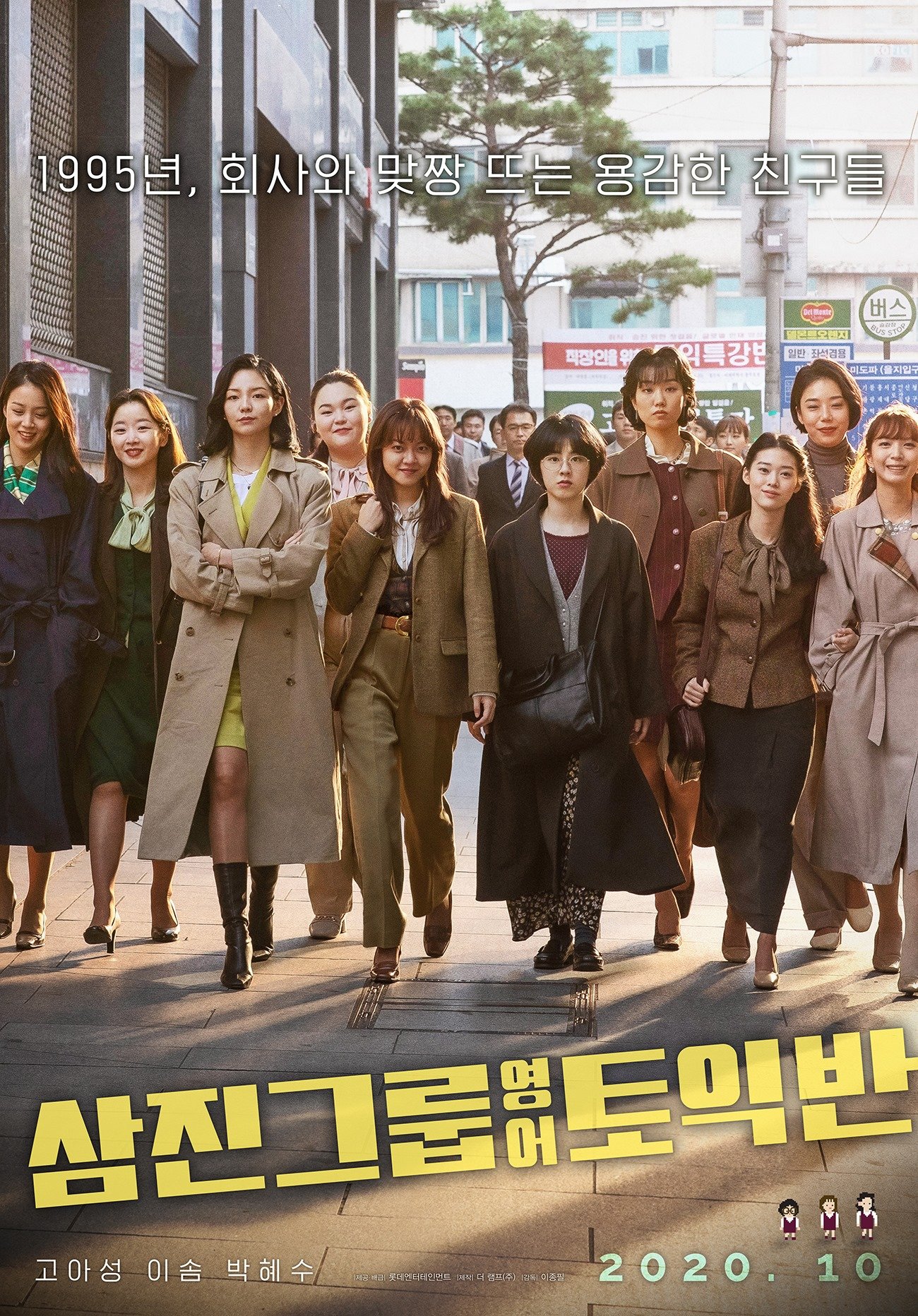
Samjin Company English Class (삼진그룹 영어토익반, Lee Jong-pil, 2020)

“The year of 1995 will mark the first year of our globalisation” according to the opening stock footage in Lee Jong-pil’s tale of tempered feminism and corporate anxiety, Samjin Company English Class (삼진그룹 영어토익반, Samjingeurup Yeongeotoikban). Partly a nostalgia fest for a mid-90s sense of aspiration which would come to a crashing halt with the financial crisis just two years later, Lee chronicles a society in flux as a new generation of women find themselves kicking back against the ingrained patriarchal attitudes of a conservative society while at the same time experiencing a gradual sense of disillusionment with growing internationalism that ironically sends them straight back into the arms of the chaebol. 

Set concretely in 1995, Lee frames his Working Girl-esque drama around the lives of three office ladies each beginning to age out of their potentially dead end jobs. An evolution of the secretarial pool, office ladies are treated more or less as domestic staff in the corporate environment often assisting the, largely but not exclusively, male workers with admin tasks such as teaching them how to use the fax machine or operate IT software while otherwise expected to perform traditionally feminine roles keeping the office clean and tidy or fetching drinks and cigarettes for their bosses. As such they are largely invisible, the men often talking indiscreetly in front of them because they don’t really matter. No one takes an office lady seriously even while they are perceived as essential, if interchangeable, in the functioning of the office. 

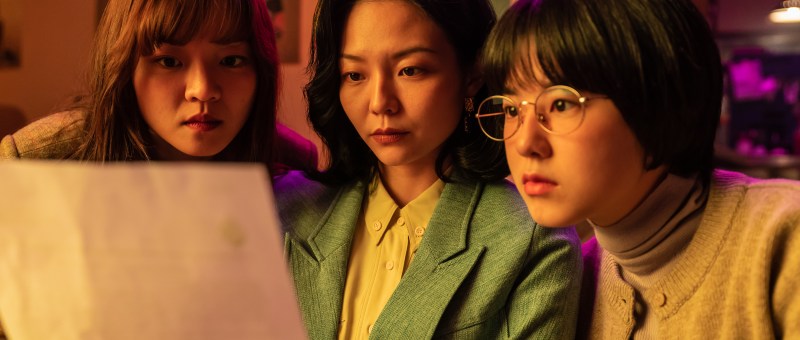
All very capable women, Ja-young (Go Ah-sung), Yuna (Esom), and Bo-ram (Park Hye-su) are looked down on by the few female members of the regular salaried staff because, largely for socio-economic reasons, they have no university degrees. Still, beginning to age out of office lady life they are faced with a conventional choice of finding a husband or attempting to gain a promotion into the ranks of permanent workers. It’s for this reason that they begin taking the company’s English classes, hoping a high TOEIC score will as they’ve been promised smooth the path towards employment. Women coming of age in a newly democratised Korea with its eyes on the rest of the world, they want more out of life than perhaps the previous generation would have done though Ja-young in particular is noticeably ahead of her time wanting not just career success but personal fulfilment. She was glad to work for Samjin because she thought they made products that enriched people’s lives and thinks her work should have a value to society aside from providing personal material comfort. 

That’s one reason she’s determined to do something when she discovers a Samjin factory has been spewing industrial waste into the waters surrounding a small rural village. As office ladies, the three women occupy a liminal space within the company that in a sense makes it easier for them to investigate but gives them little power to affect real change. Conflicted, Ja-young witnesses the company reach a settlement with the villagers assuring them the leak has been small, will have no lasting affect on their health or livelihood, and has been dealt with effectively. Her niggling doubts lead her uncover the cover up, but in this version of the story the enemy turns out not to be large corporations or chaebol greed but duplicitous foreigners taking advantage of the situation to facilitate their own goals of dominating Korean business, in this case by engineering a merger with a Japanese company brokered by an improbably handsome Korean-American corporate mole (David Lee McInnis). 

In fact, the solution that is found in one sense empowers the ranks of the office lady as Ja-young marshals the resentment of her cohorts towards challenging the corrupt status quo, but also makes an awkward defence of chaebol culture as the point of resistance lies in forcing the elderly chairman to reassume personal responsibility over his company. “Yankee go home!” he unsubtly exclaims before discovering that he no longer has much control because he runs a “corporation” in which the shareholder is king. The fact that the industrial pollution is entirely the fault of the chairman’s feckless son promoted above his abilities for dynastic reasons is quietly forgotten as if he were merely a bad apple later forced to face justice for his corporate misconduct while the system largely remains unchanged. Meanwhile, the parallel progress of the three Tess McGill’s eventually hints at a sea change in work culture that allows them to smash the unfair barriers to corporate success but in reality only grants them an unequal access to a patriarchal social order which otherwise remains the same as it ever was. 

Of course, the male members of staff are also in themselves constrained by this oppressive working culture, portrayed largely as spineless corporate drones blindly following orders for the sake of their careers only later given courage to do the right thing by the office ladies’ rebellion. Nevertheless, there is something pleasantly aspirational in the idealistic determination of Ja-young and her friends to succeed on their own terms even if their progress is ultimately undercut by a thinly veiled nationalism that repositions chaebol culture as force for good while forcing the women back into complicity with an inherently oppressive, patriarchal society defined by corporate success. 


Samjin Company English Class screened & streamed as part of this year’s New York Asian Film Festival.

International trailer (English subtitles)