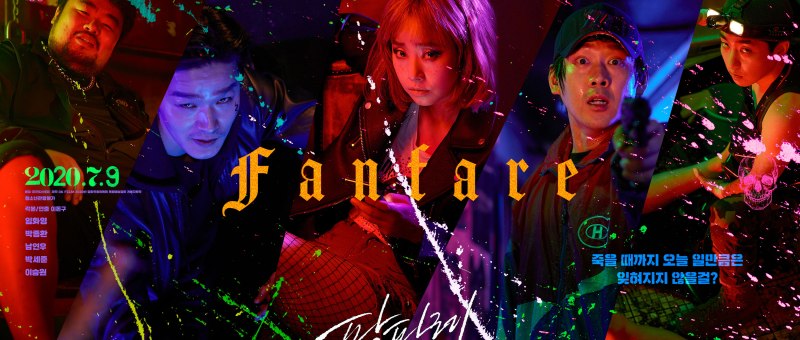
Fanfare (팡파레, Lee Don-ku, 2019)

“I’m the only one who gets out alive!” insists an accidental antagonist in Lee Don-ku’s tense theatrical chamber piece, Fanfare (팡파레). The ironic title perhaps hints at the surreal pettiness of four criminals as they find themselves engaged in a pointless battle to the death trapped in a record shop / cafe bar one very bloody Halloween, but Lee’s drama is less concerned with their darkly comic fecklessness than with the rapidly changing power dynamics of an uncertain situation largely determined as they are by initial impressions and societal prejudices. 

That’s one reason no one pays too much attention to the mysterious J (Lim Hwa-young), a young woman we first meet putting on her makeup before getting a call from a man using a voice disguiser who is supposed to send her information on her upcoming “appointment”. We can’t really be sure what it is J’s job entails, but the three men who later take her hostage seem to have drawn the conclusion that she’s some kind of sex worker and largely regard her life as unimportant while believing that she poses no kind of threat to them. She, meanwhile, strangely calm bides her time watching largely passively while sometimes playing into their stereotypical view of her as a weak and defenceless woman, crying and pleading for her life. 

J later explains to her boss that she missed her appointment because she “ran into some fun guys” which may be a strange way of describing the evening’s events but perhaps makes sense given what we can gather of her. In fact she only snuck into the cafe a little before closing because she was early and needed somewhere to hang out, ordering a tequila from the sleazy barman, dressed as Dracula, while he continues to make somewhat inappropriate and flirtatious comments that she ignores. While he goes to tidy up after the Halloween party on the upper floor, a man comes to the door pleading to be let in explaining that his brother has been taken ill. J waves them through but of course it’s a ruse, they intended to rob the place but can’t figure out the till. Younger brother Hee-tae (Park Jong-hwan) goes looking for the barman but accidentally kills him, leaving the guys with a series of problems. To solve them, older brother Kang-tae (Nam Yeon-woo) calls an underworld friend, Sen (Lee Seung-won), promising him a share of his non-existent (?) drug stash in return for help. Sen calls “cleaner” Mr. Baek (Park Se-Jun), but after a series of arguments and altercations the situation continues to deteriorate. 

The problem is, perhaps, that everyone thinks of themselves as the good guy. Hee-tae is apparently in this out of desperation trying to pay off his student loans while painting his older half-brother Kang-tae as a deadbeat drop out whose involvement with drugs brings shame on their family, both boys keen to go home and see their mum anxious that they don’t cause her any more worry. Kang-tae meanwhile evidently thinks he’s some kind of gangster mastermind, entirely unaware he’s in way over his head but reacting to the news that his brother’s just killed someone with bemusement more than horror. Hee-tae didn’t think it was a good idea to involve anyone else in their situation but is persuaded by Kang-tae’s supposed underworld experience while later resenting him, wondering if he really has a valuable drug stash he never mentioned while forcing him to help in his criminal schemes knowing he needed the money. Meanwhile, the more experienced Sen thinks he’s in control but quickly finds himself outmanoeuvred in part because of the boys’ panicky naivety. Baek is there as a contractor but finds himself without protection, a continual outsider with only the necessity of his skills to leverage for his survival along with a possible professional alliance with Sen.  

Set almost entirely within the bar, Fanfare is testament to snowballing chaos of cumulative bad decisions along with the dangers of misreading others based on impressions formed through the prism of societal prejudice. Ironic music cues lend a sense of surreal irony, though Lee’s humour is pitch black as the gang of bumbling criminals eventually consumes itself while those assumed to have the least power simply wait for events to run their course.  


Fanfare screens at Chicago’s Lincoln Yards Drive-in on April 30 as part of the 12th season of Asian Pop-Up Cinema.

Original trailer (no subtitles)

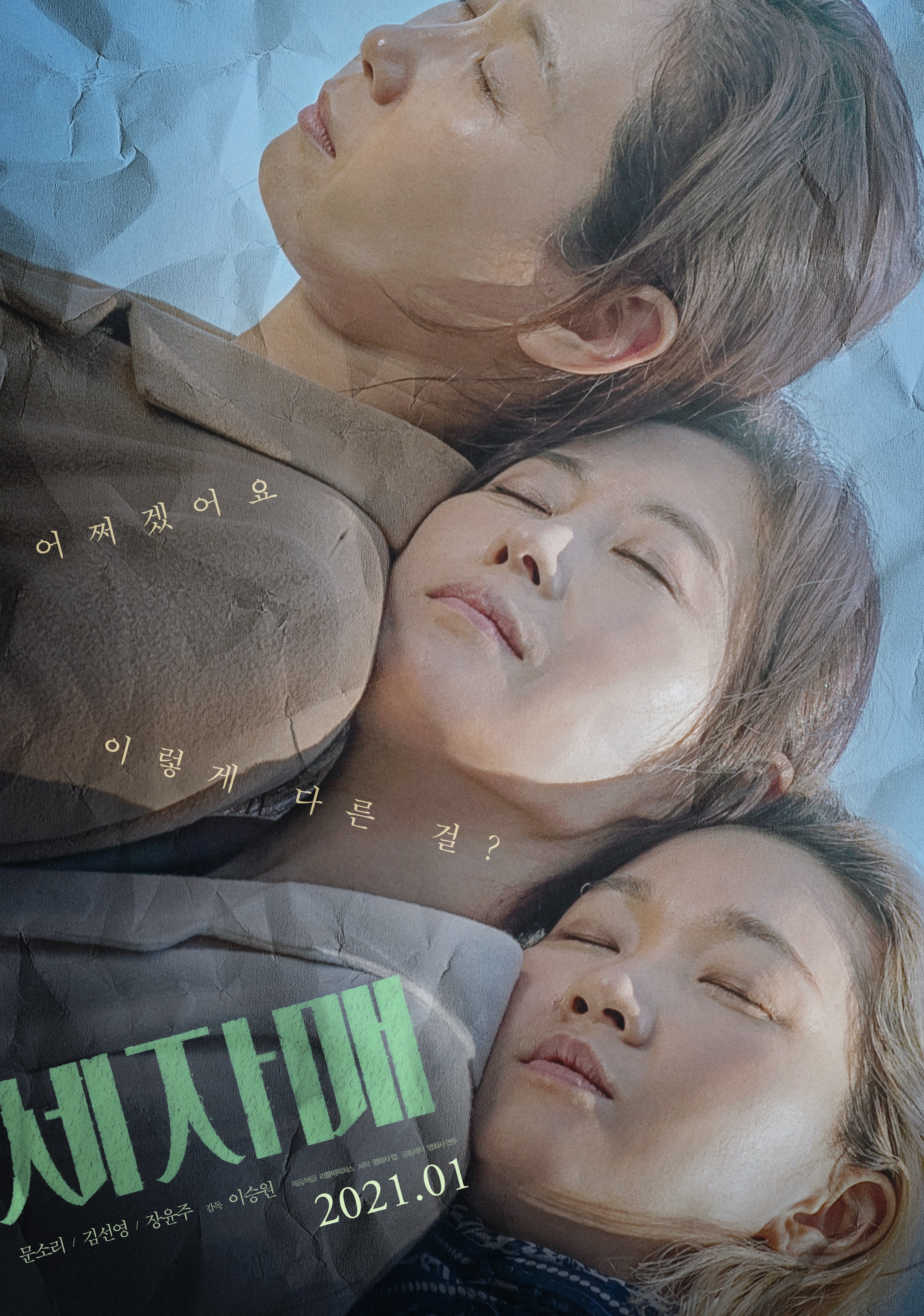
Three Sisters (세자매, Lee Seung-won, 2020)

Lee Seung-won’s lightly humorous family drama is not an adaptation of the Chekhov play, but like its namesake does find Three Sisters (세자매, Se Jamae) trapped in the past, their lives “messed up” by the demands of living in a patriarchal society. A showcase for the three actresses at its centre, Lee’s drama works towards a gradual sisterly solidarity brokered by an awkward confrontation with the source of all their trauma but also lays bare the radiating consequences of unchecked male failure as the three women struggle to lead successful adult lives in the shadow of their childhood suffering. 

Opening with a black and white sequence in which two young girls run hand in hand quite clearly away from something bad rather than just for the joy of it, Lee switches to the present day in which oldest sister Hee-sook (Kim Sun-young) is an anxious middle-aged woman perpetually making apology for her existence, while middle sister Mi-yeon (Moon So-ri) is a cooly controlled deaconess and mother of two, and little sister Mi-ok (Jang Yoon-ju) is an unstable drunk and struggling playwright married to a moderately wealthy greengrocer with a teenage son from a previous marriage. 

They have all quite obviously chosen different methods in effort to suppress the effects of their childhood trauma, raised as we later realise in a violent home abused by their drunken father but apparently expected to put up with it out of filial piety. A half-sister Hee-sook finds herself apologising for anything and everything, filled with intense shame for her very existence. Mi-yeon by contrast has chosen order, devoutly religious she maintains high standards for her family but is filled with barely repressed rage unable it seems to express any other emotion. On realising that her professor husband (Jo Han-chul) is having a highly inappropriate affair with a much younger student she reacts with both violence and cunning, unilaterally putting a stop to his philandering while subtly letting him know that she knows and has dealt with it. Further emasculated, he tries to get some kind of normal reaction from her, hoping she will shout or hit him but she continues in the same calm and controlled fashion as if nothing had happened. Meanwhile, in another echo of her father’s violence she finds herself taking out her frustrations on her young daughter, Ha-eun (Kyung Daeun), who rebels against her need for order by refusing to say grace. 

Mi-ok by contrast has in a sense chosen chaos, drinking herself into oblivion while often ringing Mi-yeon in intense confusion unable to recall a seemingly unimportant detail from their mutual past. Taking on the big sister role, Mi-yeon finds herself in a similar position with Hee-sook who apparently doesn’t remember an event that was important to her of their dining together in the same cafe they are currently visiting back when she first came to the city and Hee-sook worked in a nearby office. Later the three sisters will attempt to visit another cafe that Mi-ok had struggled to remember but will find it closed, their past perhaps locked to them but in a sense also pushing them towards a happier future as they reaffirm their sisterly bonds after living lives of highly individualised suffering. 

Failed by a feckless father, the three women find themselves at the mercy of problematic men Hee-sook apparently re-victimised as the wife of an abusive partner who returns periodically to extort money and undermine her self-esteem, while Mi-yeon attempts to evade subjugation by dominating her husband only to find him rebelling against her through an extra-marital affair. Only Mi-ok seems to have made a better marriage to a mild-mannered, patient and caring husband but is also accused of marrying him for his money while taken to task by others for her “failure” to play the part of the conventional wife and mother, her ability to do so perhaps corrupted by her traumatic childhood. “Just treat them with love” Mi-yeon ironically advises seconds after unfairly scolding her own daughter, simultaneously explaining that no one learns to be a mother, though of course in some senses they do, and that anyone can be one as long as they work at it. Nevertheless, after confronting the source of all their pain and suffering the three women manage to rediscover a sense of solidarity that perhaps allows them to reclaim their agency and live better, more fulfilling lives free of the shadow of the past. 


Three Sisters screened as part of the 2021 Osaka Asian Film Festival

Original trailer (English subtitles)

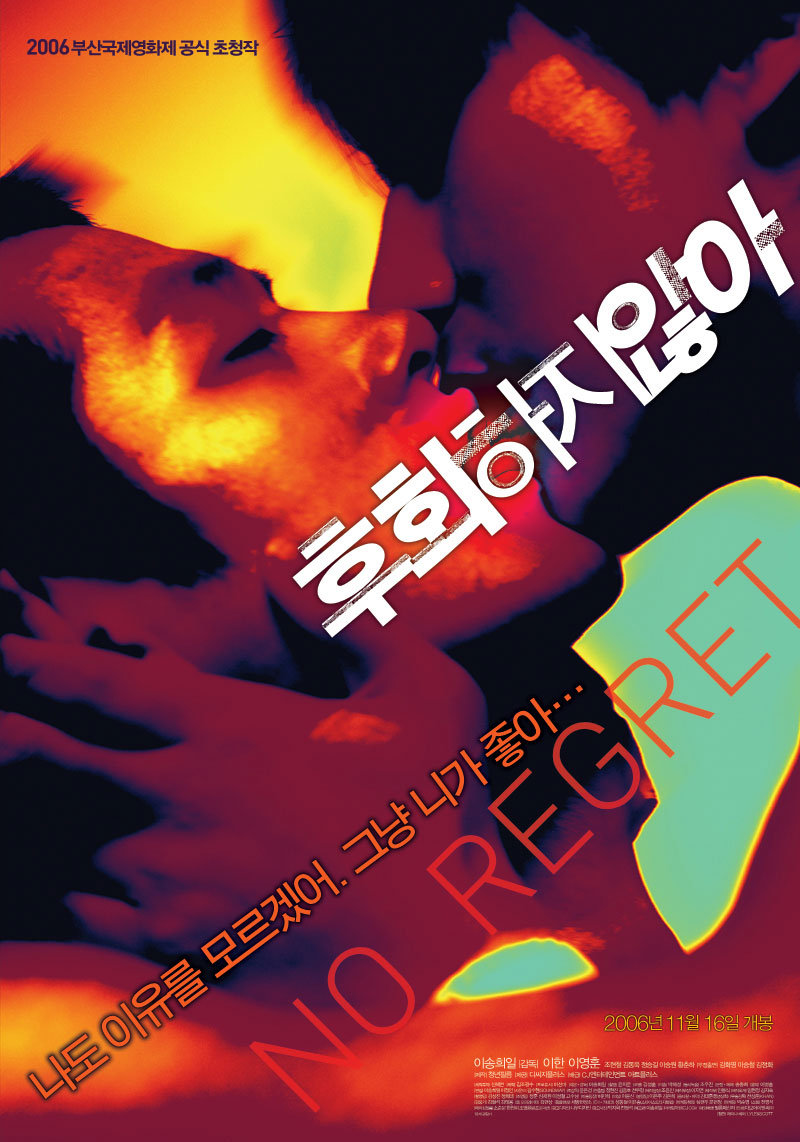
No Regret (후회하지 않아, Leesong Hee-il, 2006)

No Regret poster“Why do we have to be so miserable?” a frustrated cabaret bar owner exclaims part-way through a harebrained scheme to get both money and revenge against a lover’s betrayal and a relentlessly unfair society. The debut feature from Leesong Hee-il, No Regret (후회하지 않아, Huhoehaji Anha) is regarded as Korea’s first explicitly gay film from an out gay director but is as interested in social disparity and multiple oppressions as it is in contemporary gay life in a sometimes unforgiving Seoul.

Our hero, Su-min (Lee Yeong-hoon), is an orphan recently ejected from the orphanage after turning 18 and leaving high school. Like many young men in his position, Su-min has been effectively hung out to dry and has very little chance of making much of a life for himself. Quietly angry, he works hard in a factory by day, and studies at a cram school at night, hoping to make enough money to apply for college and ensure a better life for himself. He also has another part-time job as a “designated driver”, getting drunk people and their cars back home in one piece. One particular job, however, changes his life forever when he arrives to meet Jae-min (Kim Nam-gil) who, apparently, seems to fall in love with him at first sight. Despite perhaps being flattered, Su-min hesitates but turns down Jae-min’s overtures, either simply afraid and still uncomfortable with his sexuality or resentful of the awkward power dynamic between them.

The problematic power differential raises its head again when Su-min realises that Jae-min is the factory boss’ spoilt chaebol son seconds after learning he and his friend, both of whom are “casual” rather than “regular” employees, have been let go in a mass layoff. Jae-min, still smitten, pulls strings and makes sure Su-min keeps his job, but Su-min isn’t comfortable with being indebted in that way or of taking another man’s place just because the boss has taken a fancy to him so he quits in anger and does his best to shake Jae-min off his trail. Jobs are hard to come by for uneducated poor boys, and after a spell washing dishes proves unsuccessful he finds himself giving in and taking a job in a host bar karaoke box offering illicit sexual services to select clientele.

Su-min, as he later suggests to Jae-min, is perhaps freer than most to embrace his sexuality given that he has no family to disapprove of him. He is, in a sense, dependent on the feeling of solidarity he has with the other orphans, like his ladies’ man roommate who despite offering to take Su-min to a brothel so he’ll realise what he’s missing out on is actually broadly supportive of Su-min’s sexuality, but is afraid more of them discovering his “fall” into sex work than of them realising he is gay which most of them seem to have done already. In any case, it’s perhaps unsurprising that he personally continues to struggle with his sexuality given his extreme youth even after becoming used to life at the club and the financial benefits it can bring.

As the “madame” tells him, though he’s gay himself he doesn’t hire “gay” guys and it remains true that most of the other sex workers are straight men who are only in the business because they have no other way of making money. Jae-min, meanwhile, feels himself at least a prisoner of his privilege as he repeatedly fails to standup to his domineering mother who has arranged a marriage with a suitable young woman despite knowing that her son is gay. Well educated and wealthy, Jae-min has accepted his sexuality but is unable to embrace it or to break free of the patriarchal social codes which insist that, especially considering he is an only child, he has a responsibility to obey his parents’ wishes by living up to their conservative values, marrying a woman, providing an heir, and taking over the company. Jae-min’s mother even later tells him that she doesn’t care if he continues to sleep with men, but that he must marry the woman she’s chosen for appearance’s sake, little caring for the emotional wellbeing of the oblivious fiancée she is about to condemn to a loveless marriage.

Jae-min continues to chase Su-min who continues to rebuff him until finally seduced, but a note of darkness remains at the centre of their relationship in Jae-min’s self loathing and Su-min’s resentful sense of inferiority. An accidental betrayal born of momentary weakness and followed by an eventual breakthrough leads to a very dark place indeed as the wounded parties decide to take misplaced revenge, against an oppressive society as much as against those who have wronged them. Nevertheless, a kind of “equality” is perhaps achieved through wounds given and received giving way to a more openhearted connection albeit one with a dark genesis. An important step forward in representation, Leesong Hee-il’s indie drama is an oddly hopeful romance in which the heroes eventually succeed in becoming themselves in defiance of the societal oppression all around them.


US trailer (English subtitles)

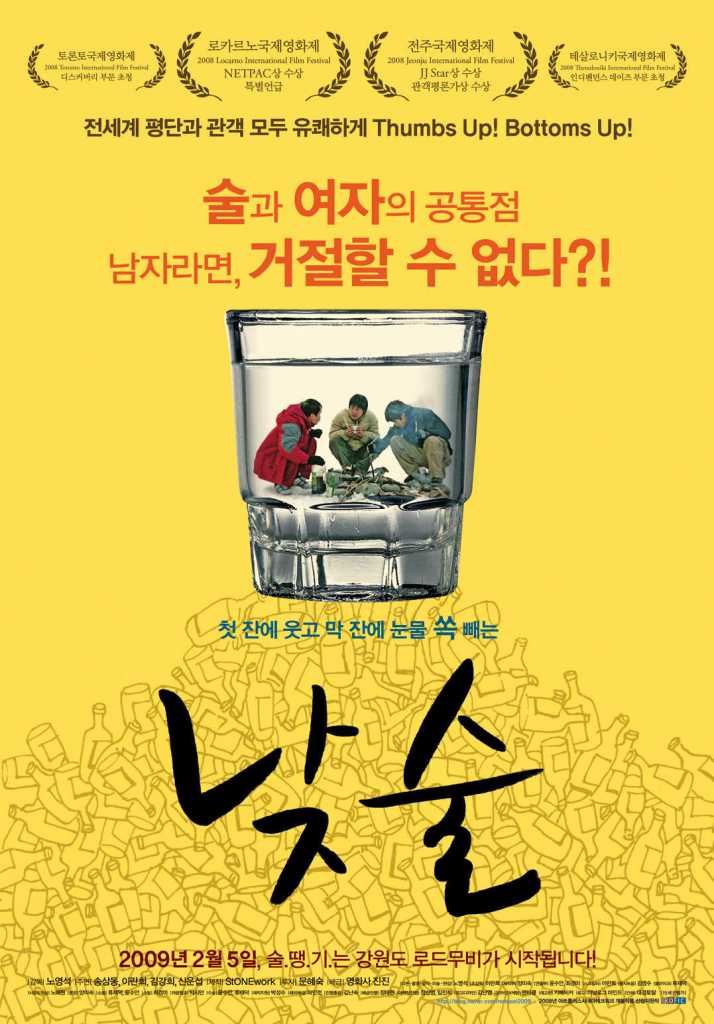
Daytime Drinking (낮술, Noh Young-seok, 2009)

daytime drinkingPoor old Hyuk-jin is about to have the worst “holiday” of his life in Noh Young-seok’s ultra low budget debut, Daytime Drinking (낮술, Natsul). Currently heartbroken and lovesick as his girlfriend has just broken up with him, Hyuk-jin is trying to cheer himself up with an evening out drinking with old university friends. Truth be told, they aren’t terribly sympathetic to his pain though one of them suddenly suggests they all take a trip together just like they did when they were students. Hyuk-jin plays the party pooper by saying he can’t go because he’s meant to be looking after the family dog but after some gentle ribbing he relents and says he’ll come if he can get someone to look in on the puppy for him while he’s gone. He will regret this.

Sure enough, Hyuk-jin arrives at the bus terminal in the town where his friend supposedly knows someone with a cosy inn where they do delicious barbecues only it’s freezing cold and his friends are nowhere to be seen. That’s right – his ultra flaky friends have forgotten all about it and stood him up. Already quite annoyed, Hyuk-jin argues with his “friend” but later accepts his offer to stay over at the inn on his own at his friend’s expense and wait for him to join him there in a couple of days. However, firstly, Hyuk-jin somehow ends up at the wrong inn which seems to be run by a madman where he also meets a female solo traveller who’s apparently fond of a drink. Everywhere he goes, everyone keeps offering Hyuk-jin a drink in a way which makes it very hard for him to say no, though there’s almost nothing else to do around here anyway. Pretty girls and drink are about to land Hyuk-jin in a series of embarrassing incidents that are most likely only bearable because of the residual booze cloud Hyuk-jin is currently residing under.

Following a loose road trip structure, Daytime Drinking follows Hyuk-jin on his strange and accidental odyssey where just about everything conspires against him. Hyuk-jin is not entirely blameless in his fate – he’s far too taken by pretty faces and gets himself into trouble by behaving rudely towards a not so pretty older woman as she bores him with endless prattle, completely failing to take the hint that he’s finding her constant conversation a little too much to bear. Hyuk-jin’s distress continues to grow as his friend keeps delaying his trip, and his troubles only increase until he is deprived of both his phone and his wallet (not to mention his trousers!), leaving him entirely dependent on the kindness of strangers. Unfortunately, though some strangers may seem kind they often have ulterior motives whether they just want someone else to pay for the drinks or they’ve only booked one bed and are planning to creep into the shower just as you’re lathering up…

Daytime Drinking is the first feature from Noh Young-seok in which he acts as scriptwriter, cinematographer and editor so it’s a real indie production. Made on a true shoestring budget of only $9000, production values are surprisingly high even if obviously filmed on low grade equipment. Noh sticks to straightforward composition with Hong Sang-soo style static camera and zooms though he manages to effortlessly bring out the sympathetic humour inherent in Hyuk-jin’s very disappointing mountain holiday. Hyuk-jin himself is never a figure of fun and though hapless is clearly an ordinary person with ordinary failings such as his weakness for pretty girls and booze or his polite way of being impolite in trying to evade the attentions of a boring fellow traveller when he’s already tired and fed up himself.

Noh’s world view seems quite a bleak one but is also undoubtedly very funny. When things get as bad as this perhaps there’s nothing left to do but laugh. You’d think a trip as disastrous as this one would have Hyuk-jin vowing never to leave the house again, but then there’s yet another pretty face at the train station so perhaps a holiday to get over one’s holiday is order? Don’t do it Hyuk-jin! Some people never learn….


US release trailer: