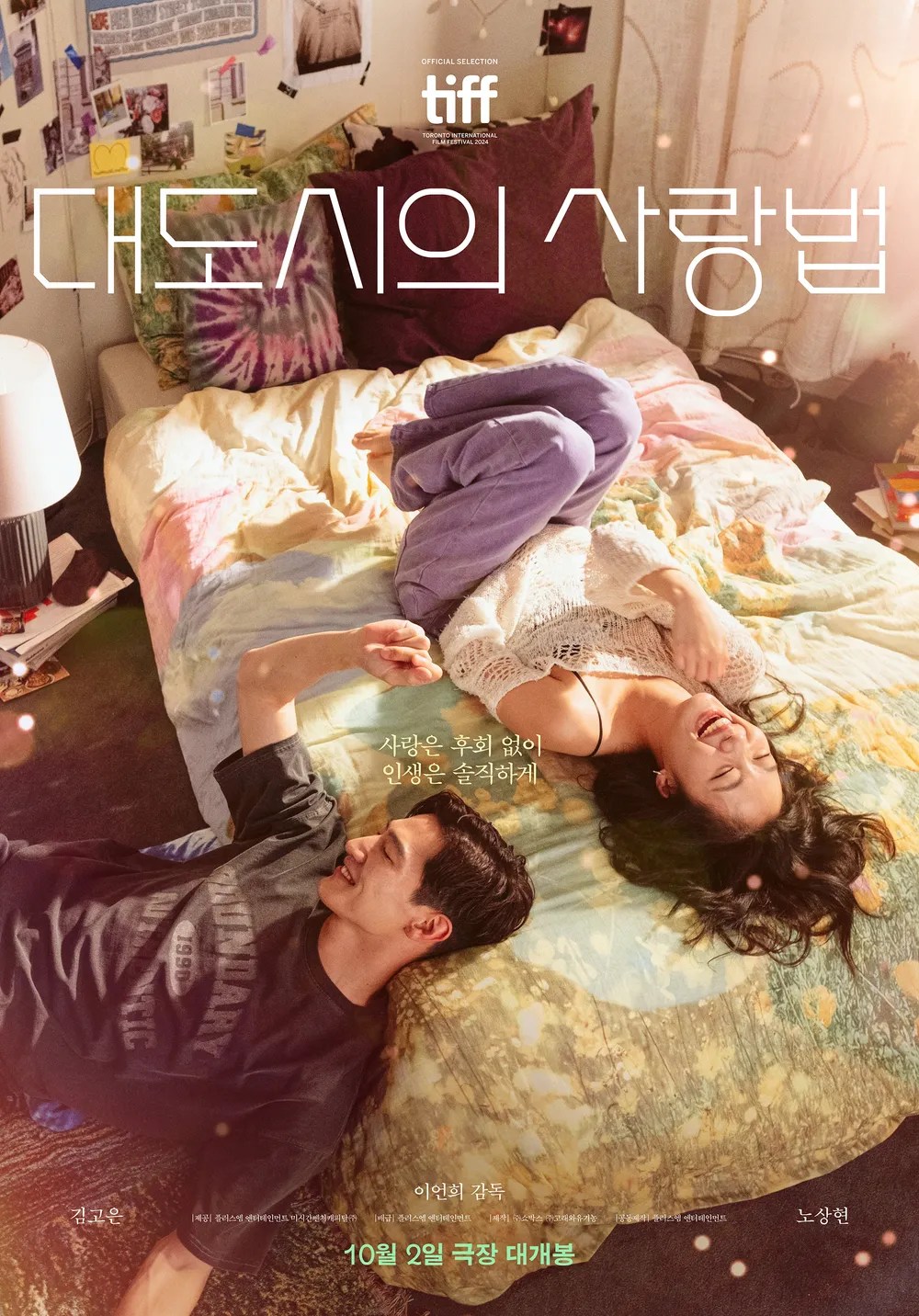
Love in the Big City (대도시의 사랑법, E.oni, 2024)

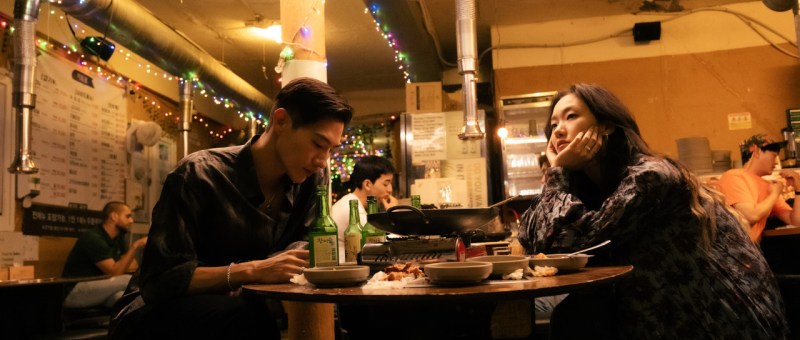
“How can being yourself be your weakness?” asks a young woman who, more than anything else, is defiantly herself, to a young man who indeed is anything but. The heroes of E.oni’s Love in the Big City (대도시의 사랑법, Daedosiui sarangbeop), adapted from the acclaimed novel by Park Sang-young, are in some ways on parallel journeys that somehow weave through and around each other as they each try to navigate an often hostile society that has no place either of them.

For aspiring writer and in the film’s early stretches student of French literature Heung-soo (Noh Sang-hyun), his “weakness” is that he’s gay and though he seems to have accepted this about himself is firmly in the closet. Free spirited Jae-hee (Kim Go-eun) who spent her teenage years abroad in France catches him making out with their professor but couldn’t care less though Heung-soo rebuffs her attempts at friendship fearing they’re akin to a kind of blackmail or that she plans to out him to their fellow students. It’s not until Jae-hee is publicly shamed when it’s rumoured a topless photo being shared online is of her that the pair finally become friends. Sick of the curious stares and covert giggles, she lifts her shirt in front of the class to prove it isn’t her, earning the nickname “crazy bitch”.

Her response is the exact opposite of Heung-soo. She claims her freedom by baring all, being defiantly herself and outwardly at least little caring for what others think of her while Heung-soo makes himself invisible and says nothing harbouring intense fear of being exposed. They are each in their way pariahs. Heung-soo because of his sexuality which is still unacceptable to many in the fiercely conformist society of South Korea in which Christian religious bodies still have huge influence and loudly oppose LGBTQ+ rights and freedoms. Heung-soo’s widowed mother is also intensely religious and having stumbled on one of his stories about a crush on a classmate is aware that he is gay but does not speak of it and continues to believe he will be “cured”. This is perhaps why she keeps urging him to do his military service believing it will make a man out of him.

For all of these reasons, it’s not surprising that Heung-soo is unwilling to live his life openly as a gay man because of the prejudice he knows he will face from those around him. Jae-hee, by contrast, refuses to hide and lives the way she wants to but is shamed by those who feel a woman should live in a certain way which is to say quietly, politely, and obediently. A man she thought was a boyfriend while he thought of her as a bit on the side publicly slut shames her and asks what sort of idiot would want to date a woman like her. Though we first meet her as a confident, rebellious student we see her gradually beaten down by the world around her and the demands of corporate culture. Considering marrying a man she may not actually like because it’s what you do, she stares sadly at a middle-aged woman opposite her on the train dressed in a near identical outfit and the comfortable shoes that are psychologically at least uncomfortable for Jae-hee in representing her capitulation to the properness of mainstream society. 

Her degradation continues to the extent that she finds herself in a relationship with a domineering, intensely patriarchal man who later turns violent when she tries to leave him. E often cross cuts and juxtaposes Heung-soo’s and Jae-hee’s experiences as they each suffer similar blows and indeed violence from a macho society if in different ways and for different reasons while having only their intense bond as fellow outsiders to rely on. This really is the love in the big city, a deeply felt platonic and unconditional love between two people who essentially have no one else. It’s through this love that each comes to love and accept themselves, Heung-soo eventually gaining the courage to fully embrace his authentic self while Jae-hee finally regains her independent spirit and refuses to let others shame her while standing up both for the LGBTQ+ community and the young woman she once was at the mercy of a male-dominated corporate culture. Warm and often funny, the film paints contemporary Seoul as an outwardly oppressive city of enforced conformity but equally discovers small pockets of freedom and joy along with the wholesome comfort of true friendship and self-acceptance.


Love in the Big City screened as part of this year’s London Korean Film Festival.

International trailer (English subtitles)
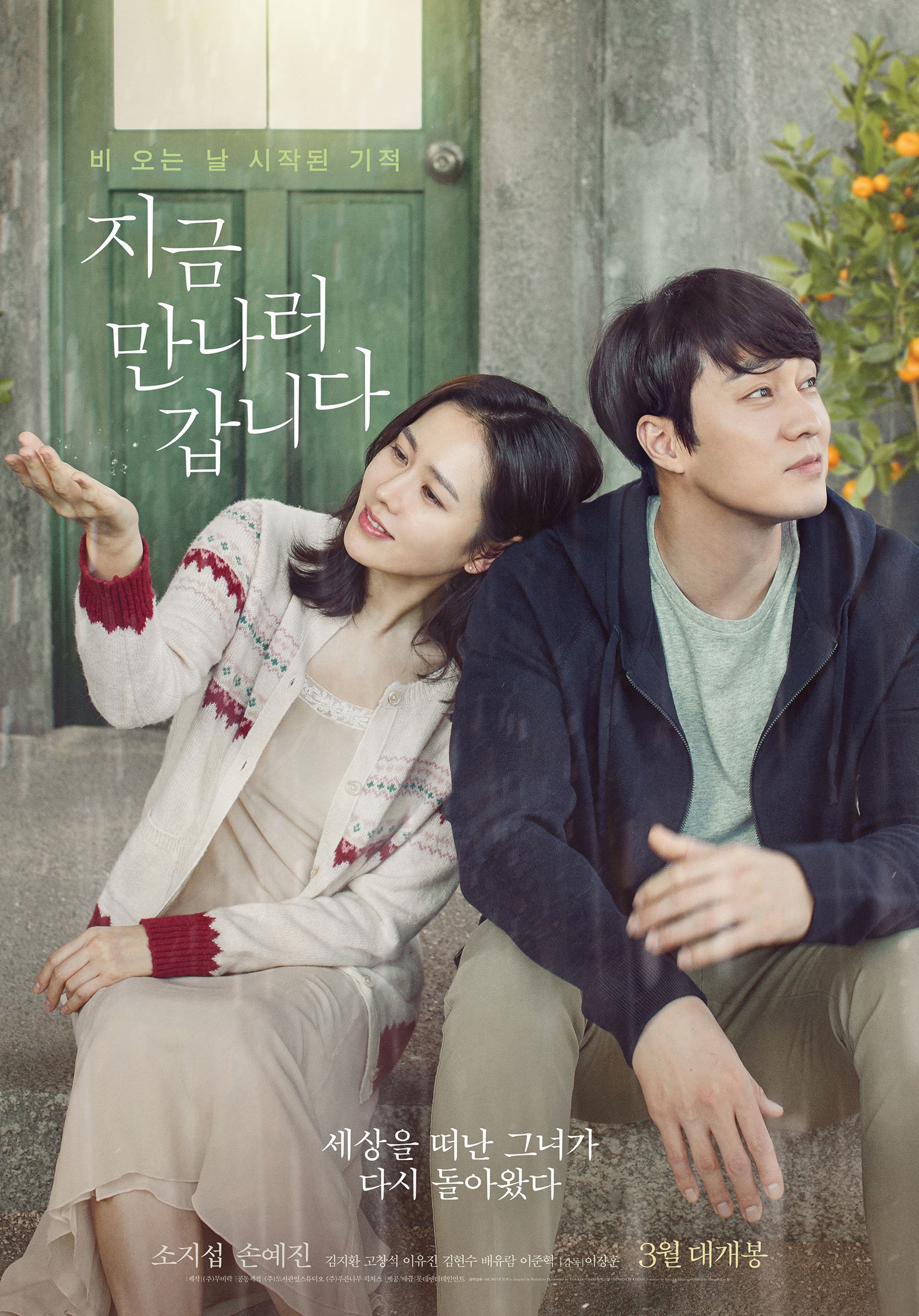
Be with You (지금 만나러 갑니다, Lee Jang-hoon, 2018)

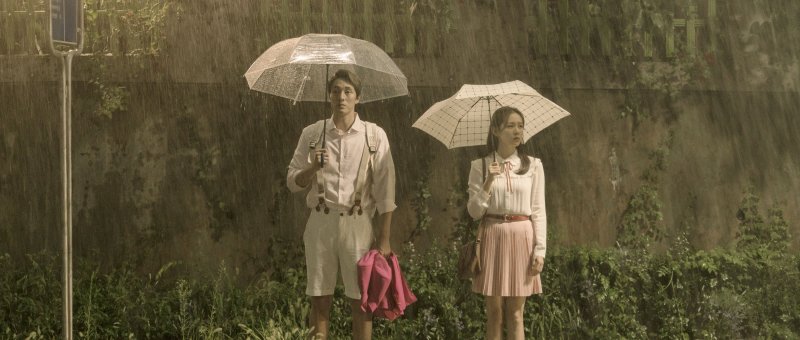
be with you Korean posterWhen Nobuhiro Doi’s Be With You was released in 2004, it followed the even more popular Crying Out Love in the Centre of the World as the second in a wave of “jun-ai” or “pure love” romantic dramas in which the heroes and heroines struggle to move past romantic tragedy. Where Be With You differed from the genre norm was on its focus on a love that was already successful – the couple were older, had married, and even had a son before their happiness was taken from them by a cruel illness. Lee Jang-hoon, adapting the source novel by Takuji Ichikawa, shifts the setting to Korea but more or less follows Doi’s blueprint with a number of notable exceptions.

Rather than the framing sequence which kicks off the original, Lee opens with the beautifully illustrated picture book Soo-a (Son Ye-jin) made for her son shortly before she passed away. In the book a cute mummy penguin lives up above in Cloudland watching her baby through a crack in the clouds. When the rainy season arrives, the mummy penguin will be able to catch the Raindrop Train to come back to Earth, but before the summer ends she’ll have to return else she’ll lose her place among the clouds and won’t be able to watch over her son even from afar.

Little Ji-ho (Kim Ji-hwan) has taken the book to heart and really believes his mother will come back when the first rains fall. His father, Woo-jin (So Ji-sub), knows better but hasn’t the heart to tell his son that the book is just a story and that he will never see his mother again. Against the odds, Ji-ho and Woo-jin do indeed find a woman who looks exactly like Soo-a collapsed in an abandoned railway tunnel in the forest but she has no memory of her life as a wife and mother or of the family who’ve been patiently waiting for her return.

In contrast to her counterpart in Doi’s original, Son Ye-jin’s Soo-a is a much less passive presence, less inclined to simply go along with her new circumstances and keen to remind us that the decision to “work or lurk” is entirely her own. Likewise, Lee scales back on Woo-jin’s disability, rendering it far less visible than it had been in Doi’s adaptation. Bar some barbed comments from insensitive relatives at Soo-a’s funeral who question Woo-jin’s ability to raise his son alone, Woo-jin suffers little by the way of stigma regarding his medical condition though he does worry he might have embarrassed his son by pushing himself too hard at a school sports day and making himself ill in the process. Rather than the typical “jun-ai” selfish selflessness which caused the hero to breakup with his one true love out of a noble desire not to be a burden, Woo-jin’s decision is perhaps more out of pride and insecurity than it is out of misplaced consideration.

Nevertheless the timeless innocence of the couple’s early courtship (such as it was) retains its essential sweetness. As Soo-a can’t remember her romantic past, Woo-jin recounts his recollection of it to her in all its painful honesty, and in return later gets to hear her side of events thanks to the diary she left behind for him to read. Having met in high school, the pair entertained crushes on each other they assumed were unrequited, never quite working up the courage to declare themselves and squandering opportunities through nerves and awkwardness. Reliving their original romance the couple fall in love all over again only to be parted by a season’s end.

Yet it is familial love rather than the romantic which eventually takes centre stage as the love of Soo-a and Woo-jin envelops their son in something deeper and richer than your average tragic love story and becomes all the more poignant for it. Realising her time is short, Soo-a sets about teaching her husband and son how to live without her – showing Ji-ho how cook eggs, how to do the washing, how to keep the place tidy etc while giving them a few more happy memories to see them through and reminding them to take care of each other in her absence. Dreamlike and ethereal as Lee effortlessly blends one time period into another in a vast web of memory, Be With You is a heartbreaking drama in which a family must attempt to come to terms with irreparable loss through learning to treasure past happiness and living on in its memory.


Screened at the 20th Udine Far East Film Festival.

Also screened as the first in a series of teaser screenings for the upcoming London Korean Film Festival. The next screening in the series will be Memoir of a Murderer on 21st May, Regent Street Cinema.

International trailer (English subtitles)
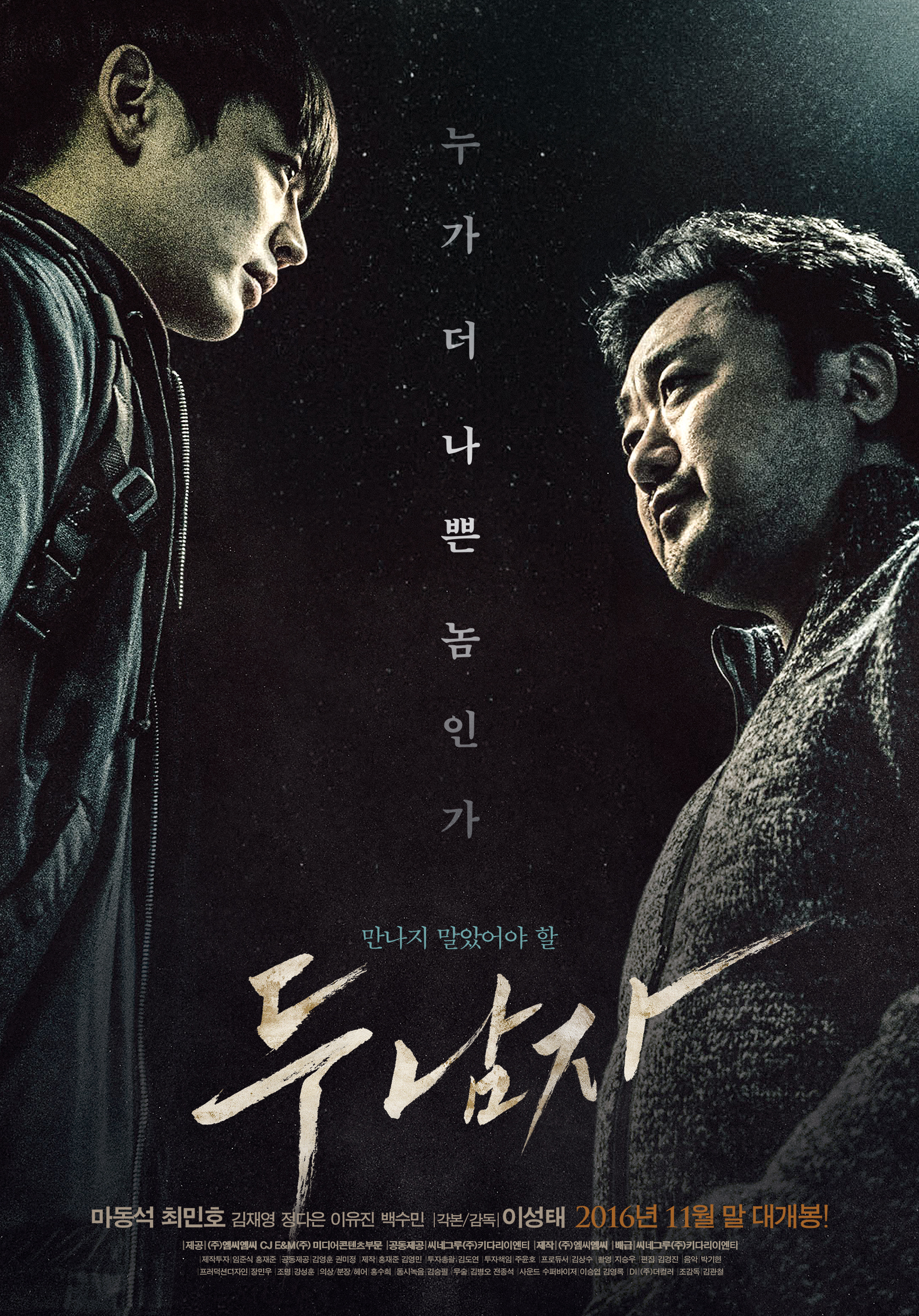
Derailed (두 남자, Lee Sung-tae, 2016)

derailed posterThe best laid plans of mice and men often go awry, as the old saying goes, but for four down at heels street kids even their meagre attempts to evade a desperate situation land them in even more trouble than they’ve ever been in before. The debut feature from director Lee Sung-tae, Derailed (두 남자, Doo Namja) is bleak and gritty though underpinned by an ironic sense of love and connection which is itself often “derailed” or subverted as genuine feeling becomes a tool to be exploited in the ongoing war between those fighting amongst themselves to get a hand on the bottom rung of the ladder.

A makeshift family of four homeless kids and runaways made up of two teenage couples fights to survive in the backstreets of Seoul. With no practical means to support themselves, Jun-il (Minho), his girlfriend Ga-young (Da-eun), friend Bon-gil (Lee You-jin) and Bon-gil’s girlfriend Min-kyung (Baek Soo-min) are often forced to resort to low-level crime just to get something to eat. Running low on supplies the gang try to steal a car but the plan goes awry when an old enemy, the former boyfriend of Ga-young who blames Jun-il for the prison sentence he’s just been released from, arrives prompting the gang to flee.

Out of options their next plan is a dangerous, possibly unpleasant one – a prostitution scam. Ga-young being a little braver than Min-kyung puts herself forward as the bait and waits for a randy guy with underage tastes to pick her up in a dingy back alley before taking her to a hotel. Once there she needs to text the boys who will march in, rescue her, and blackmail the John. What they didn’t reckon on was that their target would be a big guy and a petty thug operating on the fringes of the sex trade. The boys manage to knock the irritated bruiser, Hyung-seok (Ma Dong-Seok), out and the gang steals his wheels too but they’ve messed with the wrong guy. Hyung-seok calls his buddies, tracks them down, roughs them up and then makes them an offer they can’t refuse. In payment for the damage, inconvenience, and humiliation, Ga-young can work off the debt in one of his “karaoke bars”. Or, he could break Jun-il’s face, choice is theirs.

Jun-il begins the film with a voiceover about his life on the streets. “Being nice is being stupid” he tells us. He has a point. When you’re trapped at the bottom it’s every man for himself, you can’t trust anyone and kindness is always a weakness. Yet Jun-il is “nice”, in a sense. The unofficial daddy of the group, he takes care of the others and refuses to leave anyone behind, hungry, or afraid. It’s no surprise then that he feels so personally responsible for the fate that’s befallen his girlfriend, Ga-young. Despite Ga-young’s pleas to keep himself safe and take care of the others, Jun-il goes to great lengths to try and get the money to buy her back by paying off the impossibly high debt.

Hyung-seok, despite running a chain of seedy “karaoke bars” which straddle the line between providing female company and outright prostitution is also a committed family man with beloved teenage daughter of his own. Apparently, Hyung-seok’s business enterprises have taken a tumble recently, enough to have his wife complaining though it seems unclear if she knows exactly what her husband’s line of work entails. This crisis could not have come at a worse time for him but even if he expresses surprise, concern, and mild outrage that Ga-young’s mother tells him to get lost when he threatens to harm her daughter unless she pays up, Hyung-seok does not seem to see the link between this vulnerable teenager and his own elegantly attired little girl.

To make matters worse, Hyung-seok eventually teams up with the gang’s arch nemesis, Ga-young’s ex, to destroy the band of four as thoroughly as possible. The eventual intervention of the police is perhaps useful and well-meaning, but merely adds another motivating force to this already complicated set of intersecting vendettas. Trapped between a traumatic past and a hopeless future, these are kids whose lives have become so completely derailed that there is almost no possibility of righting them. Family betrays, love fails, friendship collapses, being nice is being stupid but in a world filled with so much corruption it might just be the only chance left.


Derailed was screened at the 19th Udine Far East Film Festival.

International trailer (English subtitles)
https://www.youtube.com/watch?v=KDAwg5i9-us