90 Years Old – So What? (九十歳。何がめでたい, Tetsu Maeda, 2024)

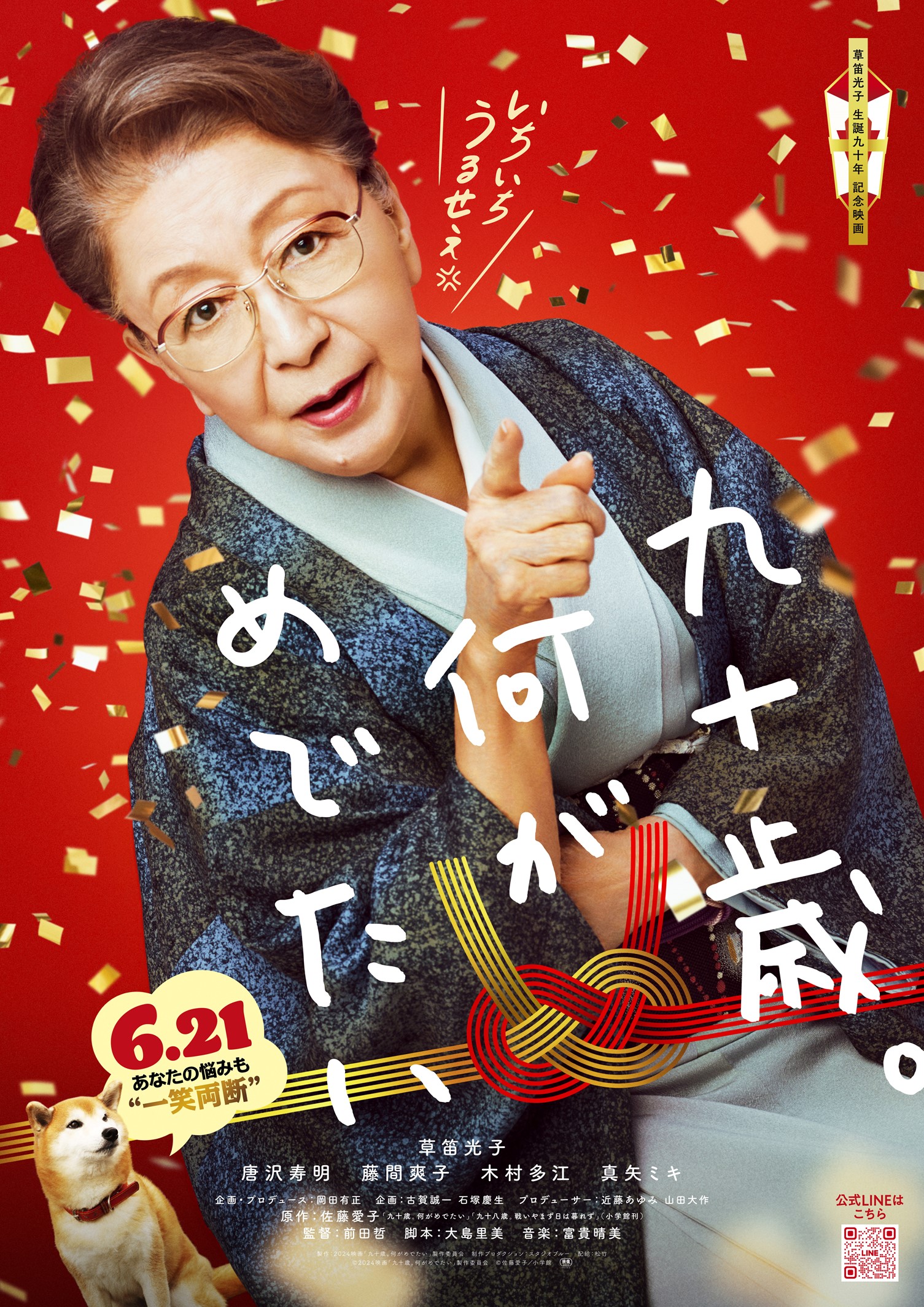
Everyone keeps congratulating Aiko Sato (Mitsuko Kusabue) on reaching 90, but she can’t see what’s so special about it. Having retired from writing after publishing her last novel at 88, she’s really feeling her age and has little desire to anything but sit around waiting to die. That is, until she’s badgered into picking up her pen by a down on his luck, “dinosaur” editor certain that her words of wisdom will strike a chord with the young people of today.

Marking the 90th birthday of its leading lady Mitsuko Kusabue and directed by comedy master Tetsu Maeda, the film takes its name from a collection of essays published under the title “90 Years Old, So What?” which largely deal with what it’s like to be old in the contemporary society along with the way things have changed or not in Japan over the last 90 years. It does not, however, shy away from the physical toll of ageing despite Kusabue’s sprightliness or the undimmed acuity of Aiko whose only barrier to writing is that she fears she’s run out of things to say and the energy to write them. During her retirement, she remarks on the fact that her legs and back hurt while she also has a heart condition and everything just feels like too much bother. Her daughter Kyoko (Miki Maya), who lives with her along with her twenty-something daughter Momoko (Sawako Fujima), asks her why she doesn’t go out to meet a friend, but as Aiko says, most of her friends have already passed on or like her don’t really have the energy to leave the house. 

In many ways, her age isolates her as she finds herself slightly at odds with the contemporary society. She turns the television up louder because she finds it difficult to understand what younger people are saying and doesn’t get why they stare at their phones all the time. Though she manages most things for herself, she has to call repair people, which costs money, if something breaks down while her daughter’s not around to fix it, even if it’s something as simple as a paper jam in a fax machine or pushing the off button on the TV too hard so it won’t turn back on again. Nevertheless, so intent is she on “enjoying” her retirement that she repeatedly turns down the entreaties of a young man from her publisher’s who wants her to write a column and always turns up with fancy sweets which are, as she says, well-considered gifts, but also a little soulless and superficial being driven by fashionable trends of which Aiko knows nothing and by which she is not really impressed.

There is something quite interesting about the contrast between herself and fifty-something Yoshikawa (Toshiaki Karasawa) who is also a man behind the times and a relic of the patriarchal culture she railed against in her writing and rejected in her personal life, divorcing two husbands and going on to raise her daughter alone. In the opening scenes, she reads an entry from an advice column about a woman who’s sick of her husband of 20 years because he’s a chauvinist who dumps all of the domestic responsibilities onto her while looking down on her because of it. Aiko tuts and contradicts the advice of the columnist, remarking that the answer is simple. She should just tell him to his face that she hates him and then leave. Nevertheless, the fact remains that not all that much has changed since she was young. The husband’s behaviour is considered “normal”, while the woman’s desire to be treated with respect or leave her marriage is not. Yoshikawa is effectively demoted because he has no idea that his treatment of a female employee amounts to workplace bullying and sexual harassment even if he didn’t intend that way because he’s trapped within this old-fashioned patriarchal ideal and is unable to see that his behaviour is not acceptable nor that he’s been taking his family for granted while considering only his own needs and positioning himself as the provider. 

Yet it’s 90-year-old Aiko rather than his humiliating demotion or the failure of his marriage who begins to show him the error of his ways by accepting him into her own family like a lonely stray. Aiko’s essays don’t really say that everything was better in the past, even if she’s confused by modern people who are annoyed by the cheerful sounds of children playing and a city alive with life because she remembers how everything went quiet during the war and how depressing that could be. But she does sometimes think that progress has gone far enough and things were better when people had more time for patience with each other. That said, patience is one of the things Aiko has no time for, advising Yoshikawa to charge forward like a wild boar because one of the benefits of age is that you just don’t care anymore what anyone thinks so get ready to annoy people or exasperate them but carry on living life to the full. Ironically, that might be a gift that he gave her by convincing her to write again which returned purpose to her life and gave her a reason to engage again with the world around her lifting her depression and making her feel as if she still mattered. The real Aiko turned 100 in 2023 and carried on writing, while 90-year-old Kusakabe is herself undergoing something of a career resurgence in recent years proving that even if you’re 90 years old, so what? There’s still a lot of life left to be lived and you might as well carry on living it doing what you love for as long as you can.


90 Years Old – So What? screens 21st June as part of this year’s Toronto Japanese Film Festival.

Trailer (English subtitles)

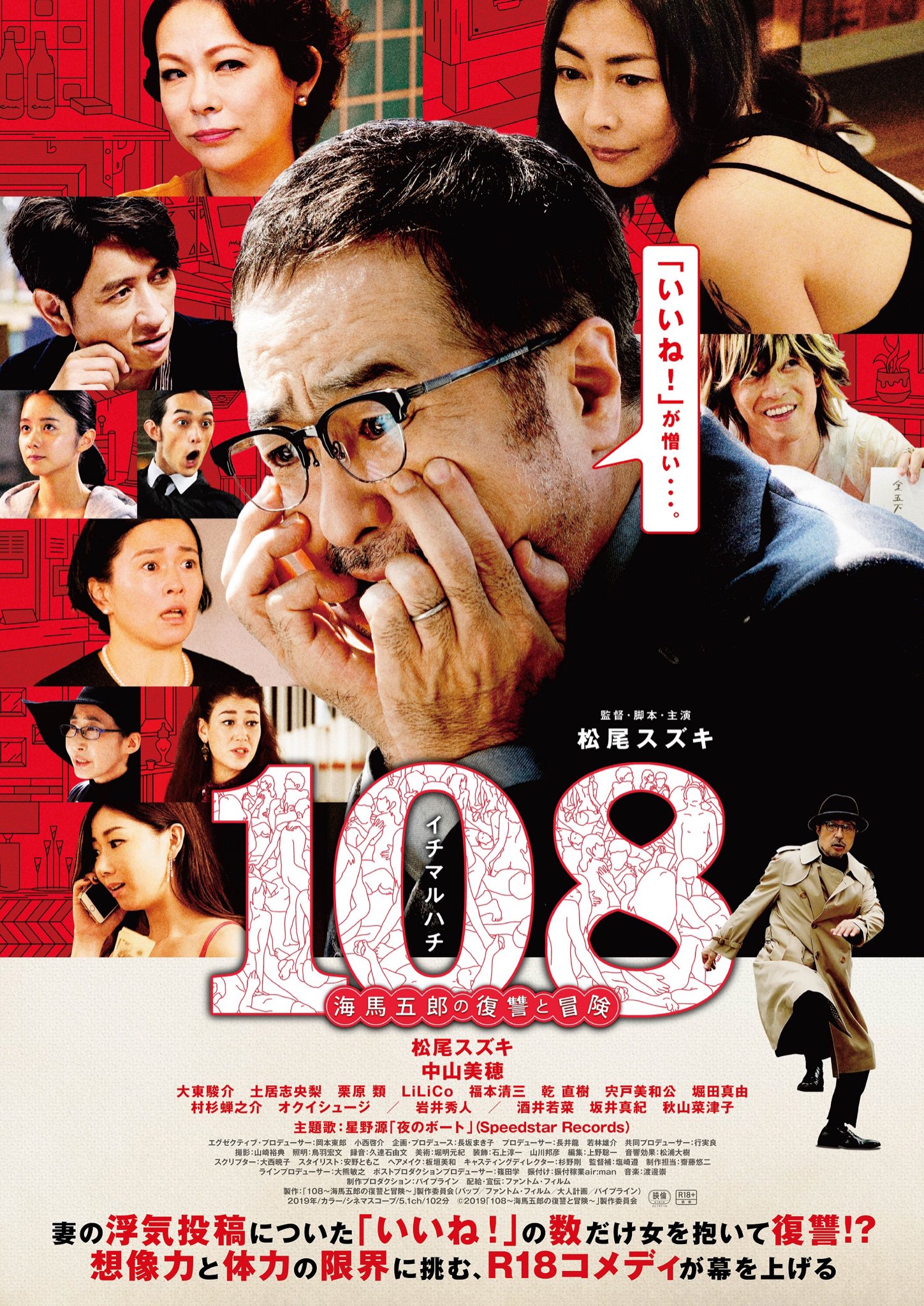
108: Revenge and Adventure of Goro Kaiba (108 海馬五郎の復讐と冒険, Suzuki Matsuo, 2019)

In Buddhism, there are said to be 108 earthly desires, 108 lies, and 108 human delusions. As he points out however, all that is merely coincidence to Goro Kaiba, his petty revenge is founded entirely on the fact that a Facebook status in which his wife, using a pseudonym, detailed an affair with a lithe young contemporary dancer, garnered 108 Likes. Waxing self-referential, Suzuki Matsuo’s surreal sex comedy 108: Revenge and Adventure of Goro Kaiba (108 海馬五郎の復讐と冒険, 108: Kaiba Goro no Fukushu to Boken) in which he also stars, finds a middle-aged screenwriter somehow still trapped in adolescent insecurity, intensely self-involved as he pursues a “revenge” which is also a strange kind of ironic self harm intended to prove his manhood but accidentally exposing the love’s sordid underbelly in the vacuousness of its inversion. 

As the film opens, successful screenwriter Goro Kaiba (Suzuki Matsuo) is overseeing auditions for the musical adaptation of his greatest hit, Dancing in the Mental Ward. He tells us that he’s bored with his work and somewhat disrespectfully is actually writing a column due in a couple of hours’ time, barely paying attention to the actress as she valiantly perseveres with the less than stellar material before rudely dismissing her performance and suggesting she dump the boyfriend who helped her come up with it. Goro claims that he carries on in a job he hates for three reasons: he loves money, his wife’s a spendthrift, and he loves her. It’s something of a shock therefore when a young actress comes up to him after the auditions to ask for a private chat which turns out to be about something slightly different than he’d assumed. She shows him a Facebook profile she believes belongs to his wife, Ayako (Miho Nakayama), in which she claims to have fallen in love with a “contemporary dancer” named “Dr. Snake”. 

Confronted, Ayako admits “everything”, but explains that the Facebook profile is nothing more than wish fulfilment, a romantic fantasy to distract from the emptiness of her married life. Predictably, Goro fails to pick up on the fact there are obviously problems in their marriage, fixating on the extent of Ayako’s relations with Dr. Snake of whom she now has a large tattoo on her shoulder, something which he hasn’t noticed because they have not been intimate in some time. Ayako assures Goro that she means to stay with him forever, but will be fantasising about Dr. Snake when they make love, further hinting at another problem undermining their relationship. Goro, however, is not convinced and starts talking to his friends about divorce only to be reminded Ayako will be entitled to half his savings if he splits up with her. Consumed by pettiness, he decides to spend all the money so she’ll be left with nothing by sleeping with 108 women as “revenge” for her infidelity. 

Of course, the problem is less Ayako than his wounded male pride and emotional immaturity. Perhaps he’s doing this because he can’t admit to himself how much he really does love his wife and how hurt he is by her “betrayal”, but in any case he makes it all about him, refusing to engage with the problems in his marriage or reflect on the fact Ayako is obviously unhappy and unfulfilled. He tries giving some of the money away to his ex-wife and 20-year-old son Michio (Louis Kurihara) from whom he has apparently been withholding alimony and child support, put out that his ex won’t take it because she has no need of him, a man who abandoned her. Not abandoned, he points out to his son, simply “ran away”. In an awkward conversation, he goes so far as to blame Michio for his family’s collapse, claiming that he left essentially because Michio didn’t love him enough while complaining that no one seems to appreciate him. 

Meanwhile, we also realise Goro has been hypocritically carrying on a casual affair with an old friend, Mitsuko (Natsuko Akiyama), perennially unlucky in love but planning to put an end to their “arrangement” to marry a much younger man she is fully aware is only after her money. As part of his sexploits, Goro hires a high class call girl, Azusa (Shiori Doi), but she is also romantically challenged in that despite being the number one herself, she’s only really doing this to make her host club boyfriend top dog at his establishment. In love, it seems there is always some kind of transaction, a misplaced desire. Edging deeper into his pointless and petty quest to bed 108 women, it’s not until late in the game as he’s overseeing a pool full of glistening, gyrating bodies that he perhaps begins to realise how vacuous and meaningless it all really is, sordid in its emptiness. By then, however, he’s gone too far to turn back. 

Better to him than he deserves, Ayako eventually confesses that she was “fighting the inevitability of ageing”, both facing and refusing to face the fears which informed the choice she made to retire from acting and become his wife, but Goro remains petulant and immature, indulging in a romanticisation of their early romance but unwilling to confront himself, his fears, and the real reason he’s embarked on this pointless and silly quest to vindicate himself through aggressive masculinity. Worryingly indulging in fantasies of sexualised violence against his wife which admittedly have an unexpected pay off, Goro struggles to identify what it is he’s really reeling from while pursuing not so much pleasure but misdirected pain in flight from adult vulnerability. In his usual style, Matsuo has ironic fun with Goro’s flights of fancy, suddenly breaking into song like one of his shows while simultaneously mocking them and undercutting Goro’s thinly veiled misogyny by having the leading actress abruptly walk out in protest against his childishly smutty song about the joys of sex. Nevertheless, we leave Goro exactly where we found him, all at sea torn between the risky rewards of honest romantic connection and the dubious pleasures of hedonistic conquest. 


108: Revenge and Adventure of Goro Kaiba screened as part of Camera Japan 2020.

Original trailer (no subtitles)