Hail, Driver! (Prebet Sapu, Muzzamer Rahman, 2021)

“Big city, small people, tough life” a jaded sex worker commiserates, slowly bonding with an illegal taxi driver trying to find a way to live in contemporary Kuala Lumpur. The ironically titled Hail, Driver! (Prebet Sapu) casts its cosmically unlucky hero adrift, literally roaming the city and coming in a sense to a new understanding of it thanks to his impromptu conversations with fares many of whom are only slightly more lucky than he is. Yet while his radio constantly updates him on the upcoming elections, he struggles to believe that real change is possible or that he will ever find a way out of his itinerant poverty. 

Aman (Amerul Affendi) was once a writer, but times have changed and no one buys magazines anymore. He’s been living with his sister in the city, but his brother-in-law makes no secret of his unhappiness with the situation, arguing with his wife about Aman’s inability to contribute economically to the household. Hoping to make some extra cash, he decides to make use of his sole inheritance from his late father, a rundown but reliable and recently serviced vehicle, to become a driver with ride hailing app Toompang. The only problem is that Aman has no official driver’s licence and is unable to get one because of his colour blindness, while the car is technically not of a sufficient standard to be used as a taxi. Paying a middle man for fake documents, he begins working but is quickly made homeless when his brother-in-law changes the locks while he’s out one day and announces he’s bringing his own brother to live with him instead forcing Aman to make the car his home, using public conveniences to wash and occasionally sleeping in 24-hr establishments such as laundromats. 

Aman’s plight is an encapsulation of the problems of the modern city, the radio explaining that house prices are a major point of interest in the upcoming elections. He searches for affordable accommodation but finds nothing suitable while quizzing his various fares about their living conditions, whether they rent or own their homes and how much they pay. One woman with a young son explains that of course she rents, there’s no way she could buy on her low salary while starting a business of her own is, she claims somewhat crassly, a no go because of the “flock of immigrants” in the city. Another of Aman’s fares reveals he came from Bangladesh some years ago, works in a hotel, and shares a reasonably priced apartment with his brother. Meanwhile Aman ferries sleazy politicians and their much younger mistresses to just such establishments. 

It’s his innate kindness, however, which eventually allows him to move forward after accidentally bonding with Chinese-Malaysian sex worker Bella (Lim Mei Fen) who came to the capital from Penang in search of a better future. She offers to let him use her spare room in return for his services getting to and from her clients, but even as they begin to develop a kind of mutual solidarity Bella confesses that she’s never felt a sense of belonging in the capital while her abandonment issues, her mother apparently living in the US after leaving her behind at five years old, have left her feeling spiritually homeless. “Not all dreams can be achieved” she advises Aman, each of them united in a sense of defeat as they reflect that nothing ever changes hearing the news that the party in power has again won the elections despite the ongoing problems in the city. 

Filmed in a crisp black and white, reflecting both Aman’s colour blindness and sense of hopelessness, Hail, Driver! paints an unflattering portrait of life on the margins of a burgeoning metropolis but eventually finds a degree of possibility in the unexpected, perhaps in its way transgressive, connection between the Malay taxi driver and Chinese sex worker who eventually find a sense of belonging, of home, in each other even as they bond over shattered dreams and urban disappointment. A striking debut feature Muzzamer Rahman’s empathetic drama captures the elusive city in all its unobtainable beauty, apartment blocks literally towering oppressively over the kindhearted Aman, but finally suggests that freedom may lie only outside of its repressive borders. 


Hail Driver! streamed as part of this year’s hybrid edition Udine Far East Film Festival.

Original trailer (English subtitles)
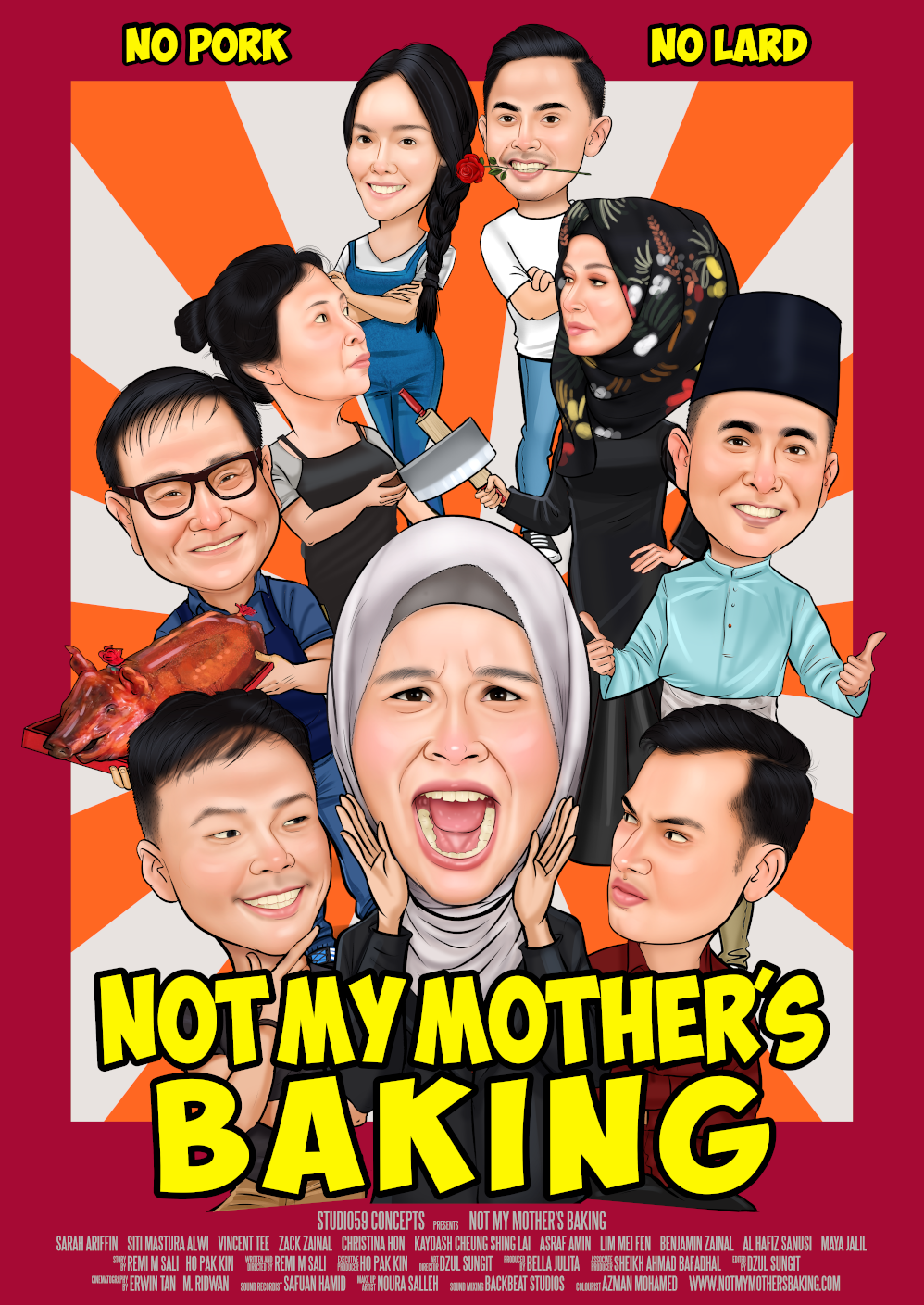
Not My Mother’s Baking (不是我妈妈的烘焙, Remi M. Sali, 2020)

True love conquers all in Remi M Sali’s warmhearted Singaporean rom-com Not My Mother’s Baking (不是我妈妈的烘焙, Búshi Wǒ Māma de Hōngbèi). Spinning a Romeo and Juliet romance between an aspiring Malay Muslim cook and the heir to a roast pork hawker stall, Not My Mother’s Baking is as much about cross-cultural connection as it is about two young people finding their own directions and the strength to pursue them free of parental expectation as they figure out what it is that will really make them happy.

Daughter of celebrity chef Siti (Siti Mastura Alwi), Sarah (Sarah Ariffin) has always lived in her mother’s shadow, harbouring a mild sense of resentment towards her for neglecting her family in favour of her career. The little brother of her best friend Tini (Maya Jalil), Imran (Asraf Amin), who has long been carrying a torch for her suggests starting her own online cookery series to establish her brand as distinct from her mother’s setting her up with Edwin (Kaydash Cheung Shing Lai), an aspiring Chinese video producer. The two do not exactly hit it off thanks to some cultural misunderstandings, but begin to grow closer after they each reluctantly agree to work together in order to avoid having to spend more time with their families, Sarah potentially roped in as a temporary/free assistant to her mum and Edwin needed to help out at his parents’ hawker stand selling roast pork. 

Cheerfully narrated by Edwin’s upbeat dad Mr. Tan (Vincent Tee), this is a story which begins with a wedding and so we know right away that it all works out and Sarah and Edwin will get their happy ending, yet there are a lot of obstacles standing in the way of their burgeoning love story not least a lack of understanding that begins with Edwin somewhat insensitively advising Sarah to remove her headscarf to make a better impression in the videos. Ill-advised by Imran, Edwin is wary of telling Sarah about his family’s occupation firstly in case it causes offence and then later uncertain what level of interaction is permitted between them considering he’s been handling pork. Sarah’s cheeky brother Yusri (Benjamin Zainal) jokes that her potential love interest is not “halal”, but then her parents aren’t quite as against the idea as she might have assumed them to be while she finds herself somewhat conflicted, not least in her ambiguous relationship with the superficially “perfect” Imran whose cheesy pick up lines and tendency to try far too hard perhaps convince her that he might in fact be too perfect or at least the wrong kind of perfect for her. 

Meanwhile, she’s also trying to find her way out of her mother’s shadow as a cook, scoring a hit online when she retitles her show “Not my Mother’s Baking” and affectionately mocks Chef Siti’s signature TV star style claiming to be a little more real and authentic in contrast to her mother’s seeming affectation. In a meta twist, Sarah and her mother are played by real life mother and daughter celebrity chefs Sarah Ariffin and Siti Mastura Alwi, though their onscreen relationship is one defined by rivalry and frustrated connection. Chef Siti is understandably hurt by Sarah’s direct attack on her brand, but it does at least enable an overdue heart to heart which brings the two women closer as they work through their complicated relationship while bonding through their shared love of cooking. 

Edwin, meanwhile, has no real desire to take over the pork stand as his parents expect while no one seems to take his video career very seriously. In a slight twist, the Tans have decided Edwin rather than his sister Joyce (Lim Mei Fen) should take over not because she’s a girl but because she went to university and so they think it’s beneath her, stubbornly refusing to see that Joyce actually loves the business and has a few ideas how to bring it into the 21st century making full use of her skills and education. Unlike Sarah’s family, Edwin’s parents are less keen on a cross-cultural romance because they fear losing their son knowing that to marry a Malay muslim woman means not only leaving the pork shop behind but fully converting to her religion. 

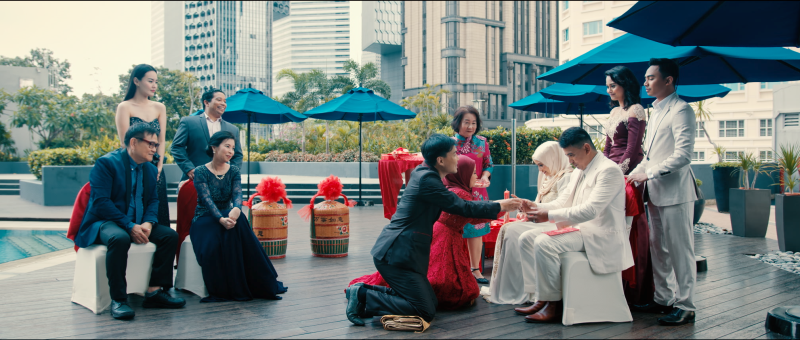
Yet as the female religious leader who accepts his conversion points out (Singapore is apparently the first country to allow women to approve a man’s conversion to Islam), there is no issue with Edwin keeping his Chinese name and it’s not as if he has to cut off contact with his family even considering the problematic nature of their occupation as demonstrated in the couple’s beautifully colourful fusion wedding at which a roast pig is served for the Chinese guests alongside halal Malay cuisine, while Edwin is followed into the ceremony by two large pink dancing lions and the nuptials are concluded with a traditional tea ceremony. A very millennial romance, Not My Mother’s Baking allows its young heroes to forge their own paths outside of those their parents might have chosen for them, proving that love really does conquer all while bringing together two very different cultures each united by the desire to see their children happy. 


Not My Mother’s Baking streams in Poland until 6th December as part of the 14th Five Flavours Film Festival.

International trailer (English subtitles)

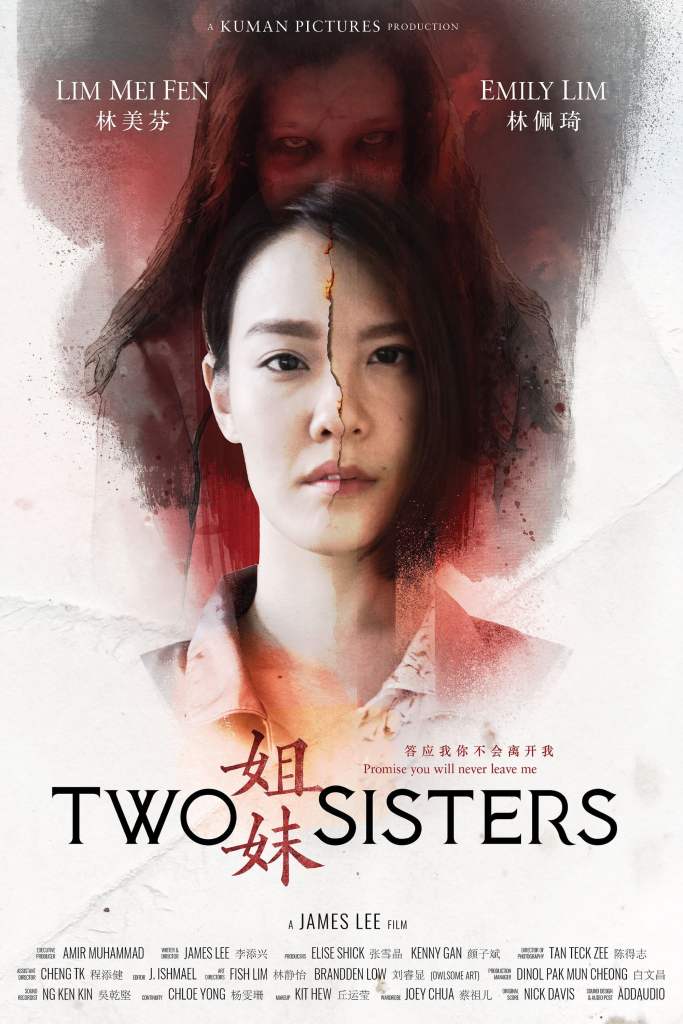
Two Sisters (姐妹, James Lee, 2019)

The family home is supposed to be a place of safety, but what can you do when it’s also a source of trauma? The young women at the centre of James Lee’s psychological horror Two Sisters (姐妹, Jiěmèi) are each trying to put their houses back in order but find that their pasts are full of locked doors, crying women, and things which go bump in the night. In the end the past is the one thing you can’t protect yourself from, but not knowing can also be its own kind of hell, an inescapable puzzle that forever corrupts the image of the self. 

Elegant and successful, Mei Xi (Emily Lim) has just published her first book – a horror novel about a woman with multiple personality disorder which is, she tells her fans at a reading, a metaphor for the dual lives many women are forced to lead because of the pressures of living under the patriarchy. Meanwhile, her home life appears to be chaotic. We see her swallow a selection of pills before a one night stand cheerfully leaves her well-appointed apartment, only for her manager, John, to interrogate her after she’s late for an appointment wondering what she was doing the night before which prevented her from answering any of his calls. She reminds him that that’s none of his business. They may have slept together once but it meant nothing to her and anyway he’s a married man. Xi hopes they can keep their relationship “professional” going forward, attempting damage control on a possibly self-destructive business move. 

The main issue, however, is that her father has recently died and she’d like to sell the family home but needs the consent of her younger sister, Yue (Lim Mei Fen), who has been in a mental institution for over a decade. The doctors tell her that Yue has made good progress and they think it might be time to discharge her from the hospital so that she can start trying to reintegrate into mainstream society. Xi agrees to take custody of her, but there is an understandable distance between the two women. Yue is uncertain that Xi will be there when she needs her, partly because she neglected to visit her in the hospital on her last birthday and had apparently seen her only infrequently, Xi claims because she was busy with her book. Meanwhile, Yue is still unable to recall any of her childhood and is determined to move back into their family home in the hope of finally finding the truth behind whatever it was that happened to her. 

As expected, not everything is quite as it seems. A locked door is never a good sign, especially when there are multiple locks to unpick, but as soon as the women try to open it their shared reality begins to crumble. “What’s the point in knowing the truth?” Yue eventually asks an increasingly confused Xi, “it’s too late to change anything now”. The two women are each haunted, literally and metaphorically, by the ghost of their mother who died when they were small in circumstances neither of them are able to remember. 

The real horror lies in the family home. Badly let down by parental betrayal, the sisters attempt to rescue each other from shared trauma but are each trapped by the inescapability of the house. “I’ll always be by your side” Xi offers as words of protection, but is entirely unable to protect herself from the traumatic past. Yet Lee ends on a note of discomfort which sees Xi apologise to her mother for something that is in no way her fault, as if she had in some way betrayed her when quite the reverse is true. Xi’s words at the book reading prove truer than she knew them to be. She herself has her dualities, as did her mother, as a victim of patriarchal oppression which in this case has a sadly literal quality. The women of the Mei household struggle to free themselves from male violence and are perhaps destroyed by its memory which manifests itself in the ominous spectre of the family home which, rather than a place of love and mutual support, is a kind of prison filled with locked doors and dark secrets. 


Two Sisters screens in Amsterdam on March 6/7 as part of this year’s CinemAsia Film Festival.

Original trailer (English subtitles)