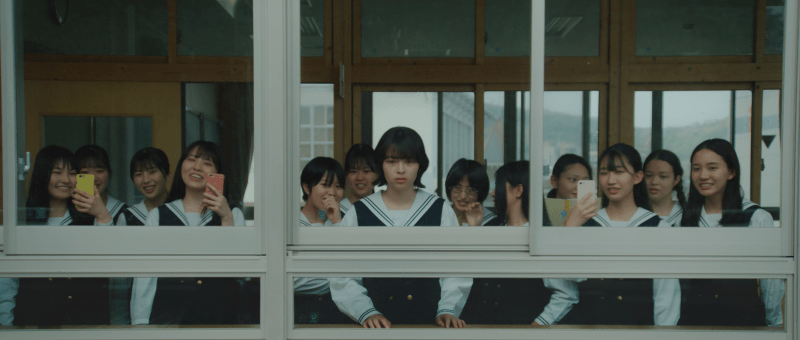

Most people don’t mean to, but in thinking they’re being nice all they do is make someone feel bad. Like they don’t belong, or there’s something wrong with them. Since returning to Japan from the UK after her parents’ divorce, Elena (Lisa Siera) can’t help thinking everyone’s staring at her. They call her the “gaijin” girl, a derogatory term for someone who is not considered to be Japanese, but Elena isn’t a “foreigner”, not that it matters. On her first day at her new school after leaving the last one due to relentless bullying, the teacher asks her what kind of mixed-ethnicity she is and then asks her to tell her all about England, though she’s been living in Japan for over 10 years and can’t really remember it. Nor can she remember much English, or perhaps simply doesn’t want to talk about it, though there’s no reason why she should anyway.
Maybe not bringing it up would be worse, but the teacher’s ham-fisted attempts at inclusion only leave Elena feeling othered. These are just a few of the microaggressions she experiences in her daily life and even another girl who tries to make friends with her, Akari (Miyu Okuno), makes a few insensitive remarks like how she’d like to have “a gaijin’s face,” and that it’s not fair because she is Japanese. She also goes straight to using Elena’s first name, which could just be friendliness or possibility circumventing the usual rules of Japanese politeness because they don’t really apply to non-Japanese people implying Akari may not think of her as one. Elena says she just wants “a normal Japanese name”, so her new friend starts calling her “Rena” which Elena seems to like because it feels like acceptance, but is it, really?
In many ways, it’s the Elena/Rena dichotomy that’s at the heart of Masaki Nishiyama’s incredibly accomplished debut as she struggles to accept the “invisible” half of herself that is nevertheless what she thinks everyone is always staring at to the extent that they don’t even really see her. There’s another girl in her class, Ito (Runa Hirasawa), who appears to be a figure of fun who everyone, including Elena, avoids and considers “weird”. It’s after the class bullies take Ito’s phone and put it in Elena’s bag to kill two birds with one stone that Elena begins to feel especially haunted. A monster with a bandaged face she can only see when she’s holding her phone begins stalking her, leaving her in a permanent state of agitation.
The phone is otherwise a source of anxiety as it’s many through group chats, text messages, and social media that bullying takes place. Elena firmly believes that the monster is real, though in other ways it reflects her own sense of internal discomfort in being unable to accept what she perceives as two sides of herself as an integrated whole. Her not altogether sympathetic mother can’t begin to imagine what she’s going through, and there’s another part of her that wonders if she should have stayed with her father, though the situation may not have been much different in the UK. Her well-meaning teacher tells her she should learn to trust adults more, and asks why Elena is keeping things from her in a way that makes it sound like a personal slight or in someway a malicious act on Elena’s part. Elena replies it’s because she also Japanese, which is to say not someone Elena currently feels she can trust while also implying that Elena also does not quite consider herself to be “Japanese”.
The lumbering, bandaged monster reflects the way in which she is pursued by her own uncertain identity while craving acceptance from others but at the same time afraid to accept it. She doubts Akari’s sincerity and worries that her overtures of friendship are a prelude to a long-form pattern of bullying, but it’s finally Akari who is prepared to help her face her monster in accepting that it actually exists. Faced with another bandaged face, Elena comes to accept it as a friend along with embracing her whole self including her full name. Filled with a genuine sense of unease, Nishiyama’s eerie debut is both an exploration of societal prejudice and a coming-of-age ghost story in which a young woman learns to make her own place to belong regardless of the gaze of others.
The Invisible Half screened as part of this year’s Raindance Film Festival.
Trailer (English subtitles)
 Windows on Worlds