The Best is Yet to Come (不止不休, Wang Jing, 2020)

A man denied a fair chance in life because of his impoverished background comes to identify with the plight of those carrying the hepatitis B virus in Wang Jing’s true life drama, The Best is Yet to Come (不止不休, bùzhǐ bùxiū). Inspired by the story of Han Fudong, a journalist who exposed the societal prejudice against those with a previous diagnosis of the disease, the film’s Chinese title “no pause no rest” makes clear how tirelessly he strived to reveal the truth even at the potential cost of destroying his dream of becoming a professional reporter. 

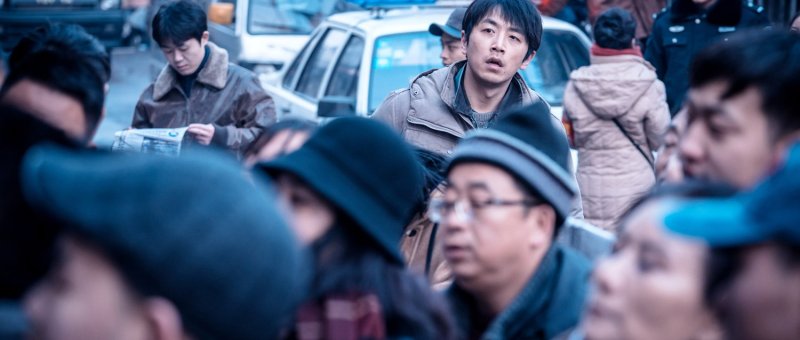
Han Dong (Bai-Ke) came to Beijing in 2003 in the hope of landing a job at a paper, but just like everywhere else journalism is a largely closed profession almost impossible to break into without elite qualifications and connections. At a jobs fair, Han Dong tries to pass off his reluctance to hand over a CV as a recruitment tactic to get people to remember him, circulating copies of his portfolio instead though recruiters quickly lose interest on realising they are all self-published articles posted online. Once he admits that he only finished middle school, it’s game over no matter how talented a writer and investigator he may turn out to be. 

It’s this sense of unfairness, of being turned away on the grounds of a few words on a piece of paper that eventually leads him to sympathise with those carrying the hepatitis B virus after investigating a company that claims it buys blood, discovering that they provide a service helping people to forge health certificates for job and school applications. Vox pop-style interviews recreated in the manner of the time feature several people describing the various ways their lives have been ruined simply because they happen to carry the virus, many of them infected since birth or early childhood. One man has been trying to apply for jobs and graduate schools for several years but finds the offers are always withdrawn after the health screening, while another woman recounts that her fiancé cancelled their engagement because his family could not accept someone with hepatitis B. 

This is also in the immediate aftermath of the SARS epidemic which perhaps caused a preoccupation with infectious disease which may be largely unfounded in the relative difficulty of passing on the hepatitis B virus. After landing a golden opportunity of an unpaid internship compensated only with 50% article fees, Han Dong finds himself conflicted. He knows the forgery operation is illegal and a threat to public health, but also cannot blame the people who make use of it when their lives have been rendered so impossible that is difficult for them simply to live. An early assignment had seen him cover a mine collapse and witness a destraught mother bounced into accepting compensation for her son’s death while shouted at by the foreman (played by film director Jia Zhangke who also produced) for having the temerity to ask to see his body. Han Dong got a front-page byline as co-author with his mentor figure, Huang (Zhang Songwen), but wonders what the point is if nothing ever changes and the truth is not enough on its own. 

For obvious reasons, films about crusading journalists are rare in Chinese cinema given that whistleblowing is not regarded as a virtue and those who try to expose wrongdoing are often shouted down or hounded into silence as seen with the doctor who drew attention to the poor medical practices in rural blood clinics that caused an HIV epidemic in farming communities, and most recently with the physician who tried to raise awareness of the new respiratory illness that later developed into a global pandemic. Journalists who report problematic stories can also find themselves facing prosecution and imprisonment. Han Fudong’s writings did however lead to an eventual change in the law and the destigmatisation of hepatitis B while he himself overcame the educational elitism of the contemporary society to achieve his dreams of becoming a professional reporter. As such, Wang’s dramatisation of his life may be in a way subversive if subtly so in hinting at a greater role for a currently not so free press in the modern China while also embracing a central philosophy that one need not simply accept an unacceptable status quo but actively reject and challenge it and that by doing so something might actually change. 


The Best is Yet to Come screens in Chicago Sept. 30 as part of the 17th season of Asian Pop-Up Cinema 

International trailer (English subtitles)
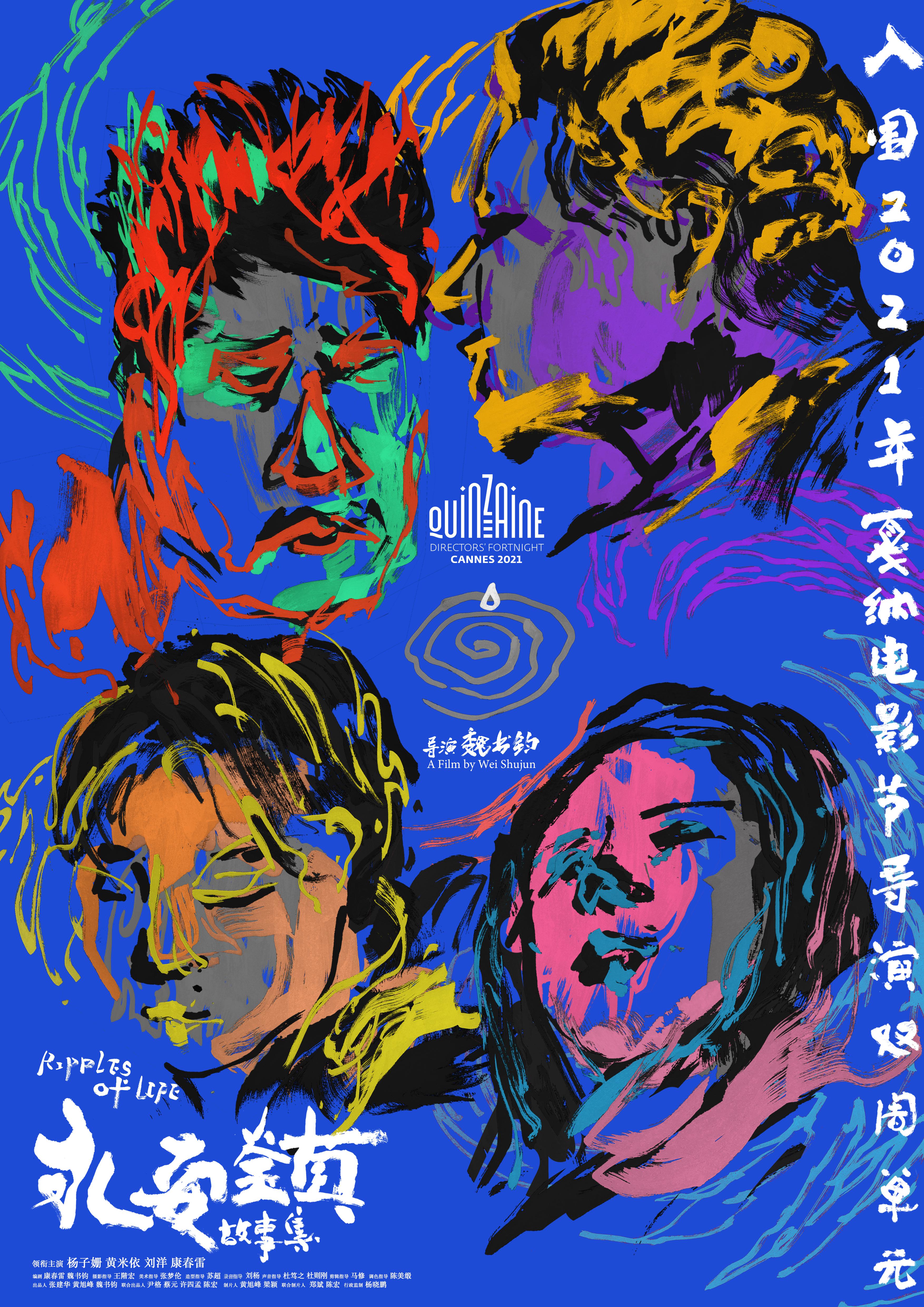
Ripples of Life (永安镇故事集, Wei Shujun, 2021)

“I had to let it happen, I had to change” the rather incongruous voice of Madonna insists, finding a note of defiance on reaching the climactic “so I chose freedom” as the movie version of Don’t Cry for Me Argentina erupts over the closing minutes of Wei Shujun’s Ripples of Life (永安镇故事集, Yǒng’ān Zhèn Gùshi Jí). Like much of the film, the use of the song is ironic but still somehow poignant its repurposing perfectly expressing the interior lives of each our “characters” who are all in some way or another looking for escape or at least a way out of personal dissatisfaction while trying to film a movie about the inertia of life in a small town in rural China where nothing ever happens. 

Divided into three segments, Wei’s film is as much about the positioning of rural China as it is about “cinema”. A Beijing film crew descend on this provincial small town with their own preconceived notions of rural life, determined not to “romanticise” country living but nevertheless bending it to their will looking only for signifiers that align with their mental image of the hinterlands of their nation. Only latterly do they realise that for true authenticity the film should be in Hunanese, but none of them speak it which is a significant stumbling block in their efforts to overcome ongoing creative differences over the script. 

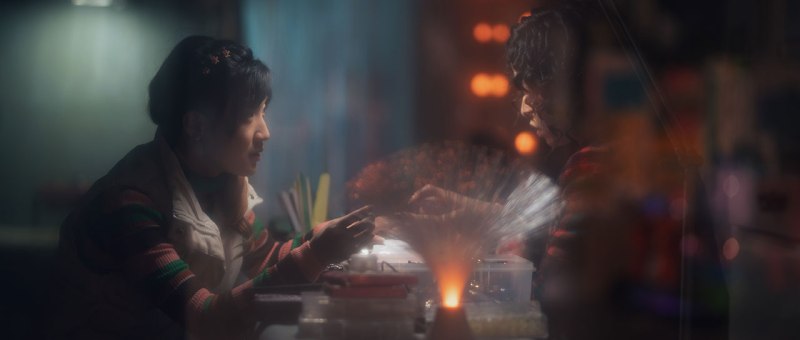
Wei is, in part, satirising the recent trend in Chinese indie cinema for gritty stories of rural poverty usually filmed with depressing naturalism determined to stress the harshness of life outside of the cities amid the nation’s ever increasing wealth divide. The first chapter in part does this too, later shifting away from early Jia Zhangke towards the neon yearning of Wong Kar-wai but always undercut with a sense of meta irony not least in its choice of heroine. The infinitely cornered Gu (Huang Miyi) longs for “a different life”, trapped in an unsatisfying marriage to a gruff man she accuses of working night shifts to get away from their toddler daughter whom she is forced to take to work with her while he constantly undermines all her parenting decisions based on articles sent by his mother. A woman at the market coos over the baby and asks when the next one’s due, Gu crestfallen realising she’s trapped in this small-town existence where nothing ever happens. But then the film crew begin to notice her, telling her she has a “real cinema face” and likening her to Kim Min-hee of whom she has never heard. Their admiration is again ironic, considering they were looking for the authentic face of rural China but taken with this cinematic vision, yet it’s also callous and cruel. They give her false hope, allowing her to dream as she puts on makeup and models costumes only to be forgotten once again when the “real” actress arrives, cast back into a life of quiet desperation. 

Perhaps this too is another unfair stereotype assuming that everyone from a small town longs for escape, but Gu’s story does indeed mimic the earlier parts of the screenplay for the film within the film which the director sees as a tale of a small-town woman’s awakening to independence and agency while the screenwriter Chunlei (Kang Chunlei) opts for an old-fashioned take on consumerist corruption. Shifting away from Gu towards formerly successful actress Chen Chen (Yang Zishan), the second arc pulls towards Chunlei as Chen Chen searches for escape from a rut in her career apparently having left her commercial agent to do more earnest work but doing not much of anything for the previous year. In another meta touch, she is from this rural backwater and like her character in the film chose to leave but now admits that sometimes she misses life in the country. As someone else puts it, city folk all want a return to simple rural life but can’t accept the reality of it which is why the plan to rejuvenate the area largely relies on tourism including the building of a waxwork museum of which Chen Chen is expected to be a notable inclusion as a local girl made good. 

Chen Chen’s image has once again been commodified, stripping her of power or agency over her name and face but on returning to Yong’an she is forced to realise that she is no longer of there, this place where nothing ever happens has already changed while she exists on a slightly different plane. Realising the maid covering her room is a childhood friend she cheerfully tries to reconnect but the woman is awkward and evasive, embarrassed perhaps to acknowledge that she is a mere hotel employee while Chen Chen has achieved her dreams of stardom. Attempts to reconnect with two other male friends similarly backfire, the first a typical provincial bureaucrat who uses her for official business without her consent while a meal with the other’s family proves even less joyful as she endures countless barbed comments from his snippy wife who eventually tries something similar in asking her to find a job for her son on the film. As she’s leaving he asks her the same question the screenwriter obsessed over, suggesting that she left for mercenary reasons only for her to answer that she didn’t want to live like his wife, or indeed like Gu, but wanted “a different life”. 

This battle between image and authenticity lies at the heart of the conflict between the director, a hipsterish festival darling with a sideline in hip hop, and the schlubby screenwriter himself perhaps trapped in the previous generation of Chinese filmmaking but also in his way more idealistic believing in cinema as an art form which can move the world rather than mere entertainment created for commercial gain. He accuses the director of hypocrisy, exploiting the arthouse aesthetic for critical credibility and with it a vision of rural China, while the director criticises him for his old-fashioned mentality in seeking melodrama over message. Shot in cooling blues their heated arguments are noticeably dispassionate, Wei even descending into some ironic iconography which sees the pair talking through their issues with a wise man film critic on a boat on a misty river. The ironic conclusion brings the whole affair full circle as the words of Madonna as Eva Peron come to speak for each of the protagonists, Gu now angrier, impatient as she shifts dishes while her husband idles nearby, and Chen Chen forced to pose next to a wax figure of herself during a launch ceremony for this film in which the script has yet to be “finalised”. “But nothing impressed me at all” the song continues, “I never expected it to” hinting at the contradictions of the modern China in the internalised defeatism of small-town dreams and the cynical filmmakers who exploit them. 


Ripples of Life screens on Oct 11 & 12 as part of this year’s BFI London Film Festival

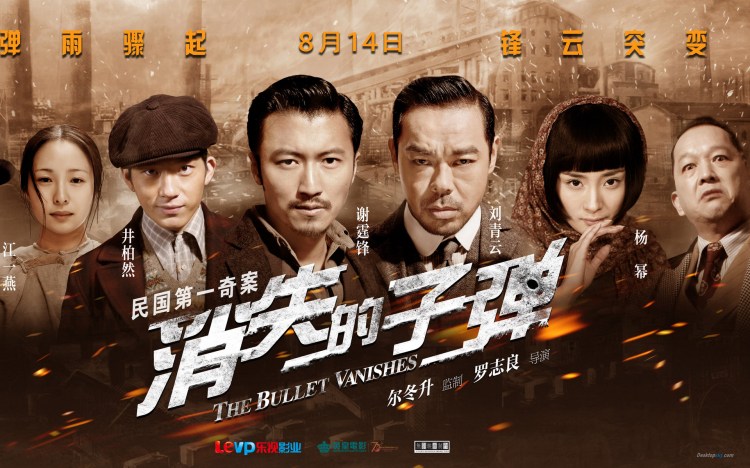
The Bullet Vanishes (消失的子弹, Law Chi-leung, 2012)

20128291720405212Review of Law Chi-leung’s The Bullet Vanishes (消失的子弹, Xiāo Shī Dè Zǐ Dàn) – first published on UK Anime Network in June 2013.


In 1930’s Shanghai there’s a bullet factory where a young girl has been accused of pilfering. The punishment, it seems, is a cruel and very public trial by Russian roulette where fate, the gods or whoever will judge her innocent or guilty with a simple click or a loud bang. Crying out her innocence to the end, the girl pulls the trigger and presumably never actually hears the outcome as her co-workers look on in horror – she must have been guilty though, right? Or she would have been spared by the immortal powers at be.

Following this horrific incident, other deaths start to occur in the factory – the strange thing is, on examining the bodies, no trace of a bullet can be found (nor any casings at the scene). Some of the munitions workers start to believe the ghost of the poor girl who died must have returned to take revenge – perhaps she was innocent after all. To solve this intriguing mystery, the police turn to two unorthodox detectives – recently transferred former prison warden Song (Lau Ching-Wan) and maverick cop “fastest gun in town” Guo (Nicholas Tse). Neither of these two are buying the “supernatural” explanation and both are determined to get to the truth even if they work in very different ways. The solution is going to be a lot more complicated than anyone could have thought, and will, ultimately, be painful to hear.

Let’s get this out of this way first – yes, the film owes a significant debt to the recent “westernisation”, if you want to put it that way, of Ritchie’s Sherlock Holmes and other Victorian set crime dramas (e.g. Ripper Street) which seek to present themselves as taking place in a totally lawless world denizened by a criminal population that is somehow both repellent and glamourous. Although The Bullet Vanishes is set in 1930s, it still has a noticeably “Victorian” sensibility presenting a world in which rapid industrialisation has brought about mass corruption and a decline in morality. Once again, setting a film in China’s past proves to be a surefire way of getting subtextual criticisms of modern China past the country’s strict censorship regulations.

The murder mystery itself is certainly very intriguing with a series of unpredictable twists and turns. The idea of disappearing bullets might not be a new one, but The Bullet Vanishes manages to find an original solution that is perfectly plausible within its own time setting. Also, the “supernatural” element exists only as an idea and is never seriously entertained as an explanation by any of the investigators – something of a break from the genre norm.

The two detectives seem much more like rivals than partners for much of the film though an awkward sort of camaraderie does eventually grow up between them. Lau and Tse both give excellent performances but Tse in particular who’s often criticised for being a pretty boy trading on family connections, really proves himself with his surprisingly complex Guo. There is, however, the familiar criticism that the female characters are severely underdeveloped and seem almost like a rushed afterthought. Yang Mi gives a lot to the barely two dimensional Little Lark but can’t disguise the fact that the character only exists as a love interest for Guo and that in turn a love interest for Guo only exists so that we can have the “obligatory” love scene. That wouldn’t be so much of a problem if the love scene itself didn’t feel quite so “obligatory” – it could easily have been excised and the film would have remained pretty much unchanged as the scene feels as if it exists purely to satisfy a perceived audience need for romance.

There really isn’t much to fault with The Bullet Vanishes. As a slightly cerebral mainstream period thriller it’s certainly very successful. It has an engaging mystery element, strong characters played excellently by the cast and extremely slick, modern direction. In Song they’ve created a very interesting character who’d be very welcome in a sequel or two. His relationship with female prison inmate, a sort of Irene Adler figure to Song’s cerebral detective, who he’d previously investigated before being transferred was quite an usual idea that would really benefit from further exploration. All in all The Bullet Vanishes is a very impressive and enjoyable period procedural that is truly a cut above its genre origins.


http://www.youtube.com/watch?v=8oZOMNeJjzQ