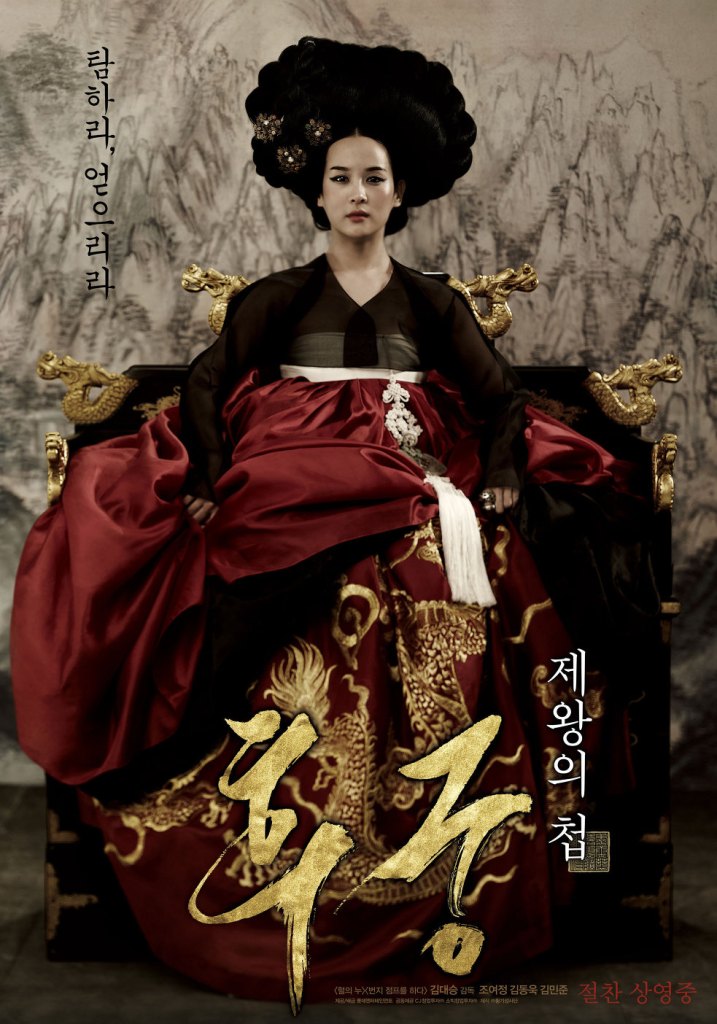
The Concubine (후궁: 제왕의 첩, Kim Dae-seung, 2012)

the-concubineYou can become the King of all Korea and your mum still won’t be happy. So it is for poor Prince Sungwon (Kim Dong-wook) who becomes accidental Iago in this Joseon tale of betrayal, cruelty, and love turning to hate in the toxic environment of the imperial court – Kim Dae-seung’s The Concubine (후궁: 제왕의 첩, Hugoong: Jewangui Chub). Power and impotence corrupt equally as the battlefield shifts to the bedroom and sex becomes weapon and currency in a complex political struggle.

Prince Sungwon first catches sight of official’s daughter Hwa-yeon (Cho Yeo-jeong) after a hunting party and develops a dangerous attraction to her. His possessive parent, the Queen Mother (Park Ji-young), finds this worrying and manoeuvres to take Hwa-yeon out of the picture by having her brought to court as a concubine of the king. Hwa-yeon, however, has a love of her own in the roguish hanger-on Kwon-yoo (Kim Min-jun) and is willing to risk her life by defying the imperial orders and running away with him. The pair consummate their union but are discovered at first light whereupon Hwa-yeon agrees to go to court on the condition Kwon-yoo’s life is spared.

Some years later, Hwa-yeon is the reigning queen as the mother of the sickly king’s only son but her life becomes considerably more complicated when the king dies in mysterious circumstances. Power passes back to the Queen Mother who puts her son, Sungwon, on the throne, making Hwa-yeon and the young prince direct threats to her power base. Sungwon is still in love with Hwa-yeon but his mother forbids him from pursuing her. Forbidding is something his mother does quite a lot of, and it’s not long before Sungwon becomes frustrated with his lack of real power. Matters come to a head when Kwon-yoo also resurfaces as a eunuch at the imperial court.

The imperial court is a golden prison and a world in itself. Once entered, it cannot be escaped. Everyone is vying for power but no one really has any. The king’s ill health and lack of a direct heir has left him dangerously vulnerable and the Queen Mother in a position of unusual strength. If one thing is clear, it’s that she has had to play a long game to get here, done terrible things in the name of power or self preservation, and will stop at nothing to make sure she remains on top.

The Queen Mother’s ascendency is contrasted with Hwa-yeon’s fall as she finds herself forced into the court against her will. Realising her total lack of agency as the court ladies are instructed to obey protocol in undressing her for the bath rather than allowing her to undress herself, Hwa-yeon exclaims that she has no right to her own body. Hwa-yeon’s body is, now, imperial property to be used and abused by the king for his pleasure and his alone. However, the Queen Mother may have met her match in the steely and intelligent politician’s daughter who seems just as well equipped to play the game as she is.

Much has been made of the sexual content of The Concubine which was largely sold on its titillating qualities. However, even if the adult content is frank it is far from erotic as sex becomes a tool of control and manipulation – one of the few available to the subjugated women of the court environment. Aside from the first love scene between Hwa-yeon and her true love, Kwon-yoo (which is perhaps the least direct), none of the subsequent scenes is fully consensual, each a part of a wider scheme or courtly ritual. Rather than an expression of love or intimacy, sex is an act of mutual conquest in which each side, essentially, loses.

Sungwon finds himself powerless both politically and romantically, unable to wrest power away from his controlling mother or win the heart of the already brutalised Hwa-yeon. A prisoner of his own circumstances, Sungwon’s increasing feelings of impotence manifest in violence and erratic behaviour as his obsession with Hwa-yeon borders on madness. Far from a liberation, Sungwon’s sex life is, in a sense literally, dictated as his ritualised consummation of marriage is conducted in front of an audience shouting out commands from behind screen doors who eventually criticise him for his lack of stamina. Kwon-yoo has been robbed of his ability to engage in this game and his desire for revenge is intense yet he will have to take it from the shadows by stealth if at all.

Director Kim Dae-seung manages the intrigue well in crafting the intensely claustrophobic environment of the oppressive court whilst ensuring motivations and desires remain crystal clear. There are no winners here even if there is a reigning champion claiming the throne. The cycle of violence and manipulation seems set to continue as even those who entered as innocents leave with blood on their hands, having become the very thing they fought so hard against. Often beautifully shot with opulent production values, The Concubine is an ice cold thriller in which desire competes with reason but rarely, if ever, with love.


Original trailer (no subtitles)
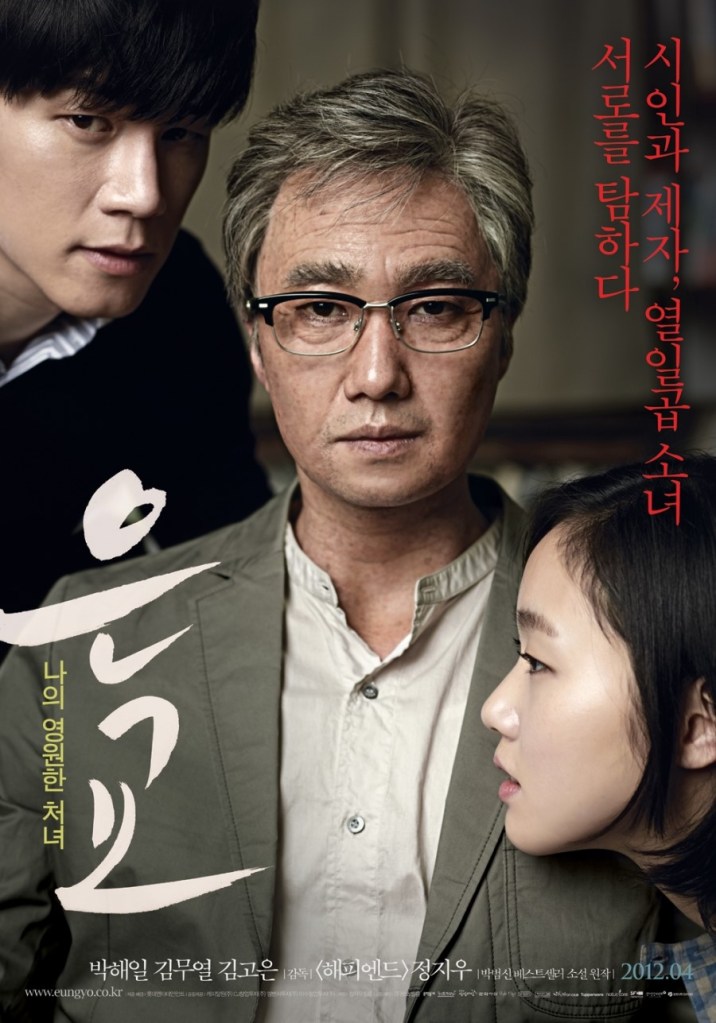
Eungyo (AKA A Muse, 은교, Jung Ji-woo, 2012)

eungyoStories of old men trying to recapture their lost youth through projecting their fantasies onto pretty young women are not exactly rare and the protagonist of Jung Ji-woo’s Eungyo ( AKA A Muse, 은교) is just as aware as most that his dreams of youthful romance border on the ridiculous. A tale of loss, nostalgia, and jealousy both professional and personal, Eungyo is a poetic exploration of the burdens and benefits of age which are often invisible to those who can only look forwards.

At 70, Lee Jeok-yo (Park Hae-il) is a respected professor and literary giant who lives a quiet and solitary life in an out of the way villa. His only companion is his apprentice-cum-assistant, Seo Ji-woo (Kim Moo-yul), who is currently experiencing a period of success as his genre crossing novel Heart is topping the best seller list. When the pair return home one day to find pretty teenager Eungyo (Kim Go-eun) asleep in their garden chair, it sparks off a three way relationship which sees her working as part-time housekeeper for Jeok-yo.

Eungyo is a lively young girl and brings a little light and laughter into the otherwise stuffy villa but when she runs away from home one stormy night and stays over, the situation changes. Catching sight of Eungyo emerging from Jeok-yo’s bed, Seo jumps to the obvious conclusion and is filled with moral outrage in thinking his aged boss is conducting an inappropriate relationship with a schoolgirl. Or, perhaps, Seo himself is attracted to the girl and is angry that Jeok-yo has once again “beaten” him and proved himself superior on the fields of both literature and romance. Eungyo’s presence deepens the divide between master and pupil, threatening to change both of their lives forever.

Jeok-yo is under no illusions and never contemplates the idea of real relationship with Eungyo. His life had been a quiet and solitary one, though there’s little indication exactly how he felt about that. What is clear is that Jeok-yo dislikes his ageing body and the loss of his youth. In his fantasy romance, Jeok-yo is young, running and playing like a naive teenager in love but as soon as he wakes up the spell is broken, he’s old again and the idyllic world he’d conjured for himself no longer exists.

Even if he dreams another world for himself, Jeok-yo is perfectly aware of how things are in this one. Ji-woo, by contrast, attempts to solve all his problems by deluding himself into believing his future is brighter than it really is. His professional relationship with Jeok-yo turns out to have an unexpected dimension and Ji-woo’s literary success is a hollow pillow for his self esteem. Insecure about his talent, especially in comparison to his mentor, Ji-woo sets about casting himself as morally superior through his objection to Eungyo’s new role in their lives but this too is a thinly veiled way of trying to eclipse his master. All Ji-woo has to offer is his youth but even this cannot heal his loneliness and lack of self worth.

Eungyo becomes a symbol of something else for both men but she is also a young woman with a number of problems of her own. Faced with an apparently difficult home environment, Eungyo is seeking a connection from these two men but her borderline status as an adolescent girl means that the water is always coloured with both men viewing her as a potential lover rather than a child in need of shelter. Coming to admire Jeok-yo for his poetic soul and literary talent and siding with him against Ji-woo, Eungyo later makes a self destructive decision which ends her relationship with both men.

There are no happy endings here, even if the idea of a “happy ending” is not quite as ironic as in Jung’s previous film centring on marital infidelity, Happy End. Nobody gets what they wanted or what the audience wanted for them and each end up unable to come back from the whirlwind of self destruction which they’ve each helped to generate. A nuanced character piece in which age competes with youth, loss competes with gain, success competes with personal fulfilment, and true feeling is sacrificed for a relief from loneliness, Eungyo is deceptively named not for the young woman at its centre but for the collection of hopes, dreams and aspects of self which each of the men have imbued her with, eclipsing the real woman with an imagined prize and losing her in the process.


International trailer (English subtitles)

The Last Princess (덕혜옹주, Hur Jin-ho, 2016)

last-princessReview of Hur Jin-ho’s The Last Princess first published by UK Anime Network.


Filmic biopics of real life historical figures are not generally known for their fierce adherence to fact, but The Last Princess (덕혜옹주, Deokhyeongjoo) is unusually honest in its approach in the sense that it includes a brief opening statement to the effect that the film pays very little attention to historical veracity. Hur Jin-ho adapts the story of Korea’s last princess, Yi Deok-hye (Son Ye-jin), as recounted in a novel by Kwon Bi-young, whilst indulging the genre he’s best known for – romantic melodrama. Another of the recent spate of films to address Korea’s colonial past, The Last Princess is the story of a woman who was fiercely loyal to her homeland, even in the face of harsh opposition and final rejection by the very people she’d been striving so hard to protect.

Told in a non-linear fashion, The Last Princess spans the majority of Deok-hye’s life from her opulent childhood in the royal palace to her eventual repatriation to Korea in the mid 1960s. In 1919, nine years after Korea had been annexed by the Japanese, Deok-hye lives in the palace with her loving father, the former Emperor (Baek Yoon-sik), and her mother, the concubine Lady Yang (Park Joo-mi). Her carefree days soon end when she witnesses her father’s death by poison and comes to understand her precarious position as puppet royalty of a subjugated regime.

Her life, and those of her remaining family members, is largely in the hands of a traitorous civil servant, Han (Yoon Je-moon), whose fierce loyalty to the Japanese emperor knows no bounds. Deok-hye is unwilling to assist him in his desire to use her as a tool to promote the “Japanisation” of the country and so is packed off to the mainland to study with the promise that she can return to live with her mother in Korea after her studies have ended. Needless to say she does not return.

In a touch of cinematic romanticism, the film elides two characters into one in the otherwise fictional character of Kim Jang-han (Park Hae-il). The son of a resistance fighter loyal to the emperor, Jang-han was betrothed to Deok-hye when they were both children and later returns to her as an adult in Japan where he is active in the Resistance, before coming back to find her years after the war. Jang-han hatches a plan to help Deok-hye and the other royal family members escape for exile in Shanghai but the the pair are eventually separated.

Recalling other recent Korean Resistance movies Age of Shadows and Assassination, The Last Princess has its share of action as Deok-hye and Jang-han attempt to escape the Japanese occupation and foster the revolution from abroad. The villain of the piece this time around is not so much the Japanese but the Koreans who willingly helped them as as exemplified here by the odious Han. Han is the most typically melodramatic character and only lacks a moustache to twirl to complete the effect. Hellbent on ingratiating himself with the Japanese, Han is determined to harness his princess’ appeal to sell the virtues of the Japanese state. When Deok-hye resolutely refuses to play along, he threatens her family members and friends in an attempt to force her compliance but finds her love for her country too strong to be bent by his egocentric cruelty.

Sent away and kept a virtual prisoner far from home, there is little Deok-hye is able to do in service of her nation. Introduced to the Resistance operating in Japan, she begins to see a way to help and eventually finds herself taking a stand when blackmailed into reading out a propaganda speech in front of a collection of forced labourers. Beginning the speech in Japanese as ordered, Deok-hye finds she cannot continue and eventually makes her real feelings known in Korean as she instructs the people in front of her not to give up, she will be right along side them fighting to regain their homeland. In a touch of Casablanca inspired drama, a chorus of Arirang suddenly springs up among the crowd, much to the consternation of the Japanese officers expecting a show of contrition, as the Princess herself is whisked off to pay a heavy price for her “betrayal”.

The Last Princess forces its heroine through constant loss – of her home, of her position, of her family, of a future, of love, of a child, of happiness, of her mind, and most importantly of her nationality. Deok-hye never wanted to be Japanese, did not travel to Japan of her own volition, and did her best to resist even at great personal cost. Nevertheless she finds eventually finds herself barred from her homeland due to opposing political concerns when the fledgling Republic fears the misuse of a powerful symbol like a royal family to frustrate the democratic future. Played with wonderful sensitivity by leading actress Son Ye-jin, Deok-hye suffers as her nation suffers, longing for independence both personal and national but finding only new cages everywhere she goes. Despite the unconvincing ageing makeup of the latter part of the film and an overly intrusive score, The Last Princess is an impressively produced prestige picture which plays its melodrama credentials to the max but is also undoubtedly moving in recounting the tragic story of its heroine whose constant misuse and lack of agency mirror much of the history of the nation she holds so dear.


Reviewed at the 2016 London Korean Film Festival.

International trailer (English subtitles)