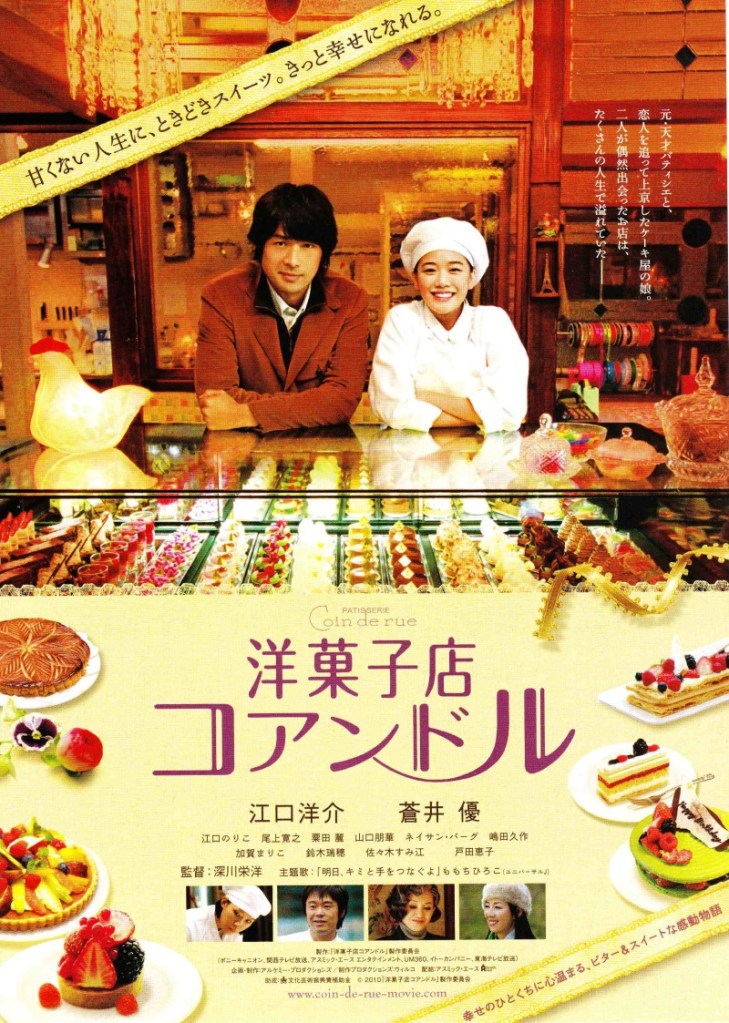
Patisserie Coin de rue (洋菓子店コアンドル, Yoshihiro Fukagawa, 2011)

coin de rue posterYou know how it is, when you’re from a small town perhaps you feel like a big fish but when you swim up to the great lake that is the city, you suddenly feel very small. Natsume has come to Tokyo from her rural backwater town in Kagoshima to look for her boyfriend, Umi, who’s not been in contact (even with his parents). When she arrives at the patisserie he’d been working at she discovers that he suddenly quit a while ago without telling anyone where he was going. Natsume is distressed and heartbroken but notices that the cafe is currently hiring and so asks if she may take Umi’s place – after all she grew up helping out at her family’s cake shop!

However, as you might expect, even if her cakes are perfectly nice in a “homecooking” sort of way, they won’t cut it at a top cafe like Patisserie Coin de rue. Natsume is not someone who takes criticism well and is hurt that her skills aren’t appreciated but vows to stay and become the best kind of pastry chef she can be.

At heart, Patisserie Coin de rue (洋菓子店コアンドル, Yougashiten Koandoru) is a fairly generic apprentice story as Natsume starts off as a slightly arrogant country girl with an over inflated opinion of her abilities but gradually develops the humility to help her learn from others around her. Natsume, played by the very talented Yu Aoi, is not an easy woman herself and often rides a rollercoaster of emotions in just a single sentence. She’s loud but passionate and she does work hard even if her over confidence and slapdash approach sometimes cause problems for her fellow workers.

Patisserie Coin de Rue is also refreshing in that it’s one of the few films of this nature that do not attempt to pack in a romantic element. Natsume may have come to Tokyo to look for her boyfriend but no attention is paid to the possibility of winning him back or finding someone else, after calling time on her quest Natsume simply buckles down to learning her craft.

This is doubly true of the film’s secondary plot strand which centres on former international pastry star Tomura (Yosuke Eguchi) who mysteriously abandoned his cooking career eight years ago and now mostly works as a critic with some teaching on the side. He cuts a fairly sad figure as a regular visitor to Patisserie Coin de rue where he’s also an old friend of the owner and Natsume’s mentor, Yuriko. Natsume finally manages to coax him out of his self imposed isolation but the relationship is more paternal than anything else and, thankfully, never attempts to go down any kind of romantic route.

It’s a story that’s familiar enough on its own to have become something of a cliché and Patisserie Coin de rue doesn’t even try to put much of a new spin on it but it does at least carry it off with a decent amount of sophistication. Occasionally the film falls into the televisual but its production values are strong with the tone neatly flitting between mainstream aesthetics and a slightly alienated indie perspective. Of course, being a cake based film there are plenty of enticing shots of the baked goods on offer which do at least create a feast for the eyes.

The saving grace of the film is its leading actors who each turn in naturalistic, nuanced performances even given the lacklustre nature of the script. Yu Aoi carries the film as her surprisingly feisty Natsume dominates each scene she’s in while support is offered by the silent, brooding Yosuke Eguchi and the wise and patient shop owner Yuriko played by Keiko Toda. The film really owes a lot to the talent and commitment of its leading players who help to elevate its rather ordinary nature into something that’s a little less disposable.

That said Patisserie Coin de Rue is a little like a pleasant cafe you find in an unfamiliar area – the coffee’s good and the pastries are pleasant enough, you might drop in again if you’re in this part of town but you probably won’t make a special journey. A little bit formulaic and ultimately too sweet, Patisserie Coin de Rue is a shop bought cake in a boutique box which though enjoyable enough at the time is unlikely to linger long in the memory.


The R3 Hong Kong DVD release of Patisserie Coin de rue includes English subtitles.

(Unsubtitled trailer)


Kagero-za 陽炎座 (Heat Haze Theatre – Seijun Suzuki 1981)

SuzukiKageroza1Zigeunerweisen was an unexpected commercial and critical hit in Japan netting both an improbably good box office return and more than a few awards. The next instalment in what would become Suzuki’s Taisho Roman Trilogy (though it would be another ten years before the final part, Yumeji, would arrive) therefore benefitted from a slighter bigger budget, bigger stars and even greater ambition. Like the others in the trilogy and as implied by its title, Kagero-za is once again based on a book set in the Taisho era though this time by Kyoka Izumi. Izumi was a novelist and kabuki playwright most closely associated with supernatural tales influenced by Edo era traditions and Kagero-za even features a playwright as its protagonist. With even less clarity than Zigeunerweisen, Kagero-za is not altogether as successful but nevertheless boasts Suzuki’s bizarre imagery and surreal world view.

Like Zigeunerweisen Kagero-za also throws dreams and reality into a giant melting pot with a non-linear narrative that floats and wefts like a strange nightmare. It begins with the central character, Matsuzaki (played by Yusaku Matsuda), meeting a lone woman near a shrine who asks him to accompany her to visit a friend in the hospital. She doesn’t want to go alone because she’s afraid of the old woman who sells charms and medicines there including bladder cherries which are said to contain the souls of women. Originally reluctant Matsuzaki agrees only to have her change her mind shortly after. Matsuzaki is pre-occupied over having dropped a love letter and worrying it’s been found by an ‘evil’ person – something which upsets his new friend as she’s convinced the letter was from a married woman.

This mysterious woman, it turns out, may be (or have been?) the wife of Matsuzaki’s wealthy patron Tamawaki. To make matters even more confusing, Tamawaki may have had two wives – the first a German woman he married while abroad and brought back with him to Japan who died her hair black and wore contact lenses to look more Japanese but regained her original blonde & blue eyed foreignness in the bright moonlight. The second is, apparently, dying in hospital – not that Tamawaki is terribly upset about it. Matsuzaki becomes increasingly obsessed with the mysterious woman, following her across the country only to discover Tamawaki waiting for him – apparently intent on witnessing a double suicide.

The film takes an even more surrealist dive towards the end as Matsuzaki finds himself the only adult audience member at a kabuki show entirely performed and witnessed by children. Not only that, this bizarre kabuki play appears to re-enact the exact same events from the first half of the film. A fitting trap for a playwright, this last, nightmarish section echoes the film’s ghost story origins complete with the creepy bladder cherry seller from the beginning as some kind of villainous demoness and Tamawaki as a tempting devil. Who talks of realism here? Says Tamawaki making an exit through an alleyway with a rifle on his shoulder. Who indeed? Not us, that’s for sure.

Even less coherent than Zigeunerweisen, Kagero-za is a veritable fever dream of a film. There’s barely any linear plot, Matsuzaki’s perceptions are recounted in fractured dream narrative where the true nature of events is always unclear. We can’t trust Matsuzaki to guide us here, nor can we trust Suzuki who employs fewer absurdist tricks than with the previous film but injects a heavy dose of kabuki inspired theatrics. Everything feels inevitable, like the action in a play it’s all been scripted and performed many times before. Yet for all that we don’t ever come to feel very much for Matsuzaki and his presumably tragic fate even though we realise fairly early on what sort of story this is. It’s hellish, and gruelling and honestly tries the patience at times but never achieves that sense of over arching dread that characterised Zigeunerweisen.

That said, if Kagero-za’s largest weakness is playing second fiddle to Zigeunerweisen that’s not so much of a problem. Once again filled with bizarre and trippy imagery, Kagero-za has many startling moments but fails to marry its visual virtuosity with the more individualistic focus of its script. Undeniably without the power of Zigeunerweisen, Kagero-za ultimately feels a little too clever (and perhaps too cold) for its own good but nevertheless does offer Suzuki’s visual flair and an entertaining (if baffling) narrative.

Masahiro Shinoda’s Pale Flower (Kawaita Hana) Criterion Collection Blu Ray

Masahiro Shinoda’s 1964 film Pale Flower (Kawaita Hana) is a total break from the romanticised yakuza films that had been common prior to its release. Heavily influenced both by American Film Noir and by the French New Wave, Shinoda’s gangster underworld is dark and empty. There maybe pretty girls and oh so shiny fast cars but these yakuza spend their off time in bowling alleys and in other ordinary daily pursuits not so different from your average salaryman. As the film begins we meet recently released Muraki (Ryo Ikebe) who is traveling back to Tokyo having completed a three year sentence for committing a murder ordered by his gang boss. We hear him reflect less than fondly on his crime, but at the same time wonder why he’s been punished for ‘slaughtering one of these stupid animals’ which crowd around him, seemingly barely alive. On arrival he pays a visit a to an old girl friend who seems to be much more fond of him than he is of her. Then he goes gambling and sees the young, beautiful but perhaps just as empty as he is, Saeko (Mariko Kaga). Presumably from a wealthy background, Saeko spends her nights gambling vast sums of money, little caring if she wins or loses, living only for the brief thrill of chance. Together Mariko and Saeko wander aimlessly through night time Tokyo desperately trying to find some kind of meaning to this chaos but pushing each other ever further down into a spiral of thrill and transgression.

Shinoda’s direction and Masao Kosugi’s photography are really fantastic here. The Noirish light and shadows perfectly depict this murky, uncertain and claustrophobic world the protagonists are constrained by and totally establish this mood of alienation which is so central to the film. This is further assisted by the wonderful score provided by Toru Takemitsu. Relying heavily on dissonance and incorporating exaggerated or found sounds – tap dancing over the sound of the cards for example, the score brilliantly brings out the underlying menace of this environment. Indeed, the sound design is one of the most distinctive attributes of this film and is extraordinarily important in establishing the mood. The final set piece accompanied by a section from Purcell’s Dido and Aeneas is absolutely pitch perfect and has obviously become hugely influential.

This new blu ray release from the Criterion Collection is absolutely stunning, the picture quality and clarity are excellent. The contrast in the black and white photography is beautiful to behold. The remastered lossless sound is also richly delivered, with no problems of audibility. This fascinating film is a must for any fan of Japanese Cinema, Film Noir or New Wave. Highly recommended.