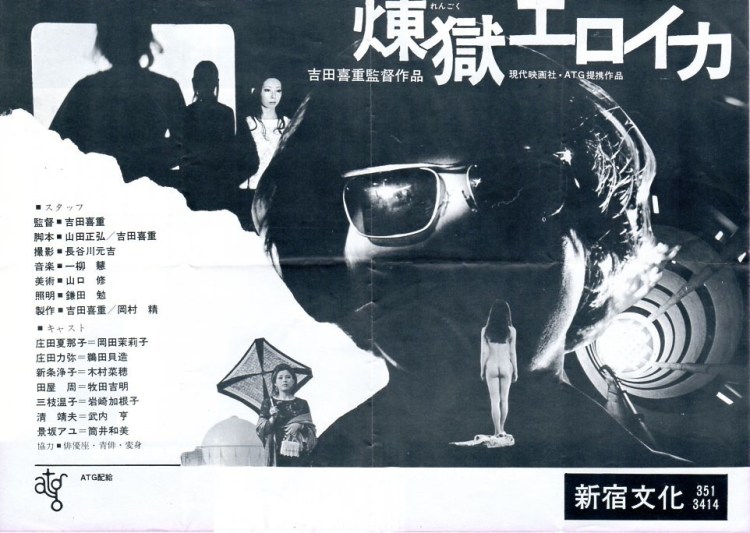
 The second film contained within Arrow’s Kiju Yoshida boxset is perhaps his least accessible. Ostensibly, Heroic Purgatory (煉獄エロイカ, Rengoku Eroika) is an examination of leftist politics in the years surrounding the renewal of the hugely controversial mutual security pact between Japan and America. However, it quickly disregards any kind of narrative sense as time periods blur so finely as to leave us with no objective “now” to belong to and characters switch identities with no warning or discernible reason. Yoshida is not really after objective truth here – there is no truth in cinema, film lies repeatedly until it finally exposes the truth.
What there is of a plot begins with the scientist Rikiya Shoda who, it seems, may have been a part of a left wing activist group in the ‘50s who were intent on assassinating an ambassador but may or may not have had a mole in their midst. Now, in the contemporary ‘60s era his quiet life is disturbed when his wife, Nanako returns home with a distressed teenage girl who begins insisting Rikiya and Nanako are her parents. Sometime later another man arrives claiming to be Ayu’s father – he’s even installed a spy cam on her because this is apparently something she does quite often. The “father” eventually leaves without Ayu but then we jump back to the ‘50s where Rikiya and the “father” seem to be part of the same left wing cell but for some reason did not recognise each other in the modern part of the film. There are repeated interrogations regarding a spy, confessions, reversals, executions and betrayals but where does it get us in the end?
There’s no making sense of Heroic Purgatory, that’s not really what it’s about. It’s the very essence of avant-garde, gently eschewing literal narrative in favour of a deeper meaning. At the end what we’re left with is a scientist who professes love to be the highest calling and a wife who answers the question “what do you do when your husband’s working?” with “Think about my husband”. This isn’t some kind of anti-feminist statement in so much as a defence of a thirty year marriage which has, apparently, survived all this chaos. What has clearly perished is the left wing student movement which has ultimately failed to instigate any real kind of social change. The film wraps itself around the dates at which Japan’s defence treaty with America was or would be renewed – something to which the leftwing movement was completely opposed to and failed to prevent. Not only did they not succeed in breaking the American security pact in the ‘50s but interest in the protests themselves slowly dwindled. The film ends with a sign reading “Dead End” which you can only read as being in reference to the eventual demise of armed leftwing rebellion in Japan.
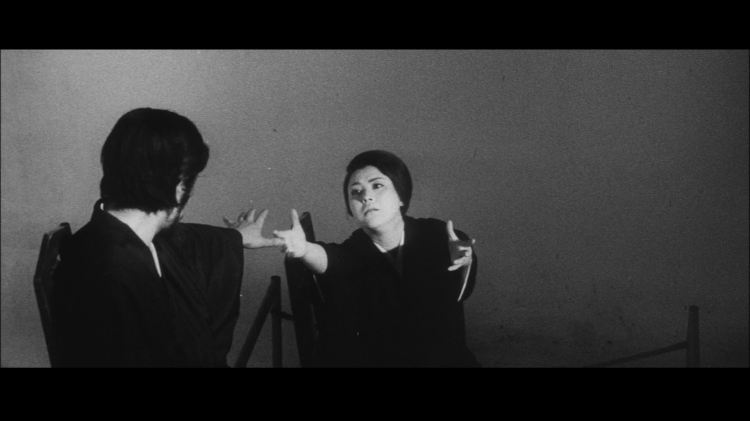
Though Heroic Purgatory is in no way Yoshida’s most easily digestible effort, it may be one of the most beautiful. Shot in 4:3 academy ratio and in glorious black and white with Yoshida’s preference for over exposure, every scene of Heroic Purgatory drips with elegance in its exquisite framing. Yoshida pushes focus to the bottom of the frame, rarely having anything other than empty space above the halfway line. Further adding to the sense of pressured claustrophobia and confusion, Yoshida’s gift for strange compositions is the perfect match for his dreamlike, incoherent, floating tale. Pushed to the edges of the frame, the actors are literally left with nowhere to run in Yoshida’s largely industrial wasteland of a stage set.
The film begins with what looks like a suicide, but turns out not to be. Accompanied by violent, stinging music, we’re trained to expect something terrible to have happened though once again Yoshida has fooled us with clever camera trickery. The music throughout is more like something from a horror film, low level thrumming strings and brief breaks of choral singing set us on edge and make us even more uncomfortable than we already were.
Heroic Purgatory is a poem of beautiful incomprehensibility. Strange and elliptical, the film is visual experience which demands emotional over intellectual engagement. Beautiful, fascinating and ultimately inscrutable Heroic Purgatory is a film that haunts with its refusal to explain itself and is likely to reverberate in the mind long after the final credits have rolled.
Available on blu-ray and DVD as part of Arrow Films’ Kiju Yoshida: Love + Anarchism box set.
Original unsubbed Japanese trailer (slightly NSFW – contains nudity)
Reviews of the other movies in the set:
 One of the foremost avant-garde filmmakers of the New Wave era (though he detested this term which, in fairness, is a retrospective and often arbitrary label), Kiju (Yoshishige) Yoshida has remained largely unseen in the West. Some of this is his own fault – fiercely independent, Yoshida nevertheless found himself working with ATG after leaving Shochiku but the relationship was an unusual one and often far from easy. All but the latest film in Arrow’s Kiju Yoshida boxset,
  Windows on Worlds