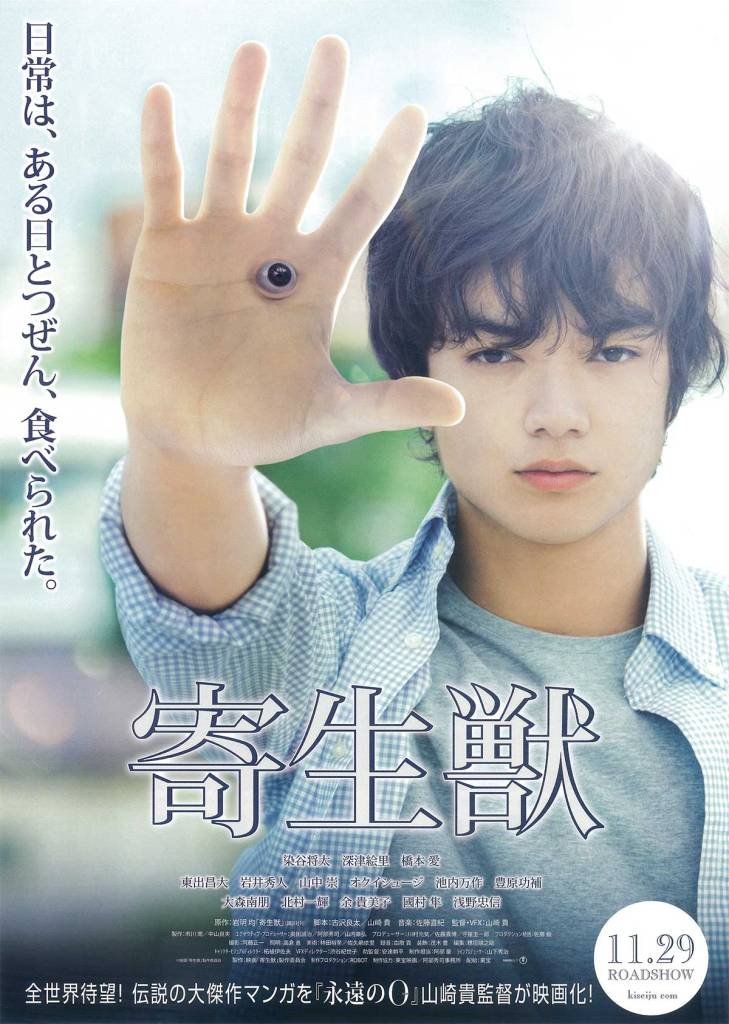
Parasyte The Movie Part 1 (寄生獣, Takashi Yamazaki, 2014)

parasyte part oneReview of Takashi Yamazaki’s adaptation of Hitoshi Iwaaki’s manga Parasyte – Parasyte: The Movie Part 1 (寄生獣, Kiseiju) first published by UK Anime Network.


Humans – are we the biggest threat to our planet and ultimately our own survival? If the world population were halved, would we also halve the number of forests that are burned and the damage that we’re doing to our natural environment? These thoughts run as a voice over beginning the full scale blockbuster adaptation of Hitoshi Iwaaki’s classic manga which was also recently adapted into a critically acclaimed anime. The Parasyte of title most obviously refers to the extraterrestrial microbes which are climbing into the driving seat of an unsuspecting host’s brain with nothing less than the colonisation of our entire species on their “minds”, yet, is it we ourselves who are the real parasites feasting on the corpse of our dying planet? Parasyte is that rare blockbuster treat that is content to give us man-eating, shapeshifting, monsters and gore filled destruction but also wants us to dig a little deeper into our own souls at the same time.

Shinichi Izumi’s (Shota Sometani) mum (Kimiko Yo) probably told him not to sleep with his headphones on but luckily they’re about to save his life as a weird little bug tries to crawl into his ears but finding them blocked opts for the arm instead. Wrapping the cord around his elbow tourniquet style, Shinichi is able to stop the bug’s progress but the parasite has taken root and Shinichi is horrified to find his right hand is no longer his own but is now controlled by a dispassionate alien that eventually names himself “Migi”.

Shinichi and Migi develop an odd kind of partnership born of their mutual dependency which is threatened only by the presence of other Parasytes who have successfully infiltrated a human brain and can blend in with the general populace (aside from their cold and robotic natures). To his horror, Shinichi discovers a new teacher at his school is actually a Parasyte stooge who recognises the “research” potential of a hybrid team like Shinichi and Migi. Becoming very keen on “experiments” Ryoko Tamiya (Eri Fukatsu) has also mated with one of her fellow Parasytes in the hopes of exploring what will happen with the birth – will it be purely a human child seeing as it’s born of two human bodies or will something of the Parasyte get through? However, Ryoko’s “network” of Parasytes aren’t all as committed to scientific research as she is and Shinichi and Migi quickly find themselves becoming humanity’s last line of defence against the invading creatures.

Shinichi is the teenage lead of the picture but in this first part at least it seems to be Ryoko leading the show. She gives us the original voice over and it’s her burgeoning motherhood that gives the film its clearest ideological standpoint. As the dispassionate Ryoko comes to develop the beginnings of maternal pangs and a desire to ensure the survival of her child (or perhaps just her “experiment”), so Shinichi finds his humanity being erased by the parasitical “child” he is gestating in the form of Migi. At the same time Migi begins to take on a protective mentality towards his host which may be more than simple self preservation particularly after a traumatic near death experience bonds the two even tighter together, in a biological sense at least.

Though the film obviously references former genre classics, in particular Invasion of the Bodysnatchers with its difficult to detect pod people, it steers clear of the “red scare” inspired sense of paranoia and the feeling of intense mistrust that exists even between supposedly good friends. Migi is able to sense (to a degree) his own kind making the presence of potentially dangerous Parasytes easier to detect but the fact that the Parasytes are able to colonise and use the form of someone all too familiar to confuse their enemies restores something of their power to lurk unsuspected in the shadows.

All this seems to suggest that the big screen live action adaptation of Parasyte would be a fairly serious affair yet the tone is often lighthearted, maintaining the darkly humorous buddy comedy side of the relationship between normal teenager Shinichi and the almost omniscient yet strange Migi. Migi, as played by veteran actor Sadao Abe who is perhaps most closely associated with comedic roles, has a thirst for a different kind of “brains” than his fellow Parasytes and quickly devours any and all knowledge he can get his “hand” on though he lacks the emotional intelligence to make sense of everything he learns and thus is dependent on his host Shinichi to get a fuller understanding of the human world.

Like the blockbuster mainstream films of recent times Parasyte boasts generally high production values on a par with any Hollywood movie though it has to be said that the film is often undermined by unconvincing CGI. However, this is mainly a problem with the action scenes and Migi himself is generally well integrated into the action and oddly adorable to boot. In some ways it might have been interesting to see a fully “in camera” take on the effects ala Cronenberg whose spirit is most definitely evoked throughout the film which also harks back to ‘80s body horror with its synth score highlights and generally gruesome scenes of carnage. Though it’s hard to judge the overall effect from just this first instalment of a two part film which drops a decent number of threads to be picked up in part two, part one at least serves as a tantalising appetiser which only heightens expectations for its final conclusion.


Parasyte: The Movie Part 1 is currently available on DVD and blu-ray in the UK from Animatsu Entertainment with Part 2 to follow in June 2016.

0.5mm (Momoko Ando, 2014)

0.5mm-poster-20.5mm is only Momoko Ando’s second film following on from her lesbian love story manga adaptation, Kakera: A Piece of Our Life. Starring her real life sister Sakura Ando in the lead role, 0.5mm is undeniably more complex and epic in scope than her previous film but retains some of its whimsical atmosphere and benign objectivity. Encompassing such disparate themes as Japan’s rapidly ageing population, entrenched sexism, archaic ideas about gender, and what it’s like to find yourself at the bottom of the heap thanks to a series of unfortunate incidents, 0.5mm is a hugely impressive sophomore effort from Ando and one of the best Japanese indie movies for quite some time.

Sawa is a home care nurse and her current assignment is caring for an elderly, bedridden gentleman who lives with his daughter and grandson. One day, the old man’s daughter makes an extremely odd and inappropriate request of Sawa which she eventually agrees to. However, things go just about as wrong as they could possibly go and Sawa finds herself out of a job and, as she lived in nurse’s accommodation, out of a home too. That’s not the end of her troubles as she manages to leave her coat, in the pocket of which is an envelope containing her life savings, on a train. At this point she’s pretty much down and out when she notices an elderly gentlemen confusedly trying to find out if it’s OK to sleep all night at a 24 hour karaoke box. Pretending to be the old man’s date she hires a room for two and bamboozles him into it for a night of singing and snoozing. In the morning it turns out the old man quite enjoyed the mad adventure as he’s temporarily run away from home because all his son seemed to care about was the inheritance so he thought he might as well spend it all himself. This strange encounter begins Sawa’s odyssey into a series of similar episodes where she blackmails an elderly gentleman into letting her stay with him for a while until one final meeting brings things full circle.

Sawa is definitely a very unusual woman. Good at her job, she’s a caring person in more ways than one. Her new found method of survival is certainly a novel one, and not entirely ethical, but then all she’s doing is exploiting circumstances in the same way circumstances have had a way of exploiting her. Though she weaselled her way into these men’s lives, she did, at least, care for them. Yes, she did the cooking and the cleaning and assisted with healthcare too but she also helped them to realise a few things about themselves and move on with their lives. Whether it’s saving them from yakuza backed pyramid scams or listening to their traumatic memories of the war, Sawa has a knack for seeing people’s hidden pain and another for knowing how to make it better.

Yet, her various encounters with the older generation speak of a number of different social problems that cannot be repaired by one person alone. The first man she meets feels unwanted by his family and is looking for escape, a reassertion of his independence and perhaps a little revenge. The second is really quite mad – obsessively counting the trees in the park, stealing bicycles and letting people’s tires down but he too is alone with no one looking after him. The third man has a bedridden wife and, apparently, a taste for erotic school girl magazines but no children of his own to take care of him. The fourth man discovered a teenage child he’d never met though is incapable of forming a relationship with him. Society is full of lonely, elderly people who either have no close family or have become estranged from them. Some of them have become vulnerable and half mad through extreme isolation and others have become embittered, violent or trapped in the past.

In the way that these men react to Sawa there’s also a complex system of ideas at play as each of Sawa’s employers seem incapable of defining exactly what sort of “services” they expect of her. Nurse, housekeeper, mother, courtesan? From the original, perhaps innocent though far from appropriate, request each of the men Sawa encounters can’t help but view her as a some kind of sex object and react with various degrees of embarrassment about it. To them she is many things though never quite a “person” until, perhaps, their relationship begins to near its end and each reaches some kind of epiphany brought about by her presence. However, Sawa herself is perfectly aware of each of these complexities and perfectly willing to exploit them with a sort of amused ruefulness.

The 0.5mm of the title refers to a metaphor offered on a farewell cassette tape from the second of Sawa’s old gentlemen that one person may be only be able to move a mountain by 0.5mm but if everyone got together the mountain would move and you could start a revolution. At once he bemoans Japan’s military past but also laments that something of the community spirit from those days has been lost. That if we all just stopped living in wilful isolation and embraced the fact that we’re all here together at the same time we could make things better for everyone. Much of the film is about the distance between people – young/old, male/female it isn’t the distinction that matters but the series of invisible walls that exist to keep people apart.

Warm, enigmatic and surprisingly funny (if in a kind of dark way) 0.5mm is is a complex and thought provoking film that is also often very beautiful and immensely enjoyable. At 196 minutes, it’s undeniably a long film with an episodic structure though it largely manages to sustain its lengthy running time without outstaying its welcome. Rich and strange, 0.5mm is all the better for its unresolved mysteries and offers an impressively nuanced cross section of modern society made all the more detailed thanks to its epic scope.

The Kirishima Thing (UK-anime.net review)

thekirishimathingThis is from a million years ago but it was caught up in the queue at UK-anime.net and has only just been liberated! Also I wrote this when I was deathly ill (festival fever is a real thing!) so I’m not entirely sure it’s completely coherent. Anyway, have at it – The Kirishima Thing reviewed at Uk-anime.net


What’s up with that girl, why is everyone crying?

Must be the Kirishima thing again, right? It’s got everyone all riled up.

Hey, what exactly happened with that? Where is Kirishima?

You didn’t hear?! Kirishima quit the volleyball team! And nobody’s heard from him since, doesn’t answer calls, doesn’t answer texts – he’s in the wind….

Damn, man, that’s cold! Wonder what happened….

What happened with Kirishima, why he’s upped and quit the volleyball team quite suddenly right after having been made captain and with the team on course to win a big championship actually turns to out be almost totally irrelevant. We may speculate on why someone might just do that but we can never really know. What is important is that Kirishima’s unpredictable action causes a seismic wave to rip through the social structure of his class. With Kirishima gone, everyone else starts to question their own place in the social hierarchy – are they really where they want to be, where they ‘belong’ within the all important high school pecking order? Some threaten to move up and others down but will anything be the same ever again?

The ‘cool’ kids are in the ‘going home’ club or possibly ‘in a sports team but blowing off practice’, the next level are ‘kind of in a club because it’ll look good on my application forms (it’s not like I like it or anything)’ and then at the bottom we have the geeky guys and girls who are really into their club activities – exemplified here by the downtrodden film club. When Kirishima just quits and effectively demotes himself from the A crowd by quitting the volleyball team nobody’s really certain of anything anymore – what’s cool, what’s not, what do I care? The volleyball team feel betrayed by their captain’s absence, the cool boys are puzzled and uncertain without their leader to look to, the popular girls doubt their status now the alpha guy isn’t around and the film club….carry on as normal and try to ignore all the silly drama going around the school.

However, there are those in the higher echelons who maybe feel they don’t belong there. One of the cool girls has a secret liking for ‘geeky’ films but is frightened of becoming ‘one of them’ and losing her ‘popular’ status. Another girl, nominally one of the cool girls both hates and admires her friends for their vacuity and refusal to see whats going on around them. She is the only who really sees what’s going on everywhere, but even she too is afraid of losing her position. The most troubled and changed though is Hiroki, Kirishima’s ‘best friend’ who nevertheless didn’t know anything about his friend’s decision. Half in half out of the baseball team, he’s trapped between the cool world of the going home club and the slightly less cool one of being able to do something very well. The only people who aren’t really affected are the film club who are, to some extent, too invested in their own sense of inferiority to really notice what’s going on everywhere else.

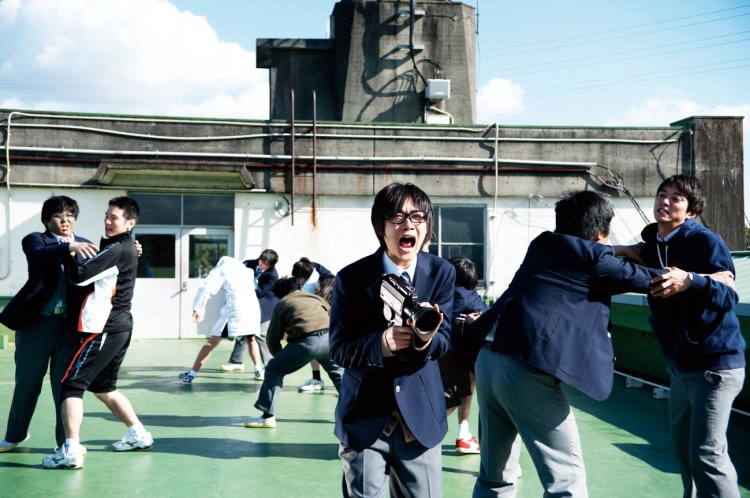
The film club  are in some ways the heart of the film as they both refuse to see and ultimately document the social fracturing that’s going on within the school. They seem to think themselves very hard done by -‘they’re always winning’ complains one boy after they find a location they want to use already occupied and later ‘I won’t cast them when I’m a director’ about the annoying popular clique who’ve just been laughing at them loud enough for them to hear before they’ve even gone past. However, they are the key to the film’s climactic roof top confrontation scene as the film club’s high school zombie invasion movie is rudely interrupted by the popular kids’ desperate search for Kirishima. This leads to a day of the dead style zombie fantasy sequence as the film club zombies devour the unwitting volleyball stars and popular girls which is the highlight of the film. The intermingling of the two groups which would never normally have anything to do with one another finally forces the ramifications of the Kirishima thing to come to a head. In some senses it clears the air; the tensions have boiled over and worked themselves out. However, for some the outcome is far from clear and they remain trapped between levels of high school cool.

The Kirishima Thing is certainly not for for those who like a lot of action, zombies aside, or something with a heavier plot element, but as an ensemble character study it excels. As an allegory for the wider problem of conformity/social norms vs individuality and self recognition in the adult world it’s certainly a very apt parable but all of the characters concerned are very well drawn and each afforded a degree of sympathy and understanding. The Kirishima thing strikes a more realistic tone than the director’s previous films (Funuke: Show some love you losers!, Perfect Nobara) which took place in a world of heightened reality but still has a strongly comic tone. An extremely nuanced and layered tale, The Kirishima Thing may require multiple viewings to completely appreciate but it’s certainly well worth the investment in time.


Also look out for fellow queue inmates Kumiko the Treasure Hunter and Tale of Iya which, I am assured, will shortly become eligible for parole.