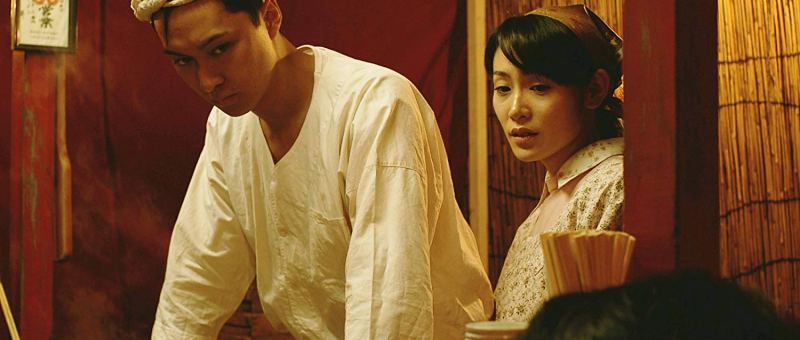
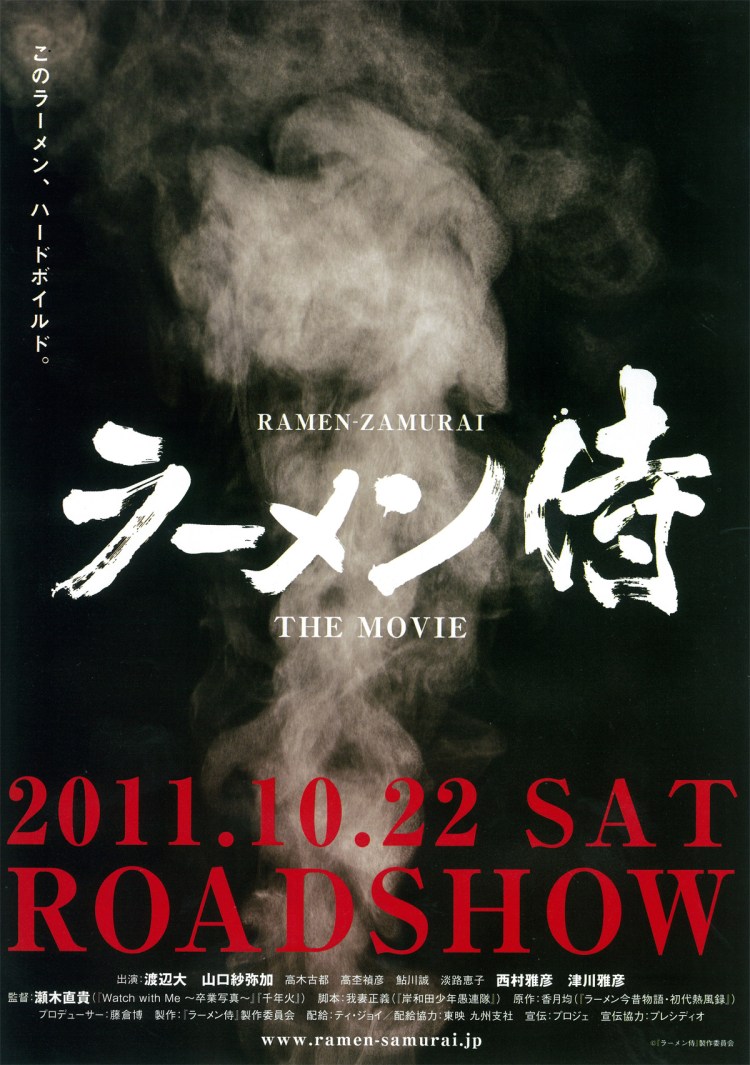
 Set in the ‘90s, Ramen Samurai (ラーメン侍) is in many ways a post-Showa story or a tale of one man’s reaction to bubble era disillusionment. It’s also in the fine tradition of legacy movies in which a troubled child reflects on a complicated relationship with a late parent and struggles to accept their role as an inheritor of skills and knowledge they’d spent much of their youth attempting to reject. Yet the hero of Ramen Samurai, though he maybe reluctant, is more willing than most to pick up his father’s burden, walking back through family history with his long-suffering mother and rediscovering the heroism which lay behind his sometimes difficult father’s tough guy exterior. Hikaru (Dai Watanabe) does not see himself as a man like his father – he’s no “hero” and bears no natural inclination towards rebellion, but only through addressing his father’s life can he learn to define his own. This is all, of course, a roundabout way to discovering the soul of ramen lies in the confidence of the chef.
In 1990 Hikaru, a graphic designer, gets a call at work from his mum to let him know his father has had a stroke. Hikaru left town in a hurry some years earlier, rejecting the idea of taking over the ramen restaurant for a life in bubble era Tokyo. On his father’s death he assumes his natural responsibility and comes home but customers say his ramen’s not as good as his dad’s, and he has trouble keeping his staff in line because they simply don’t accept him. Try as he might, Hikaru just can’t seem to find a way to replicate his father’s recipe, in the store or in life.
Yet there’s a nostalgia in him that sees him want to try. Kurume, a small town in Kyushu, is defined by its ramen – a local delicacy that once brought tourists and general prosperity to the area, but during bubble era “modernisation”, the “backward” yatai ramen stands with their colourful tarpaulins were deemed too reminiscent of post-war privation to survive. The carts were shunted away from the new sophisticated city centre while the police started restricting licenses to run them, eventually prohibiting their sale and limiting their inheritance to direct family members. Hikaru is at least his father’s son and so has a natural right to take over the business even if he has hitherto rejected it.
Rather than a cooking tale, Ramen Samurai steps back to tell the story of its vicarious protagonist – the problematic figure of Hikaru’s dad who is, in many ways, the idealised figure of the Showa era “hero”. That’s not to say he was perfect – he drank to the point of financial ruin and frequently caused problems for his family, but his heart was always in the right place and so he was mostly forgiven. A salt of the Earth type and cool with it, Hikaru’s dad was the big man around town and the defacto leader of the yatai owner community. He brooked no injustice, stood up to the yakuza (who only had the profoundest respect for him), and sought to protect those who were unable to protect themselves. Seeing a sleazy yakuza molesting a young girl, Hikaru’s dad kicked him out and later offered the girl, who is mute, a job and a place to stay, almost adopting her into his family until another act of random kindness accidentally reunites her with her own long-lost father.
Faced with such an intense legacy, it’s no wonder Hikaru struggled. A sensitive, artistic soul he tried his luck in bubble era Tokyo working in an advertising agency where he found the coolness of his colleagues puzzling and difficult to bear. Hikaru’s boss loudly discusses pub lunches and evenings spent in hostess bars, often throwing away the lovingly made bento provided by his wife. Returning home with an empty lunchbox is, he says, his way of showing love though his refusal to eat it perhaps a reaction against a salaryman’s lack of freedom. Nevertheless, even if they clashed in terms of personal morality, Hikaru’s boss compliments him on his commitment to hard work and growth as an artist even whilst admitting that the work itself is often frivolous and ultimately thankless.
Hikaru eventually learns to channel his artistic inclinations into his ramen, seeing himself as a “ramen artist” incorporating his father’s legacy into a dish which is entirely his own. In a sense, Hikaru retreats into the safety of the Showa era past, or that is the cosy 1970s in which he lived a comfortable, if eventful, childhood under a yatai’s awning while dad made trouble but only for the best of reasons. A samurai’s duty is, after all, to protect and Hikaru has decided to do exactly that in “restoring” his hometown to its former glory, dragging retro yatai culture into the rapidly disintegrating post-bubble world and bringing warmth and community back with it.
Original trailer (no subtitles)
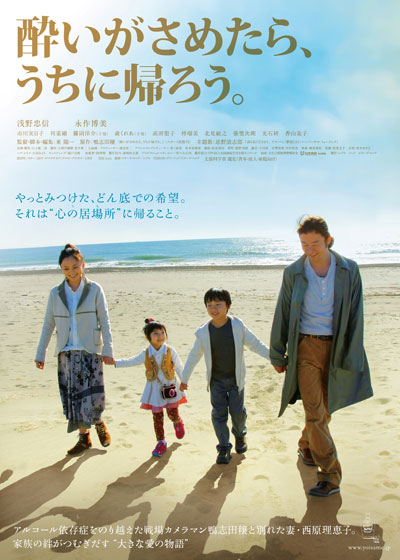 Alcoholism is not a theme which has exactly been absent from the history of cinema. From the booze drenched regret of Days of Wine and Roses to the melancholic inevitability of Leaving Las Vegas and the disdaining irony of Barfly, there has been no shortage of unsympathetic portrayals of drunkenness when it comes to the silver screen. Yoichi Higashi’s Wandering Home (酔いがさめたら、うちに帰ろう, Yoi Ga Sametara, Uchi Ni Kaerou) walks something of a middle road here as it embraces the classic “issue drama” mould but also aims for a naturalistic character study in adapting the true life memoirs of photojournalist Yutaka Kamoshida (husband of well known mangaka Reiko Saibara).
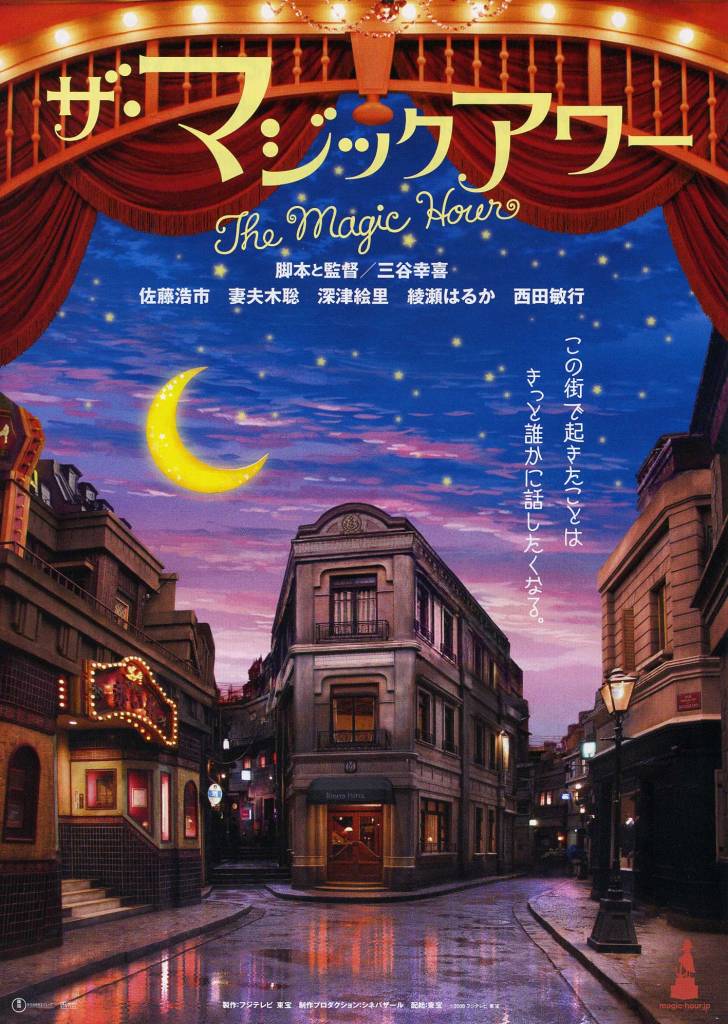 If there’s one thing you can say about the work of Japan’s great comedy master Koki Mitani, it’s that he knows his cinema. Nowhere is the abundant love of classic cinema tropes more apparent than in 2008’s The Magic Hour (ザ・マジックアワー) which takes the form of an absurdist meta comedy mixing everything from American ‘20s gangster flicks to film noir and screwball comedy to create the ultimate homage to the golden age of the silver screen.
 Windows on Worlds